Small ideas for ICRC
Sanjana Hattotuwa
ICT4Peace Foundation,TED Fellow
what’s new
• Ubiquity of two way communications
• Addressable peoples, even those who IDPs or refugees
• Both news generation and dissemination leverages new media
• Disintermediated models vs. traditional media model
• Citizens as producers
• Low resolution content broadcast on high definition media
what’s new
• Sous-veillance (observing from underneath, anchored to human security) in place
of, or in addition to, surveillance (often from centralised loci, anchored to national
security)
• Sous-veillance is crowd based intelligence, generally open data (though analysis
can be bounded). Surveillance ranges from sig int and psy ops to information
espionage, almost always bounded.
• Important to understand Arab Spring, and situational awareness in sudden onset
disasters
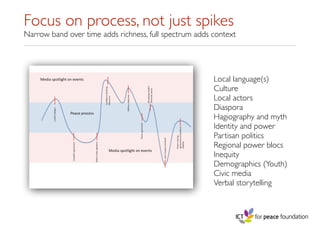
Focus on process, not just spikes
Narrow band over time adds richness, full spectrum adds context
Local language(s)
Culture
Local actors
Diaspora
Hagiography and myth
Identity and power
Partisan politics
Regional power blocs
Inequity
Demographics (Youth)
Civic media
Verbal storytelling
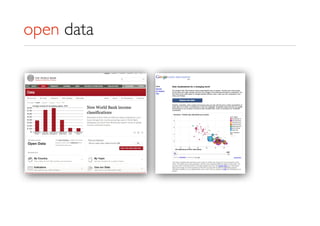
open data
open data
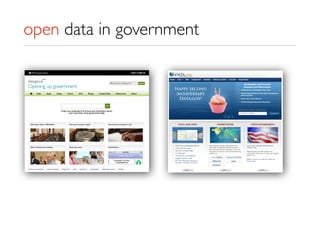
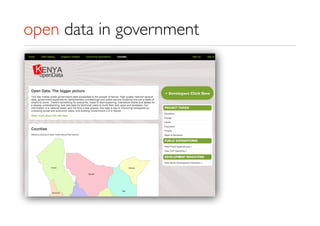
open data in government
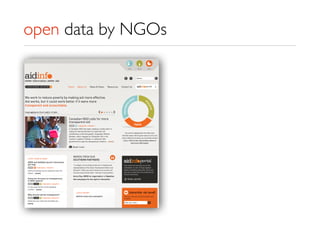
open data by NGOs
infoviz
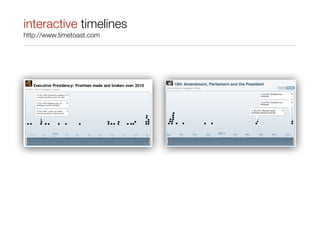
interactive timelines
http://www.timetoast.com
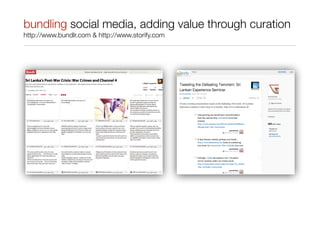
bundling social media, adding value through curation
http://www.bundlr.com & http://www.storify.com
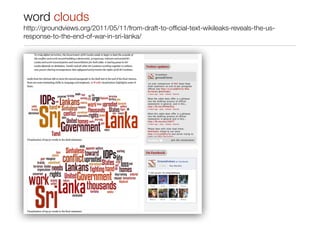
word clouds
http://groundviews.org/2011/05/11/from-draft-to-official-text-wikileaks-reveals-the-us-
response-to-the-end-of-war-in-sri-lanka/
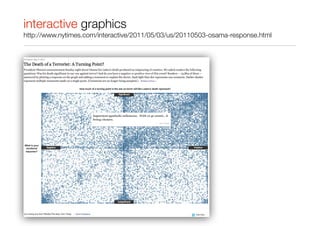
interactive graphics
http://www.nytimes.com/interactive/2011/05/03/us/20110503-osama-response.html
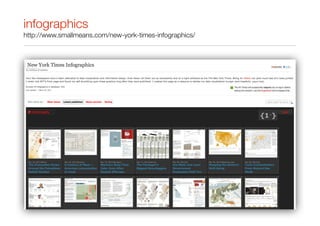
infographics
http://www.smallmeans.com/new-york-times-infographics/
Some enduring challenges
Tweets from ICCM 2010
challenges
• Concept of failing forward missing. Everyone parading what worked, but
more imp to know - what failed, why?
• Heard first cursory mention of ethics amidst overwhelmingly technocratic
perspectives. Good. Need to flesh out.
• No recognition of (geo) politics and US strategic interests in use & availability
of tech. Compare Haiti, Pakistan & Myanmar in '08
• A bigger disaster than Haiti, Pakistan had comparably little of this tech,
volunteerism and focus. Why?
challenges
• Surprisingly everyone seems to believe crowdsourcing is good, and is only
used for good. Context, content, creator, consumer absent
• At risk of sounding Rumsfeldian, why don't we know what we should know?
Core datasets vital for community resilience and response
• Trust is mutable, relative, contextual, locally defined, gendered, framed by
identity, inter alia.
• Violence as a result of knowledge creation.
challenges
• Impartial, accurate coverage still vital, increasingly hard to ascertain
• Torrent of information. Trickle of knowledge.
• Veracity hard to determine
• Pace of technology development hard to keep pace with
• Nature of violence, partisan bias, citizenship, governance structures, public
institutions heavily influence crowdsourcing.
• Crowdsourced HR or election violations mapping with volunteers from
perpetrator party/tribe/ethnicity? Proceed with caution
• Volunteerism undergirding stand-by crowdsourcing good, but what about
CPE's, where personal bias can deeply influence curation?
• Related to last tweet, volunteerism works better for sudden onset natural
disasters, which are also mediagenic
enduring challenges with crisismapping and
crowdsourcing
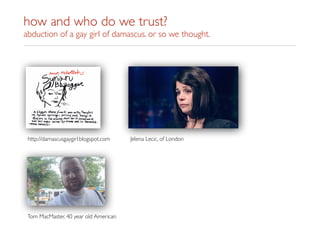
how and who do we trust?
abduction of a gay girl of damascus. or so we thought.
Tom MacMaster, 40 year old American
http://damascusgaygirl.blogspot.com Jelena Lecic, of London
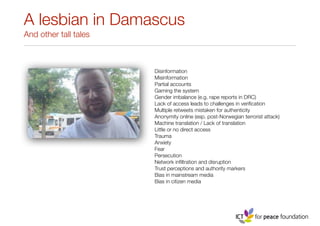
A lesbian in Damascus
And other tall tales
Disinformation
Misinformation
Partial accounts
Gaming the system
Gender imbalance (e.g. rape reports in DRC)
Lack of access leads to challenges in verification
Multiple retweets mistaken for authenticity
Anonymity online (esp. post-Norwegian terrorist attack)
Machine translation / Lack of translation
Little or no direct access
Trauma
Anxiety
Fear
Persecution
Network infiltration and disruption
Trust perceptions and authority markers
Bias in mainstream media
Bias in citizen media
filter bubbles
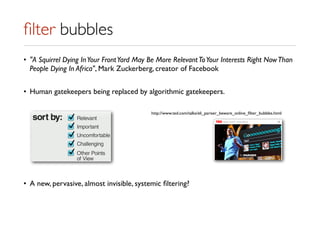
• "A Squirrel Dying InYour FrontYard May Be More RelevantToYour Interests Right NowThan
People Dying In Africa", Mark Zuckerberg, creator of Facebook
• Human gatekeepers being replaced by algorithmic gatekeepers.
• A new, pervasive, almost invisible, systemic filtering?
http://www.ted.com/talks/eli_pariser_beware_online_filter_bubbles.html
filtering to counter filter bubbles
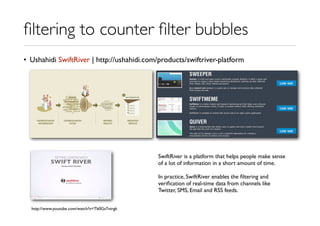
• Ushahidi SwiftRiver | http://ushahidi.com/products/swiftriver-platform
http://www.youtube.com/watch?v=Tb0Gs7vtrgk
SwiftRiver is a platform that helps people make sense
of a lot of information in a short amount of time.
In practice, SwiftRiver enables the filtering and
verification of real-time data from channels like
Twitter, SMS, Email and RSS feeds.
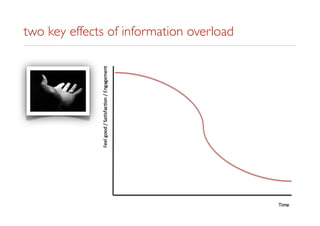
two key effects of information overload
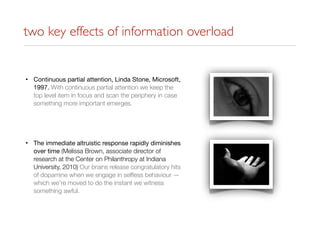
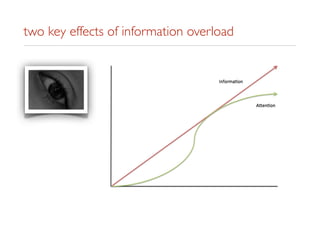
• Continuous partial attention, Linda Stone, Microsoft,
1997. With continuous partial attention we keep the
top level item in focus and scan the periphery in case
something more important emerges.
• The immediate altruistic response rapidly diminishes
over time (Melissa Brown, associate director of
research at the Center on Philanthropy at Indiana
University, 2010) Our brains release congratulatory hits
of dopamine when we engage in selfless behaviour —
which we’re moved to do the instant we witness
something awful.
two key effects of information overload
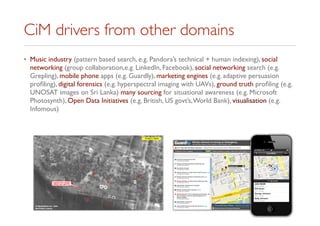
CiM drivers from other domains
• Music industry (pattern based search, e.g. Pandora’s technical + human indexing), social
networking (group collaboration,e.g. LinkedIn, Facebook), social networking search (e.g.
Grepling), mobile phone apps (e.g. Guardly), marketing engines (e.g. adaptive persuasion
profiling), digital forensics (e.g. hyperspectral imaging with UAVs), ground truth profiling (e.g.
UNOSAT images on Sri Lanka) many sourcing for situational awareness (e.g. Microsoft
Photosynth), Open Data Initiatives (e.g. British, US govt’s,World Bank), visualisation (e.g.
Infomous)
take home
• Think beyond text. Online is not print.
• Think beyond prose. Online can be satire, verse, haiku!
• Think of photos, audio, video. Rich media tells stories, adds context.
• Think of SMS and crowd-sourcing, the audience are the producers.
• Don’t suggest you know everything. Use the community to add value to story.
• Link to other stories online, they add value.
Thank you
sanjanahattotuwa@ict4peace.org
www.ict4peace.org

Small Ideas for ICRC

  • 1.
    Small ideas forICRC Sanjana Hattotuwa ICT4Peace Foundation,TED Fellow
  • 2.
    what’s new • Ubiquityof two way communications • Addressable peoples, even those who IDPs or refugees • Both news generation and dissemination leverages new media • Disintermediated models vs. traditional media model • Citizens as producers • Low resolution content broadcast on high definition media
  • 3.
    what’s new • Sous-veillance(observing from underneath, anchored to human security) in place of, or in addition to, surveillance (often from centralised loci, anchored to national security) • Sous-veillance is crowd based intelligence, generally open data (though analysis can be bounded). Surveillance ranges from sig int and psy ops to information espionage, almost always bounded. • Important to understand Arab Spring, and situational awareness in sudden onset disasters
  • 4.
    Focus on process,not just spikes Narrow band over time adds richness, full spectrum adds context Local language(s) Culture Local actors Diaspora Hagiography and myth Identity and power Partisan politics Regional power blocs Inequity Demographics (Youth) Civic media Verbal storytelling
  • 5.
  • 6.
  • 7.
    open data ingovernment
  • 8.
    open data ingovernment
  • 9.
  • 10.
  • 11.
  • 12.
    bundling social media,adding value through curation http://www.bundlr.com & http://www.storify.com
  • 13.
  • 14.
  • 15.
  • 16.
  • 17.
    challenges • Concept offailing forward missing. Everyone parading what worked, but more imp to know - what failed, why? • Heard first cursory mention of ethics amidst overwhelmingly technocratic perspectives. Good. Need to flesh out. • No recognition of (geo) politics and US strategic interests in use & availability of tech. Compare Haiti, Pakistan & Myanmar in '08 • A bigger disaster than Haiti, Pakistan had comparably little of this tech, volunteerism and focus. Why?
  • 18.
    challenges • Surprisingly everyoneseems to believe crowdsourcing is good, and is only used for good. Context, content, creator, consumer absent • At risk of sounding Rumsfeldian, why don't we know what we should know? Core datasets vital for community resilience and response • Trust is mutable, relative, contextual, locally defined, gendered, framed by identity, inter alia. • Violence as a result of knowledge creation.
  • 19.
    challenges • Impartial, accuratecoverage still vital, increasingly hard to ascertain • Torrent of information. Trickle of knowledge. • Veracity hard to determine • Pace of technology development hard to keep pace with
  • 20.
    • Nature ofviolence, partisan bias, citizenship, governance structures, public institutions heavily influence crowdsourcing. • Crowdsourced HR or election violations mapping with volunteers from perpetrator party/tribe/ethnicity? Proceed with caution • Volunteerism undergirding stand-by crowdsourcing good, but what about CPE's, where personal bias can deeply influence curation? • Related to last tweet, volunteerism works better for sudden onset natural disasters, which are also mediagenic enduring challenges with crisismapping and crowdsourcing
  • 21.
    how and whodo we trust? abduction of a gay girl of damascus. or so we thought. Tom MacMaster, 40 year old American http://damascusgaygirl.blogspot.com Jelena Lecic, of London
  • 22.
    A lesbian inDamascus And other tall tales Disinformation Misinformation Partial accounts Gaming the system Gender imbalance (e.g. rape reports in DRC) Lack of access leads to challenges in verification Multiple retweets mistaken for authenticity Anonymity online (esp. post-Norwegian terrorist attack) Machine translation / Lack of translation Little or no direct access Trauma Anxiety Fear Persecution Network infiltration and disruption Trust perceptions and authority markers Bias in mainstream media Bias in citizen media
  • 23.
    filter bubbles • "ASquirrel Dying InYour FrontYard May Be More RelevantToYour Interests Right NowThan People Dying In Africa", Mark Zuckerberg, creator of Facebook • Human gatekeepers being replaced by algorithmic gatekeepers. • A new, pervasive, almost invisible, systemic filtering? http://www.ted.com/talks/eli_pariser_beware_online_filter_bubbles.html
  • 24.
    filtering to counterfilter bubbles • Ushahidi SwiftRiver | http://ushahidi.com/products/swiftriver-platform http://www.youtube.com/watch?v=Tb0Gs7vtrgk SwiftRiver is a platform that helps people make sense of a lot of information in a short amount of time. In practice, SwiftRiver enables the filtering and verification of real-time data from channels like Twitter, SMS, Email and RSS feeds.
  • 25.
    two key effectsof information overload • Continuous partial attention, Linda Stone, Microsoft, 1997. With continuous partial attention we keep the top level item in focus and scan the periphery in case something more important emerges. • The immediate altruistic response rapidly diminishes over time (Melissa Brown, associate director of research at the Center on Philanthropy at Indiana University, 2010) Our brains release congratulatory hits of dopamine when we engage in selfless behaviour — which we’re moved to do the instant we witness something awful.
  • 26.
    two key effectsof information overload
  • 27.
    two key effectsof information overload
  • 28.
    CiM drivers fromother domains • Music industry (pattern based search, e.g. Pandora’s technical + human indexing), social networking (group collaboration,e.g. LinkedIn, Facebook), social networking search (e.g. Grepling), mobile phone apps (e.g. Guardly), marketing engines (e.g. adaptive persuasion profiling), digital forensics (e.g. hyperspectral imaging with UAVs), ground truth profiling (e.g. UNOSAT images on Sri Lanka) many sourcing for situational awareness (e.g. Microsoft Photosynth), Open Data Initiatives (e.g. British, US govt’s,World Bank), visualisation (e.g. Infomous)
  • 29.
    take home • Thinkbeyond text. Online is not print. • Think beyond prose. Online can be satire, verse, haiku! • Think of photos, audio, video. Rich media tells stories, adds context. • Think of SMS and crowd-sourcing, the audience are the producers. • Don’t suggest you know everything. Use the community to add value to story. • Link to other stories online, they add value.
  • 30.