Faruk Hossen
ID:20151109005
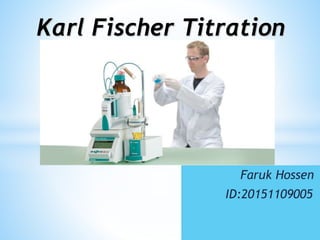
Karl Fischer Titration
KF Introduction
Reagents
KF Instruments
Types
Endpoint indication
Applications
Limitations
TOPICS
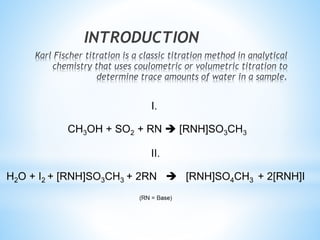
INTRODUCTION
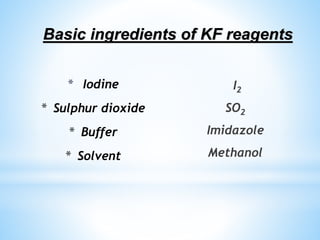
Basic ingredients of KF reagents
* Iodine
* Sulphur dioxide
* Buffer
* Solvent
I2
SO2
Imidazole
Methanol
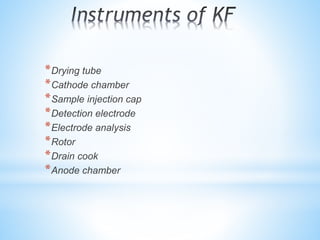
*Drying tube
*Cathode chamber
*Sample injection cap
*Detection electrode
*Electrode analysis
*Rotor
*Drain cook
*Anode chamber
log K
pH
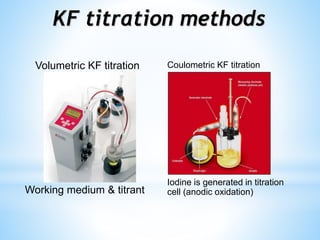
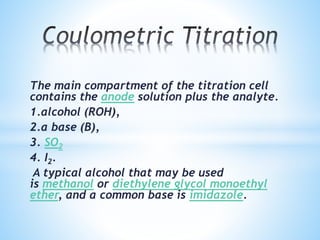
KF titration methods
Coulometric KF titration
Iodine is generated in titration
cell (anodic oxidation)
Volumetric KF titration
Working medium & titrant
The main compartment of the titration cell
contains the anode solution plus the analyte.
1.alcohol (ROH),
2.a base (B),
3. SO2
4. I2.
A typical alcohol that may be used
is methanol or diethylene glycol monoethyl
ether, and a common base is imidazole.
The volumetric titration is based on the same
principles as the coulometric titration except that
the anode solution above now is used as the titrant
solution.
The titrant:
1. an alcohol (ROH),
2. base (B),
3. SO2
4. a known concentration of I2.
5. Pyridine has been used as the base in this case.
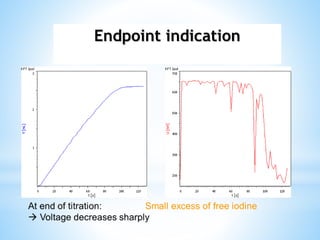
Endpoint indication
• in technical products
(oil, plastics and gases)
• in cosmetic products
• in pharmaceutical products
• in food industry
• The major disadvantage with solids is that
the water has to be accessible.
• Easily brought into methanol solution.
• KF is selective for water
karl fischer titration slide

karl fischer titration slide

Editor's Notes

  • #4  invented in 1935 by the German chemist Karl Fischer
  • #7 < pH 5: log K increases linearly with pH reaction rate to low (low results) 5.5-7: optimum, reaction rate constant >8: reaction rate increases slightly (side reactions probably occur)
  • #11 Voltage: High as long as H2O in sample + I2 added Once reaction turnover decreases, potential decreases End point is not sufficient as criteria (titration would stop at signal at 88 sec) -> Additionally drift as EP criteria Drift <- water entering system