
When helping you… Lisa Dickson Foster Care Alumni of America Ohio chapter … .is hurting me
Does this sound familiar? “ Every time you answer the phone, someone is crying, someone is raging, someone is begging you to solve their problems.” ~  Aryn Kyle “ So busy dealing with other peoples’ drama that I neglect to celebrate my own victories.” “ Caught up in my friend’s crisis-of-the-moment, I forget to take time to celebrate the milestones I've made in my life.”
 
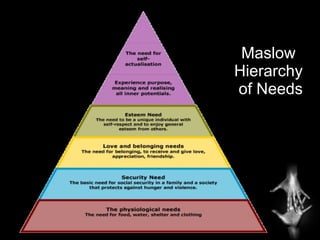
Maslow  Hierarchy  of Needs
The domino effect
True or False? 1. “Some people are addicted to chaos &  recreate it wherever they go.” 2. I can make decisions for other people. 3. I can and should rescue other people from the consequences of their decisions. 4. If someone gets mad at me for not helping them, this is my fault.
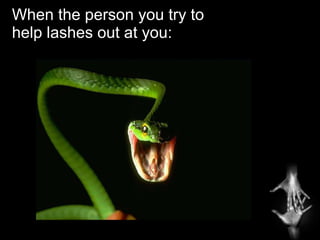
When the person you try to help lashes out at you:
Activity:
It can be hard to help someone Who is addicted to drugs or alcohol Who steals from you Who tries to manipulate you Who refuses to change their behavior Who won’t admit that something they did in the past was wrong
“ That never happened”
Cognitive Dissonance of the Abuser/Enabler Cognitive dissonance :  “ I want to believe I am a good person. But I did this / let this happen.” Choices: Denial: “What I did wasn’t wrong.” Excuses: “The other person deserved it.” Truth: Confess and take responsibility
Cognitive Dissonance of the Person Who Was Abused Cognitive dissonance :  “ This is my parent. I love my parent. How could someone I love do this to me?” Choices: Denial: “What they did wasn’t wrong.” Excuses: “I must have deserved it.” Truth: “They should have protected me. I was and am worth being protected.”
Putting together the puzzle pieces from our past…
Reconnecting with  People from the Past Am I emotionally ready for this? Will this be helpful or cause me harm? Am I taking baby steps? (email before phone calls; calls before visit in person) When visiting, do I have a back-up plan, in case I need to leave early? Have I planned time with supportive friends afterwards?
Why forgive?
Forgiveness vs. Reconciliation Forgiveness and reconciliation are two different things. Forgiveness only takes one person Reconciliation takes two  It’s still okay to keep yourself safe.
Boundaries
Sample Boundaries If you need something from me, please ask me directly. (vs. hints, manipulation) When you ask, please tell me the whole truth about the situation. Please try not to wait until the problem is catastrophe-level. When you ask, think about WHEN you are asking. (i.e. what time of day/night) I am your friend, but I am not your Savior.
“ If we always rescue people from their choices, they will never have a chance to learn  from the natural consequences of their actions.”
Compassion fatigue
Symptoms of  Compassion Fatigue: Feeling mentally or physically exhausted much of the time. Using caffeine, food or alcohol to combat feelings of being overwhelmed. Sleeping too little or too much. Feeling numb and distanced from life. Feeling less satisfied by work.  Experiencing moodiness and irritability. Physical complaints – headaches, stomach aches.
Can be a reminder of what you went through: Re-experiencing prior trauma in nightmares or flashbacks. Difficulty differentiating your experience from the other person Expecting the other person to cope in the same way you did. Responding inappropriately or disproportionately. Withdrawing from the other person.
 
Can be tough to maintain perspective: Loss of perspective, identifying too closely with the other person Feeling as if the experience happened to you. Feeling helpless, hopeless or angry at the world. Becoming disconnected from loved ones. Disengaging from that person’s pain.  Doing anything to avoid further exposure.
 
Activity:
Taking Care of Yourself Are you getting enough sleep? Do you eat well?  Exercise regularly? Do you take regular breaks from stressful activities? Do you take time to laugh every day? Do you express yourself?  Do you let someone else take care of you?
Sisyphus
 
 
Ripple Effect
Free membership

When helping you is hurting me

  • 1.
    When helping you…Lisa Dickson Foster Care Alumni of America Ohio chapter … .is hurting me
  • 2.
    Does this soundfamiliar? “ Every time you answer the phone, someone is crying, someone is raging, someone is begging you to solve their problems.” ~ Aryn Kyle “ So busy dealing with other peoples’ drama that I neglect to celebrate my own victories.” “ Caught up in my friend’s crisis-of-the-moment, I forget to take time to celebrate the milestones I've made in my life.”
  • 3.
  • 4.
  • 5.
  • 6.
    True or False?1. “Some people are addicted to chaos & recreate it wherever they go.” 2. I can make decisions for other people. 3. I can and should rescue other people from the consequences of their decisions. 4. If someone gets mad at me for not helping them, this is my fault.
  • 7.
    When the personyou try to help lashes out at you:
  • 8.
  • 9.
    It can behard to help someone Who is addicted to drugs or alcohol Who steals from you Who tries to manipulate you Who refuses to change their behavior Who won’t admit that something they did in the past was wrong
  • 10.
    “ That neverhappened”
  • 11.
    Cognitive Dissonance ofthe Abuser/Enabler Cognitive dissonance : “ I want to believe I am a good person. But I did this / let this happen.” Choices: Denial: “What I did wasn’t wrong.” Excuses: “The other person deserved it.” Truth: Confess and take responsibility
  • 12.
    Cognitive Dissonance ofthe Person Who Was Abused Cognitive dissonance : “ This is my parent. I love my parent. How could someone I love do this to me?” Choices: Denial: “What they did wasn’t wrong.” Excuses: “I must have deserved it.” Truth: “They should have protected me. I was and am worth being protected.”
  • 13.
    Putting together thepuzzle pieces from our past…
  • 14.
    Reconnecting with People from the Past Am I emotionally ready for this? Will this be helpful or cause me harm? Am I taking baby steps? (email before phone calls; calls before visit in person) When visiting, do I have a back-up plan, in case I need to leave early? Have I planned time with supportive friends afterwards?
  • 15.
  • 16.
    Forgiveness vs. ReconciliationForgiveness and reconciliation are two different things. Forgiveness only takes one person Reconciliation takes two It’s still okay to keep yourself safe.
  • 17.
  • 18.
    Sample Boundaries Ifyou need something from me, please ask me directly. (vs. hints, manipulation) When you ask, please tell me the whole truth about the situation. Please try not to wait until the problem is catastrophe-level. When you ask, think about WHEN you are asking. (i.e. what time of day/night) I am your friend, but I am not your Savior.
  • 19.
    “ If wealways rescue people from their choices, they will never have a chance to learn from the natural consequences of their actions.”
  • 20.
  • 21.
    Symptoms of Compassion Fatigue: Feeling mentally or physically exhausted much of the time. Using caffeine, food or alcohol to combat feelings of being overwhelmed. Sleeping too little or too much. Feeling numb and distanced from life. Feeling less satisfied by work. Experiencing moodiness and irritability. Physical complaints – headaches, stomach aches.
  • 22.
    Can be areminder of what you went through: Re-experiencing prior trauma in nightmares or flashbacks. Difficulty differentiating your experience from the other person Expecting the other person to cope in the same way you did. Responding inappropriately or disproportionately. Withdrawing from the other person.
  • 23.
  • 24.
    Can be toughto maintain perspective: Loss of perspective, identifying too closely with the other person Feeling as if the experience happened to you. Feeling helpless, hopeless or angry at the world. Becoming disconnected from loved ones. Disengaging from that person’s pain. Doing anything to avoid further exposure.
  • 25.
  • 26.
  • 27.
    Taking Care ofYourself Are you getting enough sleep? Do you eat well? Exercise regularly? Do you take regular breaks from stressful activities? Do you take time to laugh every day? Do you express yourself? Do you let someone else take care of you?
  • 28.
  • 29.
  • 30.
  • 31.
  • 32.

Editor's Notes

  • #2 Music to play: Use me up, chainsaw
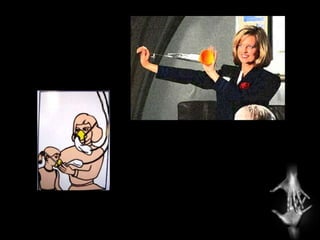
  • #4 Message to Survivors of Foster Care: "Please put the air mask on yourself first. It might feel selfish at the time - but it is NOT selfish! You have the passion, power and perseverance to see this through.... but first, you need to SURVIVE.   "It is okay to do that right now. It is okay to heal personally. It is okay to surround yourself with people who believe in you and support you.   Do you know why? Because if only you can make it through this hurdle and build into your own personal financial, emotional and educational resources, you will have SO MUCH MORE to offer others when you are on your feet. "
  • #5 With the resources I have at this moment, how capable am I of helping others, vs. if I give myself time to acquire more resources and support? What personal resources am I risking by trying to help this person? (i.e. ETV funds to help drug-addicted mother) at the point when helping a family member puts your safety or your physical/emotional health at risk, it's time to make some tough choices in terms of re-establishing boundaries.
  • #6 at the point when helping a family member puts your safety or your physical/emotional health at risk, it's time to make some tough choices in terms of re-establishing boundaries.
  • #7 Why? Because chaos is familiar
  • #8 Vipers are people who do not yet realize or want to admit that their choices are the root of their pain. Until they come to that realization and are ready to change the choices they make, it is easier for them to lash out at safe and easy targets like us. Their lashing out does not mean we did not do everything we could do or say to help, it just means they are not ready to fix the problem."
  • #9 TD Jakes: “This cup is wounded.” Pitcher of water. Paper cup with a hole in it. Basin underneath. Volunteer from audience to help fill it up. My identity was wrapped around my wounds
  • #12 Don't tell me that it never happened - because it did Share I can’t tell you how many foster care alumni have come to me and told me about this type of experience:   After being reunited with a parent, a young person might try to tell mom or dad what happened during their time in foster care. Or a young person might say, “Remember that guy you were dating before I left home? Did I ever tell you that he touched me when you weren’t around?”   More often than not, the biological parent will respond, “I don’t want to hear about it.”   Why? Because hearing what happened to their child when that parent was unable or unwilling to care for them sounds like an indictment. They don’t want to look at it. They don’t want to face up to their responsibility in abdicating care for their child.   This is an example of COGNITIVE DISSONANCE.   Cognitive dissonance is a psychological term describing the uncomfortable tension that may result from:   - Having two conflicting thoughts at the same time - Engaging in behavior that conflicts with one’s beliefs and self-concept - Experiencing something that conflicts with everything the person previously “knew” about the world   Cognitive dissonance can be defined as “an internal contradiction.” We all want to believe that we are good people. So if we do something harmful to another person, we feel that prick of our conscience. Since we cannot live in a state of “cognitive dissonance” for an extended period of time, we have to somehow make it right in our heads.   Our choice is: - To tell ourselves that what we did wasn’t wrong (denial) - To tell ourselves that they deserved it (excuses) - To confess and admit responsibility (best option)   My father is the perfect example. I rarely saw him during my time in foster care - but when I did, I was always mystified by the fact that he could never look me in the eyes. He always looked away.   Later, when I came to my father as an adult, to try to tell him some of the things that happened, including the fact that I was raped while staying in a group home, he didn’t want to hear about it.   He even went so far as to say, “Lisa, we have no way of knowing whether or not those things ever happened to you.”   I had to raise my eyebrows at that comment. Being the person who experienced those things and survived them, I found it mind-boggling that another person might think that by his denial, he could edit my entire life history, and make those painful experiences no longer exist. I made up my mind at that moment that I wanted to be a person who could face reality, in all its beauty and all its ugliness, and take full responsibility for my actions.   As a stepmother, if I feel that my reaction to something was wrong (like maybe I overreact to something), I will go to my husband and stepdaughters and apologize. I will not make excuses for myself — I will just call it what it is: “I have a big mouth sometimes,” and strive to do better.  
  • #13 Don't tell me that it never happened - because it did Sadly, cognitive dissonance can occur in the minds of abuse victims as well. When a parent is the perpetrator, rather than the protector, that clashes with everything that a child instinctively knows.   So, might a child be tempted to do? - Tell themselves that what the parent is doing isn’t wrong (denial) - Tell themselves that they deserved it (make excuses for the parent) - Tell themselves that a parent should be protector, and that the fact that theirs is not, is due that parent’s choice and not a reflection of the child’s worth (best option, but it often takes years for an abused child to recognize this)   The first two reactions can lead to both current and future emotional damage: A child experiencing sexual abuse might try to make sense of the experience by equating the act with love. Later, that same child might grow into an adult who expects abuse from his or her partner.   Now that I advocate for young people in and from foster care, it is so easy for me to see that their parents’ action are not a reflection of their worth. But, back when I was still in college, it was hardest of all to see that value in myself. I still remember the moment when I realized that my father’s rejection did not make me unworthy of love. I was reading the quote, “When I was a child, I talked like a child, I thought like a child and I reasoned like a child. When I became an adult, I left childish ways behind me.”   It occurred to me in that moment that if I were ever to grow up, I needed to assert my own worth and not judge myself as unloveable based upon my father’s reaction.   Good Will Hunting Similarly, one scene from the movie “Good Will Hunting“ has resonated with many foster care/child abuse survivors. Robin Williams (playing Sean, a psychiatrist) is counseling Matt Damon (playing Will Hunting) an abused child.
  • #14 Hands-on Activity
  • #15 forgiveness is not the same thing as reconciliation Share Saturday, August 11, 2007 at 7:14pm | Edit Note | Delete I started writing this as a response to a note on my friend's page -- and then discovered that I felt so passionate about it that I wanted to share it with everyone:   People often think that forgiveness and reconciliation are the same thing. But they aren't.   To forgive is: To renounce anger and resentment against another person for an offense perpetrated by that other person.   To reconcile is: To reestablish a close relationship between those two people.   1.) FORGIVENESS takes one person: Forgiveness is not an easy thing to do. It's not a feeling, it is a choice you make to free yourself from anger and bitterness. Forgiveness is a wise choice, and I am happy to have made it in my life.   2.) RECONCILIATION takes two people: You can only make choices for yourself. If you have done everything in your power to restore the broken ties and they have chosen not to have the privilege to be in your life - that is their loss.   If the other person is abusive or in deep denial, saying things like "You are not my daughter" or "None of those things ever happened to you" then reconciliation might not take place. Their actions and their choices might be showing you that they are a destructive influence on your life. And you have every right to protect yourself from people like that.Part of being an adult is deciding whom you will let into your world.   MY EXPERIENCE: When I approached my father to forgive him and try to make peace after I aged out of foster care, he rejected me.   I can still remember his exact words: "Lisa, I'd like to say that I love you - but I don't. Whatever love that I ever had for you has disappeared over the past 10 years and I don't think it's ever coming back."   He continued: "I'd like to say that I love you as a person, but I don't know you very well. So, basically, I don't love you at all."   That conversation took place when I was 19 years old.   WHAT I LEARNED WAS: - Forgiveness is not the same thing as reconciliation. - Forgiveness takes one person and reconciliation takes two. - I can only make decisions for myself.   I had to decide, on my own, that I was love-worthy and deserved better than his rejection.   And if I had never come to that personal realization of my own worth, I wouldn't be where I am today:   - Married - Happy - Stepmom of the two best daughters ever - Advocating for people in and from foster care   LONGING: You want your dad (or mom) to be there. That is a natural longing. The other person just might never be capable of living up to your expectations.   It's not that your expectations are wrong -- it's that the other person is broken.   Maybe you will find a father-figure in someone else or... maybe you won't. In my life, some men who offered to serve as substitute "father-figures" ended up being rather perverse - sorry, but it's true. They probably started out with good intentions, and then digressed. You might not find the love you wanted in the first place from the person you wanted it from -- but you can and will find love.   THE BOTTOM LINE IS: Other people's decisions are not a reflection of you.   If someone doesn't love you, or doesn't know how to love you, that doesn't mean that you are an unloveable person.   All people have their personal limitations. I, personally, am not good at Algebra. And some parents seem incapable of love.   But you are a loveable person. Period.   That's the truth that was freeing for me, and I hope it rings true for you also.
  • #17 forgiveness is not the same thing as reconciliation Share Saturday, August 11, 2007 at 7:14pm | Edit Note | Delete I started writing this as a response to a note on my friend's page -- and then discovered that I felt so passionate about it that I wanted to share it with everyone:   People often think that forgiveness and reconciliation are the same thing. But they aren't.   To forgive is: To renounce anger and resentment against another person for an offense perpetrated by that other person.   To reconcile is: To reestablish a close relationship between those two people.   1.) FORGIVENESS takes one person: Forgiveness is not an easy thing to do. It's not a feeling, it is a choice you make to free yourself from anger and bitterness. Forgiveness is a wise choice, and I am happy to have made it in my life.   2.) RECONCILIATION takes two people: You can only make choices for yourself. If you have done everything in your power to restore the broken ties and they have chosen not to have the privilege to be in your life - that is their loss.   If the other person is abusive or in deep denial, saying things like "You are not my daughter" or "None of those things ever happened to you" then reconciliation might not take place. Their actions and their choices might be showing you that they are a destructive influence on your life. And you have every right to protect yourself from people like that.Part of being an adult is deciding whom you will let into your world.   MY EXPERIENCE: When I approached my father to forgive him and try to make peace after I aged out of foster care, he rejected me.   I can still remember his exact words: "Lisa, I'd like to say that I love you - but I don't. Whatever love that I ever had for you has disappeared over the past 10 years and I don't think it's ever coming back."   He continued: "I'd like to say that I love you as a person, but I don't know you very well. So, basically, I don't love you at all."   That conversation took place when I was 19 years old.   WHAT I LEARNED WAS: - Forgiveness is not the same thing as reconciliation. - Forgiveness takes one person and reconciliation takes two. - I can only make decisions for myself.   I had to decide, on my own, that I was love-worthy and deserved better than his rejection.   And if I had never come to that personal realization of my own worth, I wouldn't be where I am today:   - Married - Happy - Stepmom of the two best daughters ever - Advocating for people in and from foster care   LONGING: You want your dad (or mom) to be there. That is a natural longing. The other person just might never be capable of living up to your expectations.   It's not that your expectations are wrong -- it's that the other person is broken.   Maybe you will find a father-figure in someone else or... maybe you won't. In my life, some men who offered to serve as substitute "father-figures" ended up being rather perverse - sorry, but it's true. They probably started out with good intentions, and then digressed. You might not find the love you wanted in the first place from the person you wanted it from -- but you can and will find love.   THE BOTTOM LINE IS: Other people's decisions are not a reflection of you.   If someone doesn't love you, or doesn't know how to love you, that doesn't mean that you are an unloveable person.   All people have their personal limitations. I, personally, am not good at Algebra. And some parents seem incapable of love.   But you are a loveable person. Period.   That's the truth that was freeing for me, and I hope it rings true for you also.
  • #18 Role Play Activities
  • #19 I'm trying to formulate: - Where are my boundaries when it comes to working with other foster care alumni? Particularly when they are in a state of immediate crisis.   - What is my role as a leader within my state chapter of Foster Care Alumni of America?   - How can I better handle situations like the ones I faced this week in the future?   Here are my ideas so far, in terms of communicating my expectations and boundaries to other people...   1. If you need something from me, ask.   Say: "Lisa, I need this: _________" Tell me what you need, straight-out and give me a chance to say yes or no.   Please don't try to manipulate me.   Don't hint at what you need, and wait for me to figure it out. That disrespects me and it disrespects you. Because you are underestimating both of us.   What the hints mean are that: - You don't think you are worthy of having your needs met - You don't think that I care about you   And until you ask straight out and wait for my response, you won't have the chance to find out that neither one of your fears are actually true.   2. When you ask, please tell me the whole truth.   Think of it like a doctor. If you lie to a doctor about your symptoms, that doctor will not be able to diagnose you correctly.   I am not a doctor. I cannot be your counselor. But I can and will move heaven and earth to get you connected with the right resources - something I CAN'T do if you are lying to me.   Please don't lie to me about what is really happening. Don't shade the truth about what is going on. I am guessing you are doing that because you think that I will judge you - and yes, again, you fear that I will reject you. 3. If you need something, please don't wait until it is catastrophe level.   Again, I know WHY you are probably doing this. So many of us grew up in chaos, that we just get used to living in crisis level. Once we age out of foster care, crisis still seems very familiar.   So,during the steps before a crisis, when things are just starting to go wrong, we might not think to ask for help then. No, we think we can handle it.   We can handle problem A and B and C... Which means that by the time we ask for help, we are handing the other person an enormous, HUGE amount of problems that have snowballed.   And the message to the other person (or in this case: to me) is "Fix this now. Fix this fast."   Trying to help would have been a lot easier if I'd been asked earlier.   4. When you ask, think about WHEN you are asking.   I can honestly say that: I am no longer addicted to crisis.   In my life, I have worked very hard to achieve stability and safety, not just for myself, but for my marriage and my family.   Do you really need to call me after midnight? Could you call during the daytime?   When you text me at 3 in the morning, are you really expecting that I am staying up all night?   5. I am your friend, but I am not your Savior   And again, this line has been blurred for me before.   When I first aged out of care, there was this guy, Jon. And he was the first person who really seemed to care about and take care of me. We were friends, we dated, we broke up, etc.   But at the time, I had somehow endowed Jon as being my Savior. The big brother I never had. The dad who didn't care for me. He was somehow supposed to fill that entire hole in my heart and make up for everything that I lacked. And that is WAYYYYYYYYYYYYYYYYY to much to ask from another person.   But even after we parted ways, I still kept that guy on a pedestal for years. No one else could measure up.   Finally, I realized that I never even really knew Jon. The real Jon was just a human, fallible, feet-of-clay guy with his own dreams, desires, faults and failings.   But the Jon I knew somehow existed in my mind to help me.   When I figured that out, I regretted the unfair demands that I had subconsciously placed on him.   None of us exists to SAVE everyone else. We are not building a community of Rescuers.   Hopefully, we can build a community that supports one another, and encourages our members to each take individual responsibility to grow and heal and become more empowered. And as for me as a leader, as a result of this painful learning experience week, I am seeking to partner with local mental health professionals, so that I can make timely referrals when faced with situations that are over my head in the future.
  • #20 What’s your first emotional reaction when you see this statement? Do you want to reject it? I do But do you think it’s true? We are, in a sense, rescuing them from GROWING.
  • #21 If you don’t maintain healthy boundaries, you might find yourself carrying the heavy weight of MANY other people’s problems COMPASSION FATIGUE has been described as “the cost of caring for others”
  • #23 Coping when another person’s trauma is a reminder can be challenging. But it can also be an opportunity for healing and growth.
  • #24 Have audience guess what this means Survivor Guilt: This is a lonely realization to face as an individual - because it makes you feel guilty just for having survived. Survivor, survivor's, or survivors guilt or syndrome is a mental condition that occurs when a person perceives themself to have done wrong by surviving a traumatic event. It may be found among survivors of combat, natural disasters, epidemics, among the friends and family of those who have committed suicide, and in non-mortal situations among those whose colleagues are laid off. The experience and manifestation of survivor's guilt will depend on an individual's psychological profile. When the Diagnostic and Statistical Manual of Mental Disorders IV (DSM-IV) was published, survivor guilt was removed as a recognized specific diagnosis, and redefined as a significant symptom of posttraumatic stress disorder (PTSD).
  • #26 You've come too far, thru too much, to give up - it's like you're  climbing a mountain - if you give up, you'll NEVER reach the top.   I have nothin tho....   You have your brains, your grades, your scholarship, your ETV, food, a  place to sleep - and people who care about you   You have your brains, your grades, your scholarship, your ETV, food, a  place to sleep - and people who care about you     I know it's hard to wait   I know it's hard to trust   I know it's hard to hold onto hope some days - but if you listen only  to the pain, and give up too soon, you will NEVER know what positive  things are in store for you You have all the work you've done to earn those grades on your  transcript You have the courage to stand up for what's right and say what's true  - that shows your inner strength as a person   Sometimes, when we are in pain, it's hard to remember how strong we  really are.  It's like the emotions make us forget   I wish for a miracle...I do so much   You are the miracle - all this work you do every day IS accomplishing  the foundation for your future -nothing u have done is wasted     I wish I felt that way.   Facts vs. Feelings - feelings are powerful, but truth is what stands  the test of time   This doesn't mean your feelings don't matter - they absolutely do -  but when the flood of emotions comes rushing in, you have to hold onto  the rock of facts so you don't drown
  • #28 Be mindful that your inner critic may come up with lots of reasons why this won’t work, why you won’t be able to do this, why this isn’t a good time and most commonly: “ But I already know all of this, I know how to have better self care!” Helpers are better than anyone at “yes butting” By taking care of ourselves, we can reduce our risk of developing Compassion Fatigue. And make it easier to face the challenges What can you do every day just for you? What will give you pleasure? Release your stress? Keep you physically fit? Restore balance in your life? What can you do that is just plain fun? If you don’t put it on your calendar, it won’t happen. Consider a “buddy program”
  • #30 Definition of "tenacious:" Persistent in maintaining, adhering to, or seeking something valued or desired. We all need to be tenacious right now.   As former fosters, we DO have to be tenacious in order to survive – but we can help and support one another in the process
  • #32 Whiteboard: draw Stephen Covey diagrams (or have as a handout)