Outline
Significant Figures in Numerical
Computations
Propagation of Uncertainty
Errors in Chemical Analysis
Measures of Central Tendencies
Measures of Spread
Characterizing Experimental Errors
Treating Random Errors with Statistics
RECALL
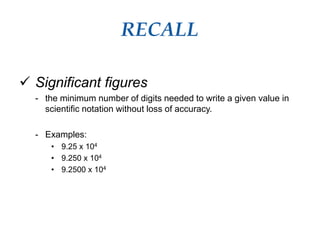
 Significant figures
- the minimum number of digits needed to write a given value in
scientific notation without loss of accuracy.
- Examples:
• 9.25 x 10⁴
• 9.250 x 10⁴
• 9.2500 x 10⁴
Significant Figures in
Numerical Computations
“Determining the appropriate number of
significant figures in the result of an
arithmetic combination of two or more
numbers requires great care.”
Significant Figures in
Numerical Computations
 Sums and Differences
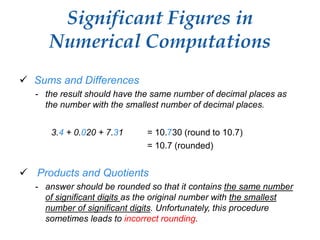
- the result should have the same number of decimal places as
the number with the smallest number of decimal places.
3.4 + 0.020 + 7.31 = 10.730 (round to 10.7)
= 10.7 (rounded)
 Products and Quotients
- answer should be rounded so that it contains the same number
of significant digits as the original number with the smallest
number of significant digits. Unfortunately, this procedure
sometimes leads to incorrect rounding.
Significant Figures in
Numerical Computations
 Logarithms and Antilogarithms
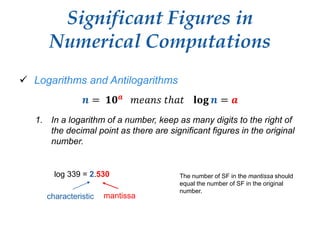
𝒏 = 𝟏𝟎 𝒂 𝑚𝑒𝑎𝑛𝑠 𝑡ℎ𝑎𝑡 𝐥𝐨𝐠 𝒏 = 𝒂
1. In a logarithm of a number, keep as many digits to the right of
the decimal point as there are significant figures in the original
number.
log 339 = 2.530 The number of SF in the mantissa should
equal the number of SF in the original
number.
characteristic mantissa
Significant Figures in
Numerical Computations
 Logarithms and Antilogarithms
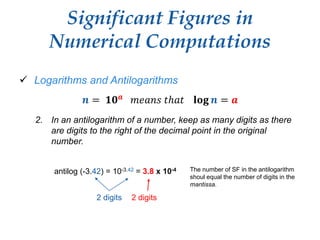
𝒏 = 𝟏𝟎 𝒂 𝑚𝑒𝑎𝑛𝑠 𝑡ℎ𝑎𝑡 𝐥𝐨𝐠 𝒏 = 𝒂
2. In an antilogarithm of a number, keep as many digits as there
are digits to the right of the decimal point in the original
number.
antilog (-3.42) = 10-3.42 = 3.8 x 10⁻⁴ The number of SF in the antilogarithm
shoul equal the number of digits in the
mantissa.
2 digits 2 digits
Propagation of Uncertainty
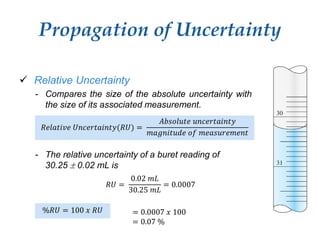
 Absolute Uncertainty
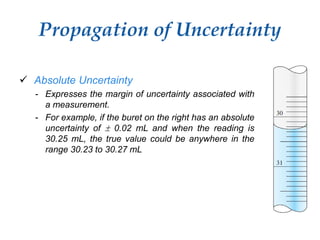
- Expresses the margin of uncertainty associated with
a measurement.
- For example, if the buret on the right has an absolute
uncertainty of  0.02 mL and when the reading is
30.25 mL, the true value could be anywhere in the
range 30.23 to 30.27 mL
Propagation of Uncertainty
 Relative Uncertainty
- Compares the size of the absolute uncertainty with
the size of its associated measurement.
- The relative uncertainty of a buret reading of
30.25  0.02 mL is
𝑅𝑒𝑙𝑎𝑡𝑖𝑣𝑒 𝑈𝑛𝑐𝑒𝑟𝑡𝑎𝑖𝑛𝑡𝑦(𝑅𝑈) =
𝐴𝑏𝑠𝑜𝑙𝑢𝑡𝑒 𝑢𝑛𝑐𝑒𝑟𝑡𝑎𝑖𝑛𝑡𝑦
𝑚𝑎𝑔𝑛𝑖𝑡𝑢𝑑𝑒 𝑜𝑓 𝑚𝑒𝑎𝑠𝑢𝑟𝑒𝑚𝑒𝑛𝑡
𝑅𝑈 =
0.02 𝑚𝐿
30.25 𝑚𝐿
= 0.0007
%𝑅𝑈 = 100 𝑥 𝑅𝑈 = 0.0007 𝑥 100
= 0.07 %
Propagation of Uncertainty
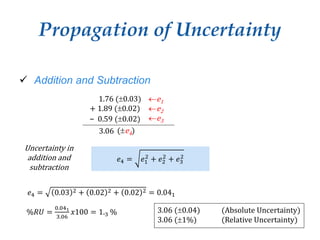
 Addition and Subtraction
𝑒4 = 𝑒1
2
+ 𝑒2
2
+ 𝑒3
2
1.76 (0.03)
+ 1.89 (0.02)
– 0.59 (0.02)
Uncertainty in
addition and
subtraction
3.06 (0.04) (Absolute Uncertainty)
3.06 (1%) (Relative Uncertainty)
3.06
e1
e2
e3
(e4)
𝑒4 = 0.03 2 + 0.02 2 + 0.02 2 = 0.041
%𝑅𝑈 =
0.041
3.06
𝑥100 = 1.3 %
Propagation of Uncertainty
Uncertainty in
multiplication and
division
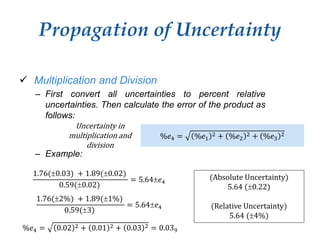
 Multiplication and Division
– First convert all uncertainties to percent relative
uncertainties. Then calculate the error of the product as
follows:
– Example:
%𝑒4 = %𝑒1
2 + %𝑒2
2 + %𝑒3
2
%𝑒4 = 0.02 2 + 0.01 2 + 0.03 2 = 0.039
1.76(0.03) + 1.89(0.02)
0.59(0.02)
= 5.64𝑒4
(Absolute Uncertainty)
5.64 (0.22)
(Relative Uncertainty)
5.64 (4%)
1.76(2%) + 1.89(1%)
0.59(3)
= 5.64𝑒4
1. Calculate the molar concentration of 8.45 (0.473%) mL
0.2517 (1.82%) g/mL ammonia solution that was
diluted to 0.5000 (0.0002) L.
(Ans. 0.250 (0.005) M)
2. Consider the function pH= –log[H+], where [H+] is the
molarity of H+. For pH = 5.21  0.03, find [H+] and its
uncertainty.
(Ans. 6.2 (0.4) x 10-6)
SAMPLE PROBLEM
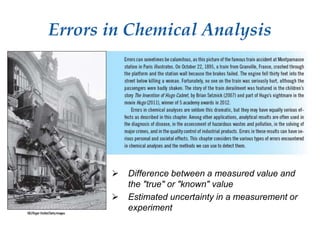
Errors in Chemical Analysis
 Difference between a measured value and
the "true" or "known" value
 Estimated uncertainty in a measurement or
experiment
Errors in Chemical Analysis
Replicates
– Samples of about the same size that are carried out
through an analysis in exactly the same way
– TRIALS - minimum of 2
Measures of Central Tendency
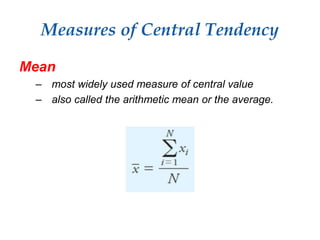
Mean
– most widely used measure of central value
– also called the arithmetic mean or the average.
Measures of Central Tendency
Median
- middle result when replicate date are
arranged in increasing or decreasing order
 For odd number of results, locate the middle
 For even number of results, average value of
middle pair
Mode
- value that has the highest frequency
Measures of Central Tendency
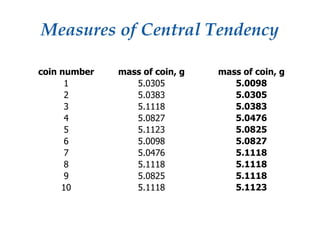
coin number mass of coin, g mass of coin, g
1 5.0305 5.0098
2 5.0383 5.0305
3 5.1118 5.0383
4 5.0827 5.0476
5 5.1123 5.0825
6 5.0098 5.0827
7 5.0476 5.1118
8 5.1118 5.1118
9 5.0825 5.1118
10 5.1118 5.1123
Measures of Spread
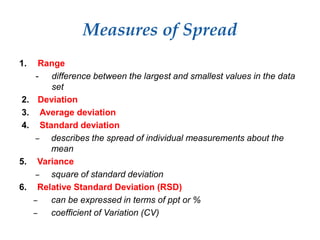
1. Range
- difference between the largest and smallest values in the data
set
2. Deviation
3. Average deviation
4. Standard deviation
– describes the spread of individual measurements about the
mean
5. Variance
– square of standard deviation
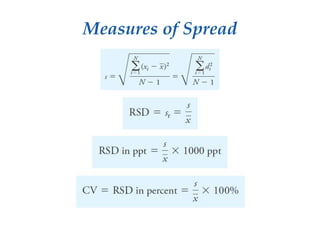
6. Relative Standard Deviation (RSD)
– can be expressed in terms of ppt or %
– coefficient of Variation (CV)
Measures of Spread
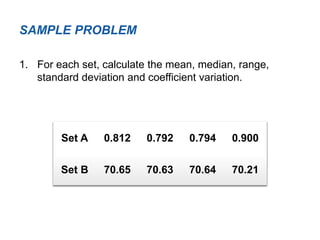
1. For each set, calculate the mean, median, range,
standard deviation and coefficient variation.
SAMPLE PROBLEM
Set A 0.812 0.792 0.794 0.900
Set B 70.65 70.63 70.64 70.21
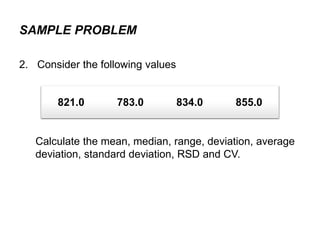
2. Consider the following values
Calculate the mean, median, range, deviation, average
deviation, standard deviation, RSD and CV.
SAMPLE PROBLEM
821.0 783.0 834.0 855.0
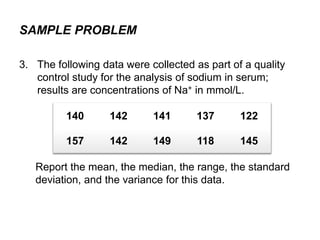
3. The following data were collected as part of a quality
control study for the analysis of sodium in serum;
results are concentrations of Na+ in mmol/L.
Report the mean, the median, the range, the standard
deviation, and the variance for this data.
SAMPLE PROBLEM
140 142 141 137 122
157 142 149 118 145
CHARACTERIZING
EXPERIMENTAL ERRORS
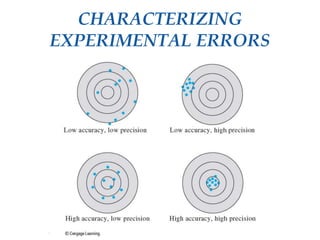
 Errors associated with the central tendency
reflect the accuracy of the analysis
 Errors associated with the spread reflect the
precision of the analysis
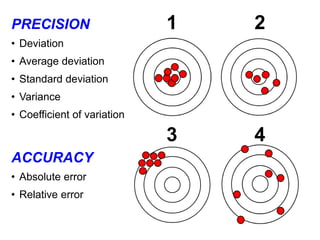
PRECISION
• Deviation
• Average deviation
• Standard deviation
• Variance
• Coefficient of variation
ACCURACY
• Absolute error
• Relative error
1 2
3 4
CHARACTERIZING
EXPERIMENTAL ERRORS
Accuracy
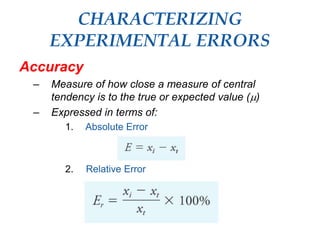
– Measure of how close a measure of central
tendency is to the true or expected value ()
– Expressed in terms of:
1. Absolute Error
2. Relative Error
CHARACTERIZING
EXPERIMENTAL ERRORS
Accuracy
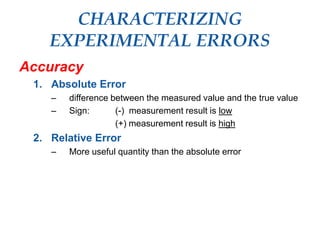
1. Absolute Error
– difference between the measured value and the true value
– Sign: (-) measurement result is low
(+) measurement result is high
2. Relative Error
– More useful quantity than the absolute error
CHARACTERIZING
EXPERIMENTAL ERRORS
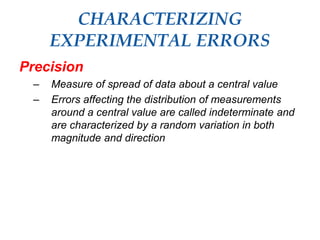
Precision
– Measure of spread of data about a central value
– Errors affecting the distribution of measurements
around a central value are called indeterminate and
are characterized by a random variation in both
magnitude and direction
CHARACTERIZING
EXPERIMENTAL ERRORS
Precision
1. Repeatability
 the precision for an analysis in which the only source of
variability is the analysis of the replicate sample
e.g. acid content ( two trials)
2. Reproducibility
 the precision when comparing results for several samples
for several analyst or for several methods
CHARACTERIZING
EXPERIMENTAL ERRORS
CHARACTERIZING
EXPERIMENTAL ERRORS
Errors affecting ACCURACY:
Determinate/Systematic Errors
 flaw in an experiment/design of an experiment
 can be discovered or corrected
 causes the mean of a data set to differ from the
accepted value
 e.g. loss of volatile analyte while heating the sample
CHARACTERIZING
EXPERIMENTAL ERRORS
Errors affecting PRECISION:
Indeterminate/Random Errors
 Causes the data to be scattered more or less
symmetrically around a mean value because they are
small enough to avoid individual detection
 Always present and cannot be corrected
 Minimize errors by increasing the number of
determinations (n)
e.g. electricity fluctuations, temperature, etc.
IDEAL:  error  average deviation (both precise and accurate)
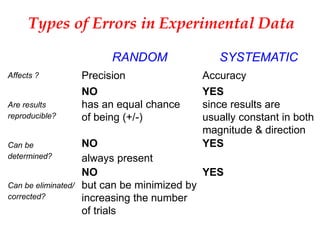
RANDOM SYSTEMATIC
Affects ? Precision Accuracy
Are results
reproducible?
NO
has an equal chance
of being (+/-)
YES
since results are
usually constant in both
magnitude & direction
Can be
determined?
NO
always present
YES
Can be eliminated/
corrected?
NO
but can be minimized by
increasing the number
of trials
YES
Types of Errors in Experimental Data
CHARACTERIZING
EXPERIMENTAL ERRORS
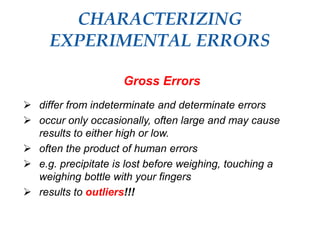
Gross Errors
 differ from indeterminate and determinate errors
 occur only occasionally, often large and may cause
results to either high or low.
 often the product of human errors
 e.g. precipitate is lost before weighing, touching a
weighing bottle with your fingers
 results to outliers!!!
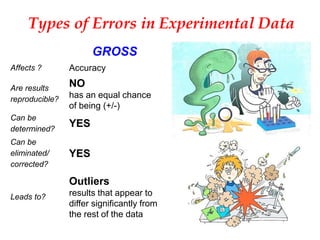
GROSS
Affects ? Accuracy
Are results
reproducible?
NO
has an equal chance
of being (+/-)
Can be
determined?
YES
Can be
eliminated/
corrected?
YES
Leads to?
Outliers
results that appear to
differ significantly from
the rest of the data
Types of Errors in Experimental Data
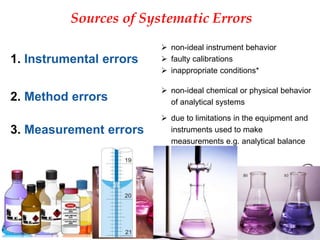
1. Instrumental errors
 non-ideal instrument behavior
 faulty calibrations
 inappropriate conditions*
2. Method errors
 non-ideal chemical or physical behavior
of analytical systems
3. Measurement errors
 due to limitations in the equipment and
instruments used to make
measurements e.g. analytical balance
Sources of Systematic Errors
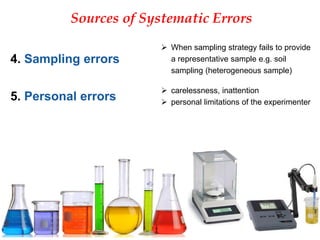
4. Sampling errors
 When sampling strategy fails to provide
a representative sample e.g. soil
sampling (heterogeneous sample)
5. Personal errors
 carelessness, inattention
 personal limitations of the experimenter
Sources of Systematic Errors
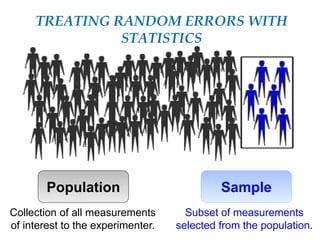
TREATING RANDOM ERRORS WITH
STATISTICS
Population
Collection of all measurements
of interest to the experimenter.
Sample
Subset of measurements
selected from the population.
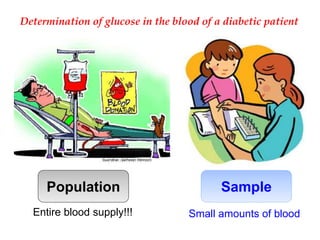
Population
Entire blood supply!!!
Sample
Small amounts of blood
Determination of glucose in the blood of a diabetic patient
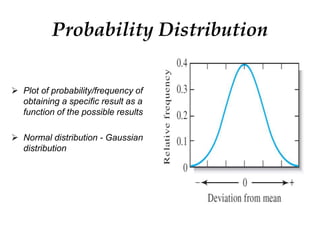
Probability Distribution
 Plot of probability/frequency of
obtaining a specific result as a
function of the possible results
 Normal distribution - Gaussian
distribution
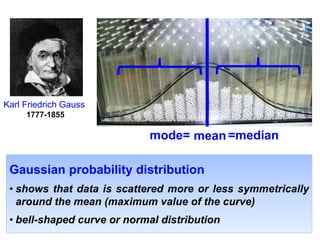
Karl Friedrich Gauss
1777-1855
Gaussian probability distribution
• shows that data is scattered more or less symmetrically
around the mean (maximum value of the curve)
• bell-shaped curve or normal distribution
meanmode= =median
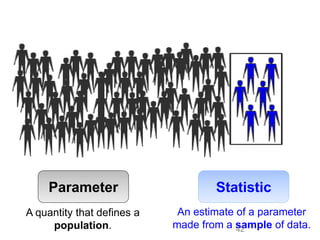
Parameter
A quantity that defines a
population.
Statistic
An estimate of a parameter
made from a sample of data.42
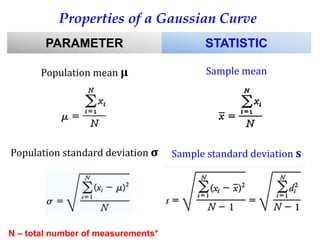
PARAMETER STATISTIC
Population mean µ Sample mean
Population standard deviation σ Sample standard deviation s
Properties of a Gaussian Curve
N – total number of measurements*
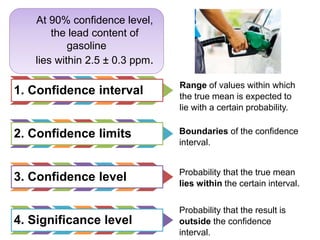
At 90% confidence level,
the lead content of
gasoline
lies within 2.5 ± 0.3 ppm.
1. Confidence interval
2. Confidence limits
3. Confidence level
4. Significance level
Range of values within which
the true mean is expected to
lie with a certain probability.
Boundaries of the confidence
interval.
Probability that the true mean
lies within the certain interval.
Probability that the result is
outside the confidence
interval.
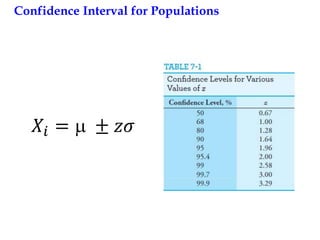
Confidence Interval for Populations
𝑋𝑖 =  ± 𝑧𝜎
Confidence Interval for Populations
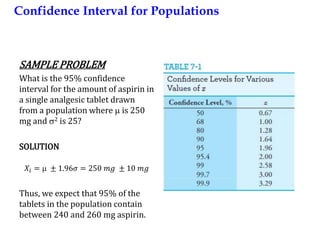
SAMPLE PROBLEM
What is the 95% confidence
interval for the amount of aspirin in
a single analgesic tablet drawn
from a population where  is 250
mg and 2 is 25?
SOLUTION
𝑋𝑖 =  ± 1.96𝜎 = 250 𝑚𝑔 ± 10 𝑚𝑔
Thus, we expect that 95% of the
tablets in the population contain
between 240 and 260 mg aspirin.
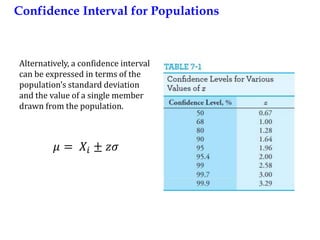
Confidence Interval for Populations
Alternatively, a confidence interval
can be expressed in terms of the
population’s standard deviation
and the value of a single member
drawn from the population.
𝜇 = 𝑋𝑖 ± 𝑧𝜎
Confidence Interval for Populations
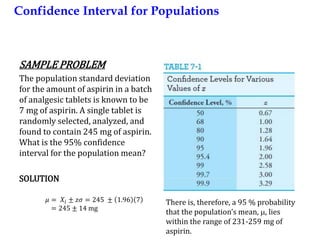
SAMPLE PROBLEM
The population standard deviation
for the amount of aspirin in a batch
of analgesic tablets is known to be
7 mg of aspirin. A single tablet is
randomly selected, analyzed, and
found to contain 245 mg of aspirin.
What is the 95% confidence
interval for the population mean?
SOLUTION
𝜇 = 𝑋𝑖 ± 𝑧𝜎 = 245 ± 1.96 7
= 245 ± 14 mg
There is, therefore, a 95 % probability
that the population’s mean, , lies
within the range of 231-259 mg of
aspirin.
Confidence Interval for Populations
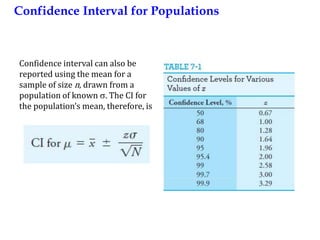
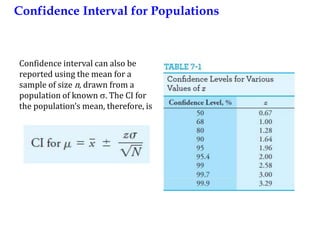
Confidence interval can also be
reported using the mean for a
sample of size n, drawn from a
population of known . The CI for
the population’s mean, therefore, is
Confidence Interval for Populations
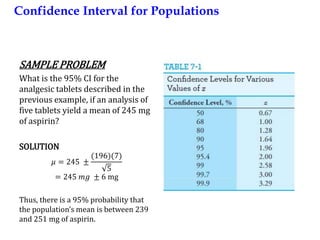
SAMPLE PROBLEM
What is the 95% CI for the
analgesic tablets described in the
previous example, if an analysis of
five tablets yield a mean of 245 mg
of aspirin?
SOLUTION
𝜇 = 245 ±
(196)(7)
5
= 245 𝑚𝑔 ± 6 mg
Thus, there is a 95% probability that
the population’s mean is between 239
and 251 mg of aspirin.
Confidence Interval for Populations
Confidence interval can also be
reported using the mean for a
sample of size n, drawn from a
population of known . The CI for
the population’s mean, therefore, is
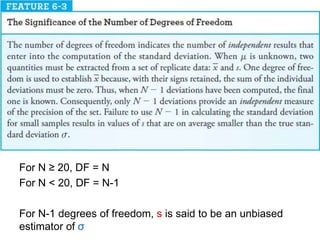
For N ≥ 20, DF = N
For N < 20, DF = N-1
For N-1 degrees of freedom, s is said to be an unbiased
estimator of σ
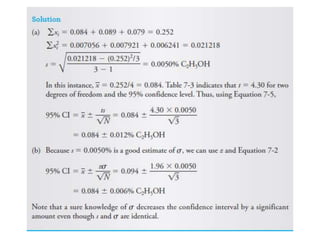
Finding the Confidence Interval
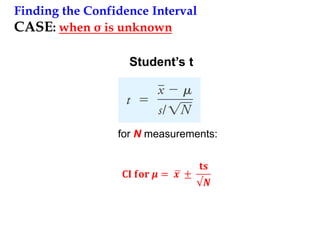
CASE: when σ is unknown
for N measurements:
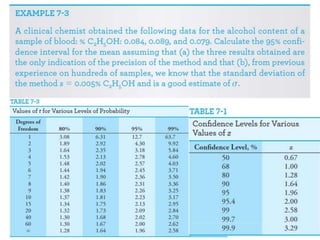
Student’s t
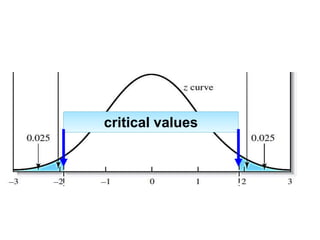
critical values
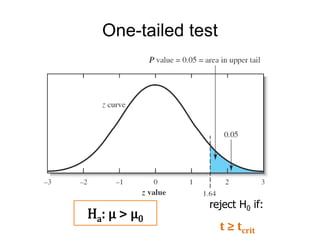
One-tailed test
Ha: µ > µ0
reject H0 if:
t ≥ tcrit
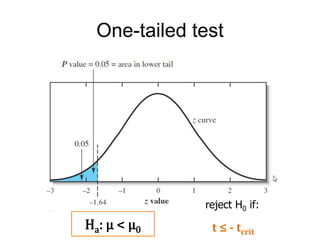
One-tailed test
Ha: µ < µ0
reject H0 if:
t ≤ - tcrit
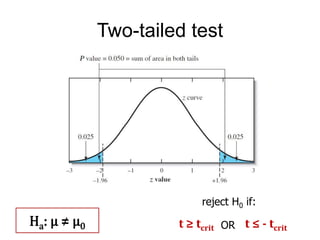
Two-tailed test
Ha: µ ≠ µ0
reject H0 if:
t ≥ tcrit t ≤ - tcritOR
SIGNIFICANCE TESTING
Designed to determine whether the difference
between two values is too large to be explained by
indeterminate errors.
Statistical Aids to Hypothesis Testing
Null Hypothesis
H0
Assumes that the numerical
quantities being compared
are the same.
Alternative Hypothesis
Ha
Difference between values is
too great to be explained by
random error.
Statistical Aids to Hypothesis Testing
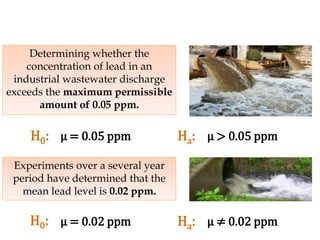
Determining whether the
concentration of lead in an
industrial wastewater discharge
exceeds the maximum permissible
amount of 0.05 ppm.
H0: µ = 0.05 ppm µ > 0.05 ppm
Experiments over a several year
period have determined that the
mean lead level is 0.02 ppm.
Ha:
µ = 0.02 ppm µ ≠ 0.02 ppmHa:H0:
ERRORS IN SIGNIFICANCE
TESTING
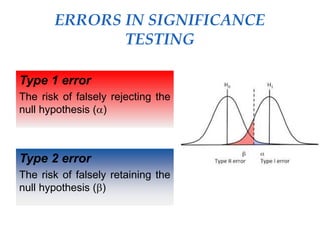
Type 1 error
The risk of falsely rejecting the
null hypothesis ()
Type 2 error
The risk of falsely retaining the
null hypothesis ()
STATISTICAL METHODS FOR
NORMAL DISTRIBUTIONS
A. Comparing an experimental mean with a
known value
B. Comparing two sample means
C. Comparing two standard deviations (F-test)
D. Dixon’s Q-test (Test for outliers)
To carry out the statistical test, a test procedure must be
implemented. The crucial elements of a test procedure are:
1. formation of an appropriate test statistic &
2. identification of a rejection region.
The test statistic is formulated from the data on which we will base the
decision to accept or reject H0. The rejection region consists of all the
values of the test statistic for which H0 will be rejected.
A. COMPARING AN EXPERIMENTAL
MEAN WITH A KNOWN VALUE
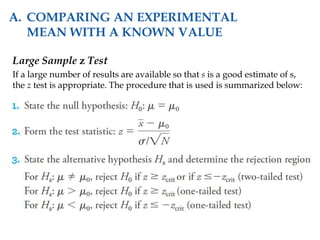
Large Sample z Test
If a large number of results are available so that s is a good estimate of s,
the z test is appropriate. The procedure that is used is summarized below:
A. COMPARING AN EXPERIMENTAL
MEAN WITH A KNOWN VALUE
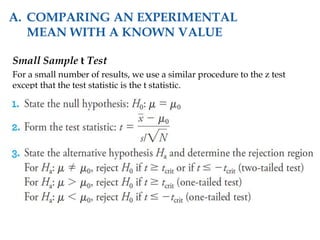
Small Sample t Test
For a small number of results, we use a similar procedure to the z test
except that the test statistic is the t statistic.
A. COMPARING AN EXPERIMENTAL
MEAN WITH A KNOWN VALUE
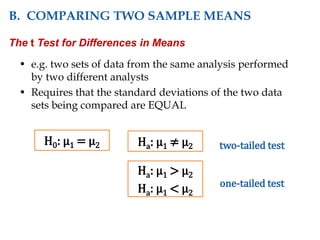
• e.g. two sets of data from the same analysis performed
by two different analysts
• Requires that the standard deviations of the two data
sets being compared are EQUAL
H0: µ1 = µ2 Ha: µ1 ≠ µ2
Ha: µ1 > µ2
Ha: µ1 < µ2
two-tailed test
one-tailed test
B. COMPARING TWO SAMPLE MEANS
The t Test for Differences in Means
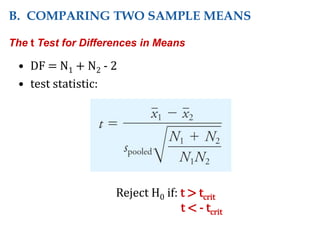
• DF = N1 + N2 - 2
• test statistic:
Reject H0 if: t > tcrit
t < - tcrit
B. COMPARING TWO SAMPLE MEANS
The t Test for Differences in Means
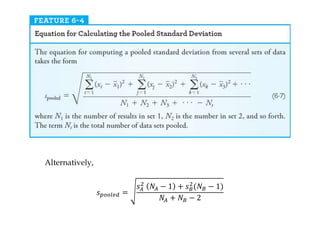
𝑠 𝑝𝑜𝑜𝑙𝑒𝑑 =
𝑠 𝐴
2
𝑁𝐴 − 1 + 𝑠 𝐵
2
(𝑁 𝐵 − 1)
𝑁𝐴 + 𝑁 𝐵 − 2
Alternatively,
SAMPLE PROBLEM
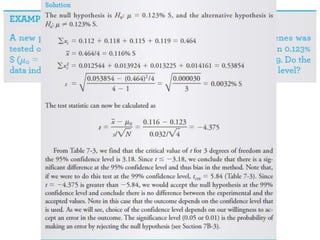
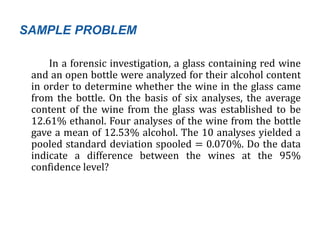
In a forensic investigation, a glass containing red wine
and an open bottle were analyzed for their alcohol content
in order to determine whether the wine in the glass came
from the bottle. On the basis of six analyses, the average
content of the wine from the glass was established to be
12.61% ethanol. Four analyses of the wine from the bottle
gave a mean of 12.53% alcohol. The 10 analyses yielded a
pooled standard deviation spooled = 0.070%. Do the data
indicate a difference between the wines at the 95%
confidence level?
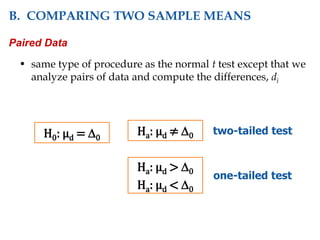
• same type of procedure as the normal t test except that we
analyze pairs of data and compute the differences, di
H0: µd = 0
Ha: µd ≠ 0
Ha: µd > 0
Ha: µd < 0
two-tailed test
one-tailed test
B. COMPARING TWO SAMPLE MEANS
Paired Data
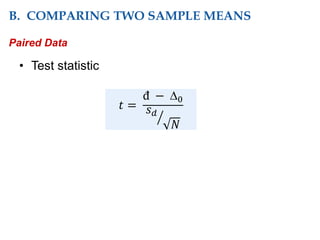
• Test statistic
𝑡 =
đ − 0
𝑠 𝑑
𝑁
B. COMPARING TWO SAMPLE MEANS
Paired Data
SAMPLE PROBLEM
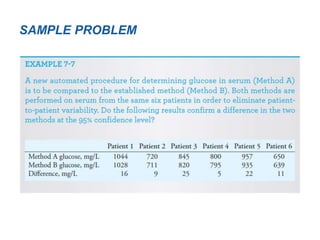
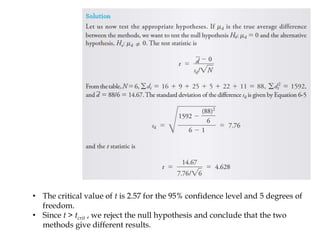
• The critical value of t is 2.57 for the 95% confidence level and 5 degrees of
freedom.
• Since t > tcrit , we reject the null hypothesis and conclude that the two
methods give different results.
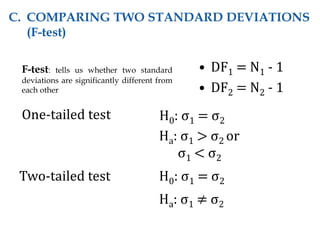
• DF1 = N1 - 1
• DF2 = N2 - 1
One-tailed test H0: σ1 = σ2
Ha: σ1 > σ2 or
σ1 < σ2
Two-tailed test H0: σ1 = σ2
Ha: σ1 ≠ σ2
C. COMPARING TWO STANDARD DEVIATIONS
(F-test)
F-test: tells us whether two standard
deviations are significantly different from
each other
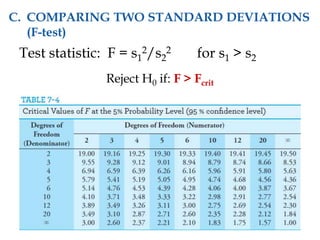
Test statistic: F = s1
2/s2
2 for s1 > s2
Reject H0 if: F > Fcrit
C. COMPARING TWO STANDARD DEVIATIONS
(F-test)
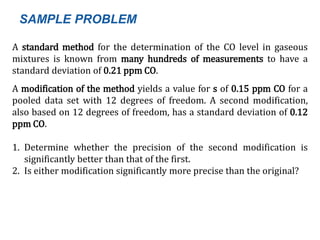
A standard method for the determination of the CO level in gaseous
mixtures is known from many hundreds of measurements to have a
standard deviation of 0.21 ppm CO.
A modification of the method yields a value for s of 0.15 ppm CO for a
pooled data set with 12 degrees of freedom. A second modification,
also based on 12 degrees of freedom, has a standard deviation of 0.12
ppm CO.
1. Determine whether the precision of the second modification is
significantly better than that of the first.
2. Is either modification significantly more precise than the original?
SAMPLE PROBLEM
SAMPLE PROBLEM
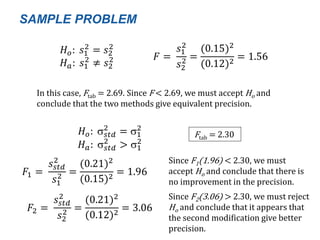
𝐹 =
𝑠1
2
𝑠2
2 =
(0.15)2
(0.12)2
= 1.56
𝐻 𝑜: 𝑠1
2
= 𝑠2
2
𝐻 𝑎: 𝑠1
2
≠ 𝑠2
2
In this case, Ftab = 2.69. Since F < 2.69, we must accept Ho and
conclude that the two methods give equivalent precision.
𝐻 𝑜:  𝑠𝑡𝑑
2
= 1
2
𝐻 𝑎:  𝑠𝑡𝑑
2
> 1
2
𝐹1 =
𝑠𝑠𝑡𝑑
2
𝑠1
2 =
(0.21)2
(0.15)2
= 1.96
𝐹2 =
𝑠𝑠𝑡𝑑
2
𝑠2
2 =
(0.21)2
(0.12)2
= 3.06
Ftab = 2.30
Since F1(1.96) < 2.30, we must
accept Ho and conclude that there is
no improvement in the precision.
Since F2(3.06) > 2.30, we must reject
Ho and conclude that it appears that
the second modification give better
precision.
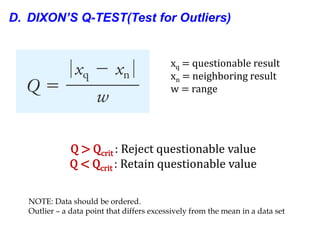
xq = questionable result
xn = neighboring result
w = range
Q > Qcrit : Reject questionable value
Q < Qcrit : Retain questionable value
D. DIXON’S Q-TEST(Test for Outliers)
NOTE: Data should be ordered.
Outlier – a data point that differs excessively from the mean in a data set
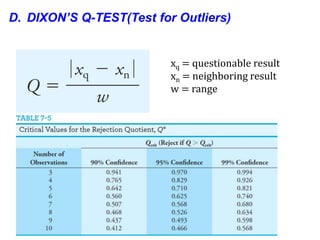
xq = questionable result
xn = neighboring result
w = range
D. DIXON’S Q-TEST(Test for Outliers)
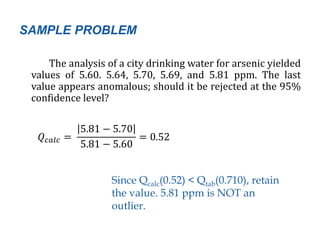
SAMPLE PROBLEM
The analysis of a city drinking water for arsenic yielded
values of 5.60. 5.64, 5.70, 5.69, and 5.81 ppm. The last
value appears anomalous; should it be rejected at the 95%
confidence level?
𝑄 𝑐𝑎𝑙𝑐 =
5.81 − 5.70
5.81 − 5.60
= 0.52
Since Qcalc(0.52) < Qtab(0.710), retain
the value. 5.81 ppm is NOT an
outlier.
References
Skoog, D. A., West, D. M., Holler, F. J., & Crouch, S. R. (2014). Skoog and
Wests Fundamentals of Analytical Chemistry.
Harris, D.C. (1999). Quantitative Chemical Analysis.
Harvey, D. (2000). Modern Analytical Chemistry.

Statistical analysis in analytical chemistry

  • 2.
    Outline Significant Figures inNumerical Computations Propagation of Uncertainty Errors in Chemical Analysis Measures of Central Tendencies Measures of Spread Characterizing Experimental Errors Treating Random Errors with Statistics
  • 3.
    RECALL  Significant figures -the minimum number of digits needed to write a given value in scientific notation without loss of accuracy. - Examples: • 9.25 x 10⁴ • 9.250 x 10⁴ • 9.2500 x 10⁴
  • 4.
    Significant Figures in NumericalComputations “Determining the appropriate number of significant figures in the result of an arithmetic combination of two or more numbers requires great care.”
  • 5.
    Significant Figures in NumericalComputations  Sums and Differences - the result should have the same number of decimal places as the number with the smallest number of decimal places. 3.4 + 0.020 + 7.31 = 10.730 (round to 10.7) = 10.7 (rounded)  Products and Quotients - answer should be rounded so that it contains the same number of significant digits as the original number with the smallest number of significant digits. Unfortunately, this procedure sometimes leads to incorrect rounding.
  • 6.
    Significant Figures in NumericalComputations  Logarithms and Antilogarithms 𝒏 = 𝟏𝟎 𝒂 𝑚𝑒𝑎𝑛𝑠 𝑡ℎ𝑎𝑡 𝐥𝐨𝐠 𝒏 = 𝒂 1. In a logarithm of a number, keep as many digits to the right of the decimal point as there are significant figures in the original number. log 339 = 2.530 The number of SF in the mantissa should equal the number of SF in the original number. characteristic mantissa
  • 7.
    Significant Figures in NumericalComputations  Logarithms and Antilogarithms 𝒏 = 𝟏𝟎 𝒂 𝑚𝑒𝑎𝑛𝑠 𝑡ℎ𝑎𝑡 𝐥𝐨𝐠 𝒏 = 𝒂 2. In an antilogarithm of a number, keep as many digits as there are digits to the right of the decimal point in the original number. antilog (-3.42) = 10-3.42 = 3.8 x 10⁻⁴ The number of SF in the antilogarithm shoul equal the number of digits in the mantissa. 2 digits 2 digits
  • 8.
    Propagation of Uncertainty Absolute Uncertainty - Expresses the margin of uncertainty associated with a measurement. - For example, if the buret on the right has an absolute uncertainty of  0.02 mL and when the reading is 30.25 mL, the true value could be anywhere in the range 30.23 to 30.27 mL
  • 9.
    Propagation of Uncertainty Relative Uncertainty - Compares the size of the absolute uncertainty with the size of its associated measurement. - The relative uncertainty of a buret reading of 30.25  0.02 mL is 𝑅𝑒𝑙𝑎𝑡𝑖𝑣𝑒 𝑈𝑛𝑐𝑒𝑟𝑡𝑎𝑖𝑛𝑡𝑦(𝑅𝑈) = 𝐴𝑏𝑠𝑜𝑙𝑢𝑡𝑒 𝑢𝑛𝑐𝑒𝑟𝑡𝑎𝑖𝑛𝑡𝑦 𝑚𝑎𝑔𝑛𝑖𝑡𝑢𝑑𝑒 𝑜𝑓 𝑚𝑒𝑎𝑠𝑢𝑟𝑒𝑚𝑒𝑛𝑡 𝑅𝑈 = 0.02 𝑚𝐿 30.25 𝑚𝐿 = 0.0007 %𝑅𝑈 = 100 𝑥 𝑅𝑈 = 0.0007 𝑥 100 = 0.07 %
  • 10.
    Propagation of Uncertainty Addition and Subtraction 𝑒4 = 𝑒1 2 + 𝑒2 2 + 𝑒3 2 1.76 (0.03) + 1.89 (0.02) – 0.59 (0.02) Uncertainty in addition and subtraction 3.06 (0.04) (Absolute Uncertainty) 3.06 (1%) (Relative Uncertainty) 3.06 e1 e2 e3 (e4) 𝑒4 = 0.03 2 + 0.02 2 + 0.02 2 = 0.041 %𝑅𝑈 = 0.041 3.06 𝑥100 = 1.3 %
  • 11.
    Propagation of Uncertainty Uncertaintyin multiplication and division  Multiplication and Division – First convert all uncertainties to percent relative uncertainties. Then calculate the error of the product as follows: – Example: %𝑒4 = %𝑒1 2 + %𝑒2 2 + %𝑒3 2 %𝑒4 = 0.02 2 + 0.01 2 + 0.03 2 = 0.039 1.76(0.03) + 1.89(0.02) 0.59(0.02) = 5.64𝑒4 (Absolute Uncertainty) 5.64 (0.22) (Relative Uncertainty) 5.64 (4%) 1.76(2%) + 1.89(1%) 0.59(3) = 5.64𝑒4
  • 12.
    1. Calculate themolar concentration of 8.45 (0.473%) mL 0.2517 (1.82%) g/mL ammonia solution that was diluted to 0.5000 (0.0002) L. (Ans. 0.250 (0.005) M) 2. Consider the function pH= –log[H+], where [H+] is the molarity of H+. For pH = 5.21  0.03, find [H+] and its uncertainty. (Ans. 6.2 (0.4) x 10-6) SAMPLE PROBLEM
  • 14.
    Errors in ChemicalAnalysis  Difference between a measured value and the "true" or "known" value  Estimated uncertainty in a measurement or experiment
  • 15.
    Errors in ChemicalAnalysis Replicates – Samples of about the same size that are carried out through an analysis in exactly the same way – TRIALS - minimum of 2
  • 16.
    Measures of CentralTendency Mean – most widely used measure of central value – also called the arithmetic mean or the average.
  • 17.
    Measures of CentralTendency Median - middle result when replicate date are arranged in increasing or decreasing order  For odd number of results, locate the middle  For even number of results, average value of middle pair Mode - value that has the highest frequency
  • 18.
    Measures of CentralTendency coin number mass of coin, g mass of coin, g 1 5.0305 5.0098 2 5.0383 5.0305 3 5.1118 5.0383 4 5.0827 5.0476 5 5.1123 5.0825 6 5.0098 5.0827 7 5.0476 5.1118 8 5.1118 5.1118 9 5.0825 5.1118 10 5.1118 5.1123
  • 19.
    Measures of Spread 1.Range - difference between the largest and smallest values in the data set 2. Deviation 3. Average deviation 4. Standard deviation – describes the spread of individual measurements about the mean 5. Variance – square of standard deviation 6. Relative Standard Deviation (RSD) – can be expressed in terms of ppt or % – coefficient of Variation (CV)
  • 20.
  • 21.
    1. For eachset, calculate the mean, median, range, standard deviation and coefficient variation. SAMPLE PROBLEM Set A 0.812 0.792 0.794 0.900 Set B 70.65 70.63 70.64 70.21
  • 22.
    2. Consider thefollowing values Calculate the mean, median, range, deviation, average deviation, standard deviation, RSD and CV. SAMPLE PROBLEM 821.0 783.0 834.0 855.0
  • 23.
    3. The followingdata were collected as part of a quality control study for the analysis of sodium in serum; results are concentrations of Na+ in mmol/L. Report the mean, the median, the range, the standard deviation, and the variance for this data. SAMPLE PROBLEM 140 142 141 137 122 157 142 149 118 145
  • 24.
    CHARACTERIZING EXPERIMENTAL ERRORS  Errorsassociated with the central tendency reflect the accuracy of the analysis  Errors associated with the spread reflect the precision of the analysis
  • 25.
    PRECISION • Deviation • Averagedeviation • Standard deviation • Variance • Coefficient of variation ACCURACY • Absolute error • Relative error 1 2 3 4
  • 26.
    CHARACTERIZING EXPERIMENTAL ERRORS Accuracy – Measureof how close a measure of central tendency is to the true or expected value () – Expressed in terms of: 1. Absolute Error 2. Relative Error
  • 27.
    CHARACTERIZING EXPERIMENTAL ERRORS Accuracy 1. AbsoluteError – difference between the measured value and the true value – Sign: (-) measurement result is low (+) measurement result is high 2. Relative Error – More useful quantity than the absolute error
  • 28.
    CHARACTERIZING EXPERIMENTAL ERRORS Precision – Measureof spread of data about a central value – Errors affecting the distribution of measurements around a central value are called indeterminate and are characterized by a random variation in both magnitude and direction
  • 29.
  • 30.
    Precision 1. Repeatability  theprecision for an analysis in which the only source of variability is the analysis of the replicate sample e.g. acid content ( two trials) 2. Reproducibility  the precision when comparing results for several samples for several analyst or for several methods CHARACTERIZING EXPERIMENTAL ERRORS
  • 31.
    CHARACTERIZING EXPERIMENTAL ERRORS Errors affectingACCURACY: Determinate/Systematic Errors  flaw in an experiment/design of an experiment  can be discovered or corrected  causes the mean of a data set to differ from the accepted value  e.g. loss of volatile analyte while heating the sample
  • 32.
    CHARACTERIZING EXPERIMENTAL ERRORS Errors affectingPRECISION: Indeterminate/Random Errors  Causes the data to be scattered more or less symmetrically around a mean value because they are small enough to avoid individual detection  Always present and cannot be corrected  Minimize errors by increasing the number of determinations (n) e.g. electricity fluctuations, temperature, etc. IDEAL:  error  average deviation (both precise and accurate)
  • 33.
    RANDOM SYSTEMATIC Affects ?Precision Accuracy Are results reproducible? NO has an equal chance of being (+/-) YES since results are usually constant in both magnitude & direction Can be determined? NO always present YES Can be eliminated/ corrected? NO but can be minimized by increasing the number of trials YES Types of Errors in Experimental Data
  • 34.
    CHARACTERIZING EXPERIMENTAL ERRORS Gross Errors differ from indeterminate and determinate errors  occur only occasionally, often large and may cause results to either high or low.  often the product of human errors  e.g. precipitate is lost before weighing, touching a weighing bottle with your fingers  results to outliers!!!
  • 35.
    GROSS Affects ? Accuracy Areresults reproducible? NO has an equal chance of being (+/-) Can be determined? YES Can be eliminated/ corrected? YES Leads to? Outliers results that appear to differ significantly from the rest of the data Types of Errors in Experimental Data
  • 36.
    1. Instrumental errors non-ideal instrument behavior  faulty calibrations  inappropriate conditions* 2. Method errors  non-ideal chemical or physical behavior of analytical systems 3. Measurement errors  due to limitations in the equipment and instruments used to make measurements e.g. analytical balance Sources of Systematic Errors
  • 37.
    4. Sampling errors When sampling strategy fails to provide a representative sample e.g. soil sampling (heterogeneous sample) 5. Personal errors  carelessness, inattention  personal limitations of the experimenter Sources of Systematic Errors
  • 38.
    TREATING RANDOM ERRORSWITH STATISTICS Population Collection of all measurements of interest to the experimenter. Sample Subset of measurements selected from the population.
  • 39.
    Population Entire blood supply!!! Sample Smallamounts of blood Determination of glucose in the blood of a diabetic patient
  • 40.
    Probability Distribution  Plotof probability/frequency of obtaining a specific result as a function of the possible results  Normal distribution - Gaussian distribution
  • 41.
    Karl Friedrich Gauss 1777-1855 Gaussianprobability distribution • shows that data is scattered more or less symmetrically around the mean (maximum value of the curve) • bell-shaped curve or normal distribution meanmode= =median
  • 42.
    Parameter A quantity thatdefines a population. Statistic An estimate of a parameter made from a sample of data.42
  • 43.
    PARAMETER STATISTIC Population meanµ Sample mean Population standard deviation σ Sample standard deviation s Properties of a Gaussian Curve N – total number of measurements*
  • 46.
    At 90% confidencelevel, the lead content of gasoline lies within 2.5 ± 0.3 ppm. 1. Confidence interval 2. Confidence limits 3. Confidence level 4. Significance level Range of values within which the true mean is expected to lie with a certain probability. Boundaries of the confidence interval. Probability that the true mean lies within the certain interval. Probability that the result is outside the confidence interval.
  • 47.
    Confidence Interval forPopulations 𝑋𝑖 =  ± 𝑧𝜎
  • 48.
    Confidence Interval forPopulations SAMPLE PROBLEM What is the 95% confidence interval for the amount of aspirin in a single analgesic tablet drawn from a population where  is 250 mg and 2 is 25? SOLUTION 𝑋𝑖 =  ± 1.96𝜎 = 250 𝑚𝑔 ± 10 𝑚𝑔 Thus, we expect that 95% of the tablets in the population contain between 240 and 260 mg aspirin.
  • 49.
    Confidence Interval forPopulations Alternatively, a confidence interval can be expressed in terms of the population’s standard deviation and the value of a single member drawn from the population. 𝜇 = 𝑋𝑖 ± 𝑧𝜎
  • 50.
    Confidence Interval forPopulations SAMPLE PROBLEM The population standard deviation for the amount of aspirin in a batch of analgesic tablets is known to be 7 mg of aspirin. A single tablet is randomly selected, analyzed, and found to contain 245 mg of aspirin. What is the 95% confidence interval for the population mean? SOLUTION 𝜇 = 𝑋𝑖 ± 𝑧𝜎 = 245 ± 1.96 7 = 245 ± 14 mg There is, therefore, a 95 % probability that the population’s mean, , lies within the range of 231-259 mg of aspirin.
  • 51.
    Confidence Interval forPopulations Confidence interval can also be reported using the mean for a sample of size n, drawn from a population of known . The CI for the population’s mean, therefore, is
  • 52.
    Confidence Interval forPopulations SAMPLE PROBLEM What is the 95% CI for the analgesic tablets described in the previous example, if an analysis of five tablets yield a mean of 245 mg of aspirin? SOLUTION 𝜇 = 245 ± (196)(7) 5 = 245 𝑚𝑔 ± 6 mg Thus, there is a 95% probability that the population’s mean is between 239 and 251 mg of aspirin.
  • 53.
    Confidence Interval forPopulations Confidence interval can also be reported using the mean for a sample of size n, drawn from a population of known . The CI for the population’s mean, therefore, is
  • 54.
    For N ≥20, DF = N For N < 20, DF = N-1 For N-1 degrees of freedom, s is said to be an unbiased estimator of σ
  • 55.
    Finding the ConfidenceInterval CASE: when σ is unknown for N measurements: Student’s t
  • 56.
  • 57.
    One-tailed test Ha: µ> µ0 reject H0 if: t ≥ tcrit
  • 58.
    One-tailed test Ha: µ< µ0 reject H0 if: t ≤ - tcrit
  • 59.
    Two-tailed test Ha: µ≠ µ0 reject H0 if: t ≥ tcrit t ≤ - tcritOR
  • 62.
    SIGNIFICANCE TESTING Designed todetermine whether the difference between two values is too large to be explained by indeterminate errors.
  • 63.
    Statistical Aids toHypothesis Testing Null Hypothesis H0 Assumes that the numerical quantities being compared are the same.
  • 64.
    Alternative Hypothesis Ha Difference betweenvalues is too great to be explained by random error. Statistical Aids to Hypothesis Testing
  • 65.
    Determining whether the concentrationof lead in an industrial wastewater discharge exceeds the maximum permissible amount of 0.05 ppm. H0: µ = 0.05 ppm µ > 0.05 ppm Experiments over a several year period have determined that the mean lead level is 0.02 ppm. Ha: µ = 0.02 ppm µ ≠ 0.02 ppmHa:H0:
  • 66.
    ERRORS IN SIGNIFICANCE TESTING Type1 error The risk of falsely rejecting the null hypothesis () Type 2 error The risk of falsely retaining the null hypothesis ()
  • 67.
    STATISTICAL METHODS FOR NORMALDISTRIBUTIONS A. Comparing an experimental mean with a known value B. Comparing two sample means C. Comparing two standard deviations (F-test) D. Dixon’s Q-test (Test for outliers)
  • 68.
    To carry outthe statistical test, a test procedure must be implemented. The crucial elements of a test procedure are: 1. formation of an appropriate test statistic & 2. identification of a rejection region. The test statistic is formulated from the data on which we will base the decision to accept or reject H0. The rejection region consists of all the values of the test statistic for which H0 will be rejected. A. COMPARING AN EXPERIMENTAL MEAN WITH A KNOWN VALUE
  • 69.
    Large Sample zTest If a large number of results are available so that s is a good estimate of s, the z test is appropriate. The procedure that is used is summarized below: A. COMPARING AN EXPERIMENTAL MEAN WITH A KNOWN VALUE
  • 70.
    Small Sample tTest For a small number of results, we use a similar procedure to the z test except that the test statistic is the t statistic. A. COMPARING AN EXPERIMENTAL MEAN WITH A KNOWN VALUE
  • 72.
    • e.g. twosets of data from the same analysis performed by two different analysts • Requires that the standard deviations of the two data sets being compared are EQUAL H0: µ1 = µ2 Ha: µ1 ≠ µ2 Ha: µ1 > µ2 Ha: µ1 < µ2 two-tailed test one-tailed test B. COMPARING TWO SAMPLE MEANS The t Test for Differences in Means
  • 73.
    • DF =N1 + N2 - 2 • test statistic: Reject H0 if: t > tcrit t < - tcrit B. COMPARING TWO SAMPLE MEANS The t Test for Differences in Means
  • 74.
    𝑠 𝑝𝑜𝑜𝑙𝑒𝑑 = 𝑠𝐴 2 𝑁𝐴 − 1 + 𝑠 𝐵 2 (𝑁 𝐵 − 1) 𝑁𝐴 + 𝑁 𝐵 − 2 Alternatively,
  • 75.
    SAMPLE PROBLEM In aforensic investigation, a glass containing red wine and an open bottle were analyzed for their alcohol content in order to determine whether the wine in the glass came from the bottle. On the basis of six analyses, the average content of the wine from the glass was established to be 12.61% ethanol. Four analyses of the wine from the bottle gave a mean of 12.53% alcohol. The 10 analyses yielded a pooled standard deviation spooled = 0.070%. Do the data indicate a difference between the wines at the 95% confidence level?
  • 76.
    • same typeof procedure as the normal t test except that we analyze pairs of data and compute the differences, di H0: µd = 0 Ha: µd ≠ 0 Ha: µd > 0 Ha: µd < 0 two-tailed test one-tailed test B. COMPARING TWO SAMPLE MEANS Paired Data
  • 77.
    • Test statistic 𝑡= đ − 0 𝑠 𝑑 𝑁 B. COMPARING TWO SAMPLE MEANS Paired Data
  • 78.
  • 79.
    • The criticalvalue of t is 2.57 for the 95% confidence level and 5 degrees of freedom. • Since t > tcrit , we reject the null hypothesis and conclude that the two methods give different results.
  • 80.
    • DF1 =N1 - 1 • DF2 = N2 - 1 One-tailed test H0: σ1 = σ2 Ha: σ1 > σ2 or σ1 < σ2 Two-tailed test H0: σ1 = σ2 Ha: σ1 ≠ σ2 C. COMPARING TWO STANDARD DEVIATIONS (F-test) F-test: tells us whether two standard deviations are significantly different from each other
  • 81.
    Test statistic: F= s1 2/s2 2 for s1 > s2 Reject H0 if: F > Fcrit C. COMPARING TWO STANDARD DEVIATIONS (F-test)
  • 82.
    A standard methodfor the determination of the CO level in gaseous mixtures is known from many hundreds of measurements to have a standard deviation of 0.21 ppm CO. A modification of the method yields a value for s of 0.15 ppm CO for a pooled data set with 12 degrees of freedom. A second modification, also based on 12 degrees of freedom, has a standard deviation of 0.12 ppm CO. 1. Determine whether the precision of the second modification is significantly better than that of the first. 2. Is either modification significantly more precise than the original? SAMPLE PROBLEM
  • 83.
    SAMPLE PROBLEM 𝐹 = 𝑠1 2 𝑠2 2= (0.15)2 (0.12)2 = 1.56 𝐻 𝑜: 𝑠1 2 = 𝑠2 2 𝐻 𝑎: 𝑠1 2 ≠ 𝑠2 2 In this case, Ftab = 2.69. Since F < 2.69, we must accept Ho and conclude that the two methods give equivalent precision. 𝐻 𝑜:  𝑠𝑡𝑑 2 = 1 2 𝐻 𝑎:  𝑠𝑡𝑑 2 > 1 2 𝐹1 = 𝑠𝑠𝑡𝑑 2 𝑠1 2 = (0.21)2 (0.15)2 = 1.96 𝐹2 = 𝑠𝑠𝑡𝑑 2 𝑠2 2 = (0.21)2 (0.12)2 = 3.06 Ftab = 2.30 Since F1(1.96) < 2.30, we must accept Ho and conclude that there is no improvement in the precision. Since F2(3.06) > 2.30, we must reject Ho and conclude that it appears that the second modification give better precision.
  • 84.
    xq = questionableresult xn = neighboring result w = range Q > Qcrit : Reject questionable value Q < Qcrit : Retain questionable value D. DIXON’S Q-TEST(Test for Outliers) NOTE: Data should be ordered. Outlier – a data point that differs excessively from the mean in a data set
  • 85.
    xq = questionableresult xn = neighboring result w = range D. DIXON’S Q-TEST(Test for Outliers)
  • 86.
    SAMPLE PROBLEM The analysisof a city drinking water for arsenic yielded values of 5.60. 5.64, 5.70, 5.69, and 5.81 ppm. The last value appears anomalous; should it be rejected at the 95% confidence level? 𝑄 𝑐𝑎𝑙𝑐 = 5.81 − 5.70 5.81 − 5.60 = 0.52 Since Qcalc(0.52) < Qtab(0.710), retain the value. 5.81 ppm is NOT an outlier.
  • 87.
    References Skoog, D. A.,West, D. M., Holler, F. J., & Crouch, S. R. (2014). Skoog and Wests Fundamentals of Analytical Chemistry. Harris, D.C. (1999). Quantitative Chemical Analysis. Harvey, D. (2000). Modern Analytical Chemistry.

Editor's Notes

  • #2 https://previews.123rf.com/images/michaelnivelet/michaelnivelet1211/michaelnivelet121100030/16577523-Conceptual-photography-of-a-statistical-analysis-Stock-Photo-statistical.jpg
  • #5 the second and third decimal places in the answer cannot be significant because 3.4 is uncertain in the first decimal place.
  • #6 the second and third decimal places in the answer cannot be significant because 3.4 is uncertain in the first decimal place.
  • #9 the second and third decimal places in the answer cannot be significant because 3.4 is uncertain in the first decimal place.
  • #10 the second and third decimal places in the answer cannot be significant because 3.4 is uncertain in the first decimal place.
  • #11 the second and third decimal places in the answer cannot be significant because 3.4 is uncertain in the first decimal place.
  • #12 the second and third decimal places in the answer cannot be significant because 3.4 is uncertain in the first decimal place.
  • #14 Experimental measurements always contain some variability, so no conclusion can be drawn with certainty. Statistics – tool to accept conclusion that have a high probability of being correct and reject conclusions that do not.
  • #15 Errors are caused by faulty calibrations or standardizations or by random variations and uncertainties in results. (Skoog, 2014)
  • #16 To improve reliability & to obtain information about the variability of the results
  • #17 "Best" estimate = central value
  • #18 Ideally, mean = median but if the n is small, they often differ
  • #33 In general, then, the random error in a measurement is reflected by its precision.
  • #35 Outliers are results that appear to differ markedly from all other data in a set of replicate measurements
  • #39 POPULATION =theoretical infinite number of data
  • #47 Change illustration if you have time  1. 2.5 ± 0.3 ppm 2. 2.2 to 2.8 ppm 3. 90% 4. 0.10
  • #53 As expected, the confidence interval based on the mean of five members of the population is smaller than that based on a single member.
  • #55 Number of independent determinations of a given statistic that can be performed on the basis of a given data set. Greater DF, better statistical basis for the determination of the statistic in question
  • #56 The t statistic is often called Student’s t. Student was the name used by W. S. Gossett when he wrote the classic paper on t that appeared in 1908.
  • #76 DF = 8; tcrit = 2.31 tcalc=1.77;
  • #81 Can be used to test the SD of 2 data sets prior to performing the t-test