An Overview
The Big Picture
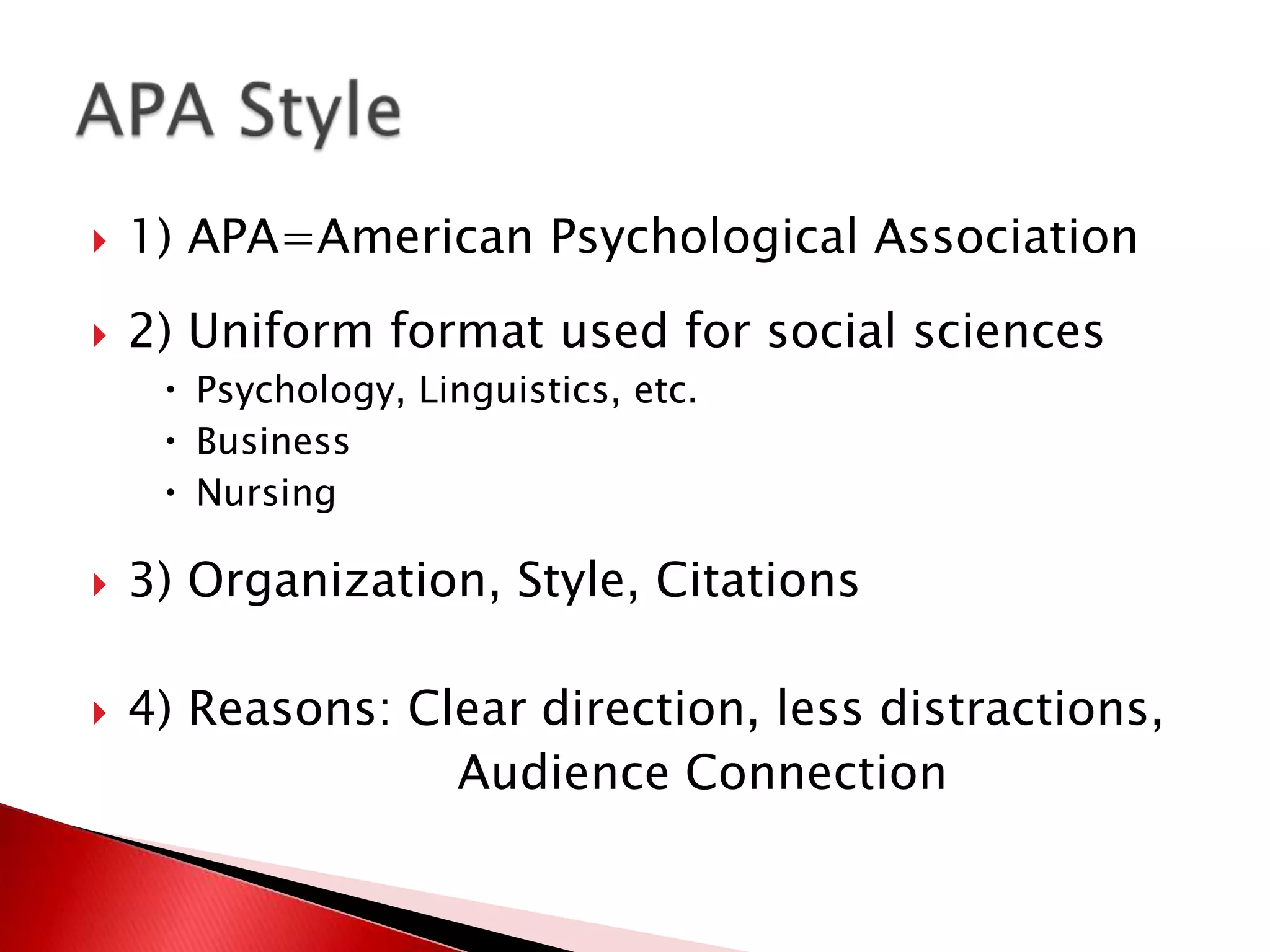
   1) APA=American Psychological Association
   2) Uniform format used for social sciences
      Psychology, Linguistics, etc.
      Business
      Nursing

   3) Organization, Style, Citations

   4) Reasons: Clear direction, less distractions,
                  Audience Connection
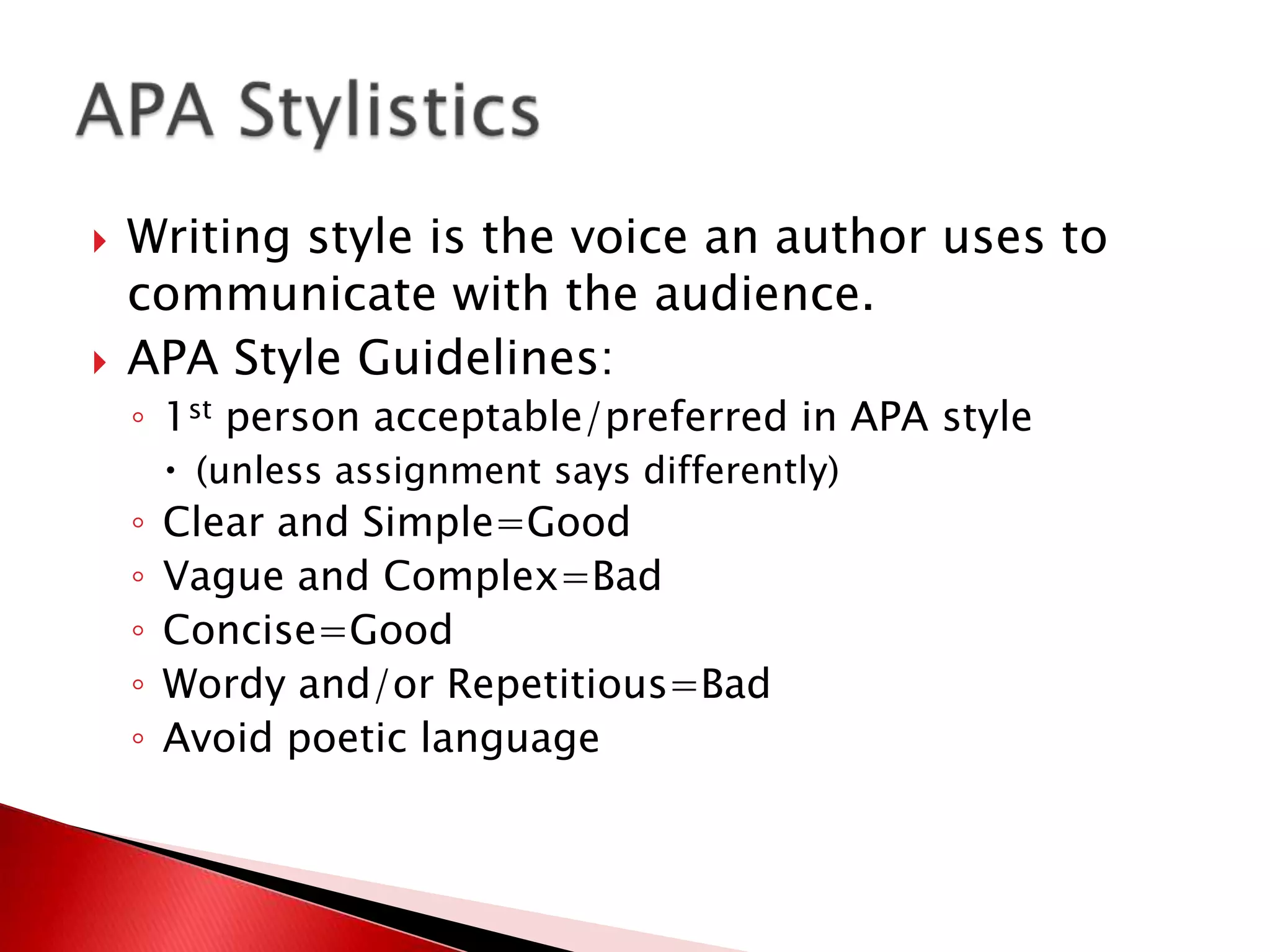
   Writing style is the voice an author uses to
    communicate with the audience.
   APA Style Guidelines:
    ◦ 1st person acceptable/preferred in APA style
         (unless assignment says differently)
    ◦   Clear and Simple=Good
    ◦   Vague and Complex=Bad
    ◦   Concise=Good
    ◦   Wordy and/or Repetitious=Bad
    ◦   Avoid poetic language
   Vary from Class to Class

   May not include all elements

   Definition of elements may vary

   May include additional elements
Overall Mechanics
   Typed
   Double Spaced
   12pt Font
   Serif (Times New Roman for Body)
   Sans-Serif (Tahoma for Headings)
   Uniform 1” Margins
   Flush left align (DO NOT JUSTIFY)
   Tab indent every new paragraph
Most Common Elements
   Title Page (First Page)

   Abstract (New Page)

   Text (New Page)

   References (New Page)

   Tables (New Page)

   Figures (New Page)

   Appendices (New Page)
   Running Head: Running Head

   Page Number

   Title (12 pt, TNR, Centered)

   Author (12 pt, TNR, Centered)

   Institution (12 pt, TNR, Centered)

   Author Note
   Various Elements

   Style Considerations

    ◦ Accurate

    ◦ Nonevaluative

    ◦ Coherent and readable

    ◦ Concise
   Mechanics
    ◦   New Page
    ◦   TNR 12 pt
    ◦   Running Head
    ◦   Page #
    ◦   Double Spaced
    ◦   Do not indent paragraph
    ◦   Single Paragraph
    ◦   Word Limit
   Introduction
    ◦ What is the problem?
    ◦ Why is it important?
    ◦ What is the hypothesis/thesis?
   Body
    ◦ What research/testing did you do?
    ◦ Does your research prove/disprove your
      thesis/hypothesis?
    ◦ How does it prove/disprove?
    ◦ What are the implications?
   Conclusion
    ◦ Tie it all together
   Mechanics
    ◦   New Page
    ◦   TNR 12 pt
    ◦   Running Head
    ◦   Page #
    ◦   Tab indent new paragraphs
    ◦   Double spaced
    ◦   Other authors properly cited
   Acknowledge Resources cited in text

   Provide an easy/accurate way to locate cited
    work

   Alphabetize by last name/first name
   Tables

   Figures

   Appendices
Avoiding Plagiarism
   Claiming the words, ideas, or research of
    another person as your own.
   Failing to cite the author when quoting
   Failing to cite the author when paraphrasing
   Theft of intellectual property
   In Text Citations
    ◦   One sentence quotes
    ◦   Block quotes
    ◦   Paraphrasing
    ◦   Graphs that are not your original work
    ◦   Figures that are not your original work
Mechanics
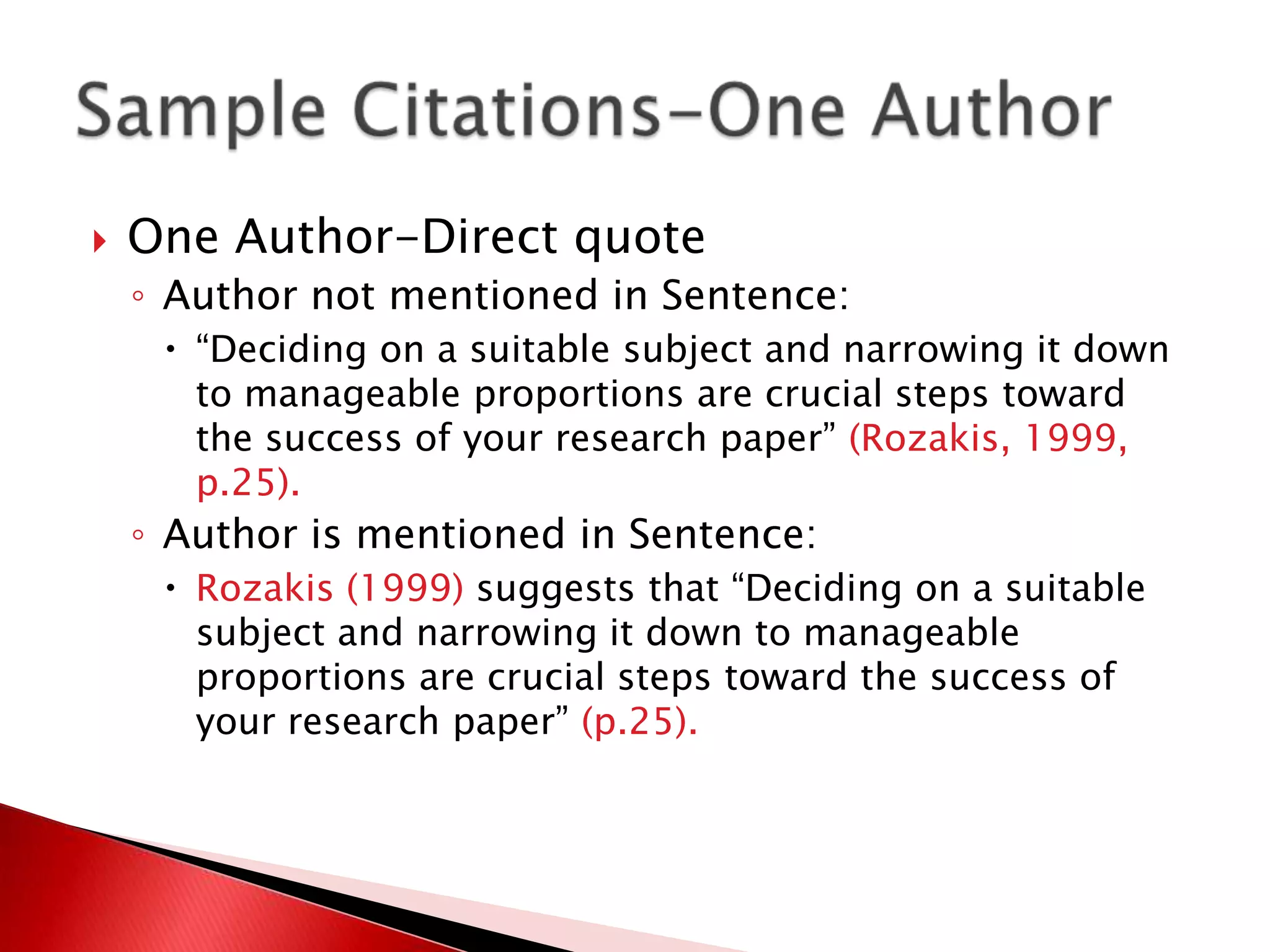
   One Author-Direct quote
    ◦ Author not mentioned in Sentence:
      “Deciding on a suitable subject and narrowing it down
       to manageable proportions are crucial steps toward
       the success of your research paper” (Rozakis, 1999,
       p.25).
    ◦ Author is mentioned in Sentence:
      Rozakis (1999) suggests that “Deciding on a suitable
       subject and narrowing it down to manageable
       proportions are crucial steps toward the success of
       your research paper” (p.25).
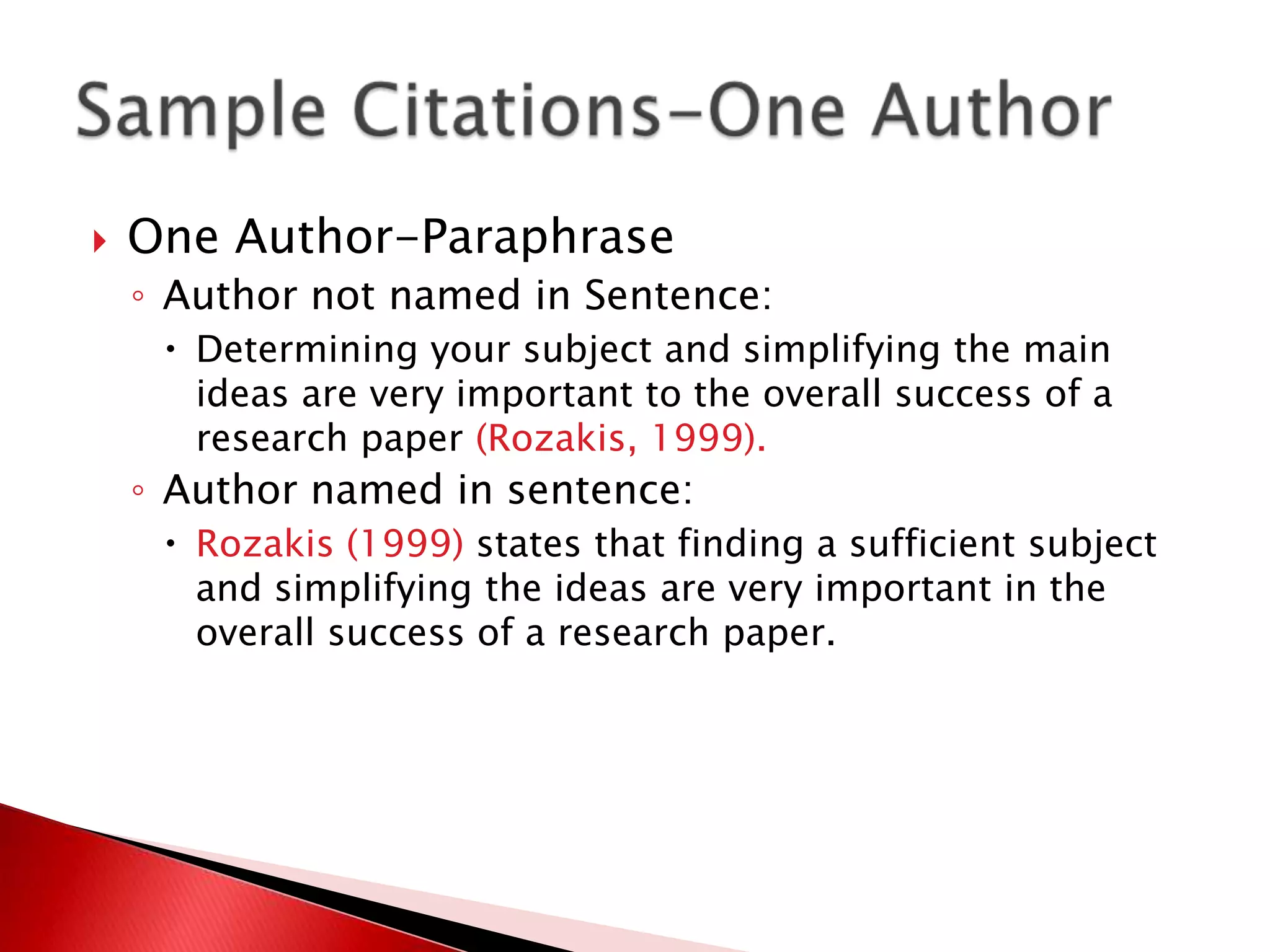
   One Author-Paraphrase
    ◦ Author not named in Sentence:
      Determining your subject and simplifying the main
       ideas are very important to the overall success of a
       research paper (Rozakis, 1999).
    ◦ Author named in sentence:
      Rozakis (1999) states that finding a sufficient subject
       and simplifying the ideas are very important in the
       overall success of a research paper.
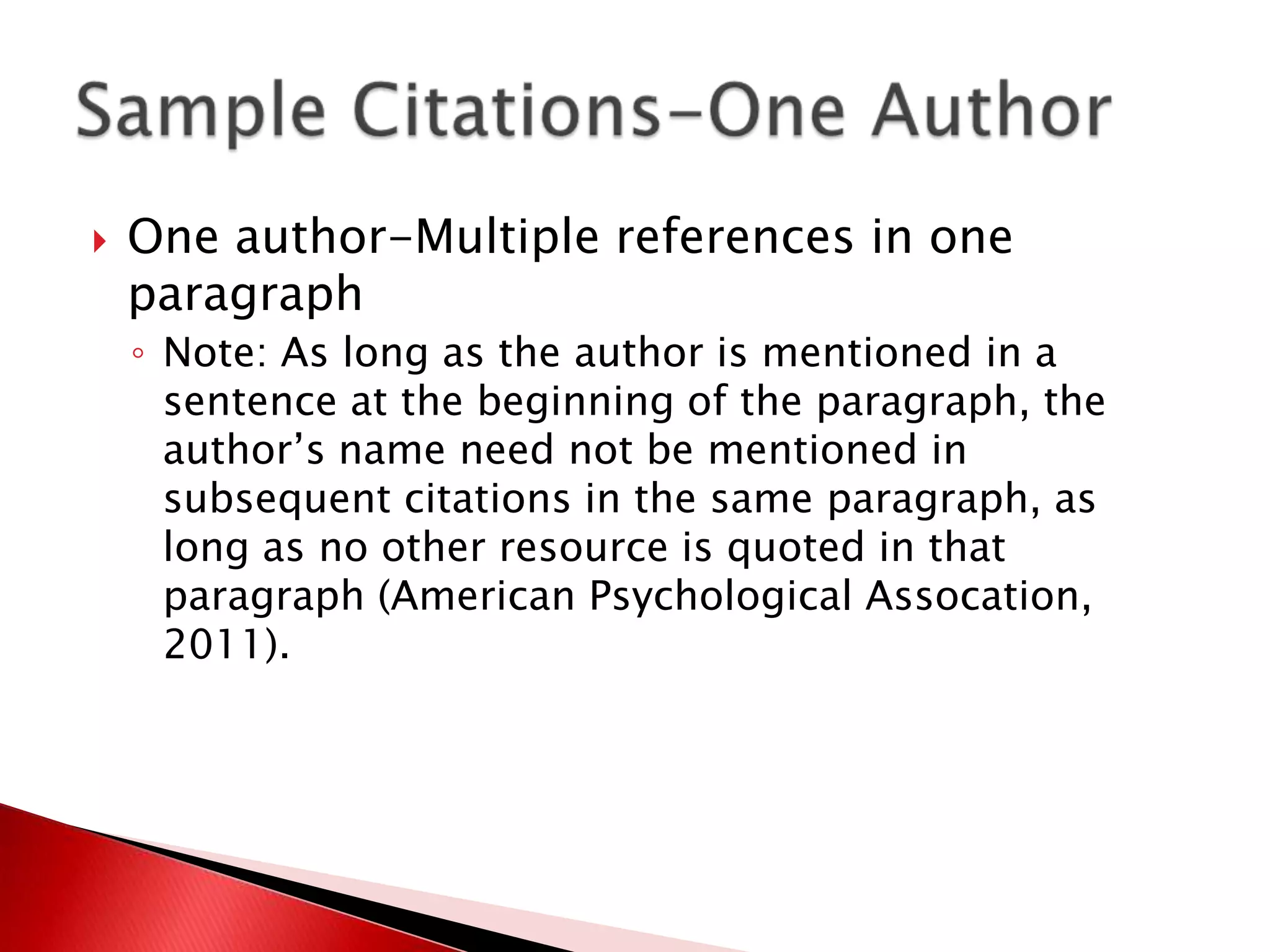
   One author-Multiple references in one
    paragraph
    ◦ Note: As long as the author is mentioned in a
      sentence at the beginning of the paragraph, the
      author’s name need not be mentioned in
      subsequent citations in the same paragraph, as
      long as no other resource is quoted in that
      paragraph (American Psychological Assocation,
      2011).
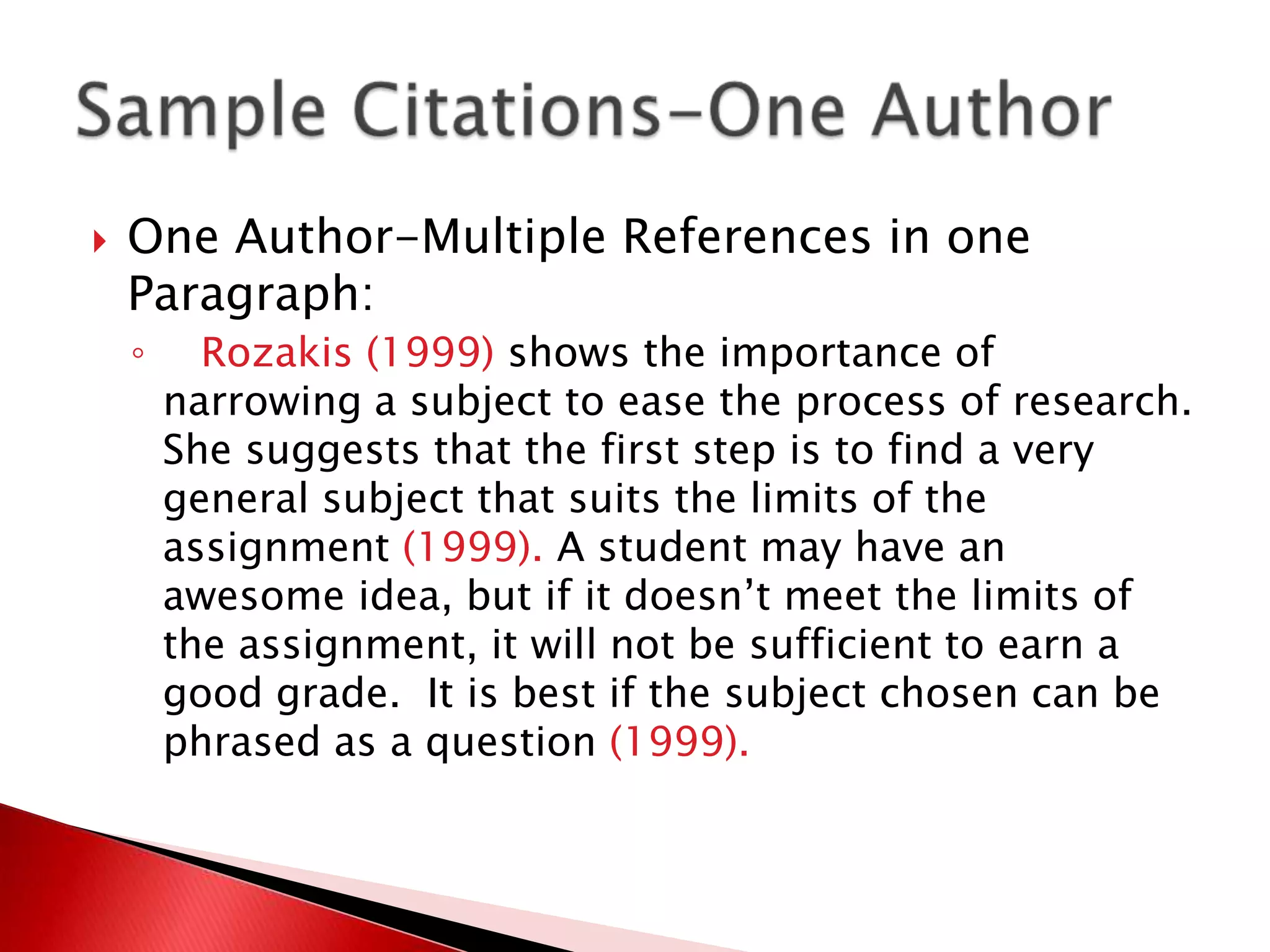
   One Author-Multiple References in one
    Paragraph:
    ◦     Rozakis (1999) shows the importance of
        narrowing a subject to ease the process of research.
        She suggests that the first step is to find a very
        general subject that suits the limits of the
        assignment (1999). A student may have an
        awesome idea, but if it doesn’t meet the limits of
        the assignment, it will not be sufficient to earn a
        good grade. It is best if the subject chosen can be
        phrased as a question (1999).
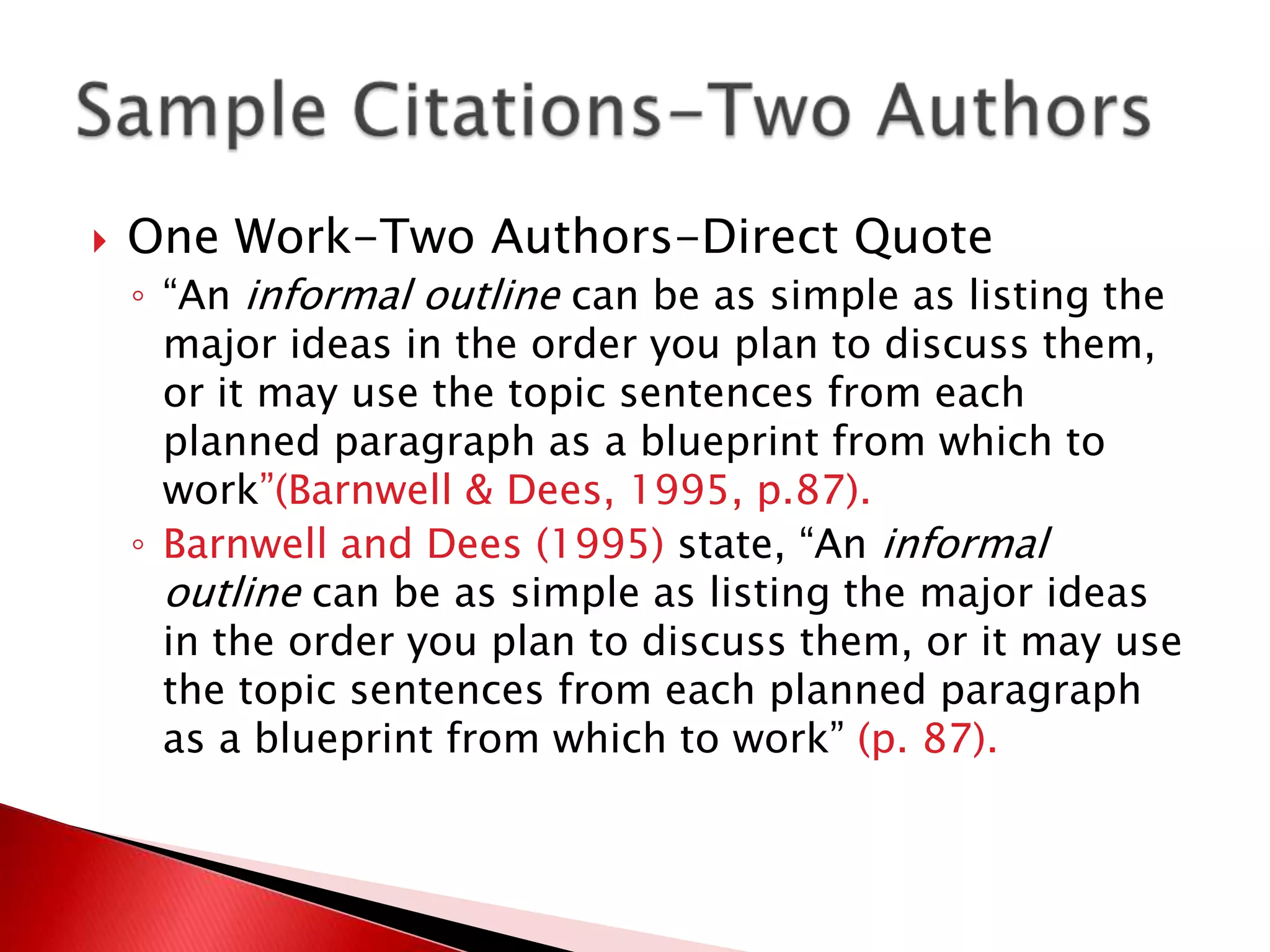
   One Work-Two Authors-Direct Quote
    ◦ “An informal outline can be as simple as listing the
      major ideas in the order you plan to discuss them,
      or it may use the topic sentences from each
      planned paragraph as a blueprint from which to
      work”(Barnwell & Dees, 1995, p.87).
    ◦ Barnwell and Dees (1995) state, “An informal
      outline can be as simple as listing the major ideas
      in the order you plan to discuss them, or it may use
      the topic sentences from each planned paragraph
      as a blueprint from which to work” (p. 87).
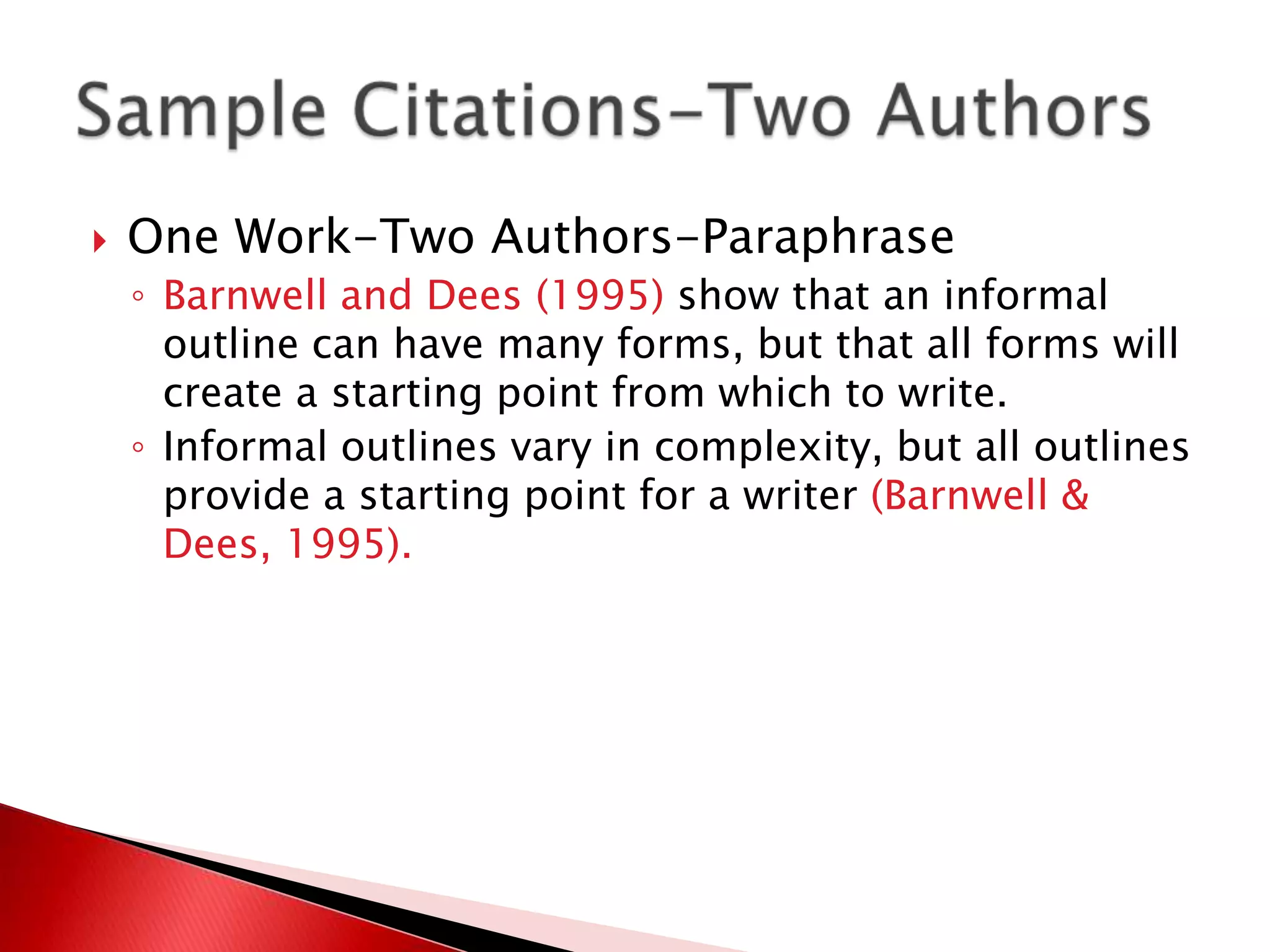
   One Work-Two Authors-Paraphrase
    ◦ Barnwell and Dees (1995) show that an informal
      outline can have many forms, but that all forms will
      create a starting point from which to write.
    ◦ Informal outlines vary in complexity, but all outlines
      provide a starting point for a writer (Barnwell &
      Dees, 1995).
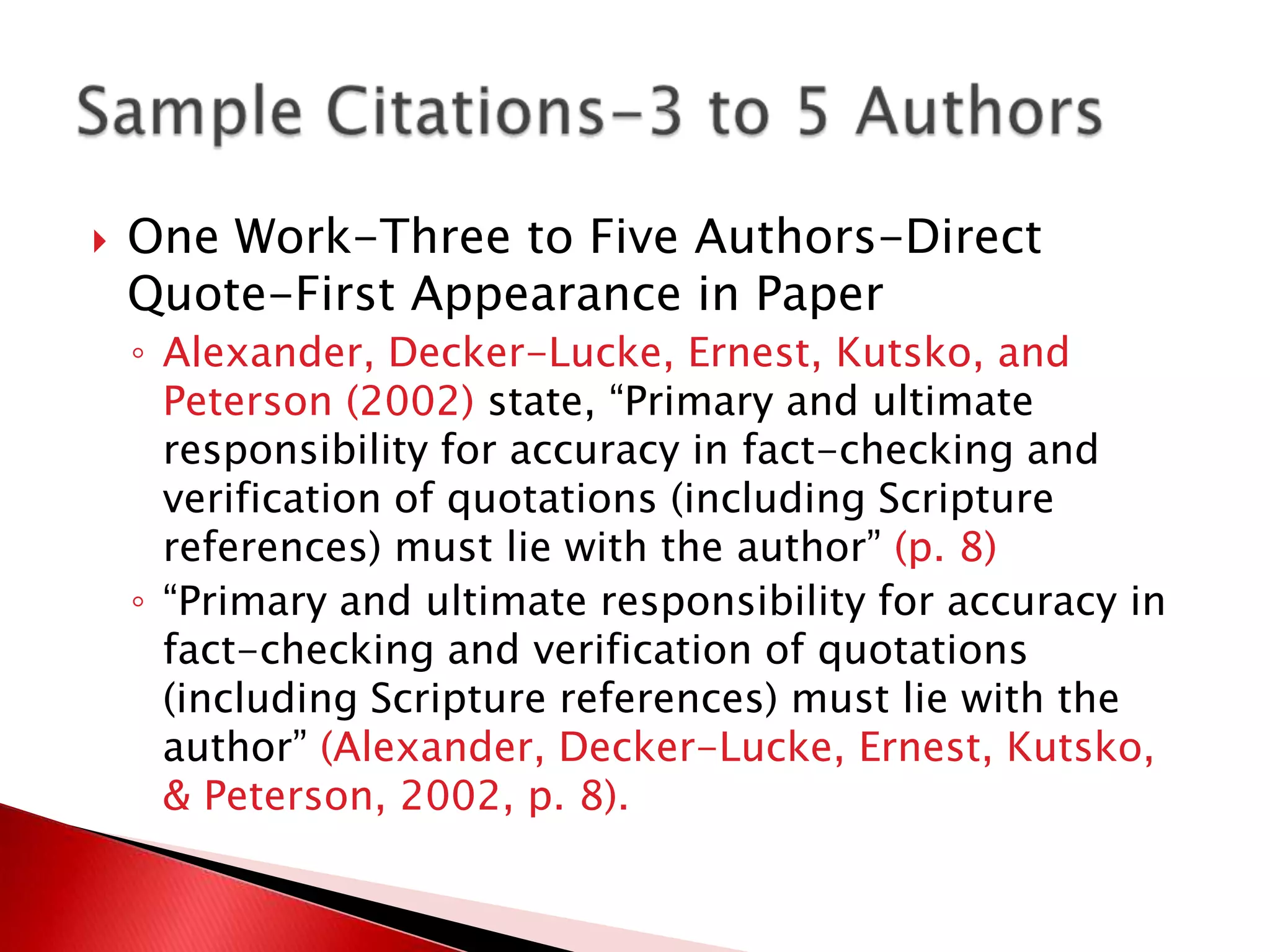
   One Work-Three to Five Authors-Direct
    Quote-First Appearance in Paper
    ◦ Alexander, Decker-Lucke, Ernest, Kutsko, and
      Peterson (2002) state, “Primary and ultimate
      responsibility for accuracy in fact-checking and
      verification of quotations (including Scripture
      references) must lie with the author” (p. 8)
    ◦ “Primary and ultimate responsibility for accuracy in
      fact-checking and verification of quotations
      (including Scripture references) must lie with the
      author” (Alexander, Decker-Lucke, Ernest, Kutsko,
      & Peterson, 2002, p. 8).
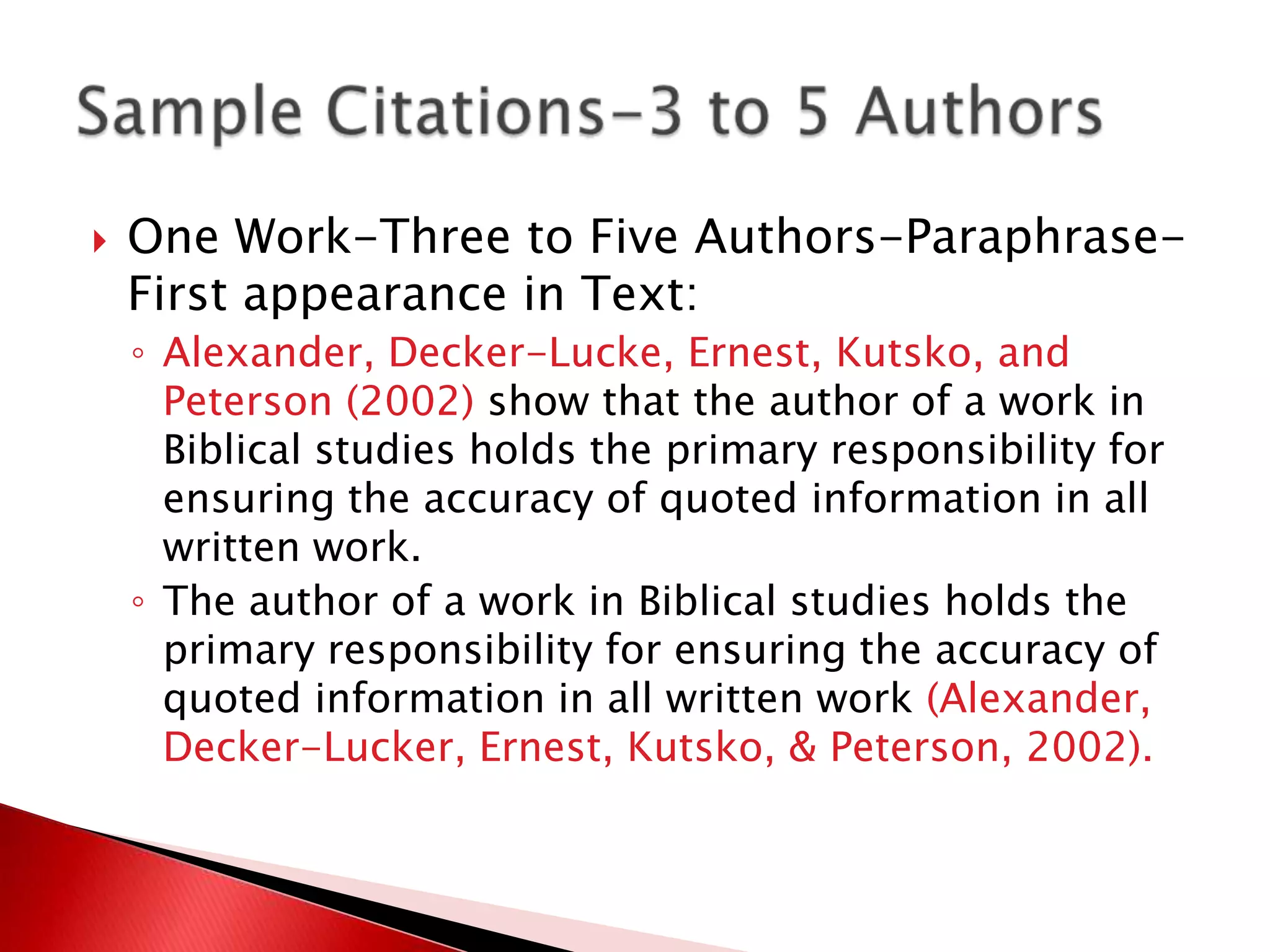
   One Work-Three to Five Authors-Paraphrase-
    First appearance in Text:
    ◦ Alexander, Decker-Lucke, Ernest, Kutsko, and
      Peterson (2002) show that the author of a work in
      Biblical studies holds the primary responsibility for
      ensuring the accuracy of quoted information in all
      written work.
    ◦ The author of a work in Biblical studies holds the
      primary responsibility for ensuring the accuracy of
      quoted information in all written work (Alexander,
      Decker-Lucker, Ernest, Kutsko, & Peterson, 2002).
   One Work-Three to Five Authors-Direct
    Quote-Subsequent Appearances in Text:
    ◦ Alexander et al. (2002) state, “Primary and ultimate
      responsibility for accuracy in fact-checking and
      verification of quotations (including Scripture
      references) must lie with the author” (p. 8)
    ◦ “Primary and ultimate responsibility for accuracy in
      fact-checking and verification of quotations
      (including Scripture references) must lie with the
      author” (Alexander et al., 2002, p. 8).
   One Work-6 or more Authors-Direct Quote:
    ◦ Huggins et al. (2011) say, “The ability to write a
      paper is a skill that students must have in order to
      successfully complete their college education” (p.
      3).
    ◦ “The ability to write a paper is a skill that students
      must have in order to successfully complete their
      college education” (Huggins et al., 2011, p.3).
   One Work-6 or more authors-Paraphrase:
    ◦ Huggins et al. (2011) shows the necessity of prior
      writing instruction for students who enter college.
    ◦ Students need to know how to write a paper before
      they enter college (Huggins et al., 2011).
Help readers find sources
   Allows readers/professors to find and use the
    same data you have
   Ensures that you have not violated any
    copyright limitations or laws
   Protects you from charges of plagiarism
Mechanics
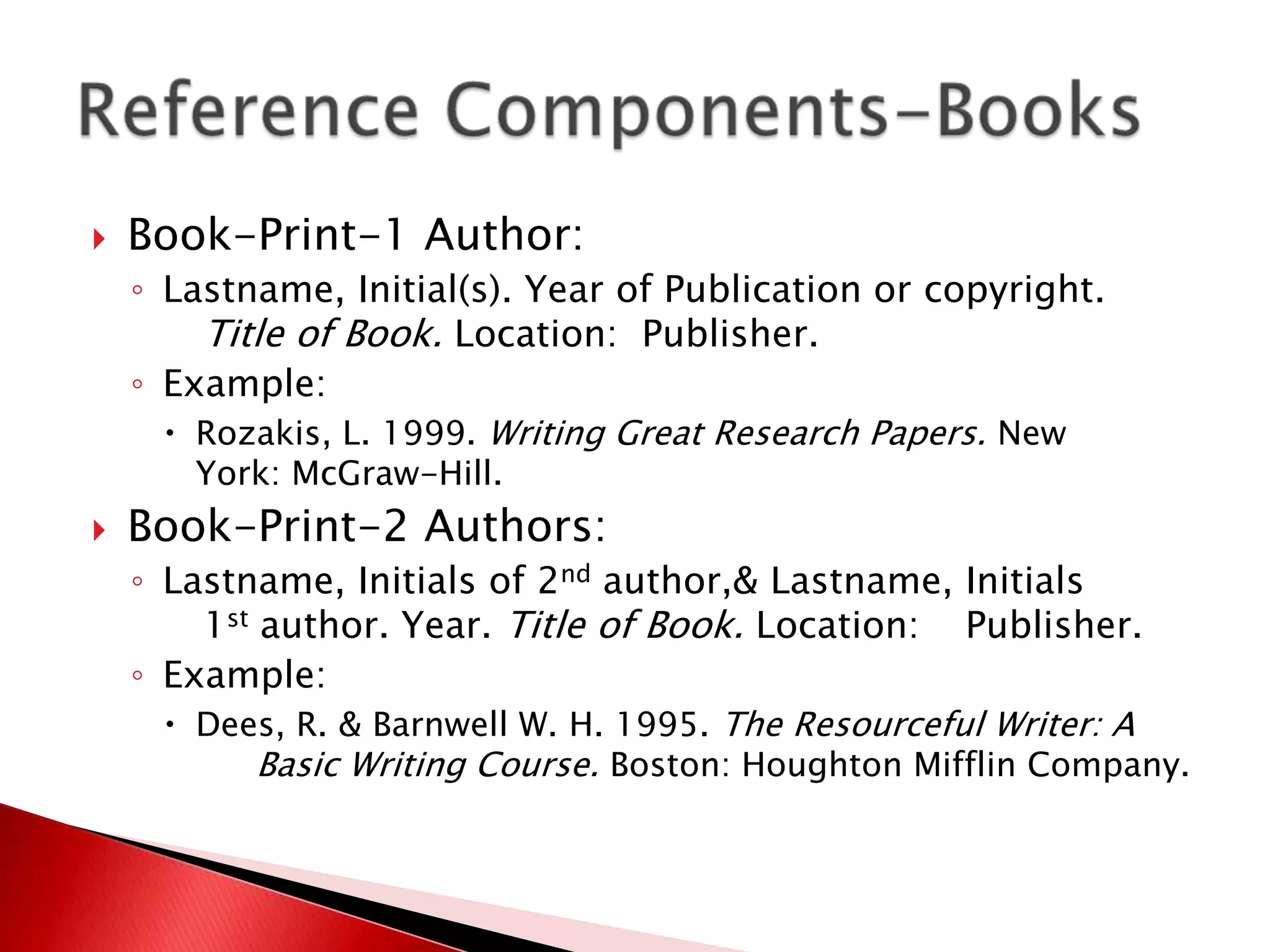
   Book-Print-1 Author:
    ◦ Lastname, Initial(s). Year of Publication or copyright.
        Title of Book. Location: Publisher.
    ◦ Example:
       Rozakis, L. 1999. Writing Great Research Papers. New
       York: McGraw-Hill.
   Book-Print-2 Authors:
    ◦ Lastname, Initials of 2nd author,& Lastname, Initials
        1st author. Year. Title of Book. Location: Publisher.
    ◦ Example:
       Dees, R. & Barnwell W. H. 1995. The Resourceful Writer: A
            Basic Writing Course. Boston: Houghton Mifflin Company.
   Book-Print-3 to 7 Authors:
    ◦ Note: Same elements as 2, but must list all authors.
      Start with 2nd author listed on book.
    ◦ Example:
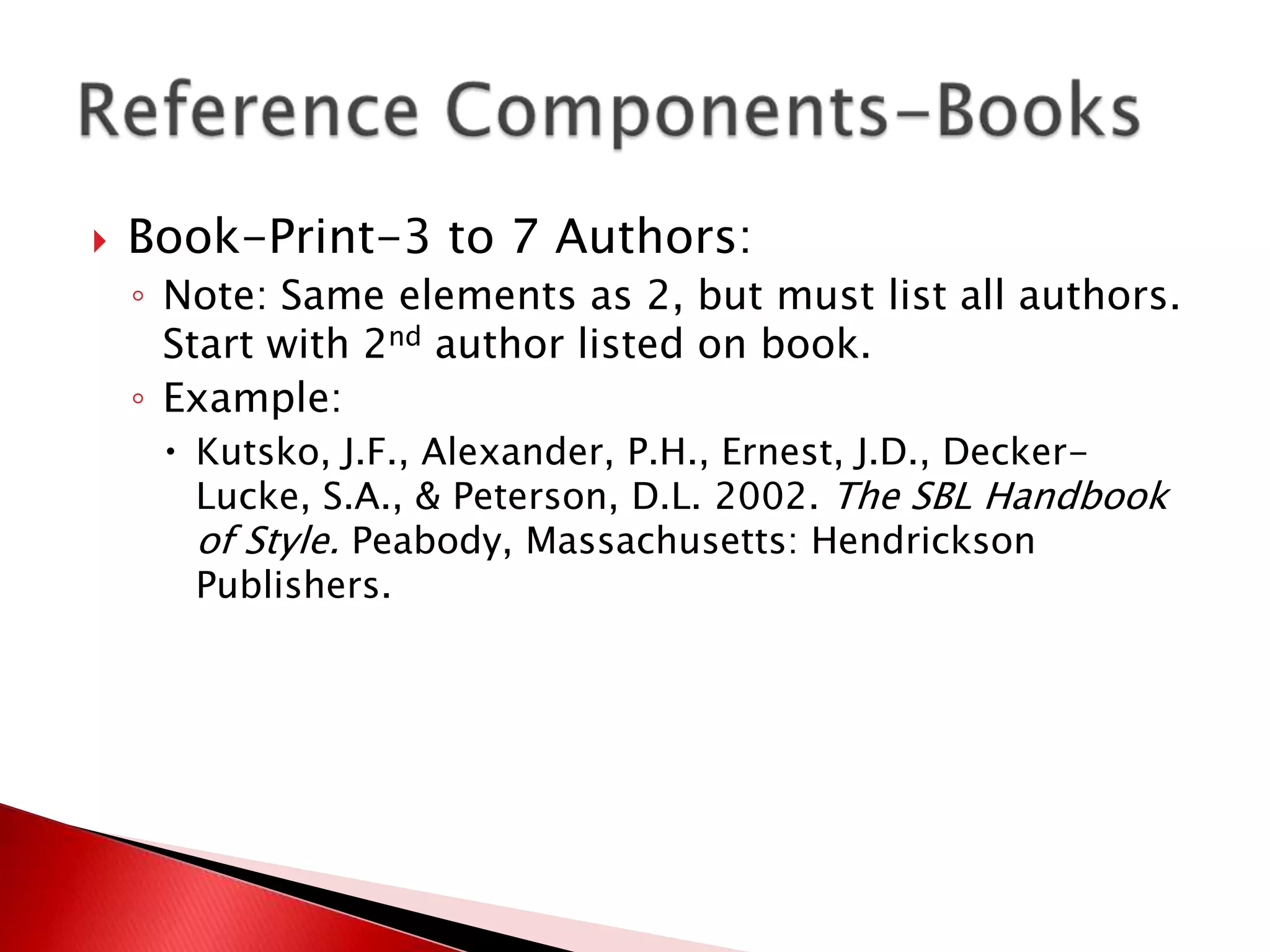
      Kutsko, J.F., Alexander, P.H., Ernest, J.D., Decker-
       Lucke, S.A., & Peterson, D.L. 2002. The SBL Handbook
       of Style. Peabody, Massachusetts: Hendrickson
       Publishers.
   Book-Print-More than 7 authors:
    ◦ Note: Same order of elements. The only thing that
      changes is the way the authors are listed.
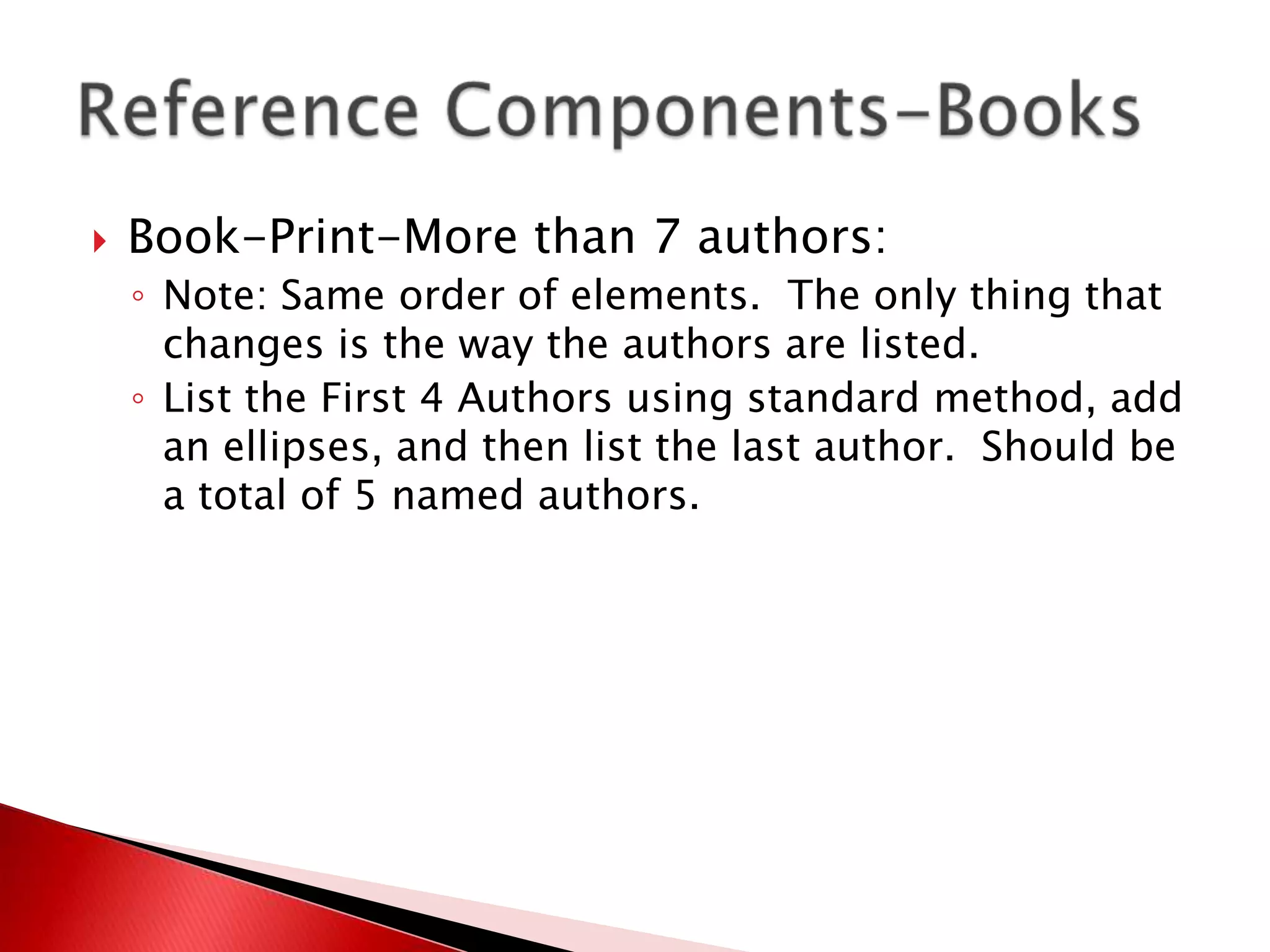
    ◦ List the First 4 Authors using standard method, add
      an ellipses, and then list the last author. Should be
      a total of 5 named authors.
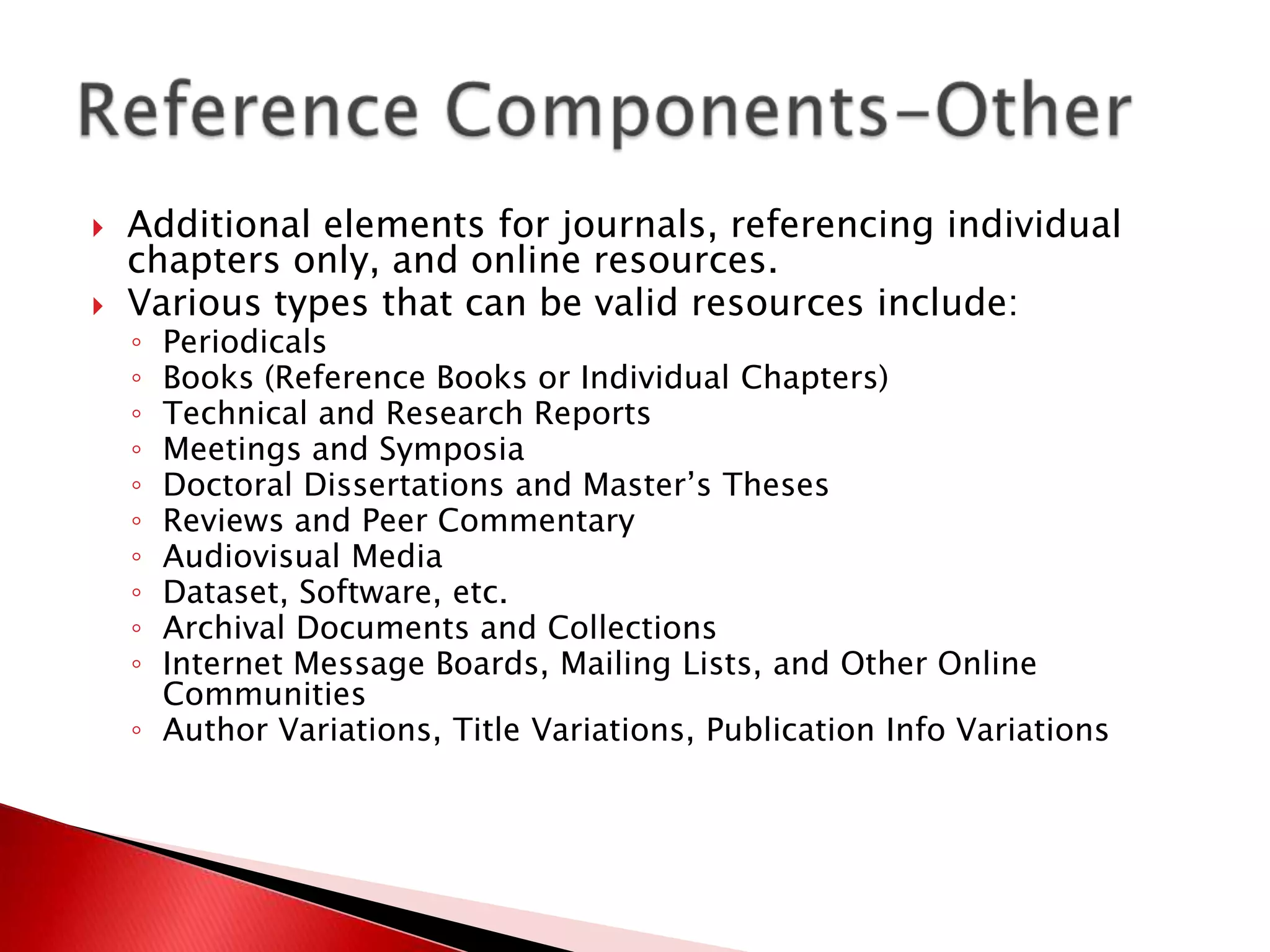
   Additional elements for journals, referencing individual
    chapters only, and online resources.
   Various types that can be valid resources include:
    ◦ Periodicals
    ◦ Books (Reference Books or Individual Chapters)
    ◦ Technical and Research Reports
    ◦ Meetings and Symposia
    ◦ Doctoral Dissertations and Master’s Theses
    ◦ Reviews and Peer Commentary
    ◦ Audiovisual Media
    ◦ Dataset, Software, etc.
    ◦ Archival Documents and Collections
    ◦ Internet Message Boards, Mailing Lists, and Other Online
      Communities
    ◦ Author Variations, Title Variations, Publication Info Variations
Online and In-Person
   Purdue Online Writing Lab
    ◦ http://owl.english.purdue.edu/owl/resource/560/0
      1/
   Publication Manual of the American
    Psychological Association
    ◦ Available for purchase on Amazon
      http://www.amazon.com/Publication-Manual-
       American-Psychological-
       Association/dp/1433805618/ref=sr_1_1?ie=UTF8&qid
       =1321658616&sr=8-1
    ◦ Available for purchase from the APA website
      http://www.apastyle.org/manual/
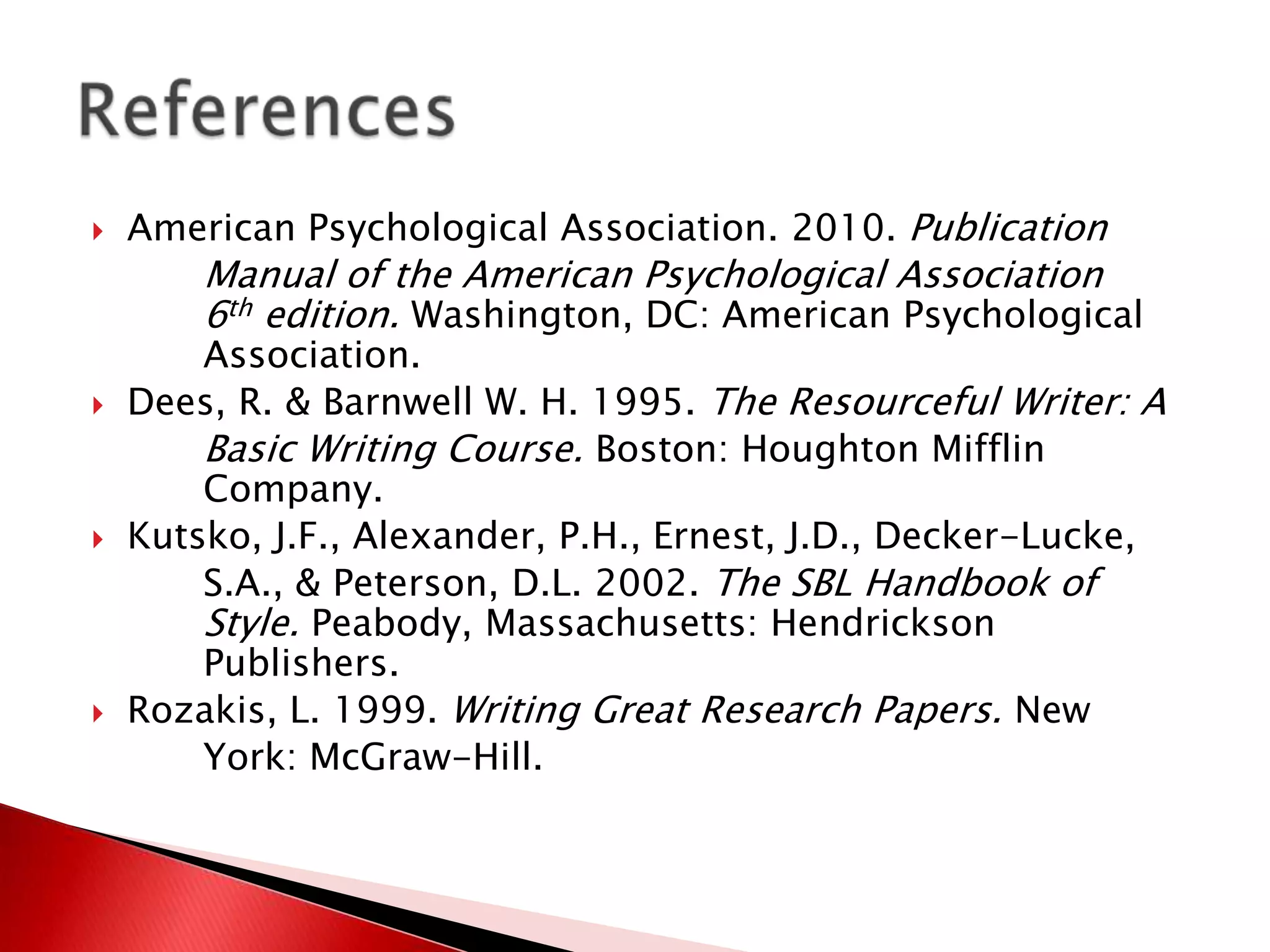
   American Psychological Association. 2010. Publication
        Manual of the American Psychological Association
        6th edition. Washington, DC: American Psychological
        Association.
   Dees, R. & Barnwell W. H. 1995. The Resourceful Writer: A
        Basic Writing Course. Boston: Houghton Mifflin
        Company.
   Kutsko, J.F., Alexander, P.H., Ernest, J.D., Decker-Lucke,
        S.A., & Peterson, D.L. 2002. The SBL Handbook of
        Style. Peabody, Massachusetts: Hendrickson
        Publishers.
   Rozakis, L. 1999. Writing Great Research Papers. New
        York: McGraw-Hill.

APA Style-Citation and Reference Guide

  • 1.
  • 2.
  • 3.
    1) APA=American Psychological Association  2) Uniform format used for social sciences  Psychology, Linguistics, etc.  Business  Nursing  3) Organization, Style, Citations  4) Reasons: Clear direction, less distractions, Audience Connection
  • 4.
    Writing style is the voice an author uses to communicate with the audience.  APA Style Guidelines: ◦ 1st person acceptable/preferred in APA style  (unless assignment says differently) ◦ Clear and Simple=Good ◦ Vague and Complex=Bad ◦ Concise=Good ◦ Wordy and/or Repetitious=Bad ◦ Avoid poetic language
  • 5.
    Vary from Class to Class  May not include all elements  Definition of elements may vary  May include additional elements
  • 6.
  • 7.
    Typed  Double Spaced  12pt Font  Serif (Times New Roman for Body)  Sans-Serif (Tahoma for Headings)  Uniform 1” Margins  Flush left align (DO NOT JUSTIFY)  Tab indent every new paragraph
  • 8.
  • 9.
    Title Page (First Page)  Abstract (New Page)  Text (New Page)  References (New Page)  Tables (New Page)  Figures (New Page)  Appendices (New Page)
  • 10.
    Running Head: Running Head  Page Number  Title (12 pt, TNR, Centered)  Author (12 pt, TNR, Centered)  Institution (12 pt, TNR, Centered)  Author Note
  • 11.
    Various Elements  Style Considerations ◦ Accurate ◦ Nonevaluative ◦ Coherent and readable ◦ Concise
  • 12.
    Mechanics ◦ New Page ◦ TNR 12 pt ◦ Running Head ◦ Page # ◦ Double Spaced ◦ Do not indent paragraph ◦ Single Paragraph ◦ Word Limit
  • 13.
    Introduction ◦ What is the problem? ◦ Why is it important? ◦ What is the hypothesis/thesis?  Body ◦ What research/testing did you do? ◦ Does your research prove/disprove your thesis/hypothesis? ◦ How does it prove/disprove? ◦ What are the implications?  Conclusion ◦ Tie it all together
  • 14.
    Mechanics ◦ New Page ◦ TNR 12 pt ◦ Running Head ◦ Page # ◦ Tab indent new paragraphs ◦ Double spaced ◦ Other authors properly cited
  • 15.
    Acknowledge Resources cited in text  Provide an easy/accurate way to locate cited work  Alphabetize by last name/first name
  • 16.
    Tables  Figures  Appendices
  • 17.
  • 18.
    Claiming the words, ideas, or research of another person as your own.  Failing to cite the author when quoting  Failing to cite the author when paraphrasing  Theft of intellectual property
  • 19.
    In Text Citations ◦ One sentence quotes ◦ Block quotes ◦ Paraphrasing ◦ Graphs that are not your original work ◦ Figures that are not your original work
  • 20.
  • 21.
    One Author-Direct quote ◦ Author not mentioned in Sentence:  “Deciding on a suitable subject and narrowing it down to manageable proportions are crucial steps toward the success of your research paper” (Rozakis, 1999, p.25). ◦ Author is mentioned in Sentence:  Rozakis (1999) suggests that “Deciding on a suitable subject and narrowing it down to manageable proportions are crucial steps toward the success of your research paper” (p.25).
  • 22.
    One Author-Paraphrase ◦ Author not named in Sentence:  Determining your subject and simplifying the main ideas are very important to the overall success of a research paper (Rozakis, 1999). ◦ Author named in sentence:  Rozakis (1999) states that finding a sufficient subject and simplifying the ideas are very important in the overall success of a research paper.
  • 23.
    One author-Multiple references in one paragraph ◦ Note: As long as the author is mentioned in a sentence at the beginning of the paragraph, the author’s name need not be mentioned in subsequent citations in the same paragraph, as long as no other resource is quoted in that paragraph (American Psychological Assocation, 2011).
  • 24.
    One Author-Multiple References in one Paragraph: ◦ Rozakis (1999) shows the importance of narrowing a subject to ease the process of research. She suggests that the first step is to find a very general subject that suits the limits of the assignment (1999). A student may have an awesome idea, but if it doesn’t meet the limits of the assignment, it will not be sufficient to earn a good grade. It is best if the subject chosen can be phrased as a question (1999).
  • 25.
    One Work-Two Authors-Direct Quote ◦ “An informal outline can be as simple as listing the major ideas in the order you plan to discuss them, or it may use the topic sentences from each planned paragraph as a blueprint from which to work”(Barnwell & Dees, 1995, p.87). ◦ Barnwell and Dees (1995) state, “An informal outline can be as simple as listing the major ideas in the order you plan to discuss them, or it may use the topic sentences from each planned paragraph as a blueprint from which to work” (p. 87).
  • 26.
    One Work-Two Authors-Paraphrase ◦ Barnwell and Dees (1995) show that an informal outline can have many forms, but that all forms will create a starting point from which to write. ◦ Informal outlines vary in complexity, but all outlines provide a starting point for a writer (Barnwell & Dees, 1995).
  • 27.
    One Work-Three to Five Authors-Direct Quote-First Appearance in Paper ◦ Alexander, Decker-Lucke, Ernest, Kutsko, and Peterson (2002) state, “Primary and ultimate responsibility for accuracy in fact-checking and verification of quotations (including Scripture references) must lie with the author” (p. 8) ◦ “Primary and ultimate responsibility for accuracy in fact-checking and verification of quotations (including Scripture references) must lie with the author” (Alexander, Decker-Lucke, Ernest, Kutsko, & Peterson, 2002, p. 8).
  • 28.
    One Work-Three to Five Authors-Paraphrase- First appearance in Text: ◦ Alexander, Decker-Lucke, Ernest, Kutsko, and Peterson (2002) show that the author of a work in Biblical studies holds the primary responsibility for ensuring the accuracy of quoted information in all written work. ◦ The author of a work in Biblical studies holds the primary responsibility for ensuring the accuracy of quoted information in all written work (Alexander, Decker-Lucker, Ernest, Kutsko, & Peterson, 2002).
  • 29.
    One Work-Three to Five Authors-Direct Quote-Subsequent Appearances in Text: ◦ Alexander et al. (2002) state, “Primary and ultimate responsibility for accuracy in fact-checking and verification of quotations (including Scripture references) must lie with the author” (p. 8) ◦ “Primary and ultimate responsibility for accuracy in fact-checking and verification of quotations (including Scripture references) must lie with the author” (Alexander et al., 2002, p. 8).
  • 30.
    One Work-6 or more Authors-Direct Quote: ◦ Huggins et al. (2011) say, “The ability to write a paper is a skill that students must have in order to successfully complete their college education” (p. 3). ◦ “The ability to write a paper is a skill that students must have in order to successfully complete their college education” (Huggins et al., 2011, p.3).
  • 31.
    One Work-6 or more authors-Paraphrase: ◦ Huggins et al. (2011) shows the necessity of prior writing instruction for students who enter college. ◦ Students need to know how to write a paper before they enter college (Huggins et al., 2011).
  • 32.
  • 33.
    Allows readers/professors to find and use the same data you have  Ensures that you have not violated any copyright limitations or laws  Protects you from charges of plagiarism
  • 34.
  • 35.
    Book-Print-1 Author: ◦ Lastname, Initial(s). Year of Publication or copyright. Title of Book. Location: Publisher. ◦ Example:  Rozakis, L. 1999. Writing Great Research Papers. New York: McGraw-Hill.  Book-Print-2 Authors: ◦ Lastname, Initials of 2nd author,& Lastname, Initials 1st author. Year. Title of Book. Location: Publisher. ◦ Example:  Dees, R. & Barnwell W. H. 1995. The Resourceful Writer: A Basic Writing Course. Boston: Houghton Mifflin Company.
  • 36.
    Book-Print-3 to 7 Authors: ◦ Note: Same elements as 2, but must list all authors. Start with 2nd author listed on book. ◦ Example:  Kutsko, J.F., Alexander, P.H., Ernest, J.D., Decker- Lucke, S.A., & Peterson, D.L. 2002. The SBL Handbook of Style. Peabody, Massachusetts: Hendrickson Publishers.
  • 37.
    Book-Print-More than 7 authors: ◦ Note: Same order of elements. The only thing that changes is the way the authors are listed. ◦ List the First 4 Authors using standard method, add an ellipses, and then list the last author. Should be a total of 5 named authors.
  • 38.
    Additional elements for journals, referencing individual chapters only, and online resources.  Various types that can be valid resources include: ◦ Periodicals ◦ Books (Reference Books or Individual Chapters) ◦ Technical and Research Reports ◦ Meetings and Symposia ◦ Doctoral Dissertations and Master’s Theses ◦ Reviews and Peer Commentary ◦ Audiovisual Media ◦ Dataset, Software, etc. ◦ Archival Documents and Collections ◦ Internet Message Boards, Mailing Lists, and Other Online Communities ◦ Author Variations, Title Variations, Publication Info Variations
  • 39.
  • 40.
    Purdue Online Writing Lab ◦ http://owl.english.purdue.edu/owl/resource/560/0 1/  Publication Manual of the American Psychological Association ◦ Available for purchase on Amazon  http://www.amazon.com/Publication-Manual- American-Psychological- Association/dp/1433805618/ref=sr_1_1?ie=UTF8&qid =1321658616&sr=8-1 ◦ Available for purchase from the APA website  http://www.apastyle.org/manual/
  • 41.
    American Psychological Association. 2010. Publication Manual of the American Psychological Association 6th edition. Washington, DC: American Psychological Association.  Dees, R. & Barnwell W. H. 1995. The Resourceful Writer: A Basic Writing Course. Boston: Houghton Mifflin Company.  Kutsko, J.F., Alexander, P.H., Ernest, J.D., Decker-Lucke, S.A., & Peterson, D.L. 2002. The SBL Handbook of Style. Peabody, Massachusetts: Hendrickson Publishers.  Rozakis, L. 1999. Writing Great Research Papers. New York: McGraw-Hill.

Editor's Notes

  • #25 The rules for multiple references from same work in single paragraph are the same no matter the number of authors of the work as long as all of the authors are mentioned in a sentence.
  • #41 Have my own copy to show.