13IDP14– Digital Electronics
Basic Logic Operations,
Boolean Expressions,
&
Boolean Algebra
2
Basic Logic Operations
3
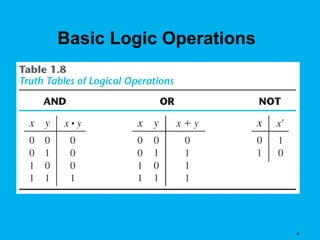
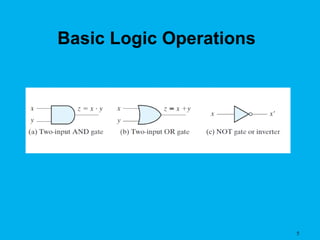
Basic Logic Operations
 AND
 OR
 NOT (Complement)
 Order of Precedence
1. NOT
2. AND
3. OR
 can be modified using parenthesis
4
Basic Logic Operations
5
Basic Logic Operations
6
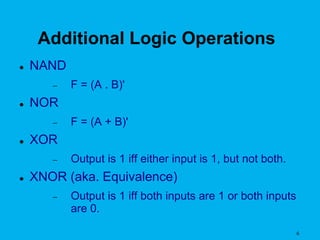
Additional Logic Operations
 NAND
 F = (A . B)'
 NOR
 F = (A + B)'
 XOR
 Output is 1 iff either input is 1, but not both.
 XNOR (aka. Equivalence)
 Output is 1 iff both inputs are 1 or both inputs
are 0.
7
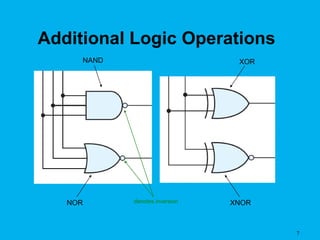
Additional Logic Operations
NAND
NOR
XOR
XNORdenotes inversion
8
Exercise:
Derive the Truth table for each of the
following logic operations:
1. 2-input NAND
2. 2-input NOR
Additional Logic Operations
9
Exercise:
Derive the Truth table for each of the
following logic operations:
1. 2-input XOR
2. 2-input XNOR
Additional Logic Operations
10
Truth Tables
11
Truth Tables
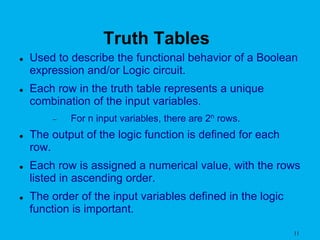
 Used to describe the functional behavior of a Boolean
expression and/or Logic circuit.
 Each row in the truth table represents a unique
combination of the input variables.
 For n input variables, there are 2n rows.
 The output of the logic function is defined for each
row.
 Each row is assigned a numerical value, with the rows
listed in ascending order.
 The order of the input variables defined in the logic
function is important.
12
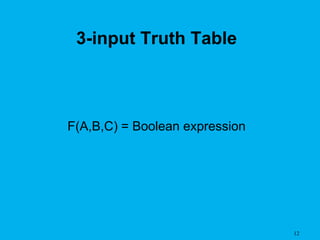
3-input Truth Table
F(A,B,C) = Boolean expression
13
4-input Truth Table
F(A,B,C,D) = Boolean expression
14
Boolean Expressions
13IDP14- Digital Electronics 15
Boolean Expressions
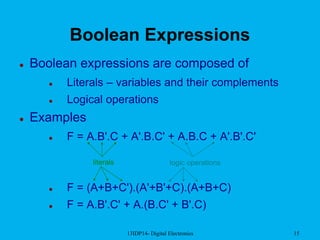
 Boolean expressions are composed of
 Literals – variables and their complements
 Logical operations
 Examples
 F = A.B'.C + A'.B.C' + A.B.C + A'.B'.C'
 F = (A+B+C').(A'+B'+C).(A+B+C)
 F = A.B'.C' + A.(B.C' + B'.C)
literals logic operations
13IDP14- Digital Electronics 16
Boolean Expressions
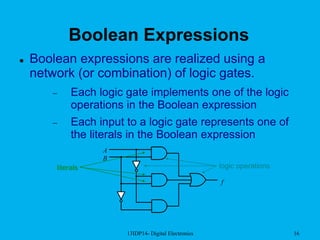
 Boolean expressions are realized using a
network (or combination) of logic gates.
 Each logic gate implements one of the logic
operations in the Boolean expression
 Each input to a logic gate represents one of
the literals in the Boolean expression
f
A
B
logic operationsliterals
13IDP14- Digital Electronics 17
Boolean Expressions
 Boolean expressions are evaluated by
 Substituting a 0 or 1 for each literal
 Calculating the logical value of the expression
 A Truth Table specifies the value of the Boolean
expression for every combination of the
variables in the Boolean expression.
 For an n-variable Boolean expression, the truth
table has 2n rows (one for each combination).
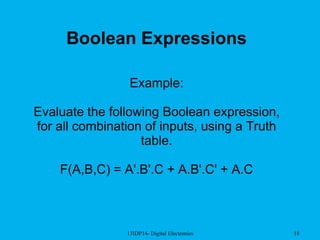
13IDP14- Digital Electronics 18
Boolean Expressions
Example:
Evaluate the following Boolean expression,
for all combination of inputs, using a Truth
table.
F(A,B,C) = A'.B'.C + A.B'.C' + A.C
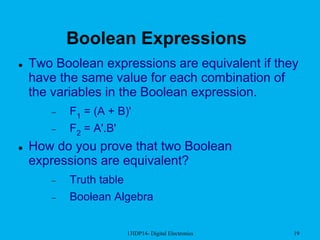
13IDP14- Digital Electronics 19
Boolean Expressions
 Two Boolean expressions are equivalent if they
have the same value for each combination of
the variables in the Boolean expression.
 F1 = (A + B)'
 F2 = A'.B'
 How do you prove that two Boolean
expressions are equivalent?
 Truth table
 Boolean Algebra
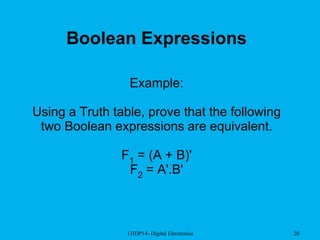
13IDP14- Digital Electronics 20
Boolean Expressions
Example:
Using a Truth table, prove that the following
two Boolean expressions are equivalent.
F1 = (A + B)'
F2 = A'.B'
13IDP14- Digital Electronics 21
Boolean Algebra
13IDP14- Digital Electronics 22
Boolean Algebra
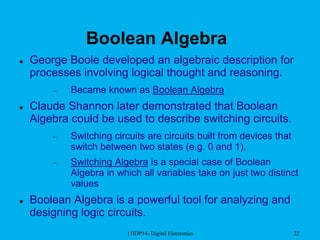
 George Boole developed an algebraic description for
processes involving logical thought and reasoning.
 Became known as Boolean Algebra
 Claude Shannon later demonstrated that Boolean
Algebra could be used to describe switching circuits.
 Switching circuits are circuits built from devices that
switch between two states (e.g. 0 and 1).
 Switching Algebra is a special case of Boolean
Algebra in which all variables take on just two distinct
values
 Boolean Algebra is a powerful tool for analyzing and
designing logic circuits.
13IDP14- Digital Electronics 23
Basic Laws and Theorems
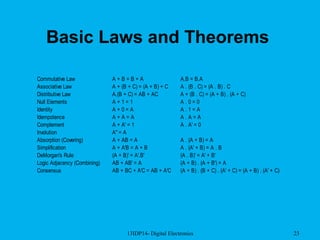
Commutative Law A + B = B + A A.B = B.A
Associative Law A + (B + C) = (A + B) + C A . (B . C) = (A . B) . C
Distributive Law A.(B + C) = AB + AC A + (B . C) = (A + B) . (A + C)
Null Elements A + 1 = 1 A . 0 = 0
Identity A + 0 = A A . 1 = A
A + A = A A . A = A
Complement A + A' = 1 A . A' = 0
Involution A'' = A
Absorption (Covering) A + AB = A A . (A + B) = A
Simplification A + A'B = A + B A . (A' + B) = A . B
DeMorgan's Rule (A + B)' = A'.B' (A . B)' = A' + B'
Logic Adjacency (Combining) AB + AB' = A (A + B) . (A + B') = A
Consensus AB + BC + A'C = AB + A'C (A + B) . (B + C) . (A' + C) = (A + B) . (A' + C)
Idempotence
13IDP14- Digital Electronics 24
Idempotence
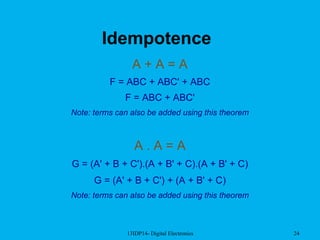
A + A = A
F = ABC + ABC' + ABC
F = ABC + ABC'
Note: terms can also be added using this theorem
A . A = A
G = (A' + B + C').(A + B' + C).(A + B' + C)
G = (A' + B + C') + (A + B' + C)
Note: terms can also be added using this theorem
13IDP14- Digital Electronics 25
Complement
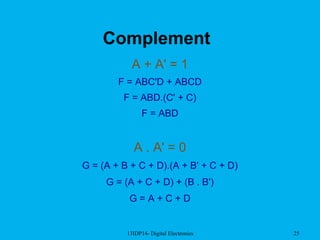
A + A' = 1
F = ABC'D + ABCD
F = ABD.(C' + C)
F = ABD
A . A' = 0
G = (A + B + C + D).(A + B' + C + D)
G = (A + C + D) + (B . B')
G = A + C + D
13IDP14- Digital Electronics 26
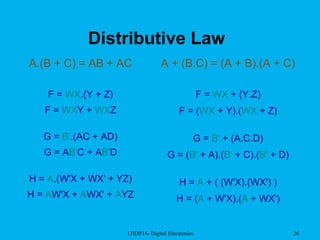
Distributive Law
A.(B + C) = AB + AC
F = WX.(Y + Z)
F = WXY + WXZ
G = B'.(AC + AD)
G = AB'C + AB'D
H = A.(W'X + WX' + YZ)
H = AW'X + AWX' + AYZ
A + (B.C) = (A + B).(A + C)
F = WX + (Y.Z)
F = (WX + Y).(WX + Z)
G = B' + (A.C.D)
G = (B' + A).(B' + C).(B' + D)
H = A + ( (W'X).(WX') )
H = (A + W'X).(A + WX')
13IDP14- Digital Electronics 27
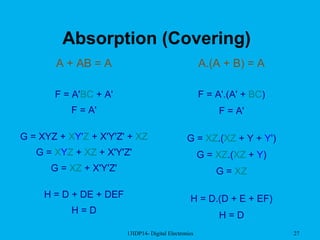
Absorption (Covering)
A + AB = A
F = A'BC + A'
F = A'
G = XYZ + XY'Z + X'Y'Z' + XZ
G = XYZ + XZ + X'Y'Z'
G = XZ + X'Y'Z'
H = D + DE + DEF
H = D
A.(A + B) = A
F = A'.(A' + BC)
F = A'
G = XZ.(XZ + Y + Y')
G = XZ.(XZ + Y)
G = XZ
H = D.(D + E + EF)
H = D
13IDP14- Digital Electronics 28
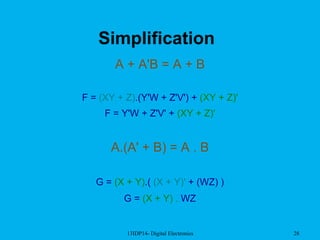
Simplification
A + A'B = A + B
F = (XY + Z).(Y'W + Z'V') + (XY + Z)'
F = Y'W + Z'V' + (XY + Z)'
A.(A' + B) = A . B
G = (X + Y).( (X + Y)' + (WZ) )
G = (X + Y) . WZ
13IDP14- Digital Electronics 29
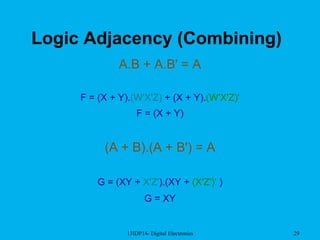
Logic Adjacency (Combining)
A.B + A.B' = A
F = (X + Y).(W'X'Z) + (X + Y).(W'X'Z)'
F = (X + Y)
(A + B).(A + B') = A
G = (XY + X'Z').(XY + (X'Z')' )
G = XY
13IDP14- Digital Electronics 30
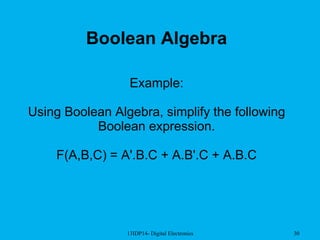
Boolean Algebra
Example:
Using Boolean Algebra, simplify the following
Boolean expression.
F(A,B,C) = A'.B.C + A.B'.C + A.B.C
13IDP14- Digital Electronics 31
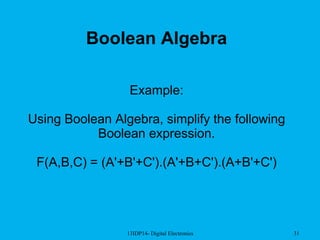
Boolean Algebra
Example:
Using Boolean Algebra, simplify the following
Boolean expression.
F(A,B,C) = (A'+B'+C').(A'+B+C').(A+B'+C')
13IDP14- Digital Electronics 32
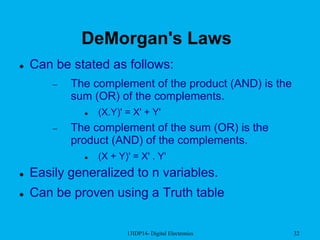
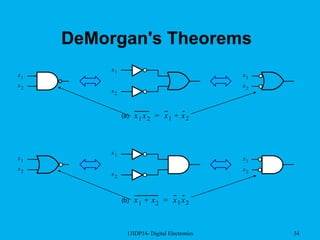
DeMorgan's Laws
 Can be stated as follows:
 The complement of the product (AND) is the
sum (OR) of the complements.
 (X.Y)' = X' + Y'
 The complement of the sum (OR) is the
product (AND) of the complements.
 (X + Y)' = X' . Y'
 Easily generalized to n variables.
 Can be proven using a Truth table
13IDP14- Digital Electronics 33
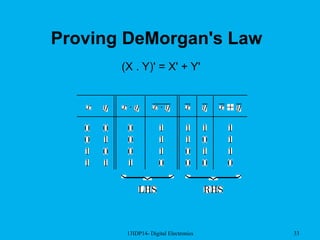
Proving DeMorgan's Law
(X . Y)' = X' + Y'
13IDP14- Digital Electronics 34
x1
x2
x1
x2
x1
x2
x1
x2
x1
x2
x1
x2
x1 x2 x1 x2+=(a)
x1 x2+ x1 x2=(b)
DeMorgan's Theorems
13IDP14- Digital Electronics 35
Importance of Boolean Algebra
 Boolean Algebra is used to simplify Boolean
expressions.
– Through application of the Laws and Theorems
discussed
 Simpler expressions lead to simpler circuit realization,
which, generally, reduces cost, area requirements, and
power consumption.
 The objective of the digital circuit designer is to design
and realize optimal digital circuits.
13IDP14- Digital Electronics 36
Algebraic Simplification
 Justification for simplifying Boolean expressions:
– Reduces the cost associated with realizing the
expression using logic gates.
– Reduces the area (i.e. silicon) required to fabricate the
switching function.
– Reduces the power consumption of the circuit.
 In general, there is no easy way to determine when a
Boolean expression has been simplified to a minimum
number of terms or minimum number of literals.
– No unique solution
13IDP14- Digital Electronics 37
Algebraic Simplification
 Boolean (or Switching) expressions can be
simplified using the following methods:
1. Multiplying out the expression
2. Factoring the expression
3. Combining terms of the expression
4. Eliminating terms in the expression
5. Eliminating literals in the expression
6. Adding redundant terms to the expression

Basic gates and boolean algebra

  • 1.
    13IDP14– Digital Electronics BasicLogic Operations, Boolean Expressions, & Boolean Algebra
  • 2.
  • 3.
    3 Basic Logic Operations AND  OR  NOT (Complement)  Order of Precedence 1. NOT 2. AND 3. OR  can be modified using parenthesis
  • 4.
  • 5.
  • 6.
    6 Additional Logic Operations NAND  F = (A . B)'  NOR  F = (A + B)'  XOR  Output is 1 iff either input is 1, but not both.  XNOR (aka. Equivalence)  Output is 1 iff both inputs are 1 or both inputs are 0.
  • 7.
  • 8.
    8 Exercise: Derive the Truthtable for each of the following logic operations: 1. 2-input NAND 2. 2-input NOR Additional Logic Operations
  • 9.
    9 Exercise: Derive the Truthtable for each of the following logic operations: 1. 2-input XOR 2. 2-input XNOR Additional Logic Operations
  • 10.
  • 11.
    11 Truth Tables  Usedto describe the functional behavior of a Boolean expression and/or Logic circuit.  Each row in the truth table represents a unique combination of the input variables.  For n input variables, there are 2n rows.  The output of the logic function is defined for each row.  Each row is assigned a numerical value, with the rows listed in ascending order.  The order of the input variables defined in the logic function is important.
  • 12.
    12 3-input Truth Table F(A,B,C)= Boolean expression
  • 13.
  • 14.
  • 15.
    13IDP14- Digital Electronics15 Boolean Expressions  Boolean expressions are composed of  Literals – variables and their complements  Logical operations  Examples  F = A.B'.C + A'.B.C' + A.B.C + A'.B'.C'  F = (A+B+C').(A'+B'+C).(A+B+C)  F = A.B'.C' + A.(B.C' + B'.C) literals logic operations
  • 16.
    13IDP14- Digital Electronics16 Boolean Expressions  Boolean expressions are realized using a network (or combination) of logic gates.  Each logic gate implements one of the logic operations in the Boolean expression  Each input to a logic gate represents one of the literals in the Boolean expression f A B logic operationsliterals
  • 17.
    13IDP14- Digital Electronics17 Boolean Expressions  Boolean expressions are evaluated by  Substituting a 0 or 1 for each literal  Calculating the logical value of the expression  A Truth Table specifies the value of the Boolean expression for every combination of the variables in the Boolean expression.  For an n-variable Boolean expression, the truth table has 2n rows (one for each combination).
  • 18.
    13IDP14- Digital Electronics18 Boolean Expressions Example: Evaluate the following Boolean expression, for all combination of inputs, using a Truth table. F(A,B,C) = A'.B'.C + A.B'.C' + A.C
  • 19.
    13IDP14- Digital Electronics19 Boolean Expressions  Two Boolean expressions are equivalent if they have the same value for each combination of the variables in the Boolean expression.  F1 = (A + B)'  F2 = A'.B'  How do you prove that two Boolean expressions are equivalent?  Truth table  Boolean Algebra
  • 20.
    13IDP14- Digital Electronics20 Boolean Expressions Example: Using a Truth table, prove that the following two Boolean expressions are equivalent. F1 = (A + B)' F2 = A'.B'
  • 21.
    13IDP14- Digital Electronics21 Boolean Algebra
  • 22.
    13IDP14- Digital Electronics22 Boolean Algebra  George Boole developed an algebraic description for processes involving logical thought and reasoning.  Became known as Boolean Algebra  Claude Shannon later demonstrated that Boolean Algebra could be used to describe switching circuits.  Switching circuits are circuits built from devices that switch between two states (e.g. 0 and 1).  Switching Algebra is a special case of Boolean Algebra in which all variables take on just two distinct values  Boolean Algebra is a powerful tool for analyzing and designing logic circuits.
  • 23.
    13IDP14- Digital Electronics23 Basic Laws and Theorems Commutative Law A + B = B + A A.B = B.A Associative Law A + (B + C) = (A + B) + C A . (B . C) = (A . B) . C Distributive Law A.(B + C) = AB + AC A + (B . C) = (A + B) . (A + C) Null Elements A + 1 = 1 A . 0 = 0 Identity A + 0 = A A . 1 = A A + A = A A . A = A Complement A + A' = 1 A . A' = 0 Involution A'' = A Absorption (Covering) A + AB = A A . (A + B) = A Simplification A + A'B = A + B A . (A' + B) = A . B DeMorgan's Rule (A + B)' = A'.B' (A . B)' = A' + B' Logic Adjacency (Combining) AB + AB' = A (A + B) . (A + B') = A Consensus AB + BC + A'C = AB + A'C (A + B) . (B + C) . (A' + C) = (A + B) . (A' + C) Idempotence
  • 24.
    13IDP14- Digital Electronics24 Idempotence A + A = A F = ABC + ABC' + ABC F = ABC + ABC' Note: terms can also be added using this theorem A . A = A G = (A' + B + C').(A + B' + C).(A + B' + C) G = (A' + B + C') + (A + B' + C) Note: terms can also be added using this theorem
  • 25.
    13IDP14- Digital Electronics25 Complement A + A' = 1 F = ABC'D + ABCD F = ABD.(C' + C) F = ABD A . A' = 0 G = (A + B + C + D).(A + B' + C + D) G = (A + C + D) + (B . B') G = A + C + D
  • 26.
    13IDP14- Digital Electronics26 Distributive Law A.(B + C) = AB + AC F = WX.(Y + Z) F = WXY + WXZ G = B'.(AC + AD) G = AB'C + AB'D H = A.(W'X + WX' + YZ) H = AW'X + AWX' + AYZ A + (B.C) = (A + B).(A + C) F = WX + (Y.Z) F = (WX + Y).(WX + Z) G = B' + (A.C.D) G = (B' + A).(B' + C).(B' + D) H = A + ( (W'X).(WX') ) H = (A + W'X).(A + WX')
  • 27.
    13IDP14- Digital Electronics27 Absorption (Covering) A + AB = A F = A'BC + A' F = A' G = XYZ + XY'Z + X'Y'Z' + XZ G = XYZ + XZ + X'Y'Z' G = XZ + X'Y'Z' H = D + DE + DEF H = D A.(A + B) = A F = A'.(A' + BC) F = A' G = XZ.(XZ + Y + Y') G = XZ.(XZ + Y) G = XZ H = D.(D + E + EF) H = D
  • 28.
    13IDP14- Digital Electronics28 Simplification A + A'B = A + B F = (XY + Z).(Y'W + Z'V') + (XY + Z)' F = Y'W + Z'V' + (XY + Z)' A.(A' + B) = A . B G = (X + Y).( (X + Y)' + (WZ) ) G = (X + Y) . WZ
  • 29.
    13IDP14- Digital Electronics29 Logic Adjacency (Combining) A.B + A.B' = A F = (X + Y).(W'X'Z) + (X + Y).(W'X'Z)' F = (X + Y) (A + B).(A + B') = A G = (XY + X'Z').(XY + (X'Z')' ) G = XY
  • 30.
    13IDP14- Digital Electronics30 Boolean Algebra Example: Using Boolean Algebra, simplify the following Boolean expression. F(A,B,C) = A'.B.C + A.B'.C + A.B.C
  • 31.
    13IDP14- Digital Electronics31 Boolean Algebra Example: Using Boolean Algebra, simplify the following Boolean expression. F(A,B,C) = (A'+B'+C').(A'+B+C').(A+B'+C')
  • 32.
    13IDP14- Digital Electronics32 DeMorgan's Laws  Can be stated as follows:  The complement of the product (AND) is the sum (OR) of the complements.  (X.Y)' = X' + Y'  The complement of the sum (OR) is the product (AND) of the complements.  (X + Y)' = X' . Y'  Easily generalized to n variables.  Can be proven using a Truth table
  • 33.
    13IDP14- Digital Electronics33 Proving DeMorgan's Law (X . Y)' = X' + Y'
  • 34.
    13IDP14- Digital Electronics34 x1 x2 x1 x2 x1 x2 x1 x2 x1 x2 x1 x2 x1 x2 x1 x2+=(a) x1 x2+ x1 x2=(b) DeMorgan's Theorems
  • 35.
    13IDP14- Digital Electronics35 Importance of Boolean Algebra  Boolean Algebra is used to simplify Boolean expressions. – Through application of the Laws and Theorems discussed  Simpler expressions lead to simpler circuit realization, which, generally, reduces cost, area requirements, and power consumption.  The objective of the digital circuit designer is to design and realize optimal digital circuits.
  • 36.
    13IDP14- Digital Electronics36 Algebraic Simplification  Justification for simplifying Boolean expressions: – Reduces the cost associated with realizing the expression using logic gates. – Reduces the area (i.e. silicon) required to fabricate the switching function. – Reduces the power consumption of the circuit.  In general, there is no easy way to determine when a Boolean expression has been simplified to a minimum number of terms or minimum number of literals. – No unique solution
  • 37.
    13IDP14- Digital Electronics37 Algebraic Simplification  Boolean (or Switching) expressions can be simplified using the following methods: 1. Multiplying out the expression 2. Factoring the expression 3. Combining terms of the expression 4. Eliminating terms in the expression 5. Eliminating literals in the expression 6. Adding redundant terms to the expression