The document discusses various database models including flat file, hierarchical, network, relational, object-relational, and object-based models. It provides a brief history of database development, from manual files to relational databases. It describes key aspects of relational databases including how data is organized into logical tables with rows and columns.
Introduction to various database models, including Flat file, Hierarchical, Network, Relational, Object Relational, and Object Based, along with a brief history of relational model.
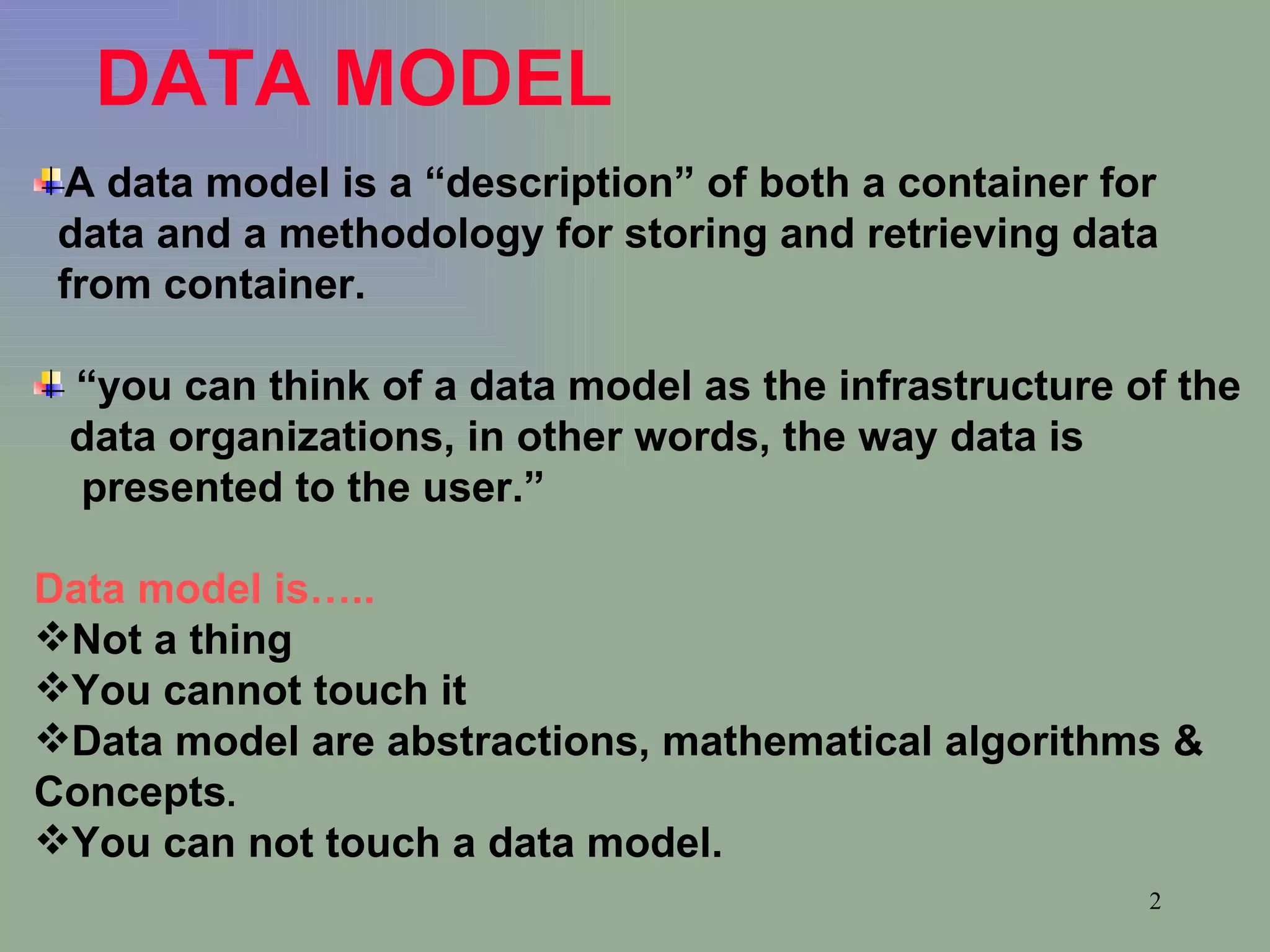
Definition of data models as abstractions for storing and retrieving data, highlighting their conceptual nature and function.
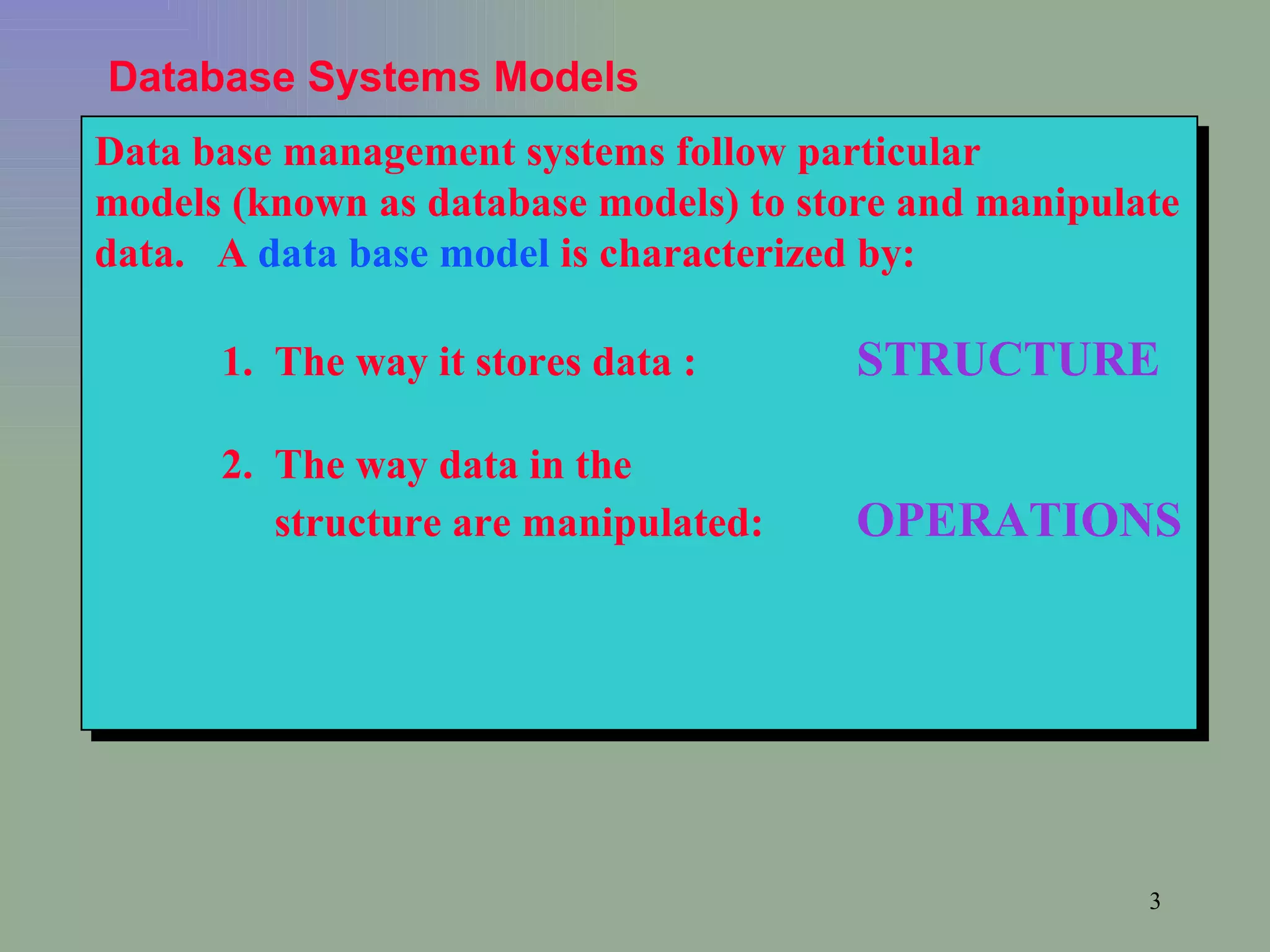
Characteristics of database models concerning data structure and manipulation operations, emphasizing structural and operational aspects.
Different styles of database management systems and their architectures, focusing on how data is defined and structured.
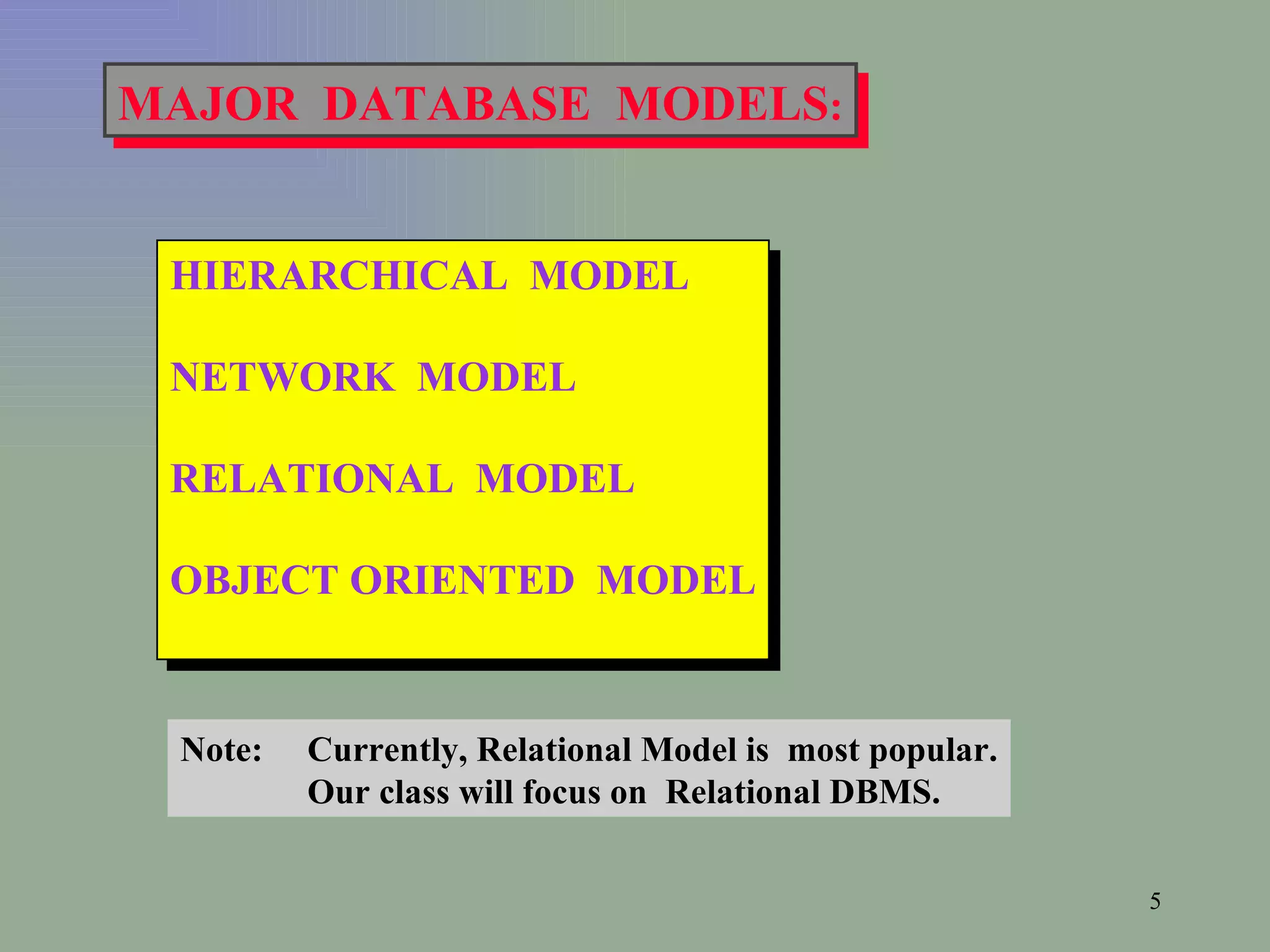
Overview of major database models: Hierarchical, Network, Relational, and Object-Oriented, with emphasis on the popularity of the Relational Model.
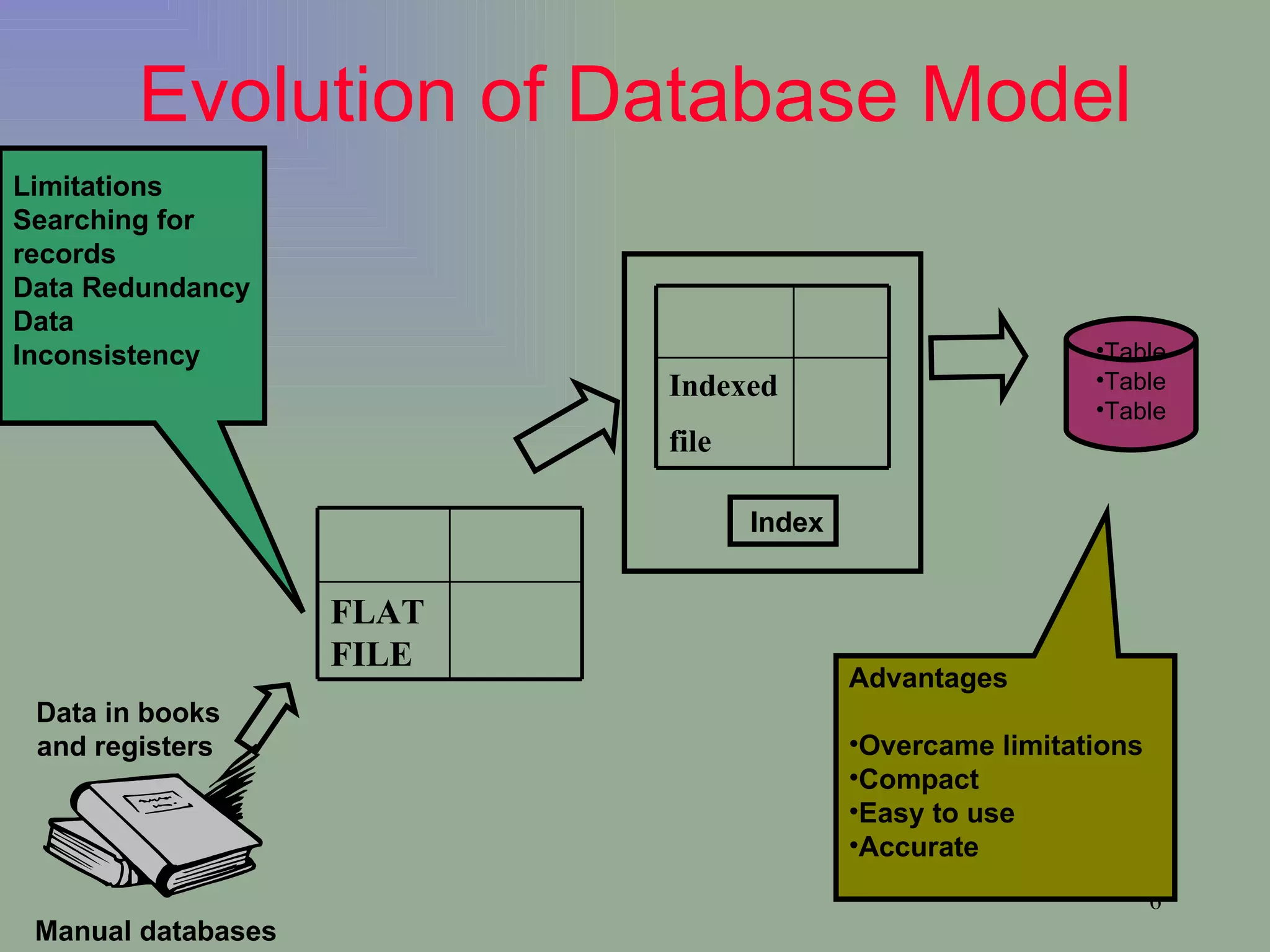
Describes the evolution from Flat file to various models highlighting limitations like redundancy and inconsistency, and advancements for ease of use.
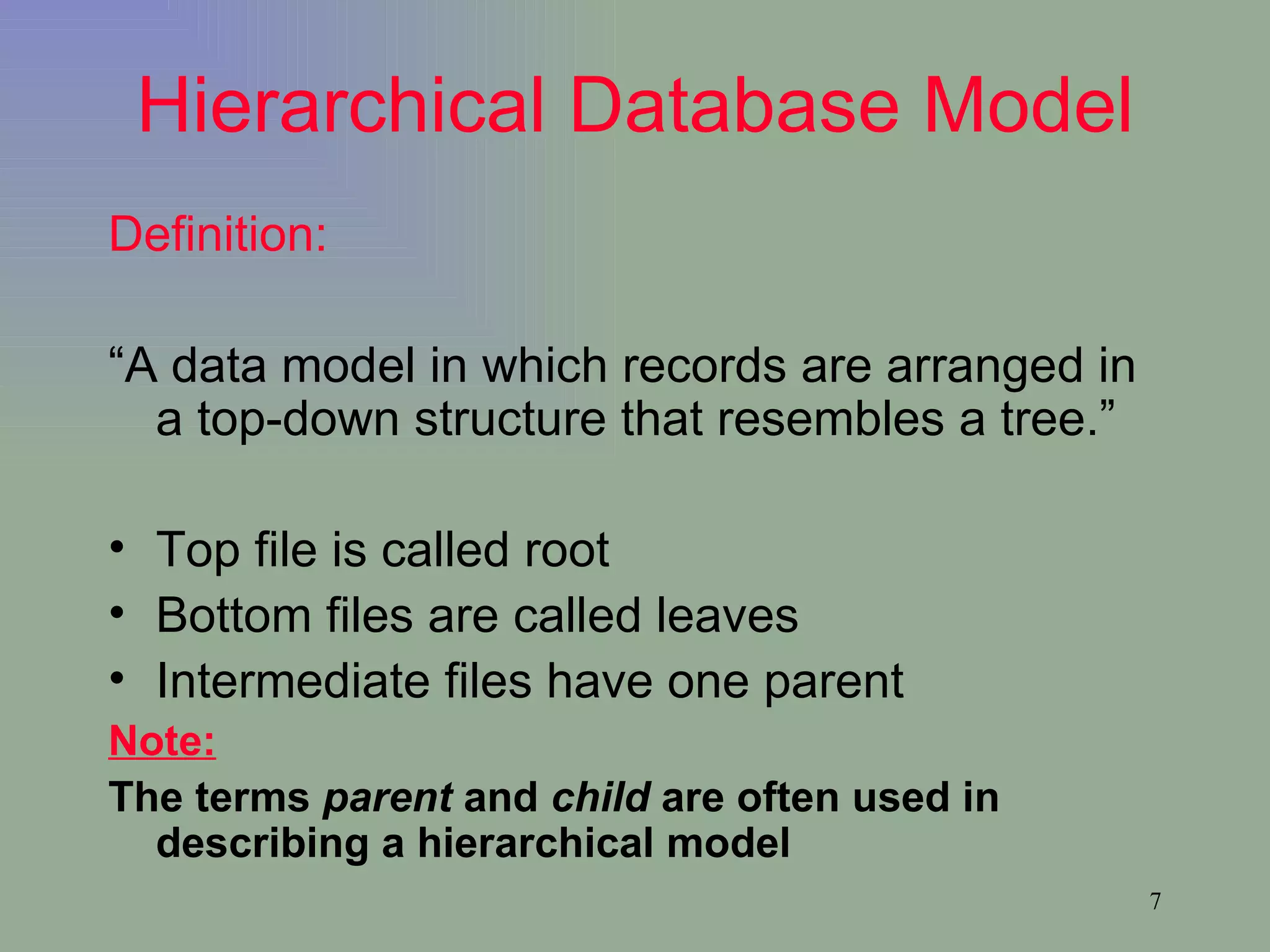
Definition and structure of hierarchical database models, resembling a tree format with a parent-child relationship for records.
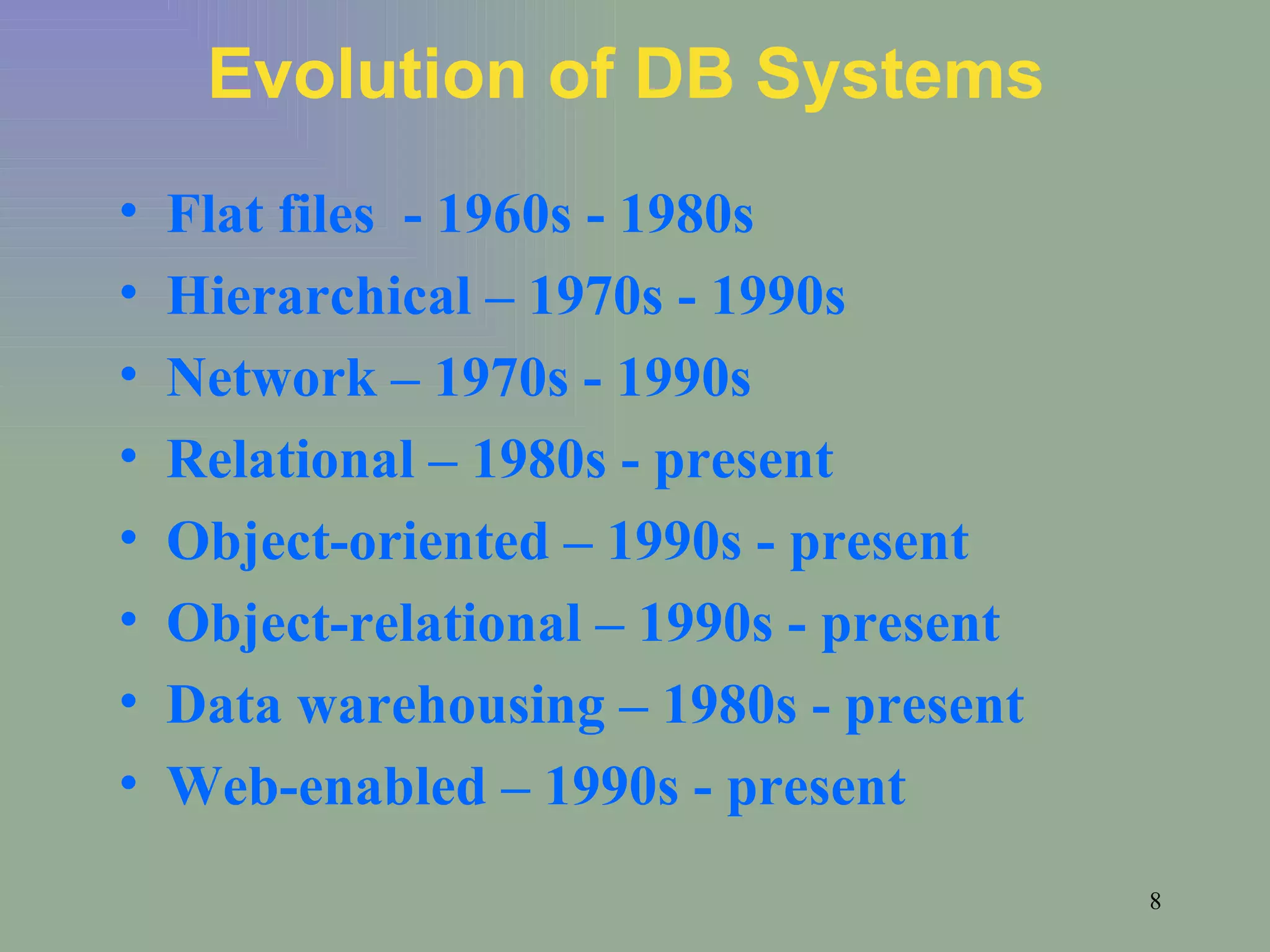
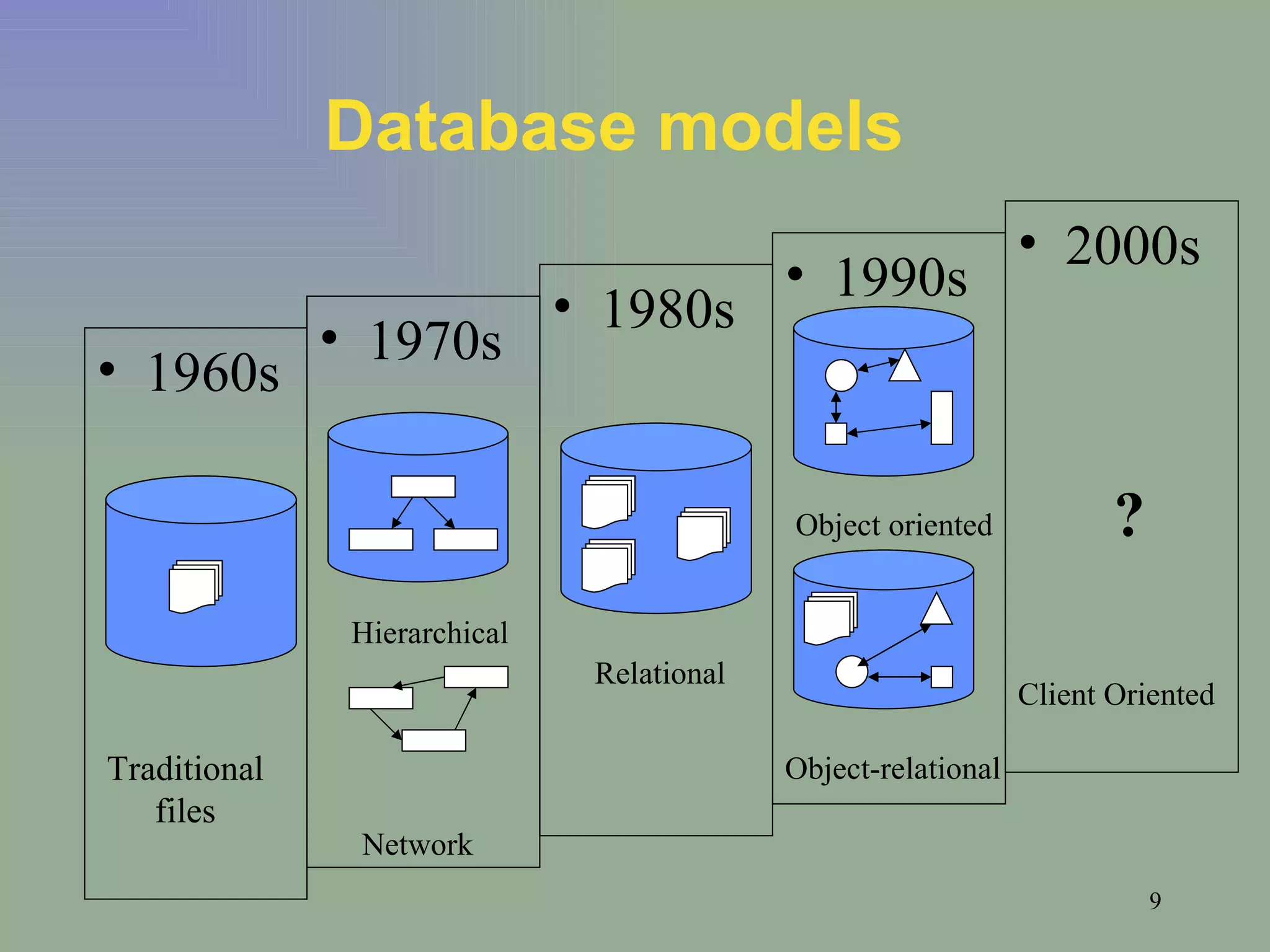
Chronology of database models from Flat files in the 1960s to Web-enabled systems, showcasing the timeline of development.
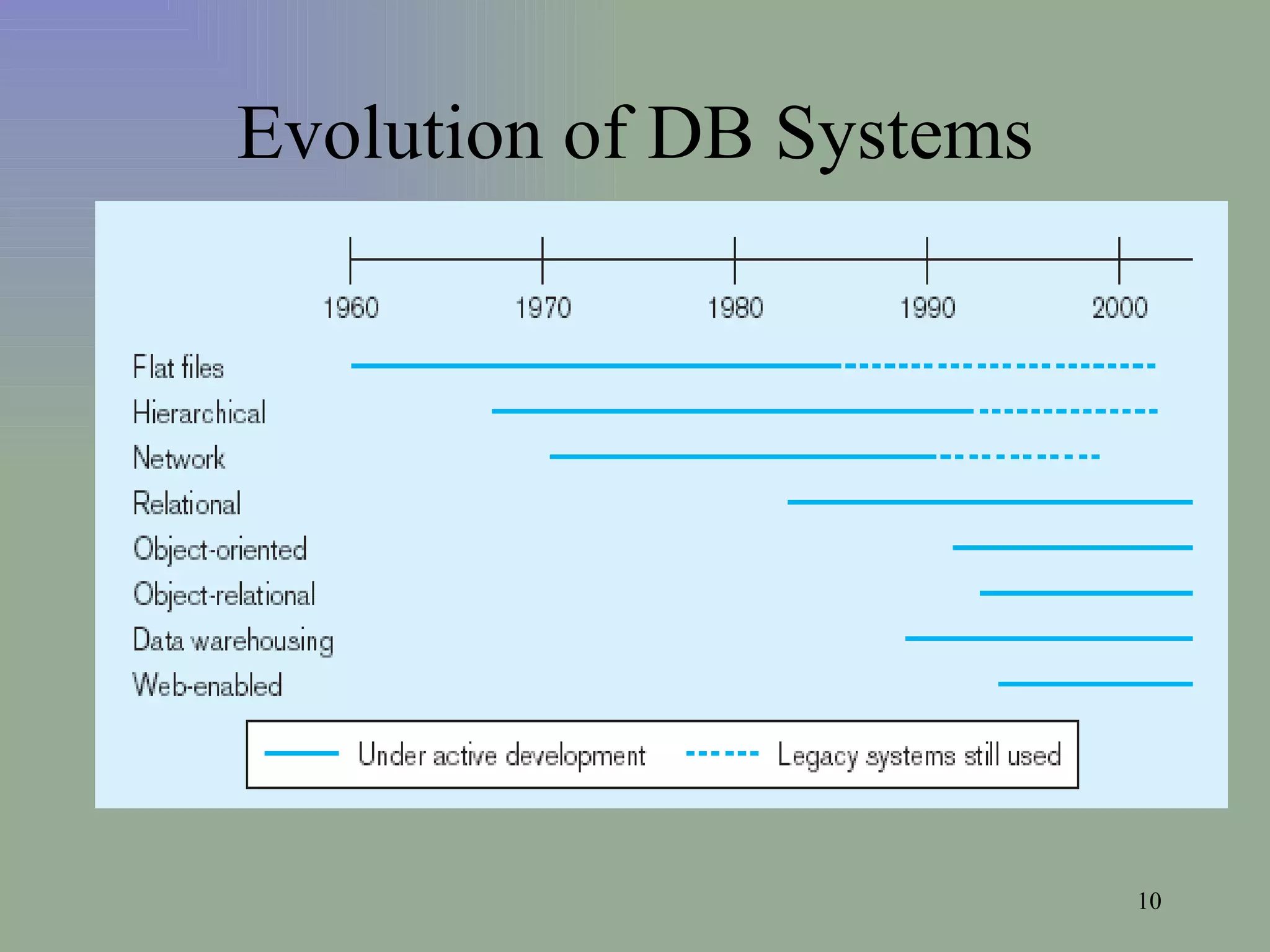
Timeframe for the evolution of various database systems from the 1960s to 2000s, identifying specific models and their popularity.
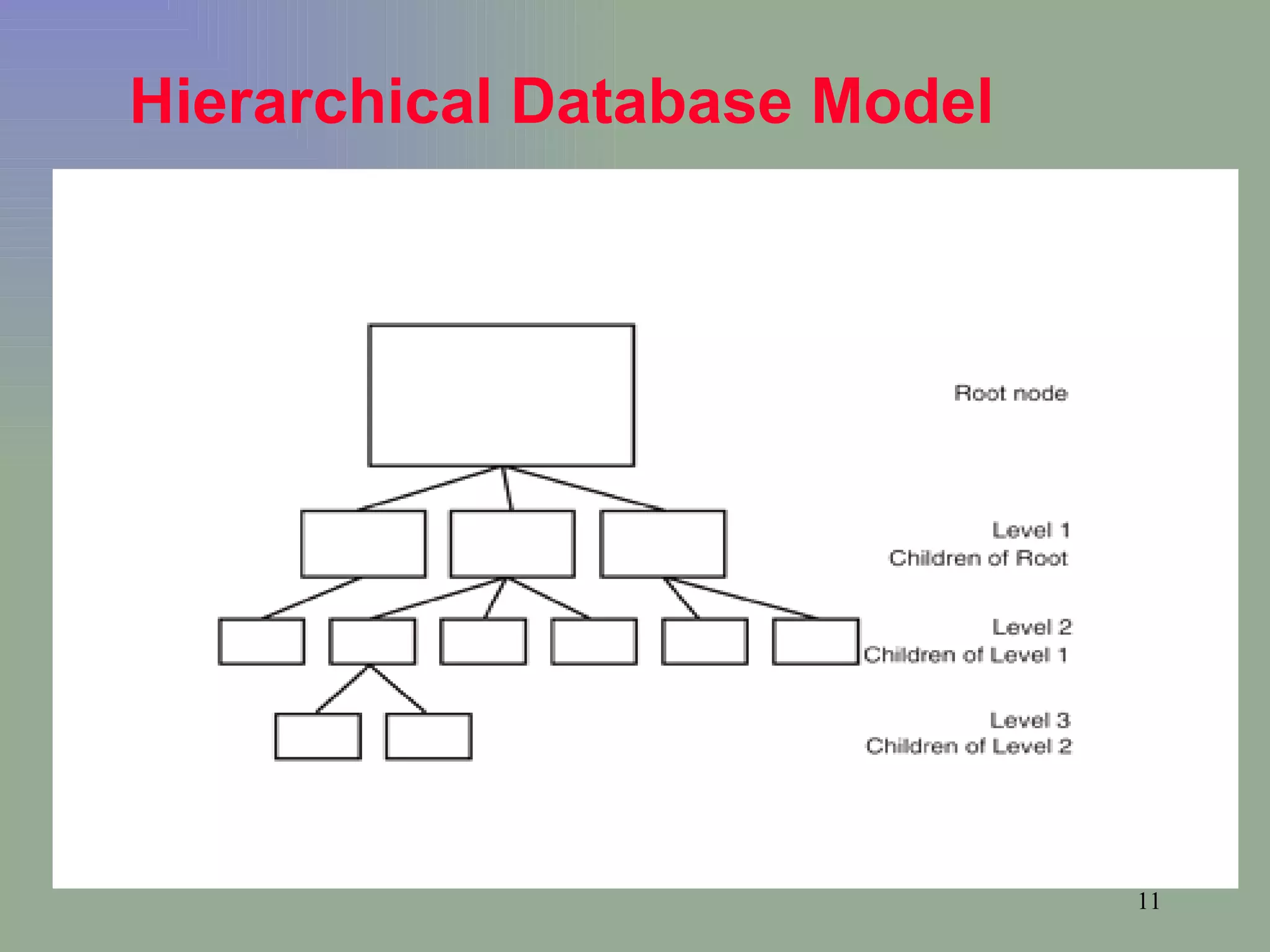
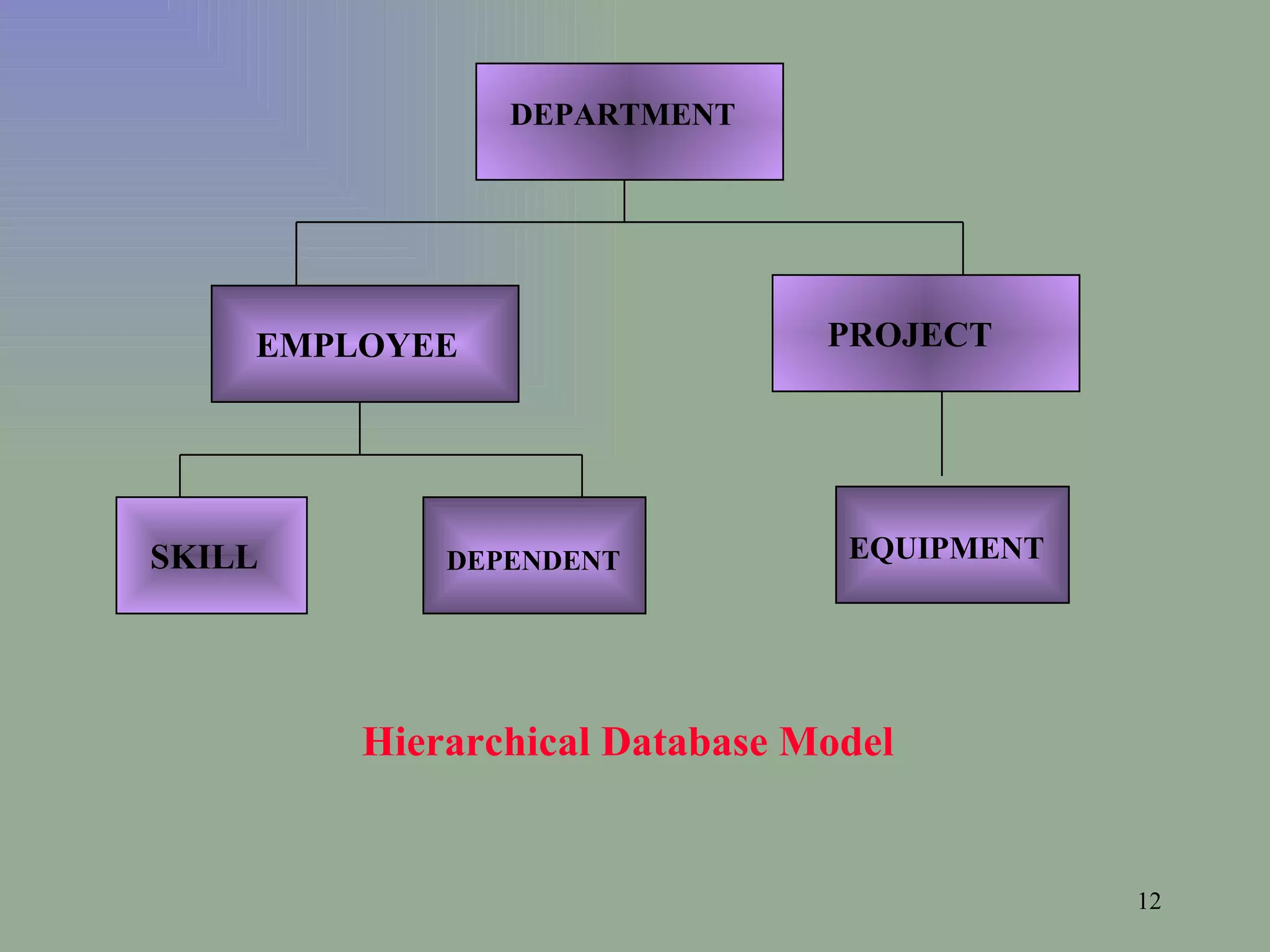
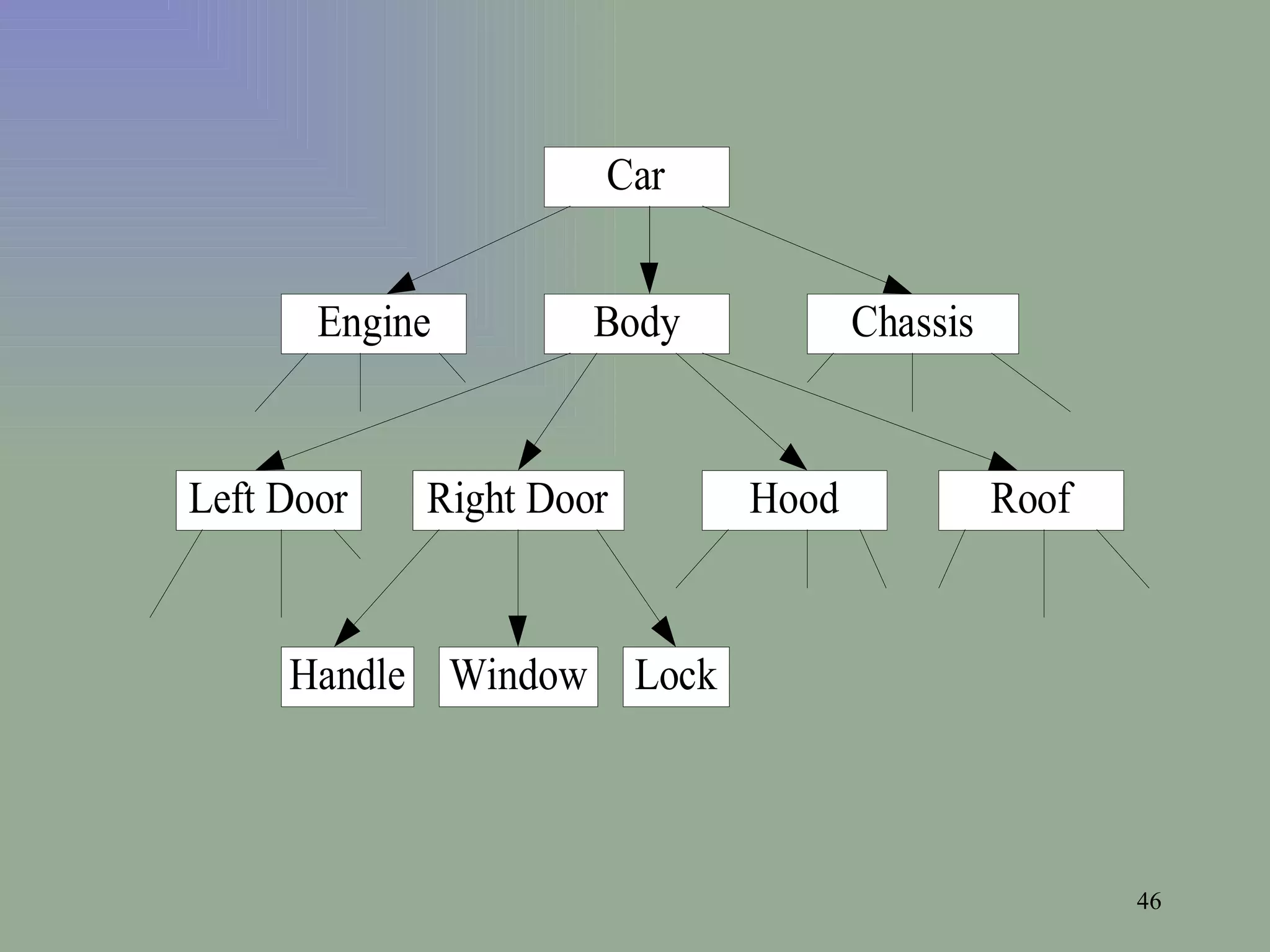
Detailed explanation of hierarchical database structures with examples, showing relationships and organization in a tree format.
Explanation of models and schemas, representing real-world entities through data structure and relationships documented in a data dictionary.
Features of Hierarchical DBMS including parent-child relationships and drawbacks related to complexity and rigidity in structure.
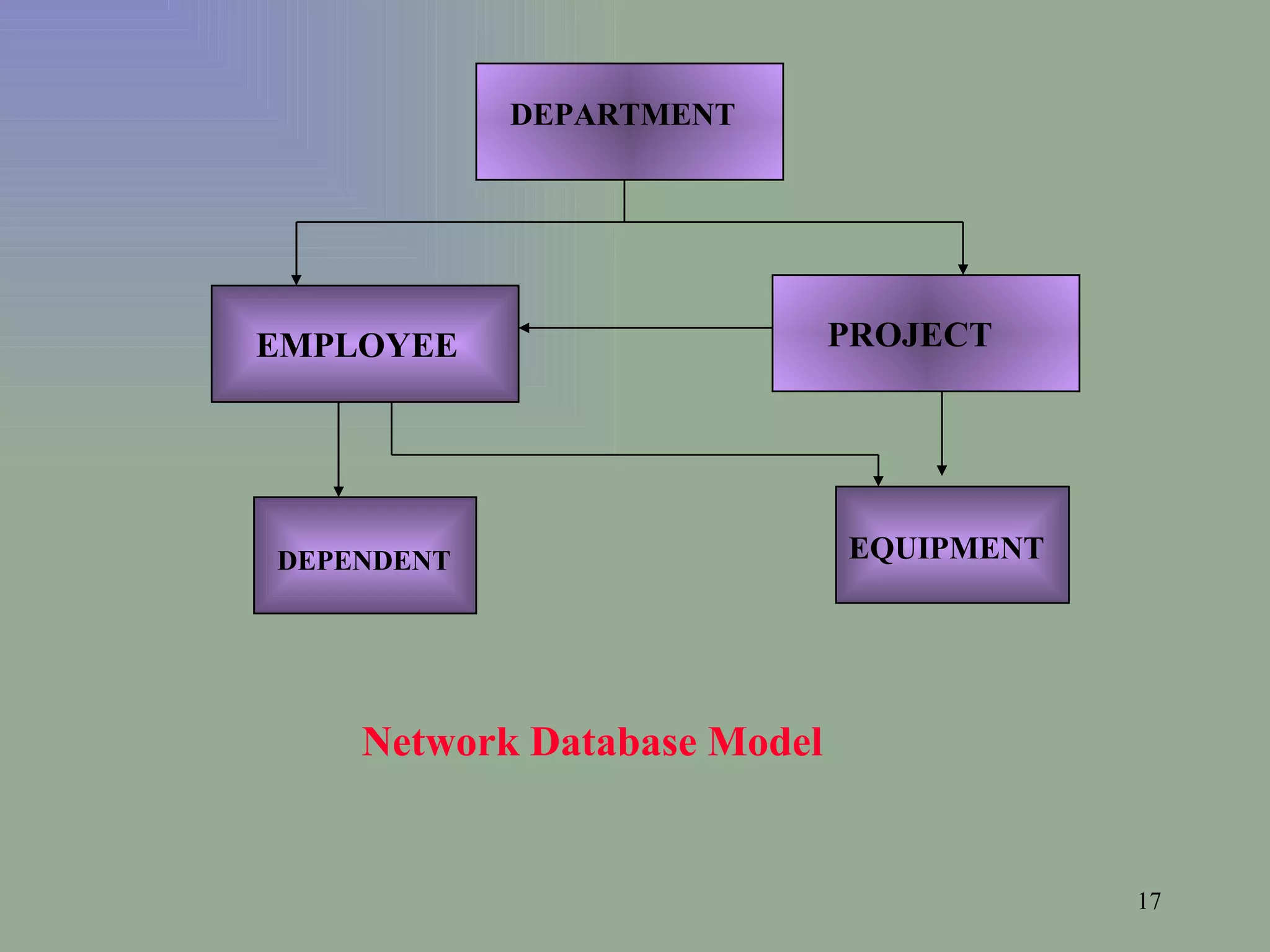
Definition and structure of the network database model, illustrating its advantages over hierarchical models and explaining data relationships.
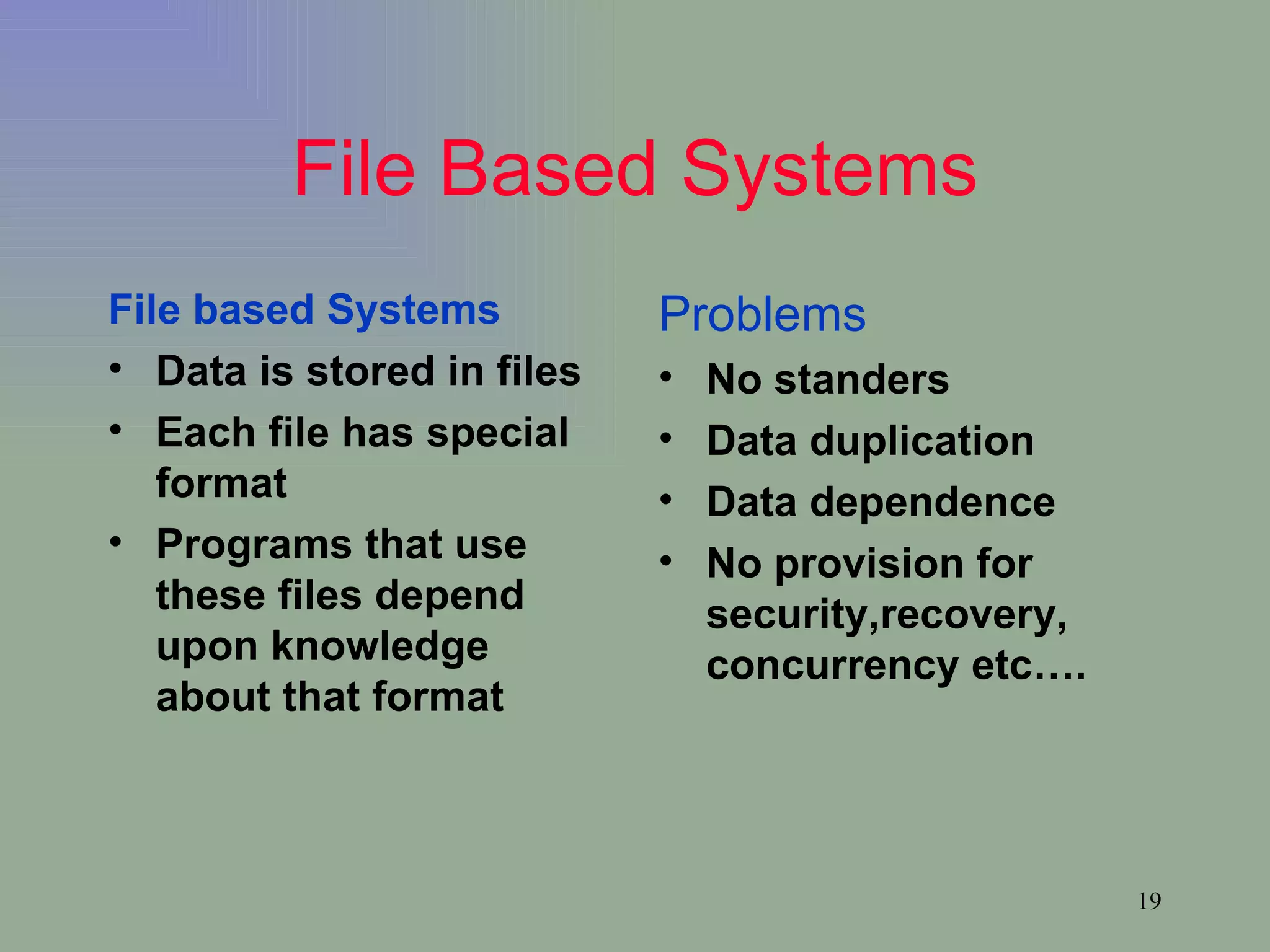
Problems associated with file-based systems like data duplication and lack of standards, underscoring their limitations compared to relational systems.
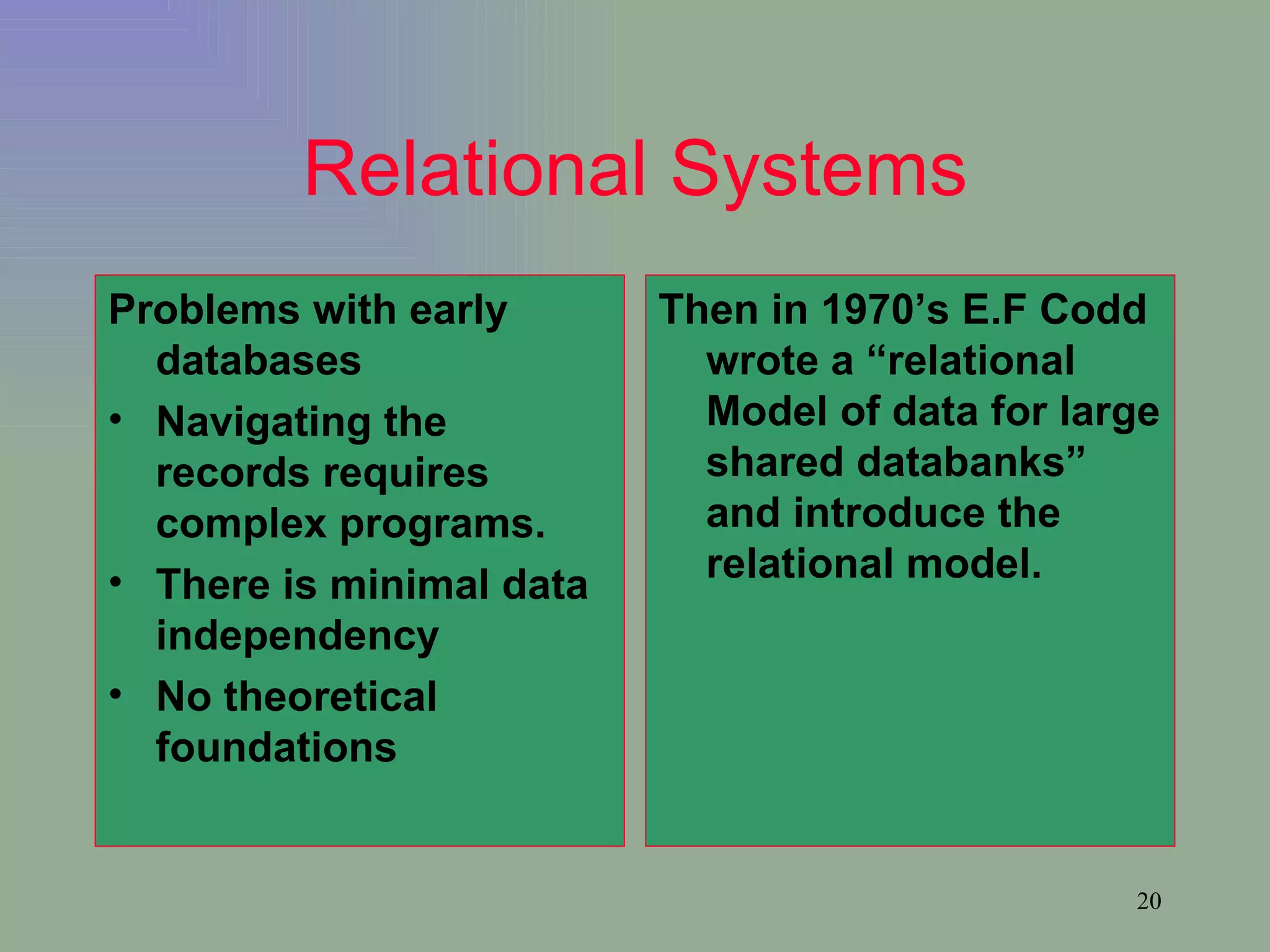
Problems with early database navigation and the introduction of Codd's relational model as a solution for managing large databases.
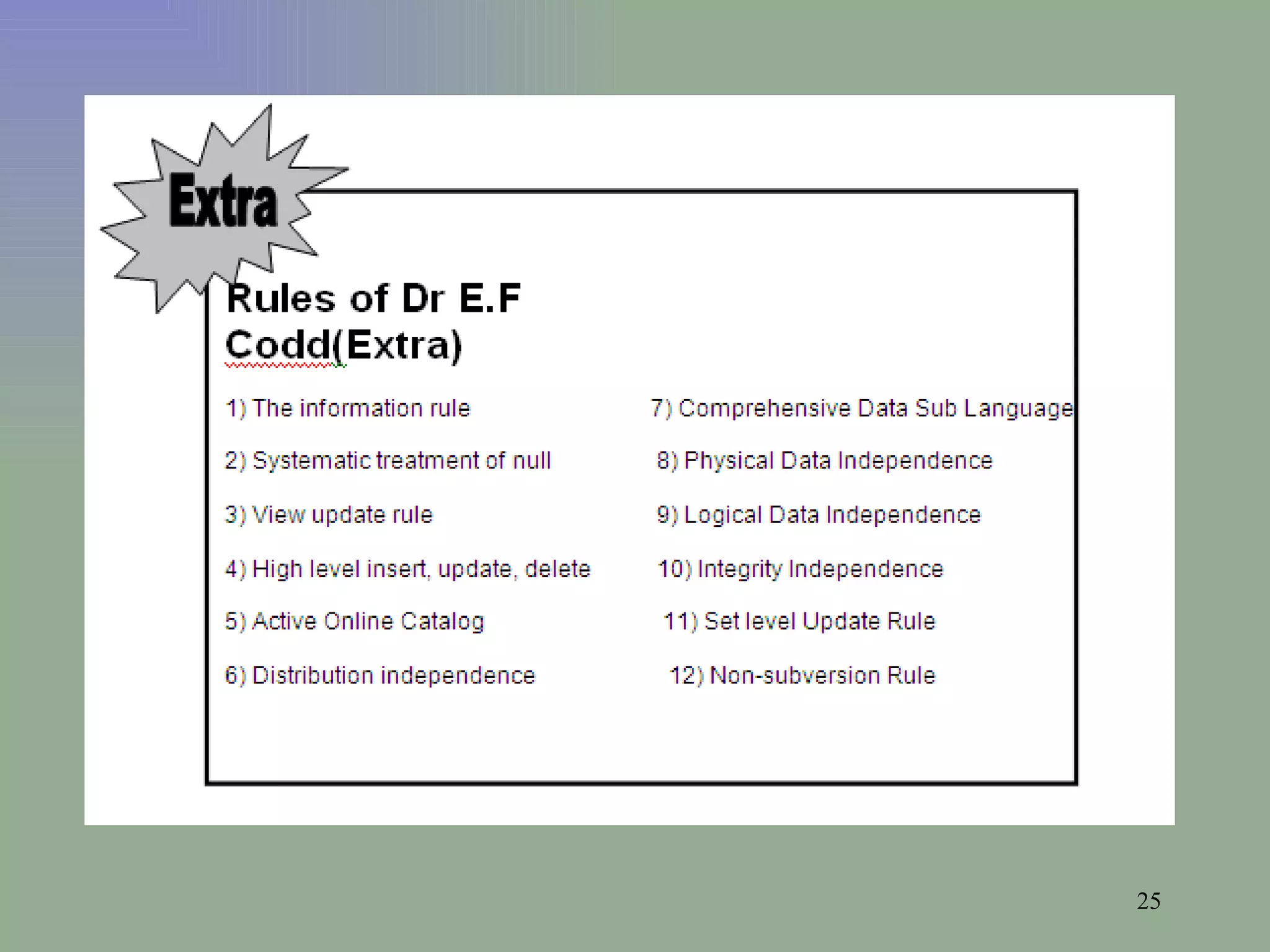
Definitions of relational databases focusing on managing data in tables, also covering Codd's rules for relational database systems.
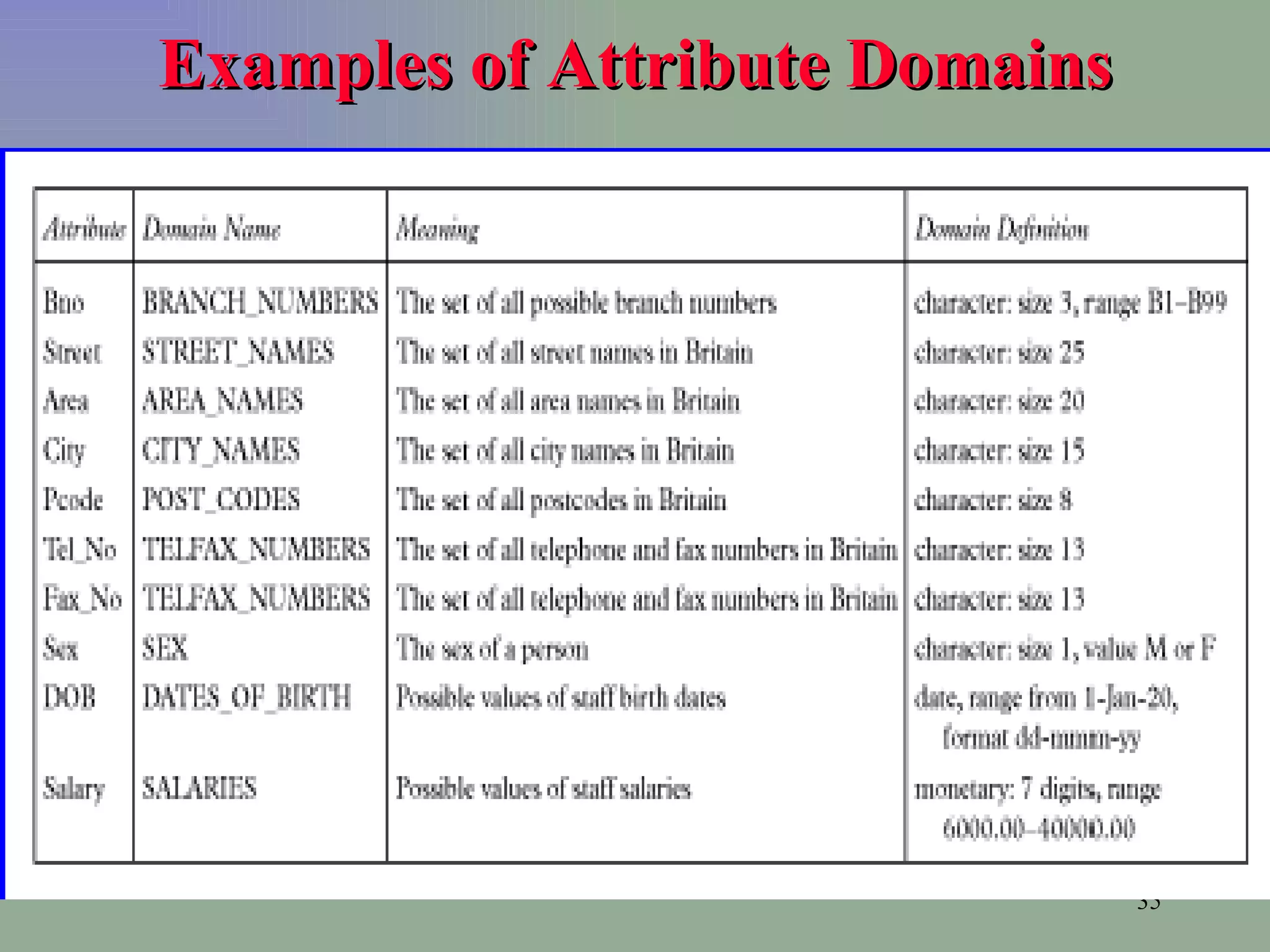
Components of relational databases, including schema, instance, attributes, and the significance of structured tables.
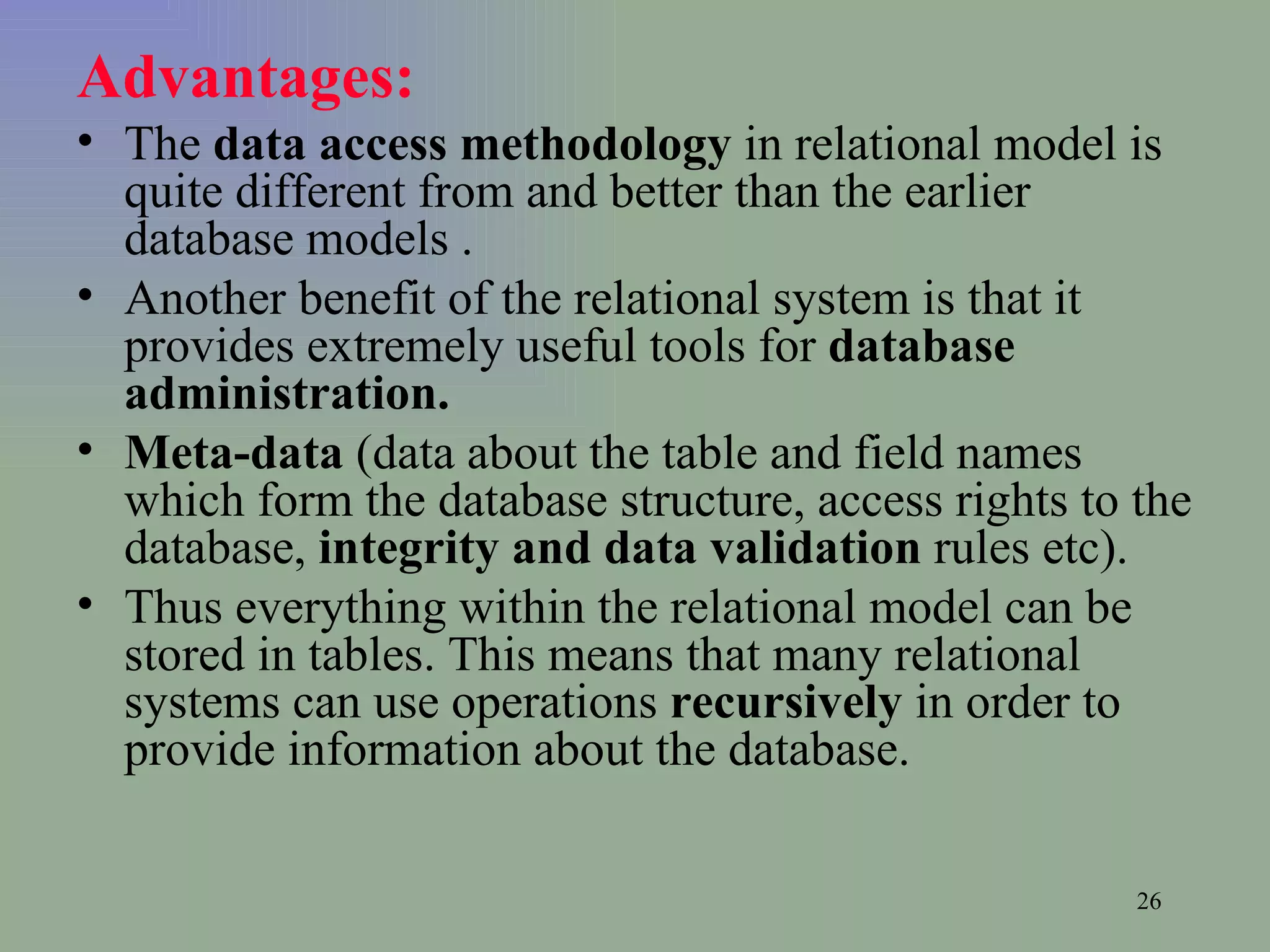
Key benefits of relational models such as data access methodology, administration tools, and metadata use for operational efficiency.
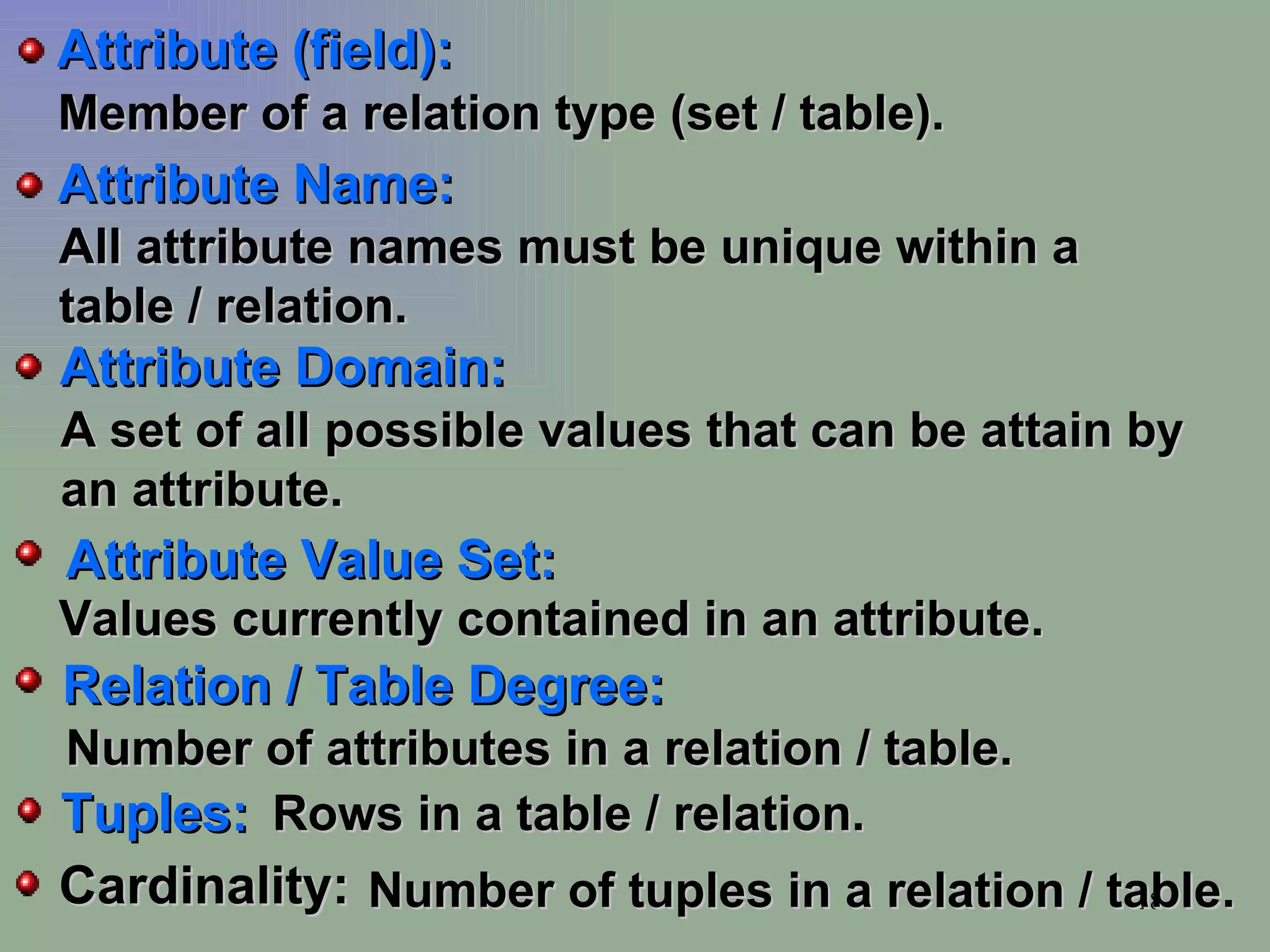
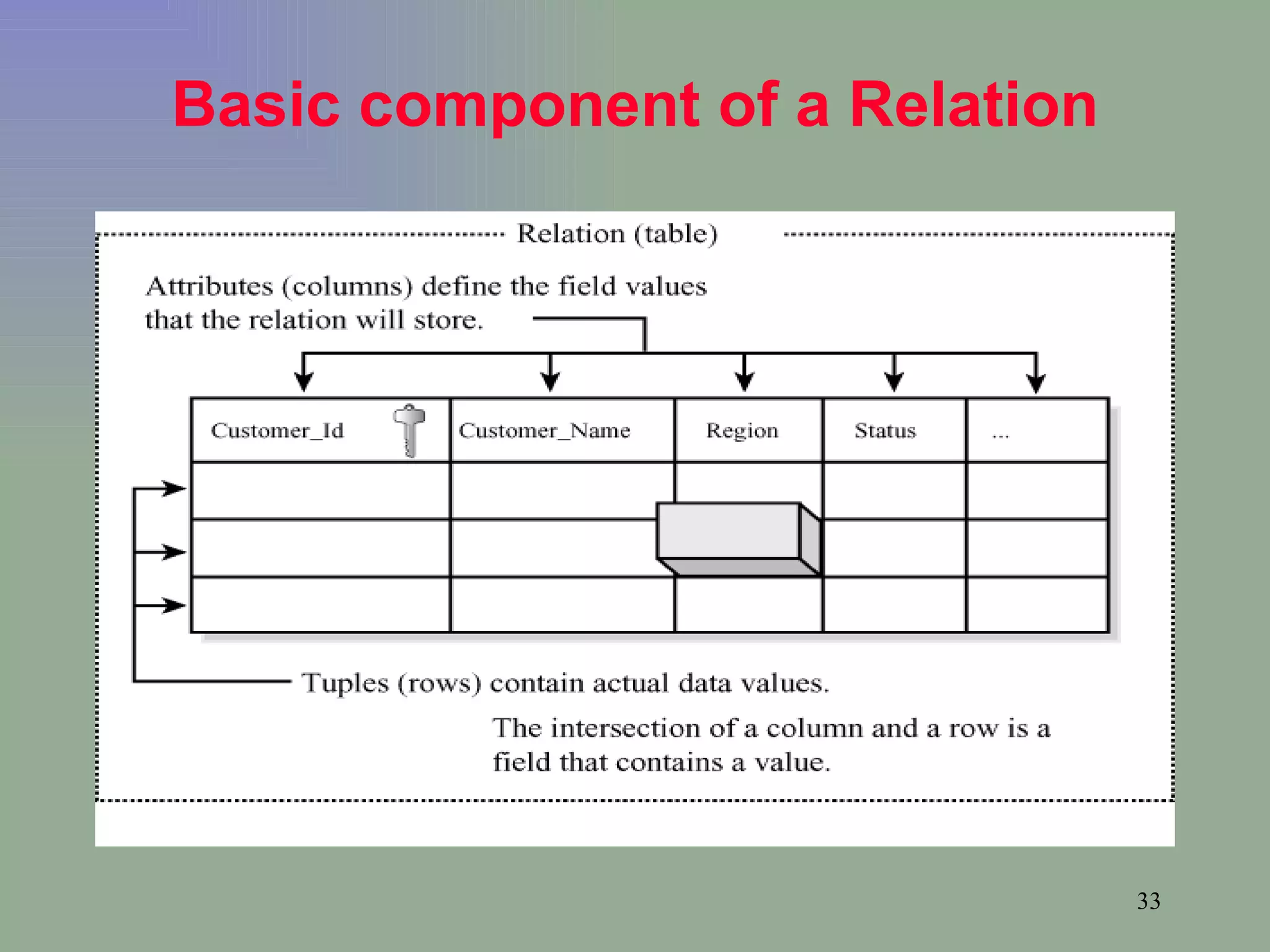
Definitions of tuples, attributes, and their uniqueness in relations, along with examples illustrating the structure of instance data.
Explanation of database schema concepts, including its description, design process, and relationship with database instances.
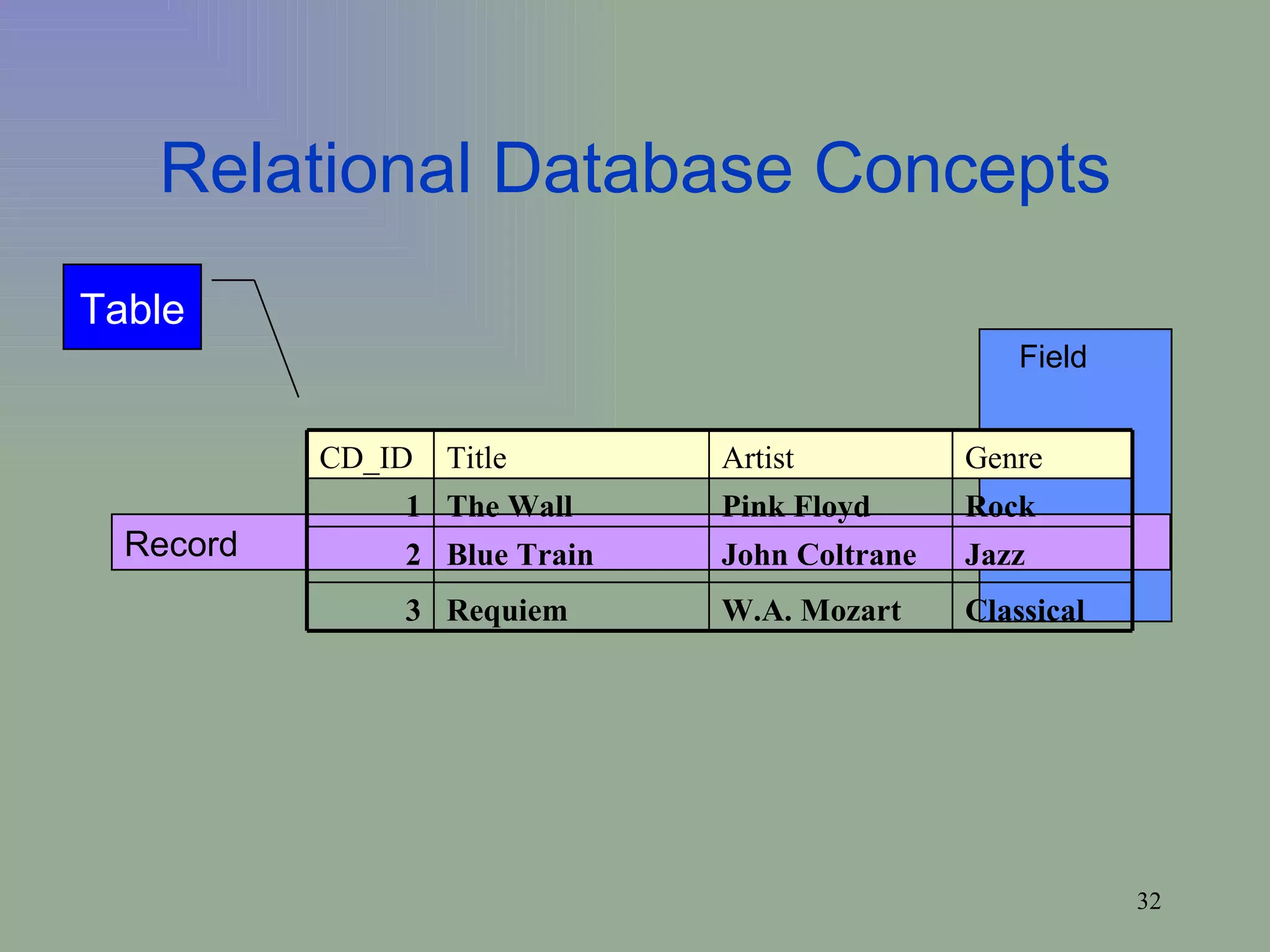
Basic terms related to relational databases including fields, records, and the meaning of attributes in database contexts.
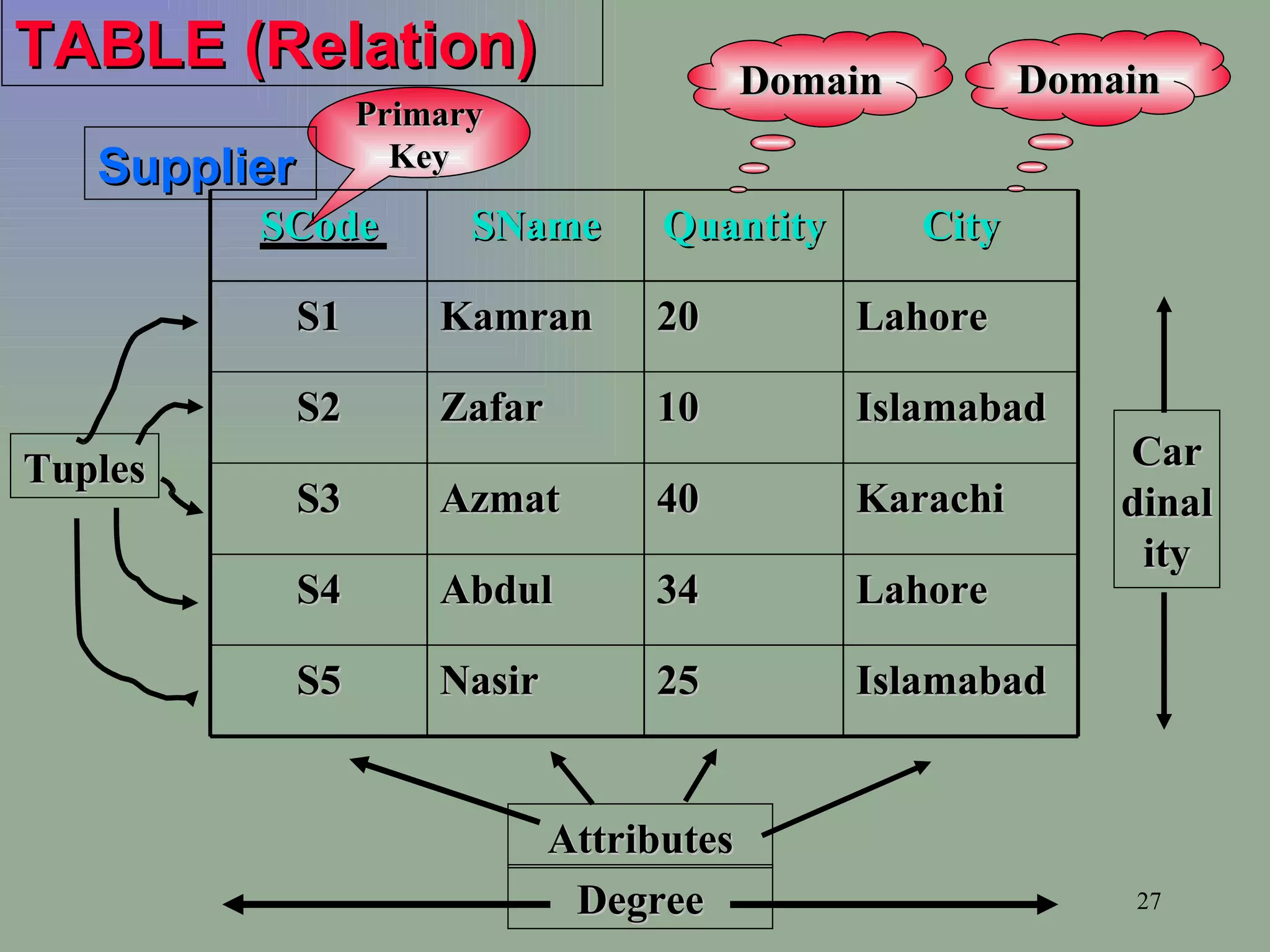
Detailed explanation of relations, tuples, attributes, and their importance within the relation structure in databases.
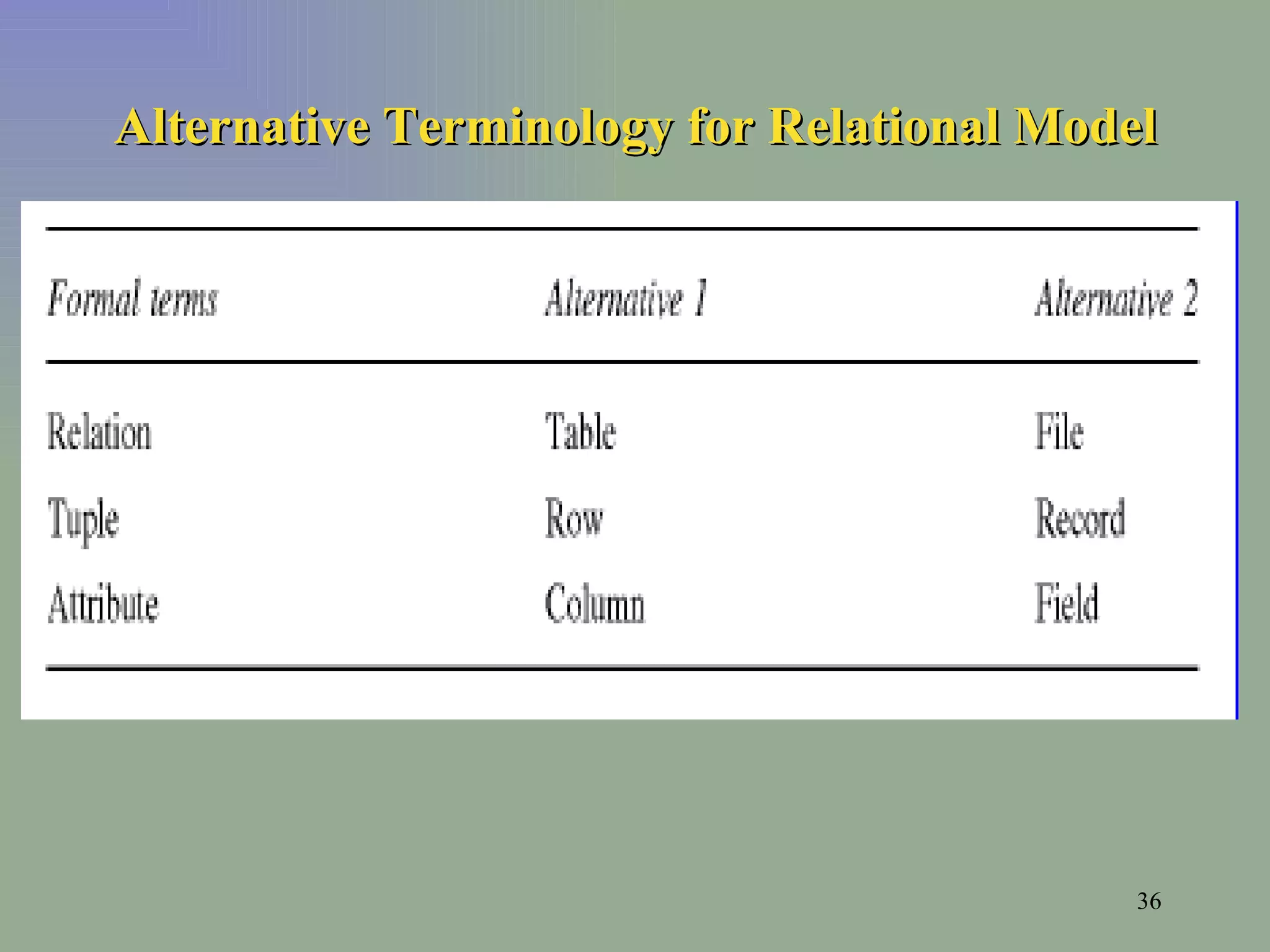
Alternative terminology used within the relational model to enhance understanding of its components and structure.
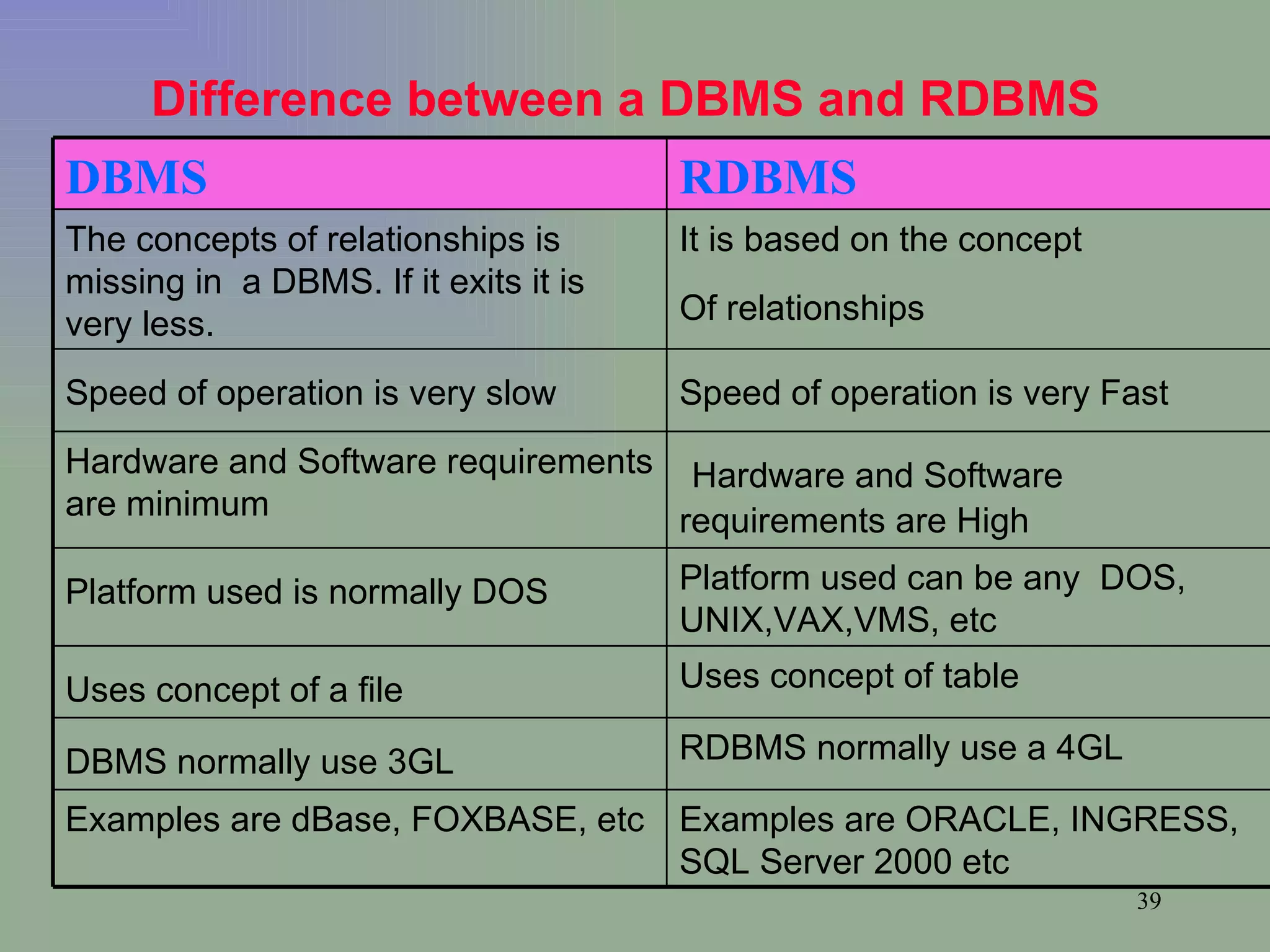
Key characteristics of relational DBMS such as data integrity, consistency, retrieval ease, and security, along with differences from DBMS.
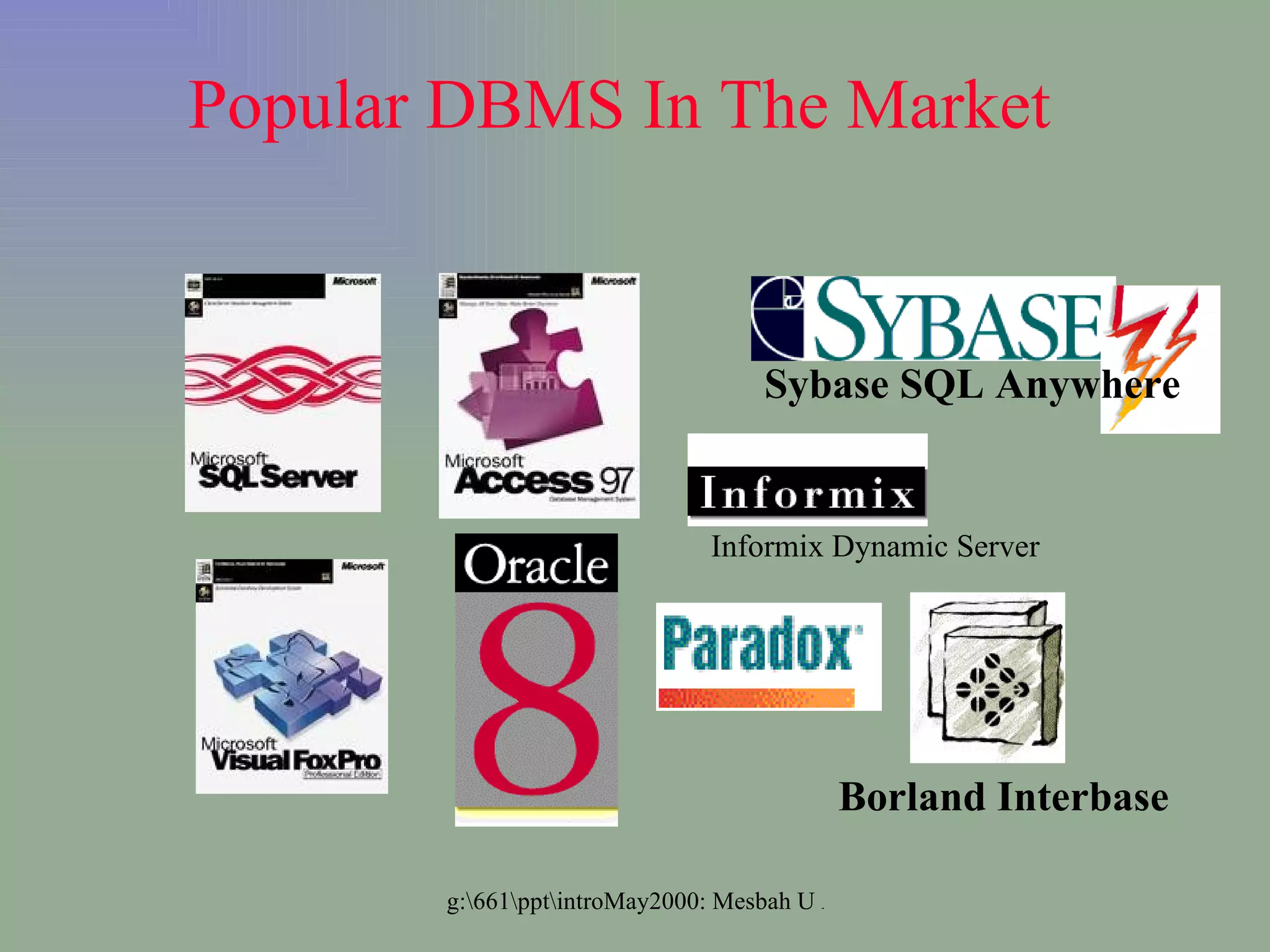
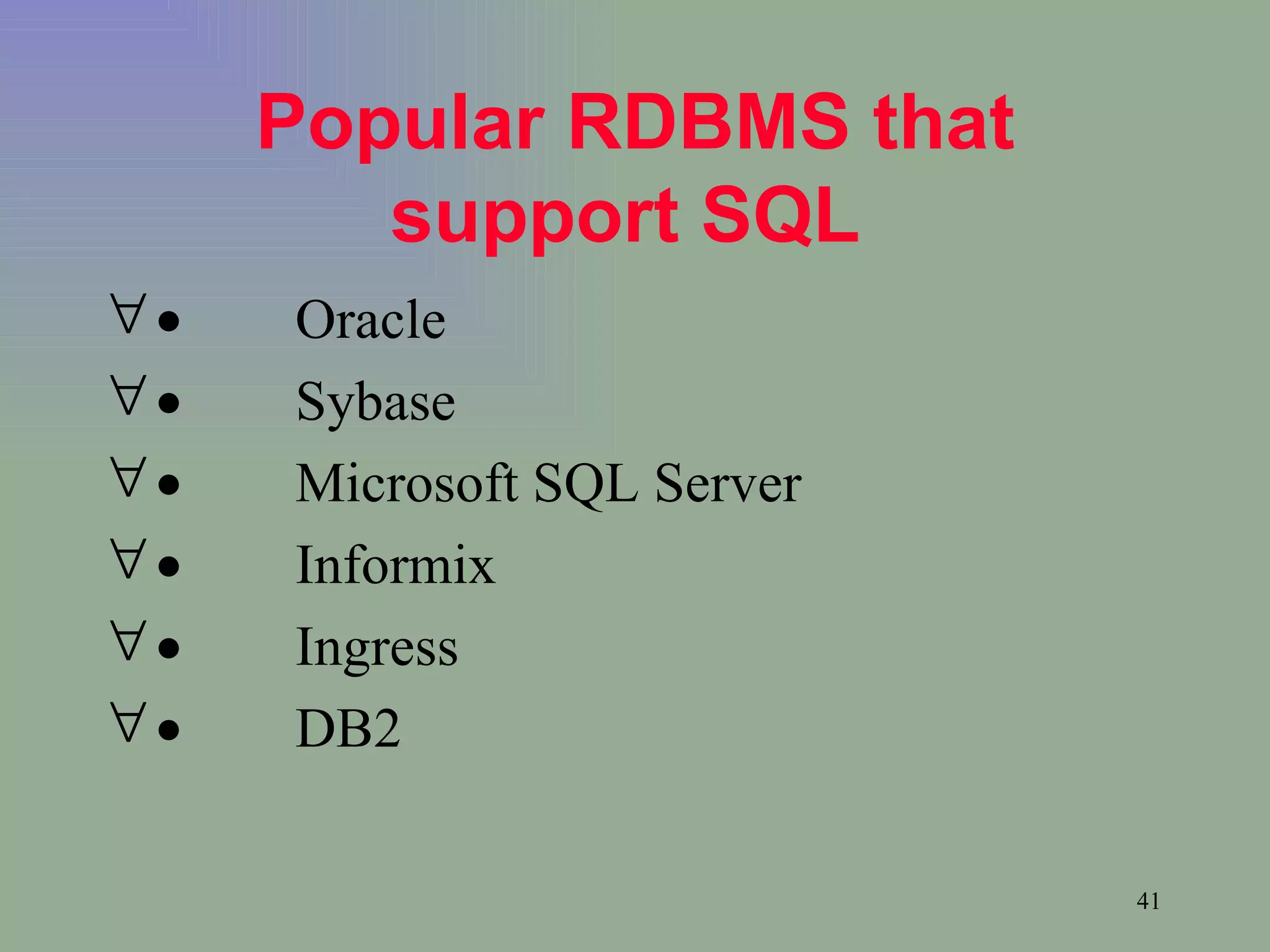
List of popular DBMS and RDBMS in the market including examples like Oracle, SQL Server, and their distinct features.
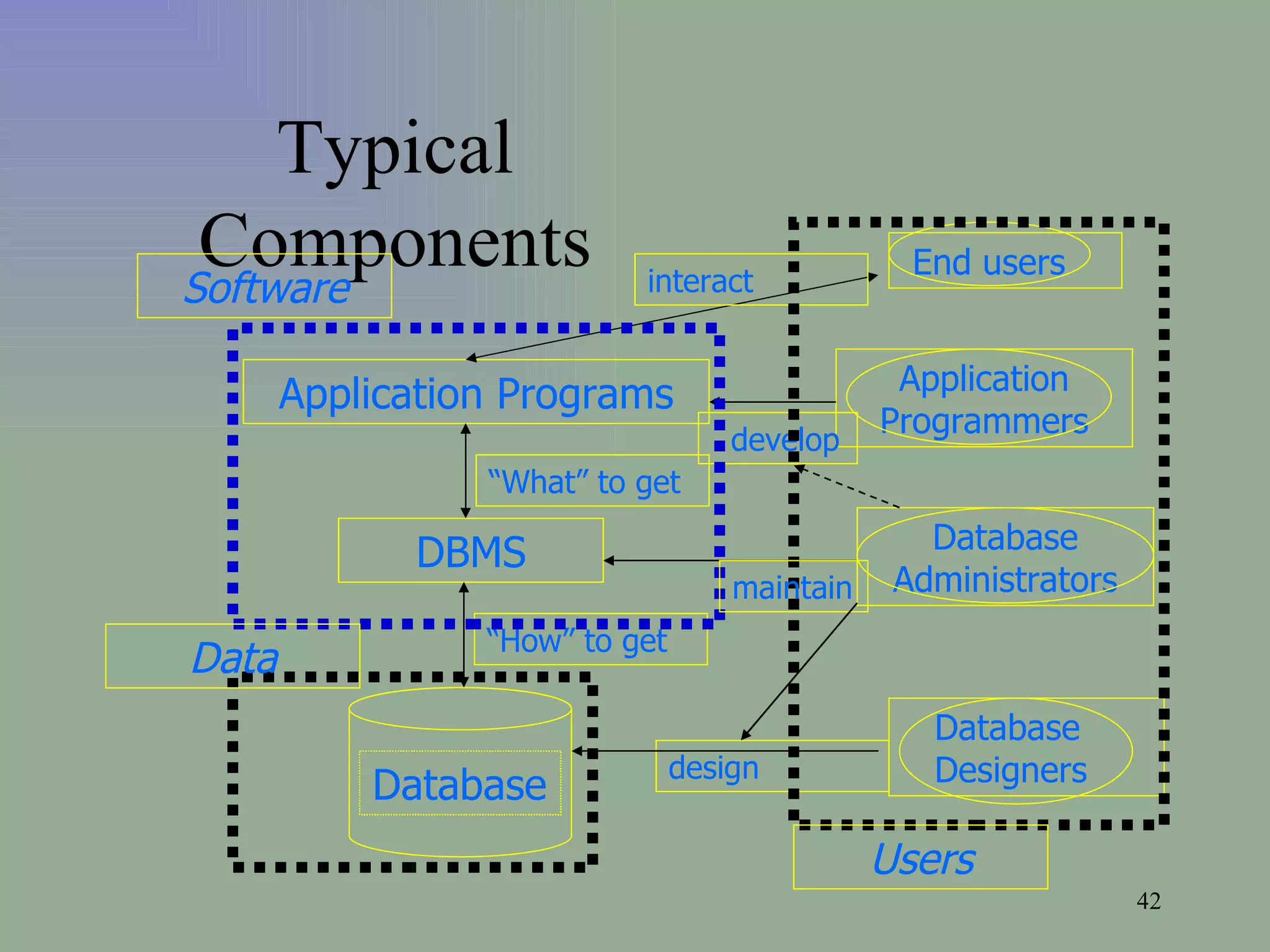
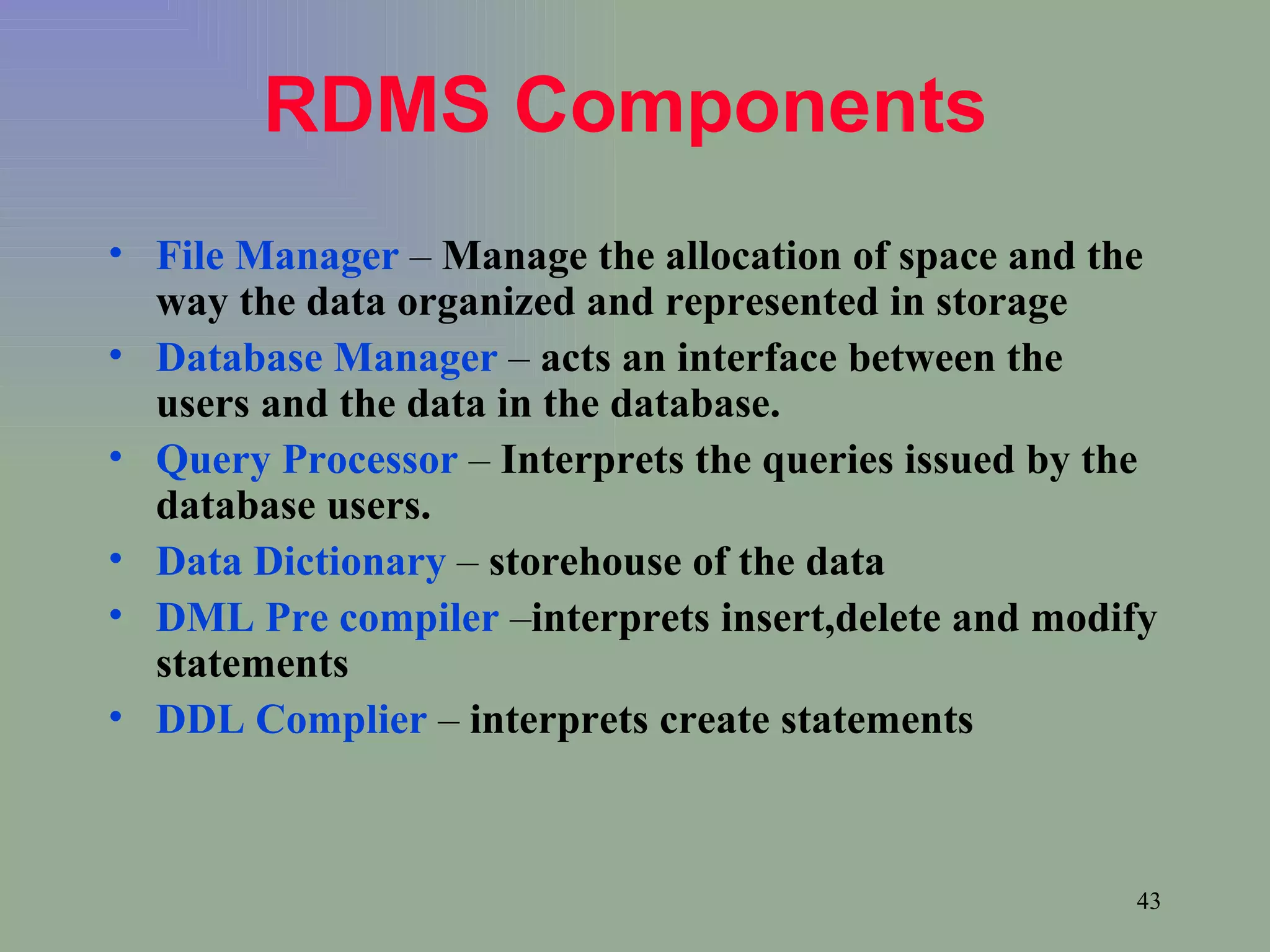
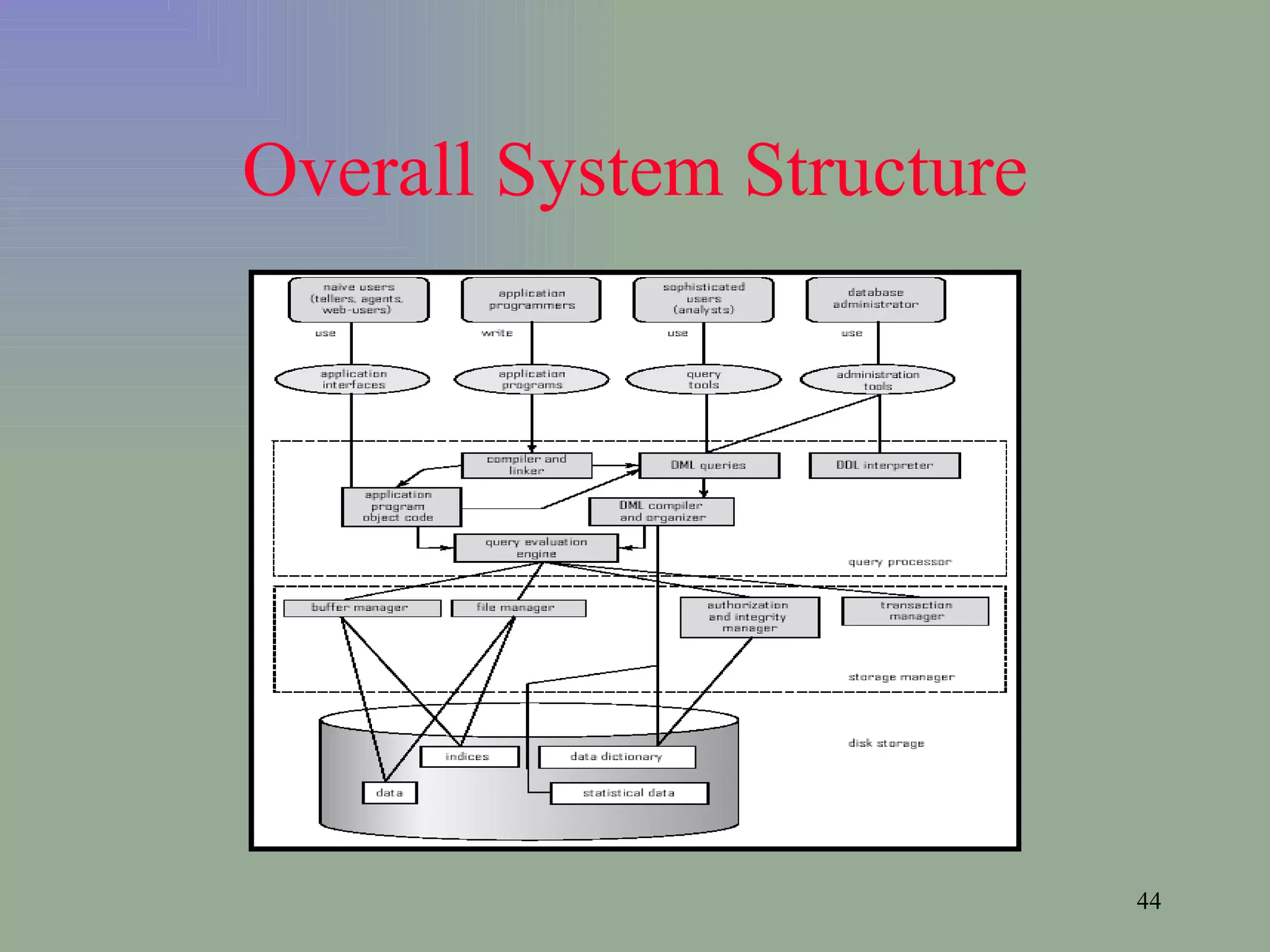
Overview of typical components of RDBMS including software, users, data management, and the functions of DBMS components.
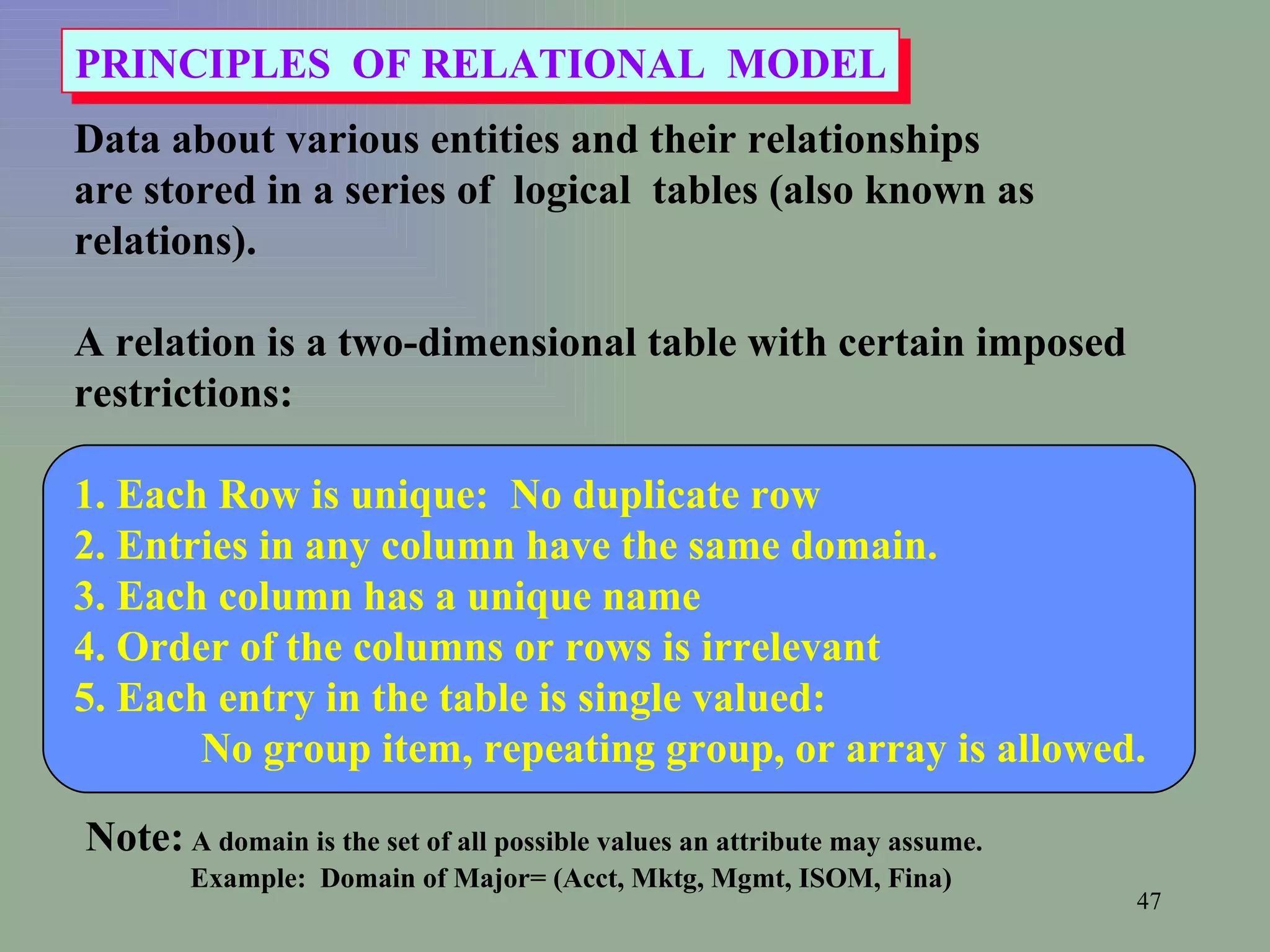
Fundamental principles guiding relational models, focus on uniqueness, data entry values, domains, and table structure restrictions.
Session Objectives Conceptand Evaluation Of Database Model Flat file Model Hierarchical model Network Model Relational Model Object Relational Model Object Based data Model Brief History of the Relational Model Components of DBMS
2.
DATA MODEL A data model is a “description” of both a container for data and a methodology for storing and retrieving data from container. “ you can think of a data model as the infrastructure of the data organizations, in other words, the way data is presented to the user.” Data model is….. Not a thing You cannot touch it Data model are abstractions, mathematical algorithms & Concepts . You can not touch a data model.
3.
Data base managementsystems follow particular models (known as database models) to store and manipulate data. A data base model is characterized by: 1. The way it stores data : STRUCTURE 2. The way data in the structure are manipulated: OPERATIONS Database Systems Models
4.
Choosing Data ModelThere are three different styles of database management systems, each characterized by the way data are defined and structured, called database model. A particular database management system supports one of the four different architecture.
5.
MAJOR DATABASE MODELS : HIERARCHICAL MODEL NETWORK MODEL RELATIONAL MODEL OBJECT ORIENTED MODEL Note: Currently, Relational Model is most popular. Our class will focus on Relational DBMS.
6.
Evolution of DatabaseModel Limitations Searching for records Data Redundancy Data Inconsistency Index Table Table Table Advantages Overcame limitations Compact Easy to use Accurate Data in books and registers Manual databases FLAT FILE Indexed file
7.
Hierarchical Database ModelDefinition: “ A data model in which records are arranged in a top-down structure that resembles a tree.” Top file is called root Bottom files are called leaves Intermediate files have one parent Note: The terms parent and child are often used in describing a hierarchical model
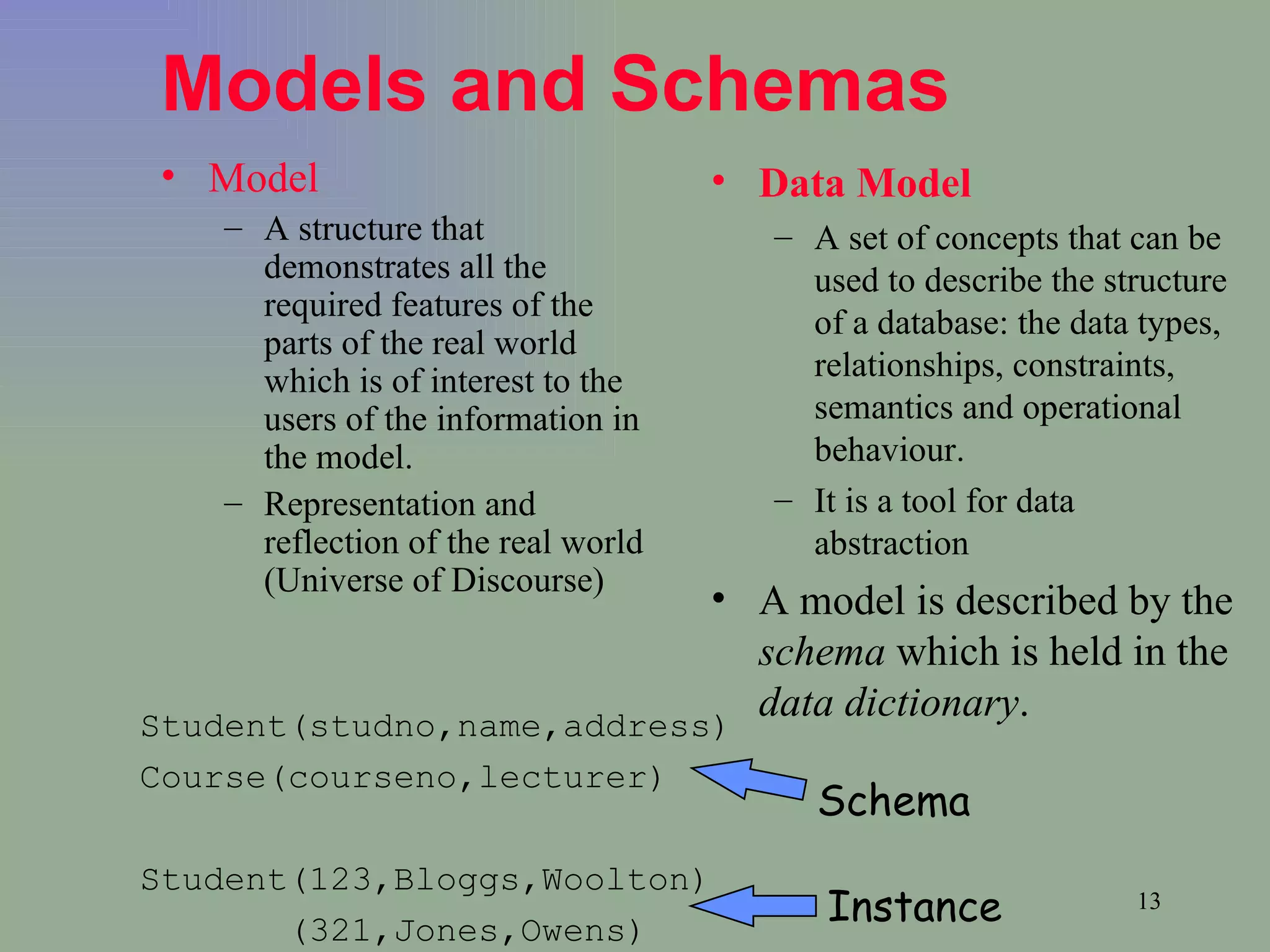
Models and SchemasModel A structure that demonstrates all the required features of the parts of the real world which is of interest to the users of the information in the model. Representation and reflection of the real world (Universe of Discourse) Data Model A set of concepts that can be used to describe the structure of a database: the data types, relationships, constraints, semantics and operational behaviour. It is a tool for data abstraction A model is described by the schema which is held in the data dictionary . Student(studno,name,address) Course(courseno,lecturer) Student(123,Bloggs,Woolton) (321,Jones,Owens) Schema Instance
14.
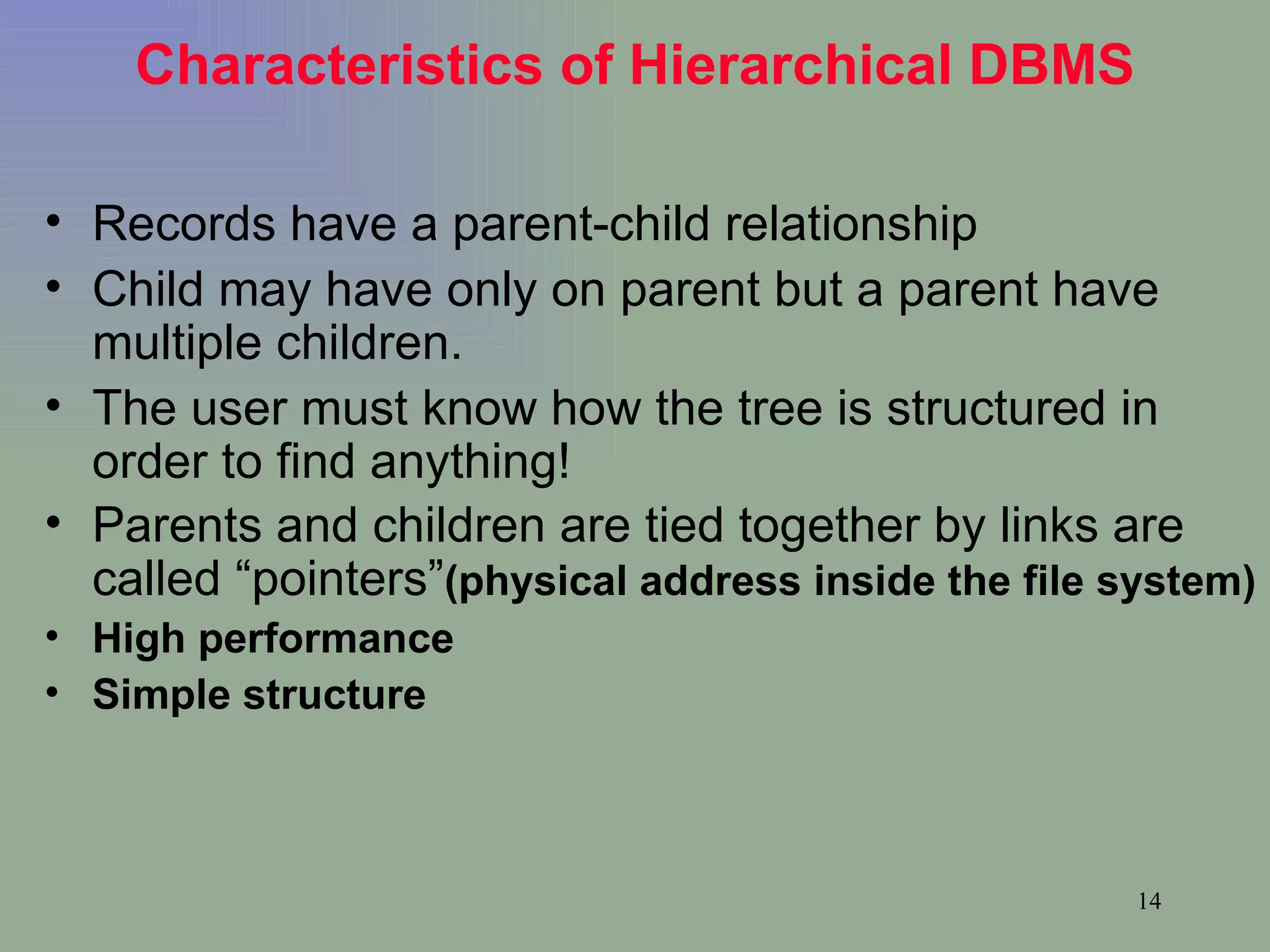
Characteristics of HierarchicalDBMS Records have a parent-child relationship Child may have only on parent but a parent have multiple children. The user must know how the tree is structured in order to find anything! Parents and children are tied together by links are called “pointers” (physical address inside the file system) High performance Simple structure
15.
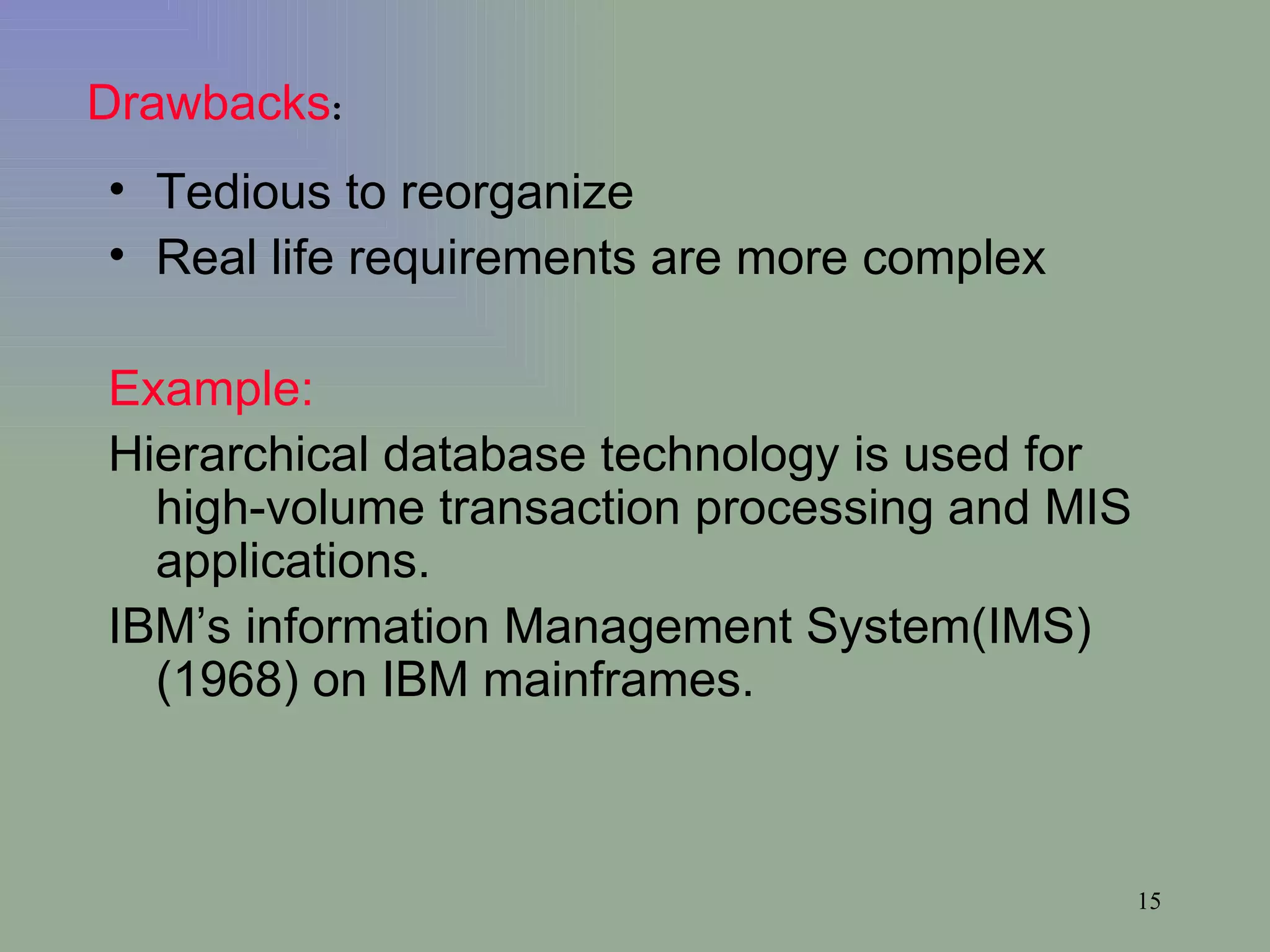
Tedious to reorganizeReal life requirements are more complex Example: Hierarchical database technology is used for high-volume transaction processing and MIS applications. IBM’s information Management System(IMS) (1968) on IBM mainframes. Drawbacks :
16.
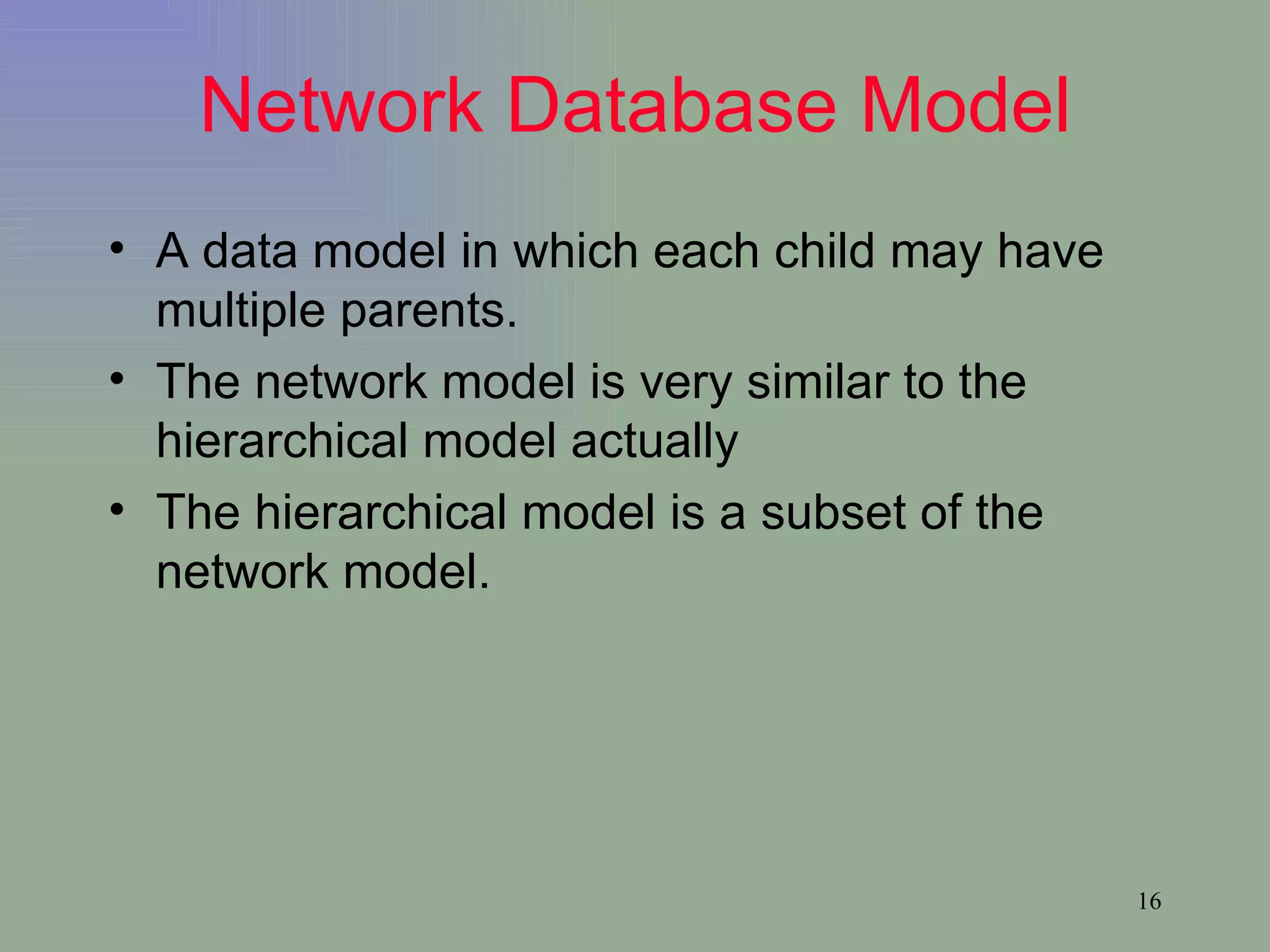
Network Database ModelA data model in which each child may have multiple parents. The network model is very similar to the hierarchical model actually The hierarchical model is a subset of the network model.
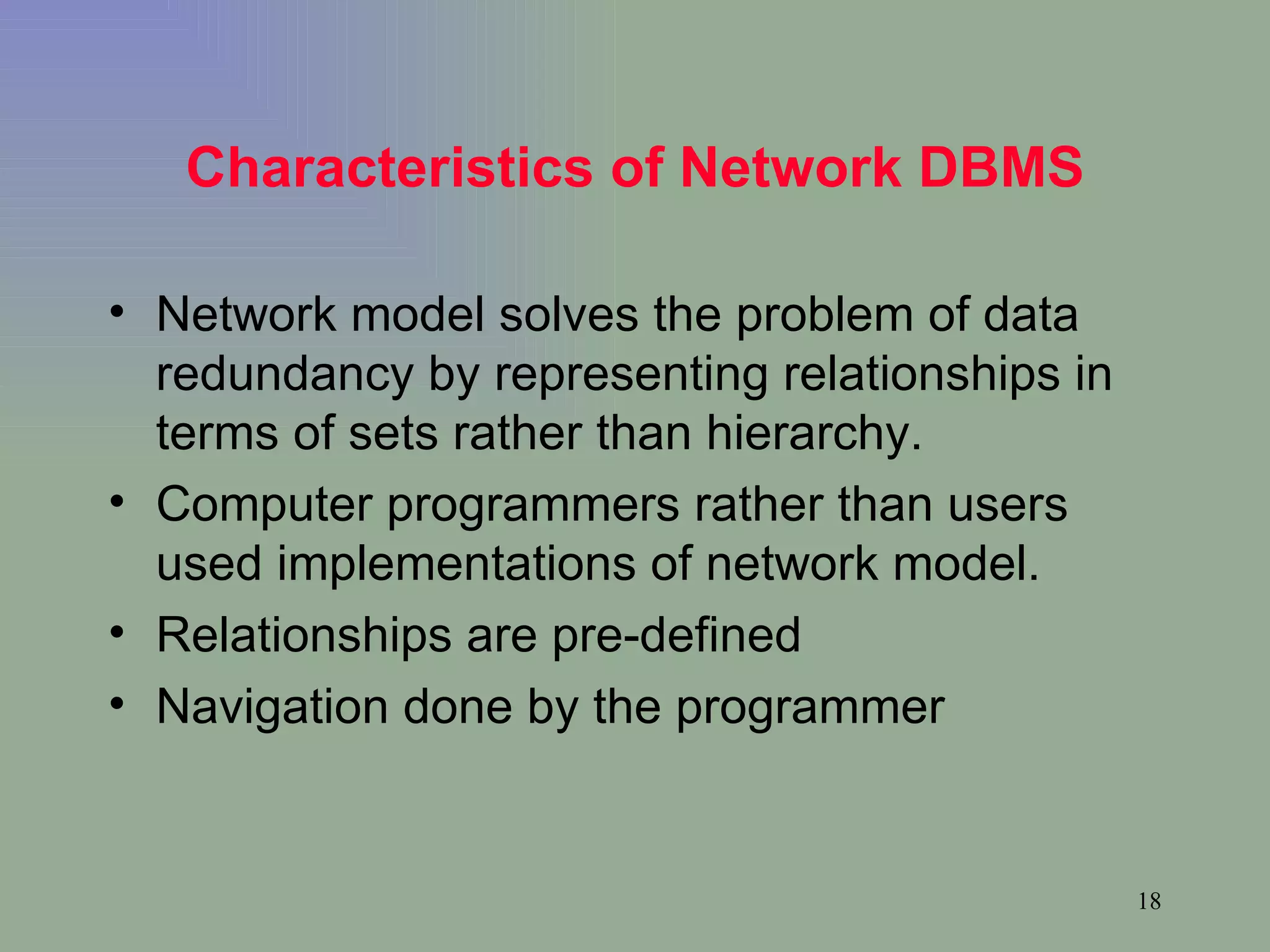
Characteristics of NetworkDBMS Network model solves the problem of data redundancy by representing relationships in terms of sets rather than hierarchy. Computer programmers rather than users used implementations of network model. Relationships are pre-defined Navigation done by the programmer
19.
File Based SystemsFile based Systems Data is stored in files Each file has special format Programs that use these files depend upon knowledge about that format Problems No standers Data duplication Data dependence No provision for security,recovery, concurrency etc….
20.
Relational Systems Problemswith early databases Navigating the records requires complex programs. There is minimal data independency No theoretical foundations Then in 1970’s E.F Codd wrote a “relational Model of data for large shared databanks” and introduce the relational model.
21.
The Relational database:Definitions“ A DBMS that manages data as collection of tables in which all data relationships are represented by common values in related tables.” “ A DBMS that follows all the twelve rules of CODD is called RDBMS”
22.
Relational Database definitionAll information must be represented explicitly in one and only one way: as values in tables and each & every datum in the database must be accessible by specifying a table name, a column name, and a primary key.
23.
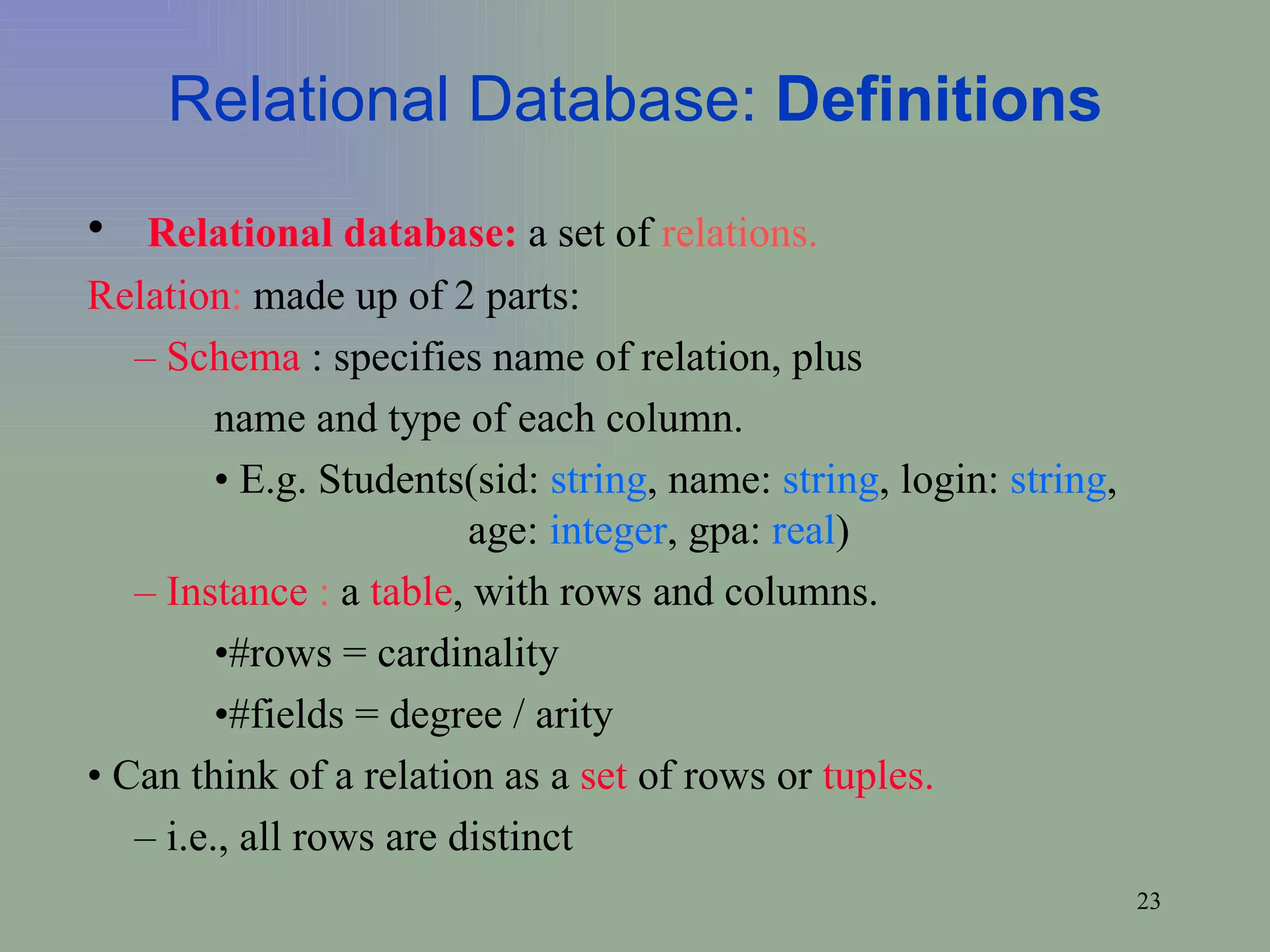
Relational Database: Definitions Relational database: a set of relations. Relation : made up of 2 parts: – Schema : specifies name of relation, plus name and type of each column. • E.g. Students(sid: string , name: string , login: string , age: integer , gpa: real ) – Instance : a table , with rows and columns. • #rows = cardinality • #fields = degree / arity • Can think of a relation as a set of rows or tuples. – i.e., all rows are distinct
24.
Relational Model The Relational Model developed by Dr. E. F. Codd at IBM in the late 1960s The model built on mathematical concepts, which expounded in the famous work called " A Relational Model of Data for Large Shared Databanks". At the core of the relational model is the concept of a table (also called a relation) in which all data is stored. R ecords ( horizontal rows also known as tuples) & F ields (vertical columns also known as attributes). It is important to note that how or where the tables of data are stored makes no difference. Table can be identified by a unique name. This is quite a bit different from the Hierarchical & Network models in which the user had to have an understanding of how the data was structured within the database in order to retrieve, insert, update, or delete records from the database.
25.
26.
Advantages: The data access methodology in relational model is quite different from and better than the earlier database models . Another benefit of the relational system is that it provides extremely useful tools for database administration. Meta-data (data about the table and field names which form the database structure, access rights to the database, integrity and data validation rules etc). Thus everything within the relational model can be stored in tables. This means that many relational systems can use operations recursively in order to provide information about the database.
Member of arelation type (set / table). All attribute names must be unique within a table / relation. A set of all possible values that can be attain by an attribute. Values currently contained in an attribute. Number of attributes in a relation / table. Rows in a table / relation. Number of tuples in a relation / table. Tuples: Relation / Table Degree: Attribute Value Set: Attribute Domain: Attribute Name: Attribute (field): Cardinality:
29.
Ex: Instance ofStudents Relation • Cardinality = 3, arity = 5 , all rows distinct Do all values in each column of a relation instance have to be distinct? Student(studno,name,address) Course(courseno,lecturer) Student(123,Bloggs,Woolton) (321,Jones,Owens) Schema Instance 3.8 19 [email_address] Blake 53777 3.2 18 [email_address] smith 53444 3.4 18 [email_address] Jones 53666 GPA age Login Name sid
30.
Database Schema Thedescription of the database is called database schema. A database schema is describe during database design and not expected to change frequently. Schema Diagram Displayed schema is called schema diagram. Each object in schema is called a schema construct.
31.
Database instance (occurrenceor state) The data in a database at a particular moment of time. Intension & Extension The schema is sometimes called the intension and a database instance is called an extension of the schema.
32.
Relational Database ConceptsField Record Table Classical W.A. Mozart Requiem 3 Jazz John Coltrane Blue Train 2 Rock Pink Floyd The Wall 1 Genre Artist Title CD_ID
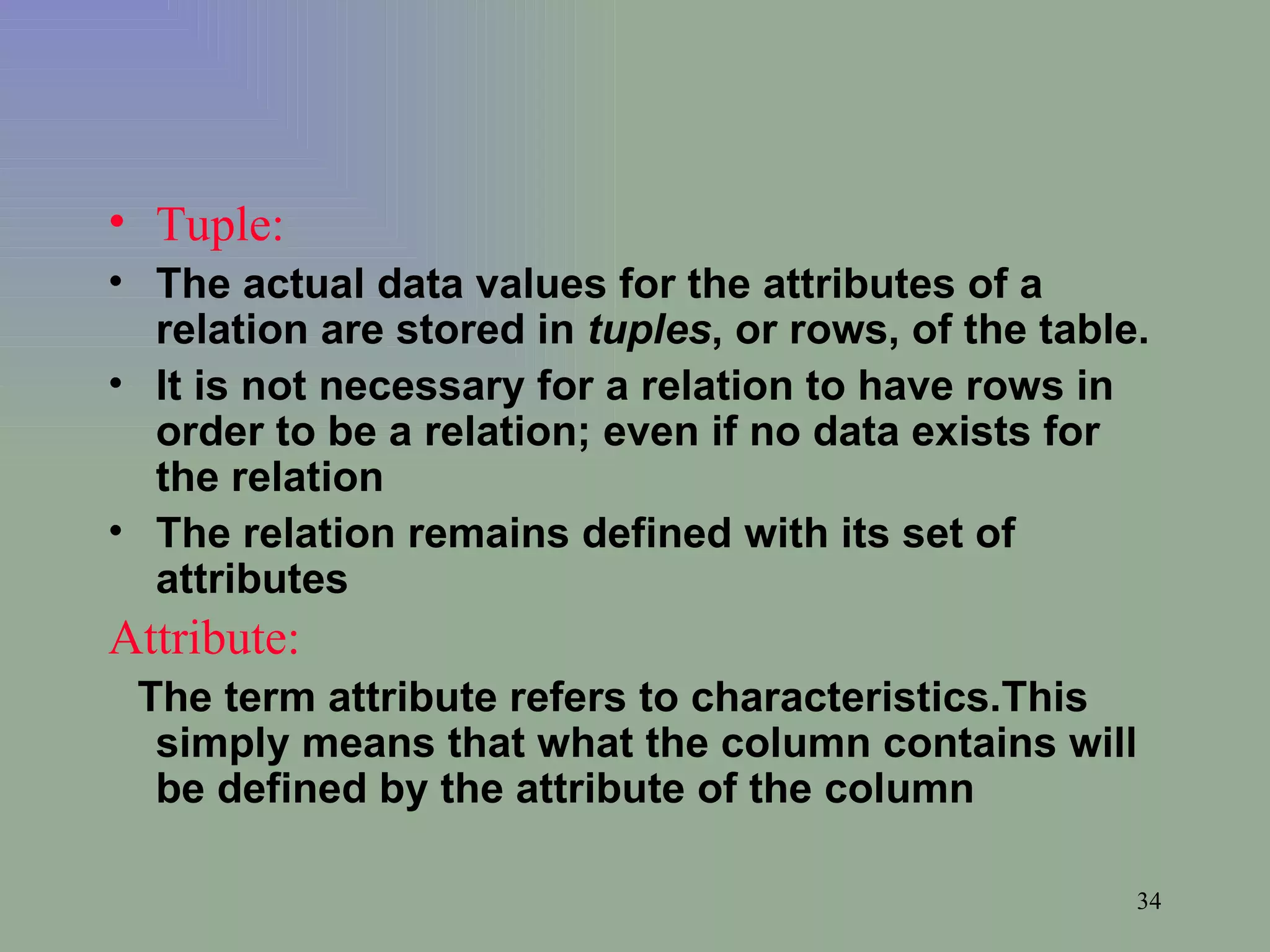
Tuple: The actual data values for the attributes of a relation are stored in tuples , or rows, of the table. It is not necessary for a relation to have rows in order to be a relation; even if no data exists for the relation The relation remains defined with its set of attributes Attribute: The term attribute refers to characteristics.This simply means that what the column contains will be defined by the attribute of the column
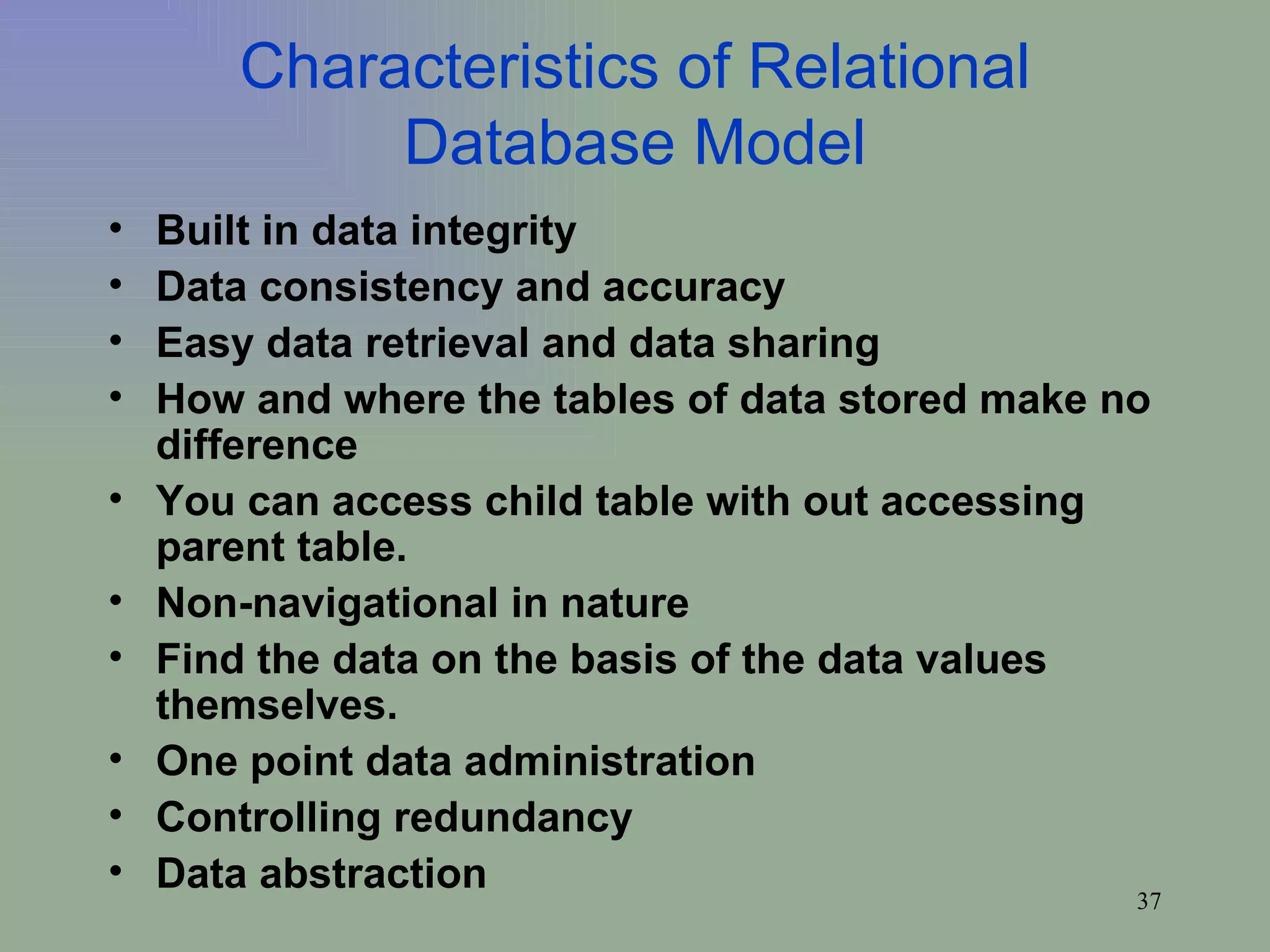
Characteristics of RelationalDatabase Model Built in data integrity Data consistency and accuracy Easy data retrieval and data sharing How and where the tables of data stored make no difference You can access child table with out accessing parent table. Non-navigational in nature Find the data on the basis of the data values themselves. One point data administration Controlling redundancy Data abstraction
38.
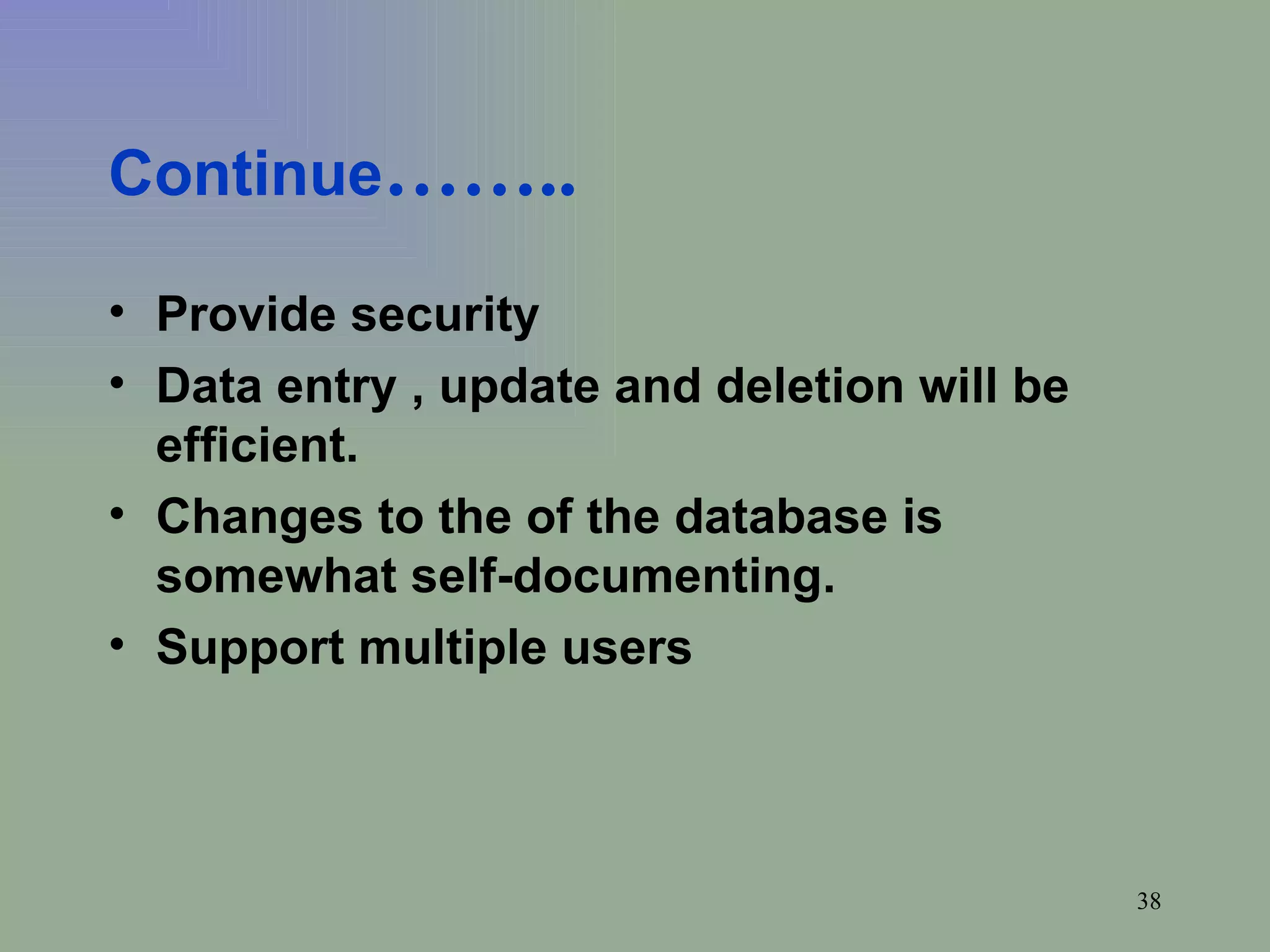
Continue …….. Providesecurity Data entry , update and deletion will be efficient. Changes to the of the database is somewhat self-documenting. Support multiple users
39.
Difference between aDBMS and RDBMS RDBMS normally use a 4GL DBMS normally use 3GL Examples are ORACLE, INGRESS, SQL Server 2000 etc Examples are dBase, FOXBASE, etc Uses concept of table Uses concept of a file Platform used can be any DOS, UNIX,VAX,VMS, etc Platform used is normally DOS Hardware and Software requirements are High Hardware and Software requirements are minimum Speed of operation is very Fast Speed of operation is very slow It is based on the concept Of relationships The concepts of relationships is missing in a DBMS. If it exits it is very less. RDBMS DBMS
40.
Popular DBMS InThe Market Sybase SQL Anywhere Informix Dynamic Server Borland Interbase
41.
Popular RDBMS thatsupport SQL Oracle Sybase Microsoft SQL Server Informix Ingress DB2
42.
Typical Components SoftwareUsers Data DBMS Database “ How” to get Application Programs “ What” to get End users interact Application Programmers develop Database Designers design maintain Database Administrators
43.
RDMS Components File Manager – Manage the allocation of space and the way the data organized and represented in storage Database Manager – acts an interface between the users and the data in the database. Query Processor – Interprets the queries issued by the database users. Data Dictionary – storehouse of the data DML Pre compiler – interprets insert,delete and modify statements DDL Complier – interprets create statements
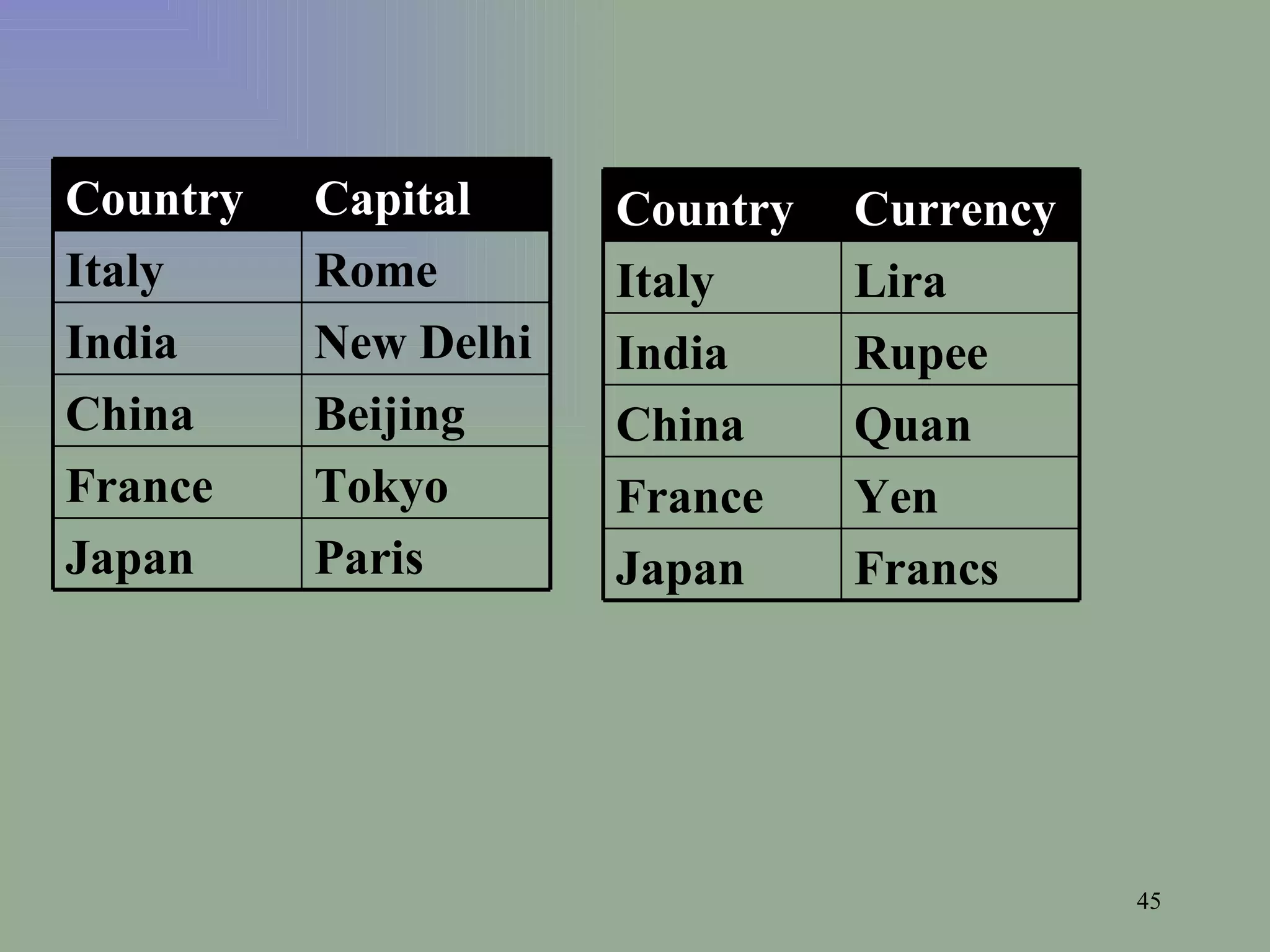
Tokyo France ParisJapan Beijing China New Delhi India Rome Italy Capital Country Francs Japan Yen France Quan China Rupee India Lira Italy Currency Country
46.
47.
Data about variousentities and their relationships are stored in a series of logical tables (also known as relations). A relation is a two-dimensional table with certain imposed restrictions: 1. Each Row is unique: No duplicate row 2. Entries in any column have the same domain. 3. Each column has a unique name 4. Order of the columns or rows is irrelevant 5. Each entry in the table is single valued: No group item, repeating group, or array is allowed. PRINCIPLES OF RELATIONAL MODEL Note: A domain is the set of all possible values an attribute may assume. Example: Domain of Major= (Acct, Mktg, Mgmt, ISOM, Fina)
![Ex: Instance of Students Relation • Cardinality = 3, arity = 5 , all rows distinct Do all values in each column of a relation instance have to be distinct? Student(studno,name,address) Course(courseno,lecturer) Student(123,Bloggs,Woolton) (321,Jones,Owens) Schema Instance 3.8 19 [email_address] Blake 53777 3.2 18 [email_address] smith 53444 3.4 18 [email_address] Jones 53666 GPA age Login Name sid](https://image.slidesharecdn.com/dbms-lec-uog-02-090604082302-phpapp01/75/Dbms-Lec-Uog-02-29-2048.jpg)


![Database System Concepts AND architecture [Autosaved].pptx](https://cdn.slidesharecdn.com/ss_thumbnails/databasesystemconceptsandarchitectureautosaved-230817173311-be7f8590-thumbnail.jpg?width=640&height=640&fit=bounds)


