Microscopes! 
Regents Biology
Mutual dependence: Science & Technology 
 Technology…the pragmatist 
 Does it work? 
 Is it useful? 
 Is it sustainable? 
 Science…the idealist 
 What is it? 
 How does it work? 
 What does it tell us? 
Regents Biology
Mutual dependence: Science & Technology 
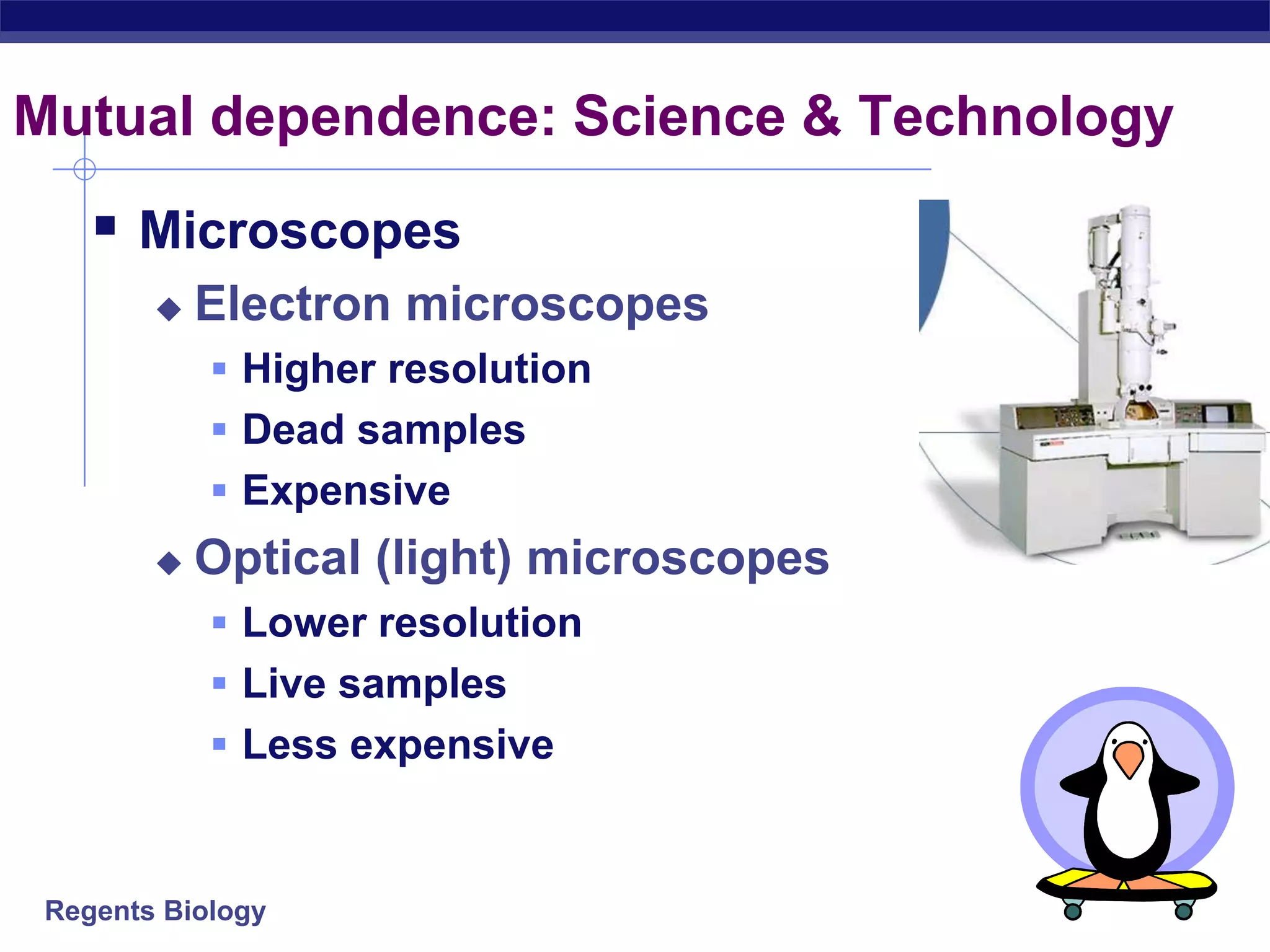
 Microscopes 
 Electron microscopes 
 Higher resolution 
 Dead samples 
 Expensive 
 Optical (light) microscopes 
 Lower resolution 
 Live samples 
 Less expensive 
Regents Biology
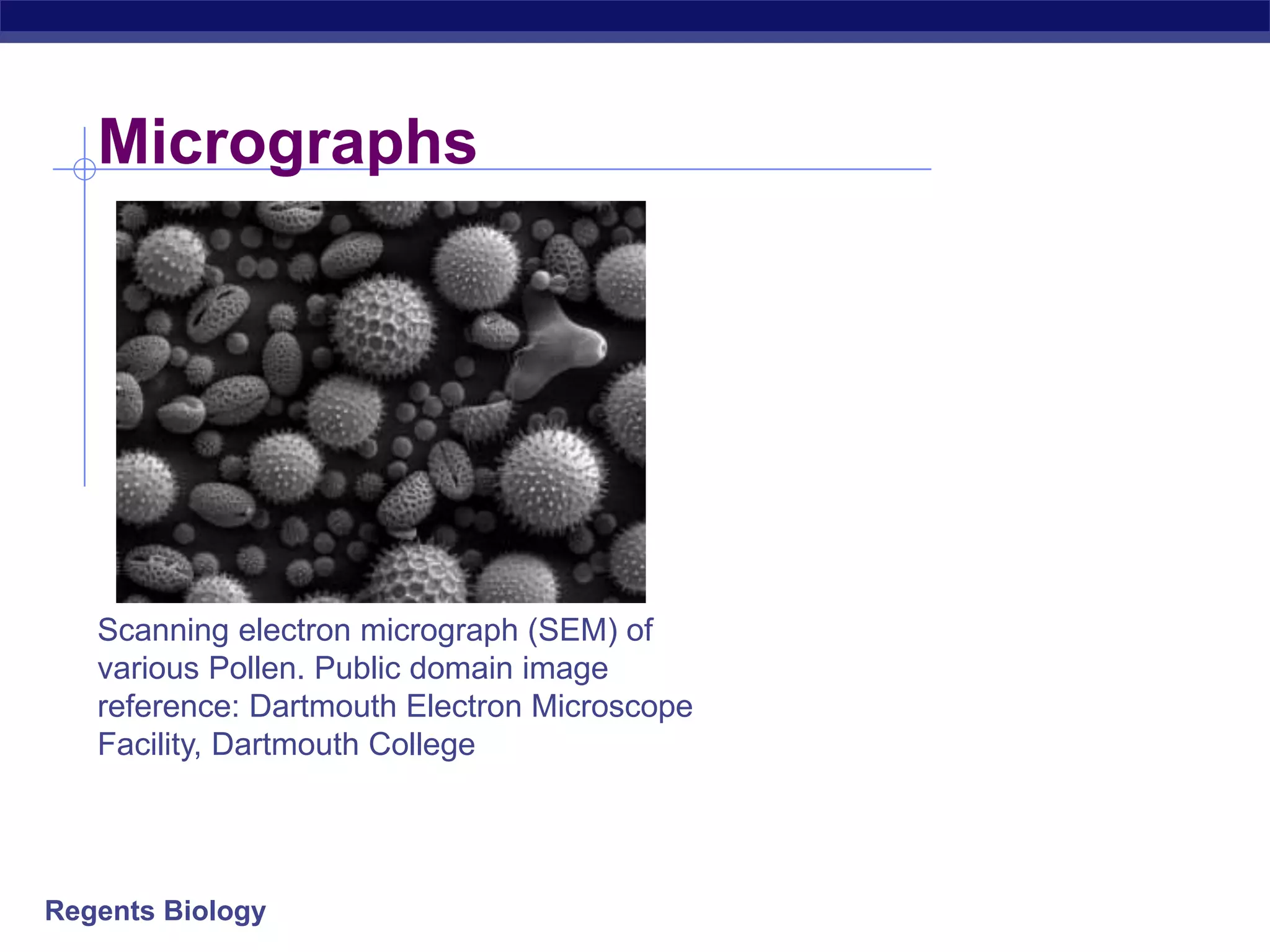
Micrographs 
Scanning electron micrograph (SEM) of 
various Pollen. Public domain image 
reference: Dartmouth Electron Microscope 
Facility, Dartmouth College 
Regents Biology
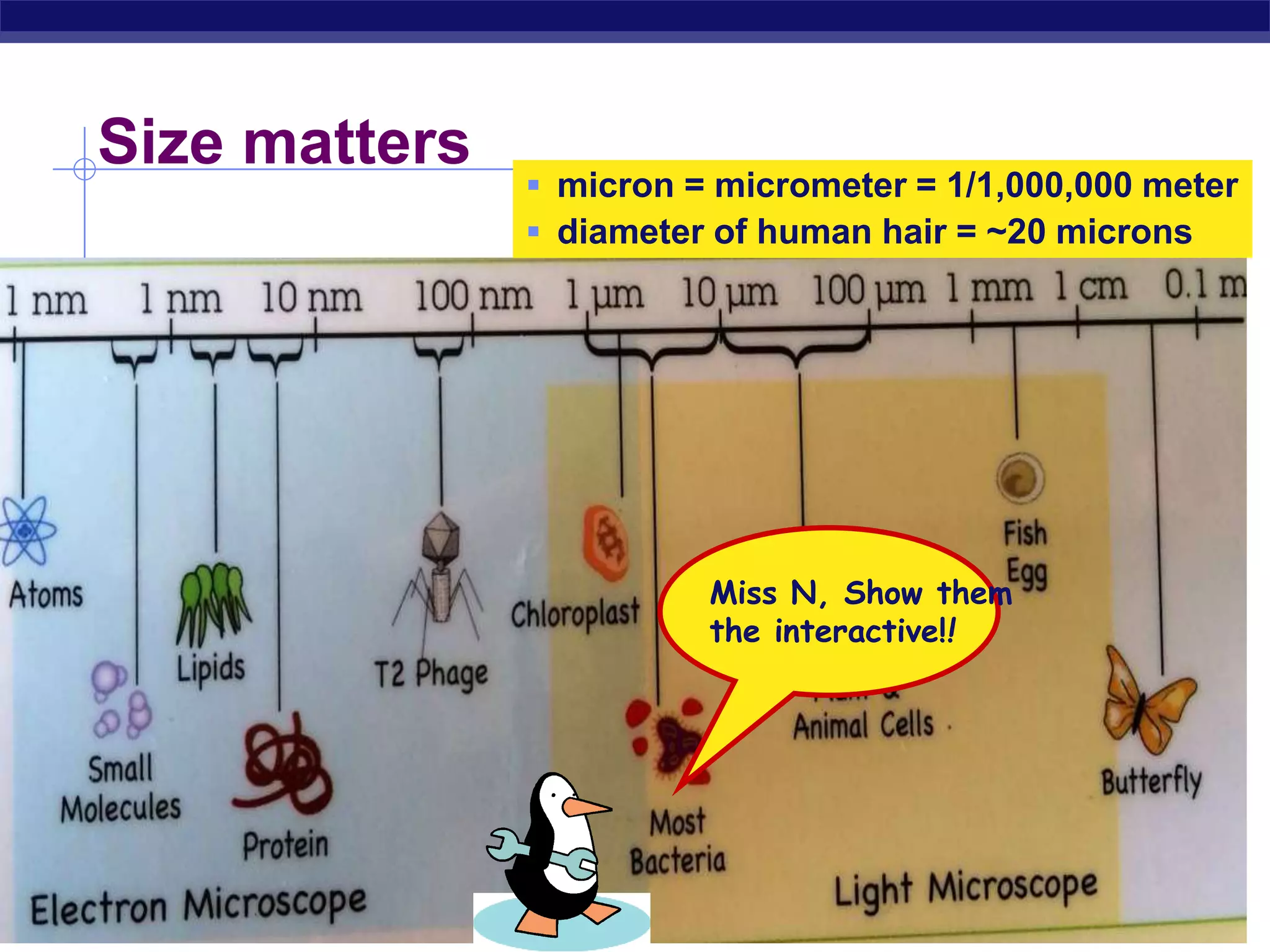
Size matters 
Regents Biology 
 micron = micrometer = 1/1,000,000 meter 
 diameter of human hair = ~20 microns 
Miss N, Show them 
the interactive!!
Microscopic units of measurement 
Regents Biology
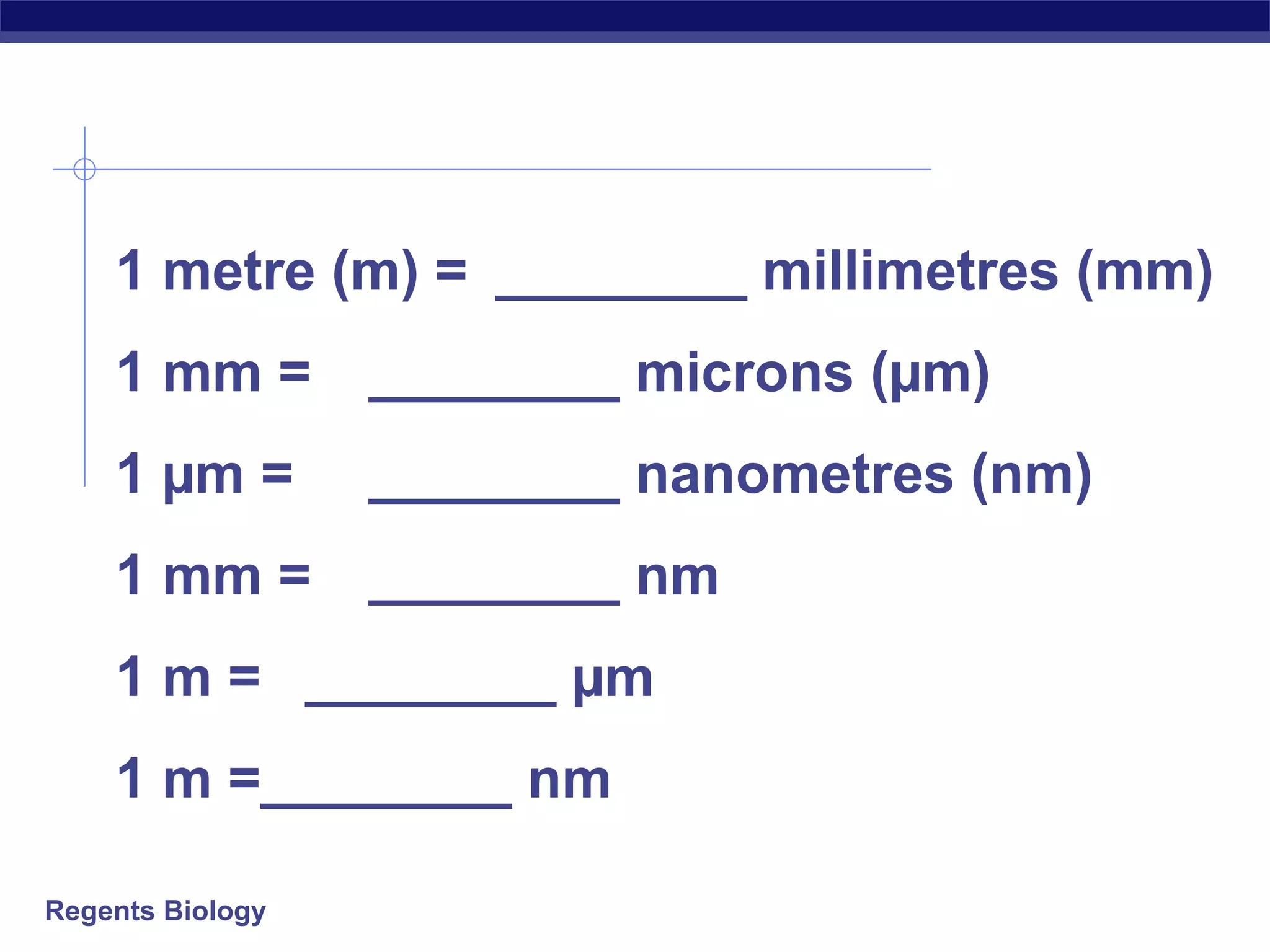
1 metre (m) = ________ millimetres (mm) 
1 mm = ________ microns (μm) 
1 μm = ________ nanometres (nm) 
1 mm = ________ nm 
1 m = ________ μm 
1 m =________ nm 
Regents Biology
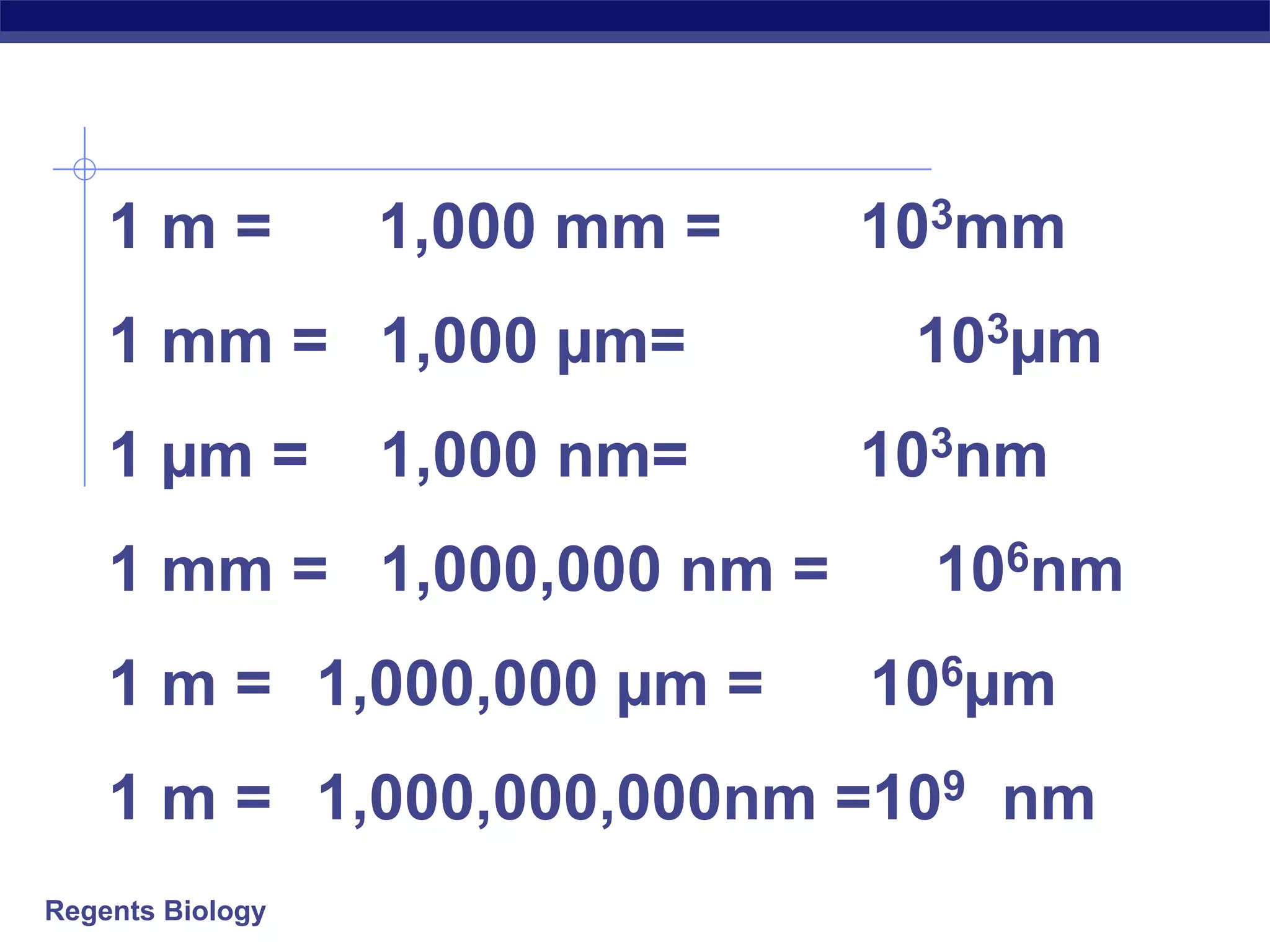
1 m = 1,000 mm = 103mm 
1 mm = 1,000 μm= 103μm 
1 μm = 1,000 nm= 103nm 
1 mm = 1,000,000 nm = 106nm 
1 m = 1,000,000 μm = 106μm 
1 m = 1,000,000,000nm =109 nm 
Regents Biology
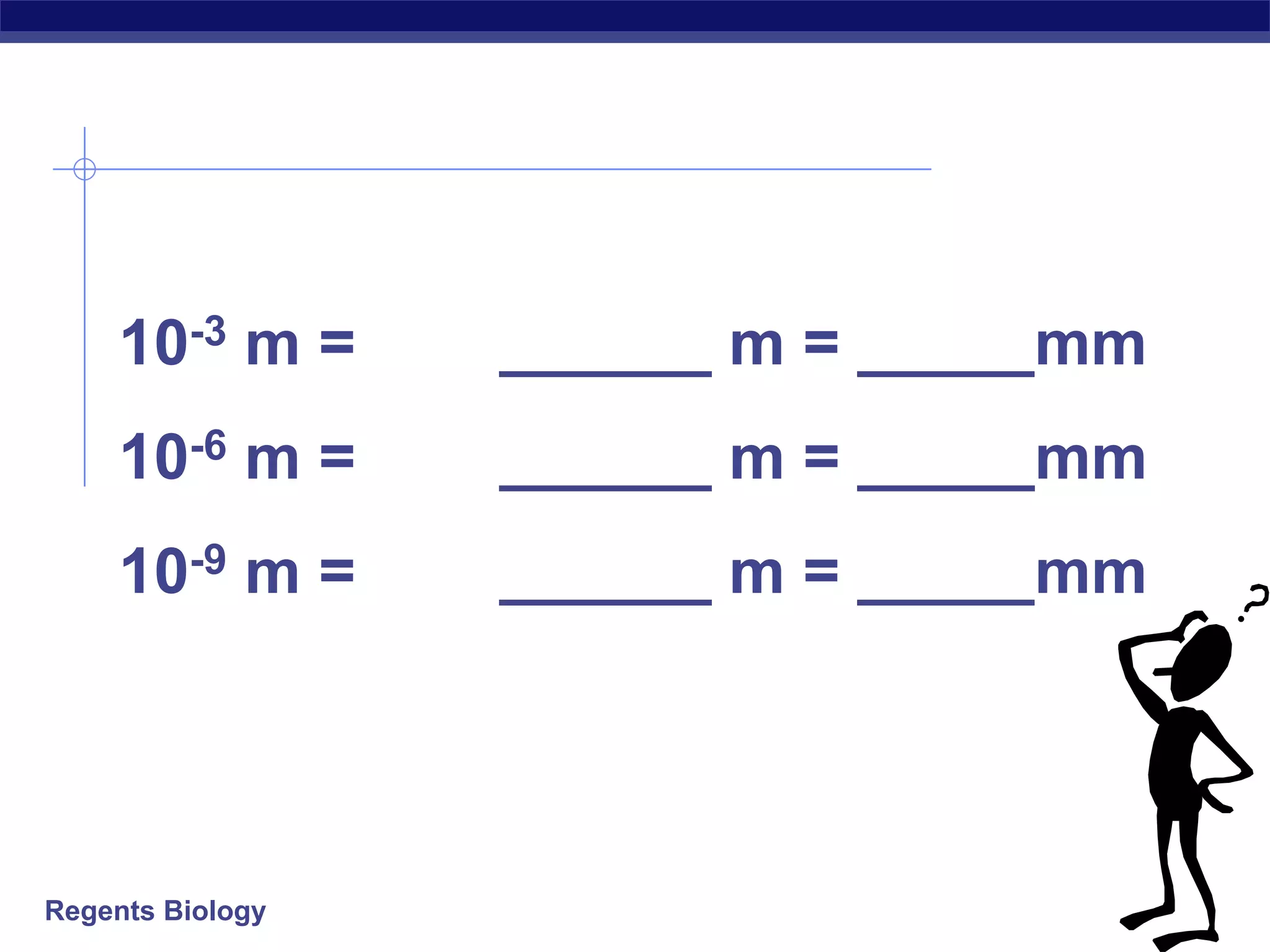
10-3 m = ______ m = _____mm 
10-6 m = ______ m = _____mm 
10-9 m = ______ m = _____mm 
Regents Biology
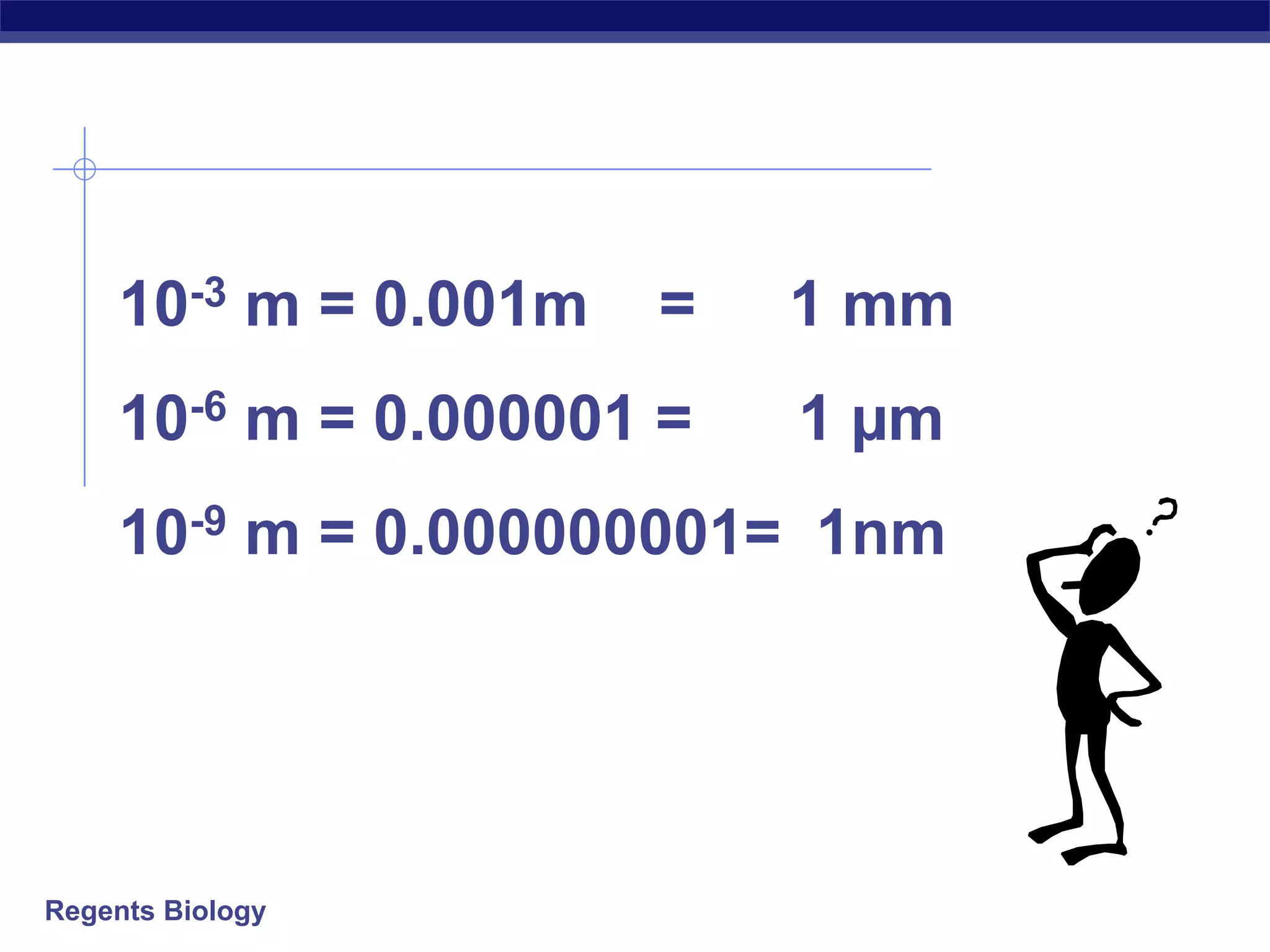
10-3 m = 0.001m = 1 mm 
10-6 m = 0.000001 = 1 μm 
10-9 m = 0.000000001= 1nm 
Regents Biology
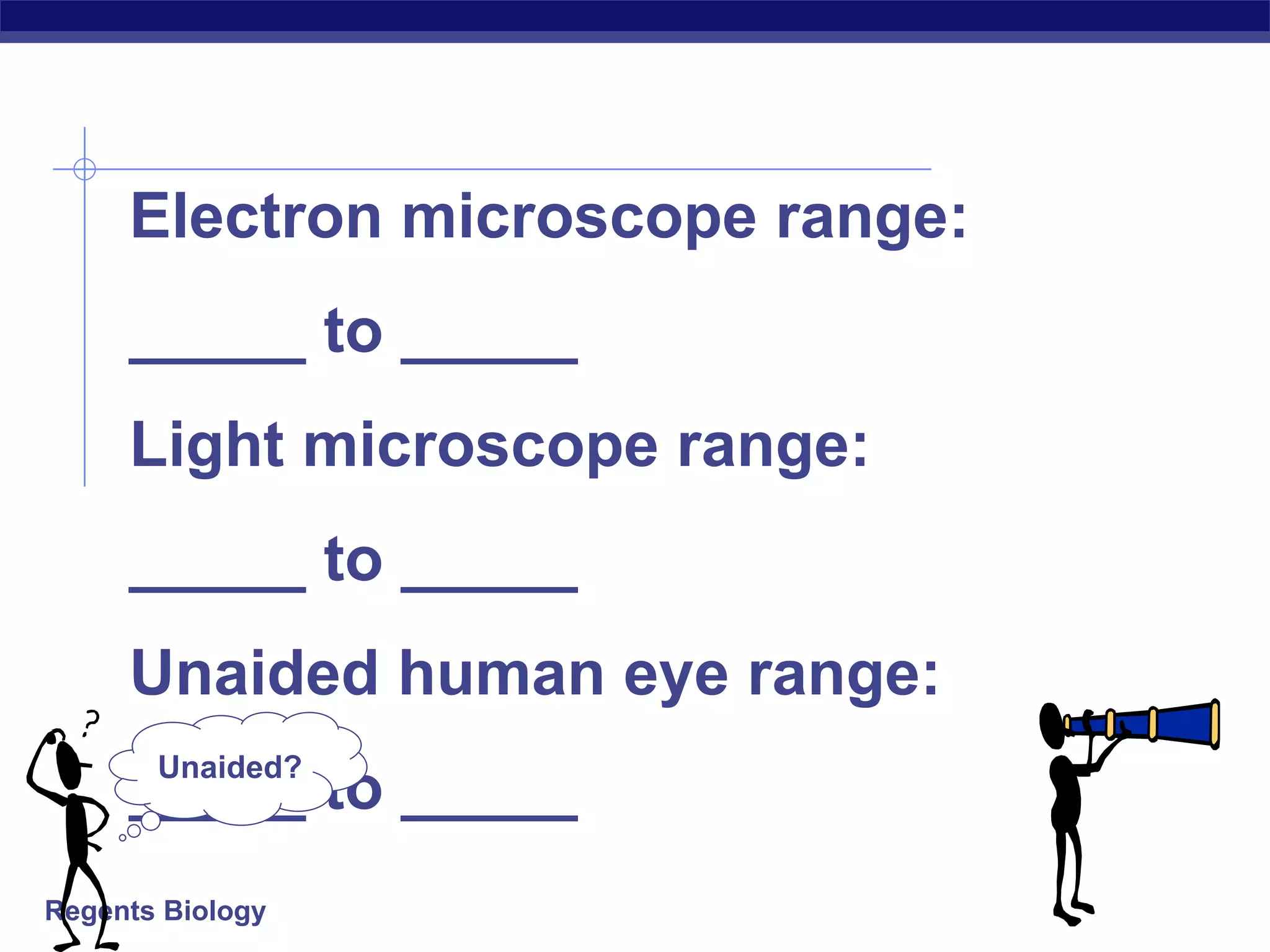
Electron microscope range: 
_____ to _____ 
Light microscope range: 
_____ to _____ 
Unaided human eye range: 
_____ to _____ Unaided? 
Regents Biology
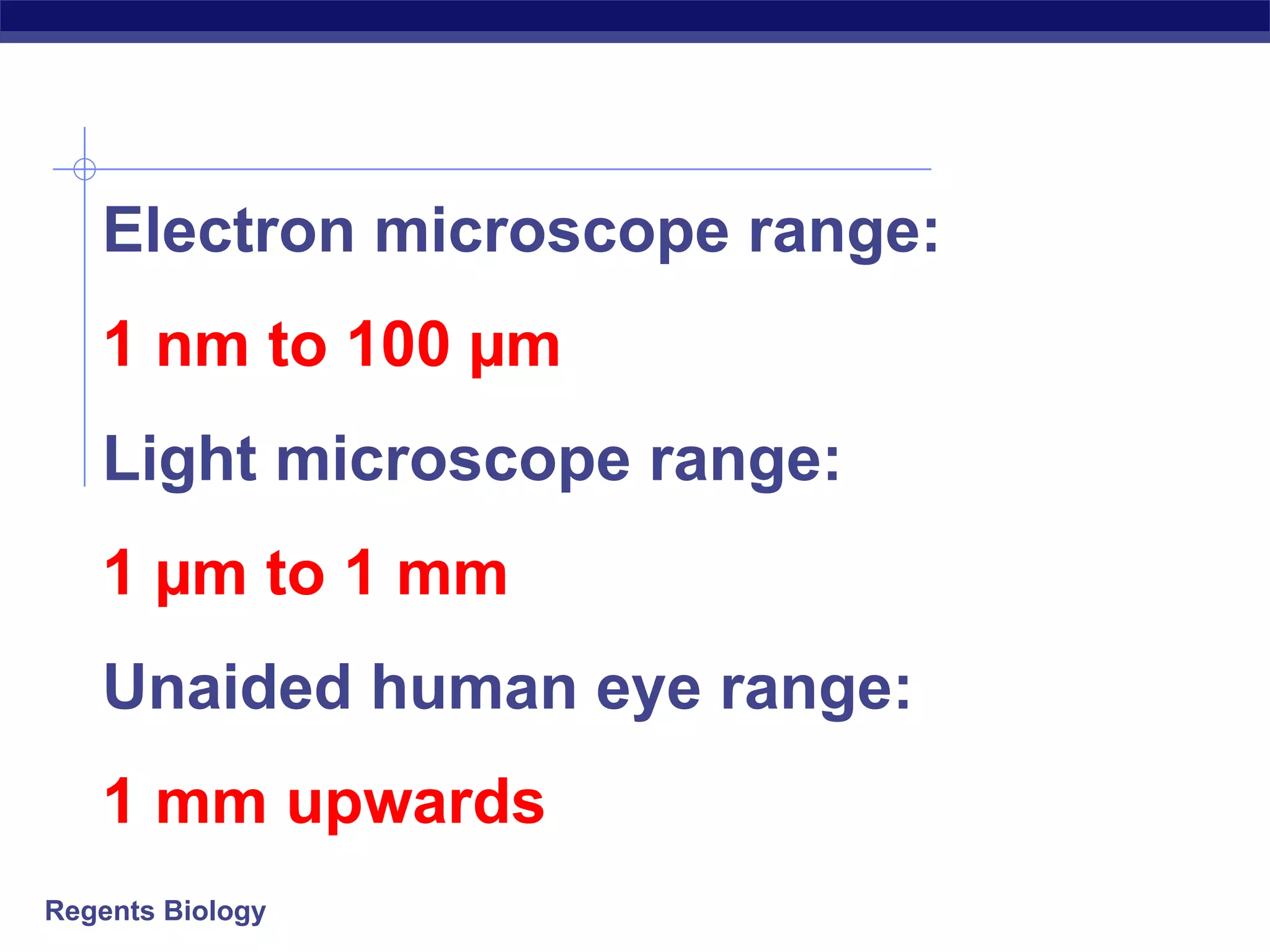
Electron microscope range: 
1 nm to 100 μm 
Light microscope range: 
1 μm to 1 mm 
Unaided human eye range: 
1 mm upwards 
Regents Biology
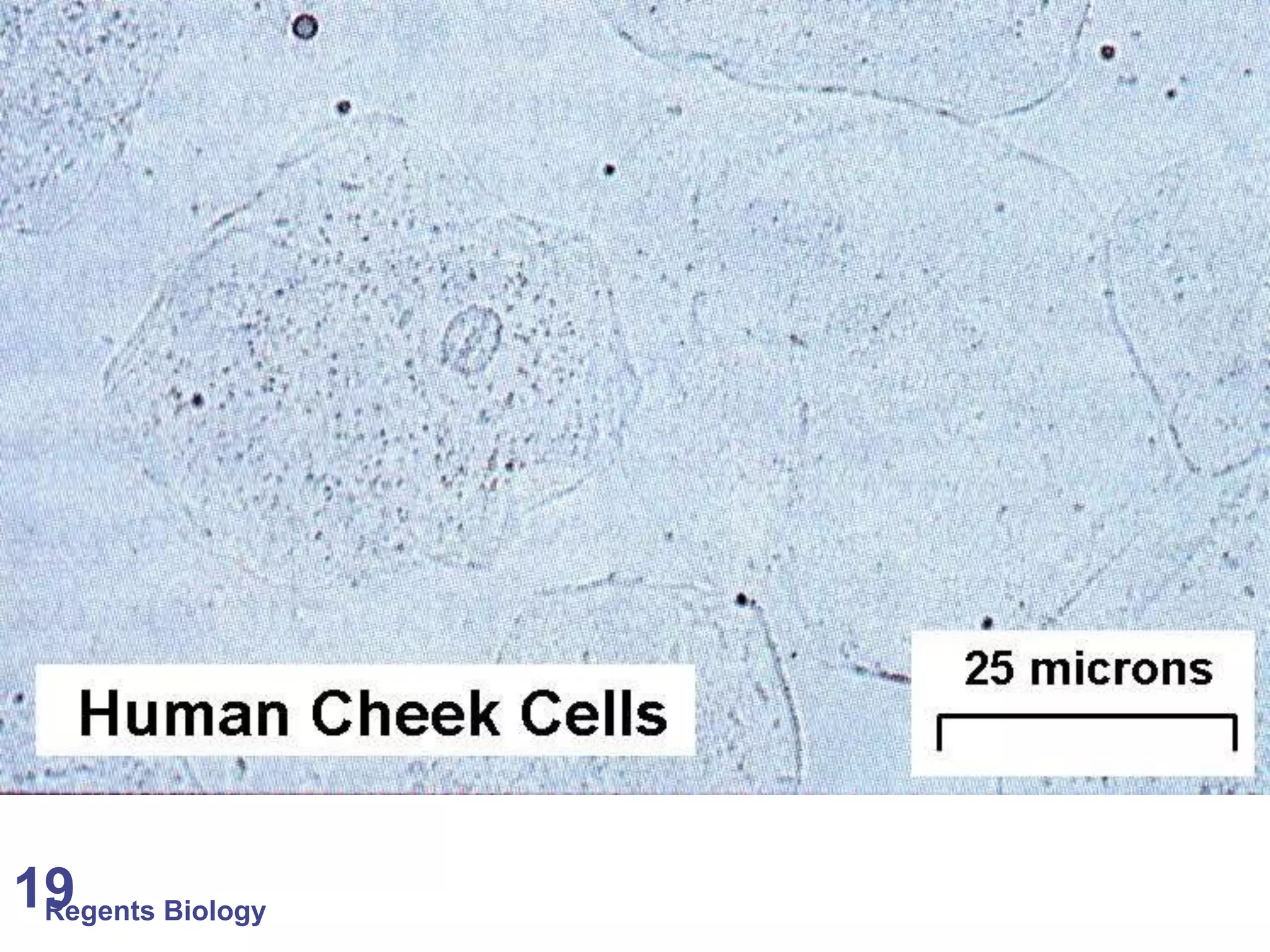
Name that micrograph 
Light microscope 
or 
Electron microscope? 
Regents Biology
Regents Biology 19
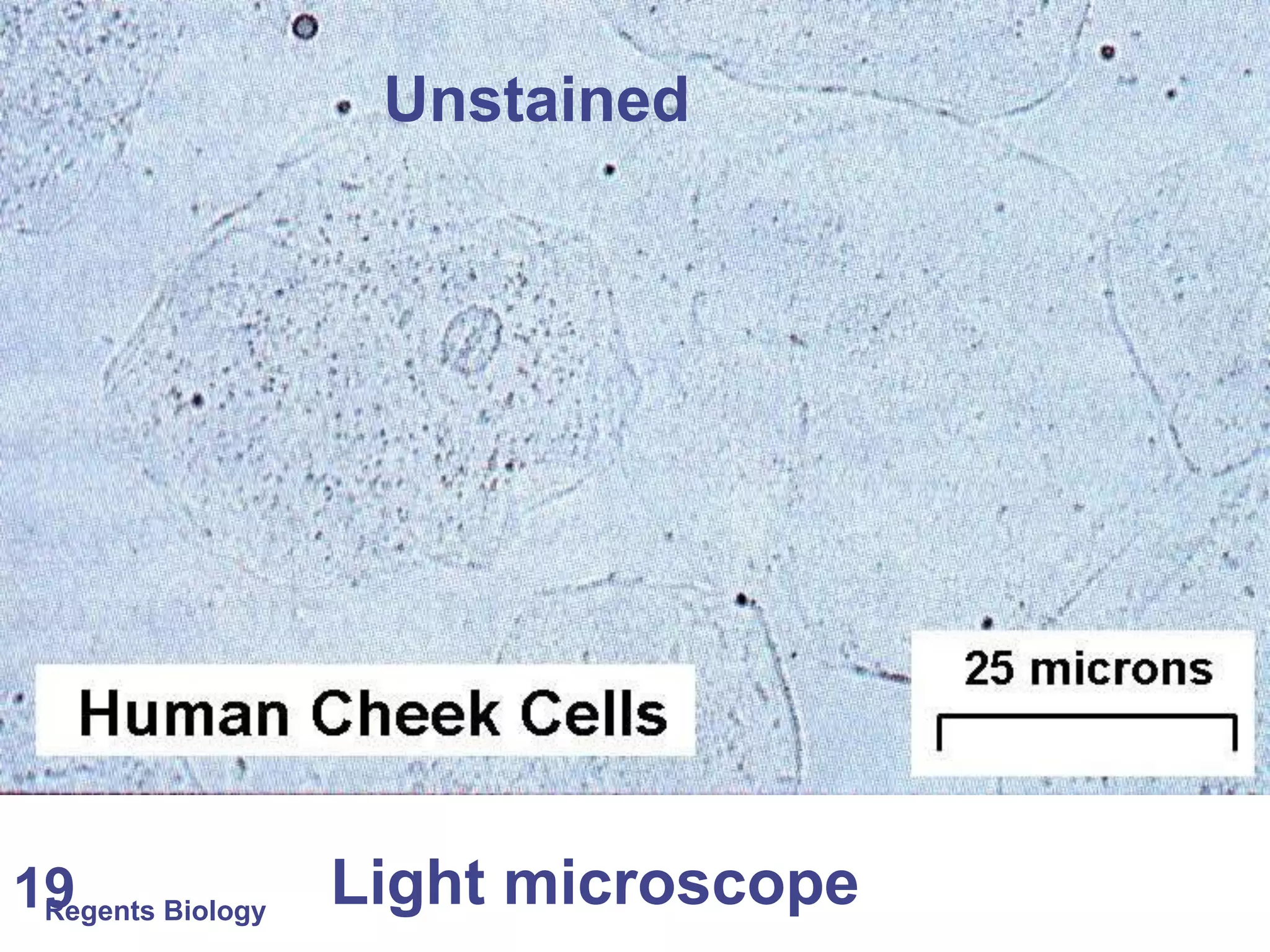
Unstained 
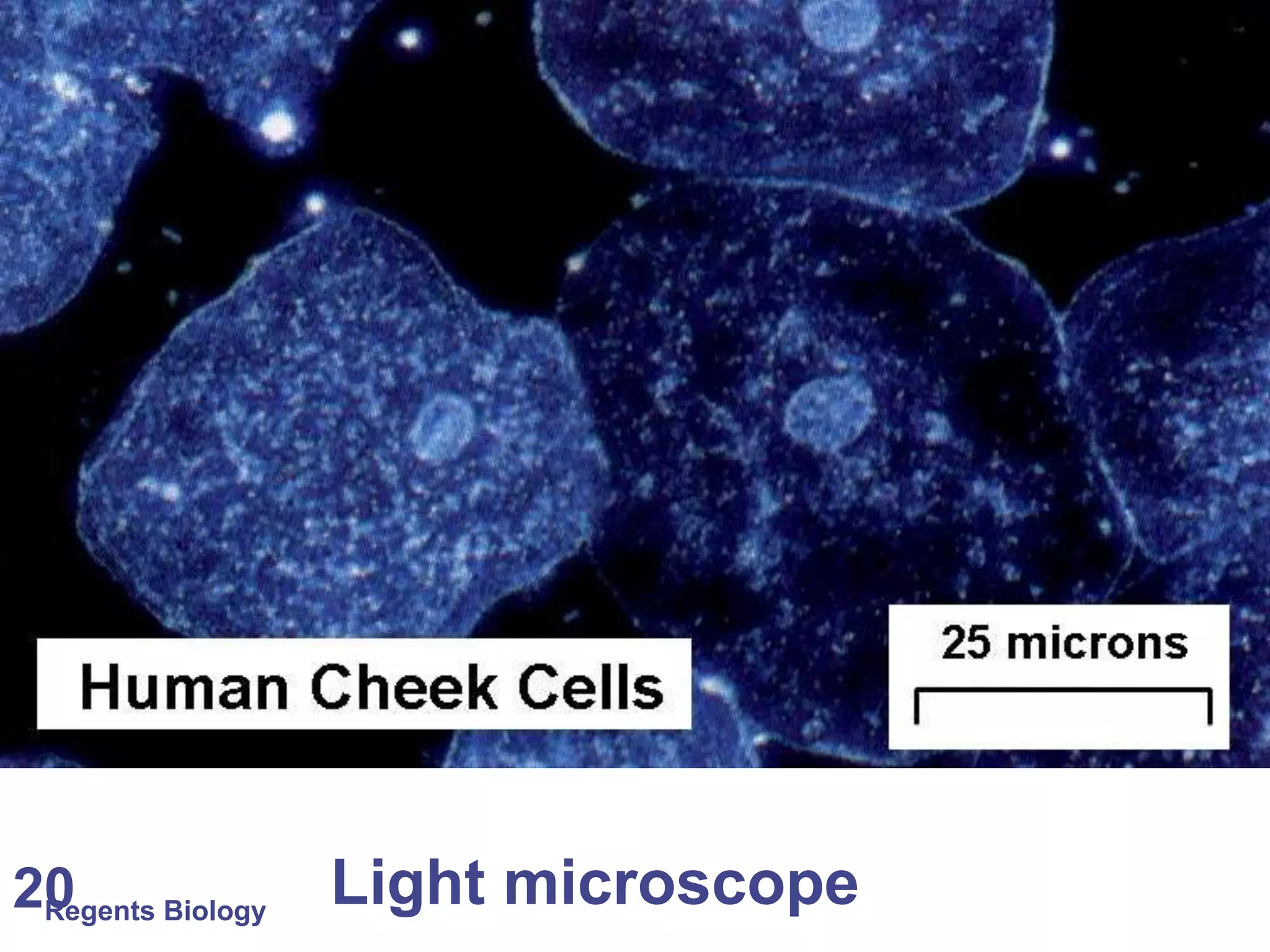
Regents Biology 19 Light microscope
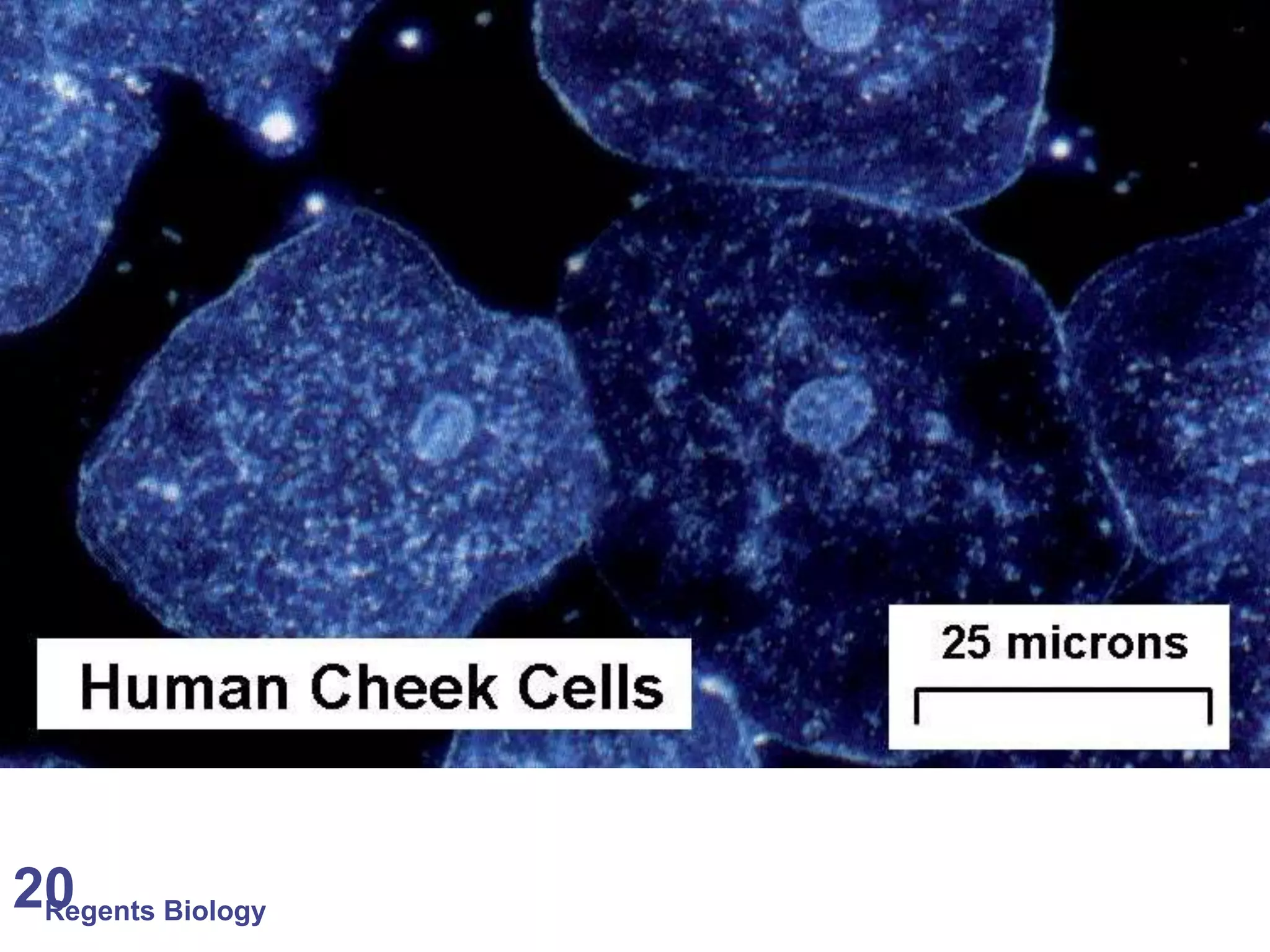
Regents Biology 20
Regents Biology 20 Light microscope
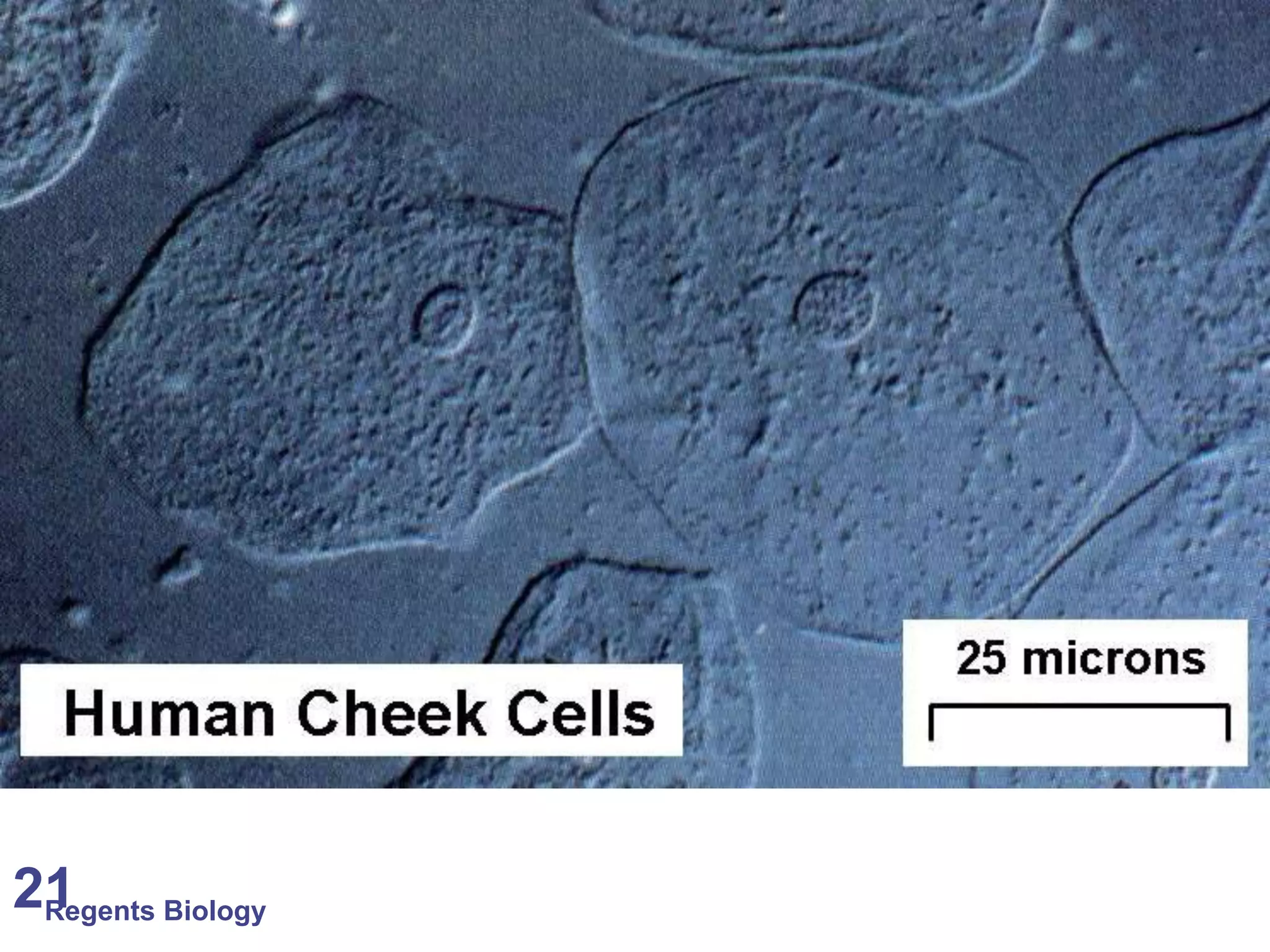
Regents Biology 21
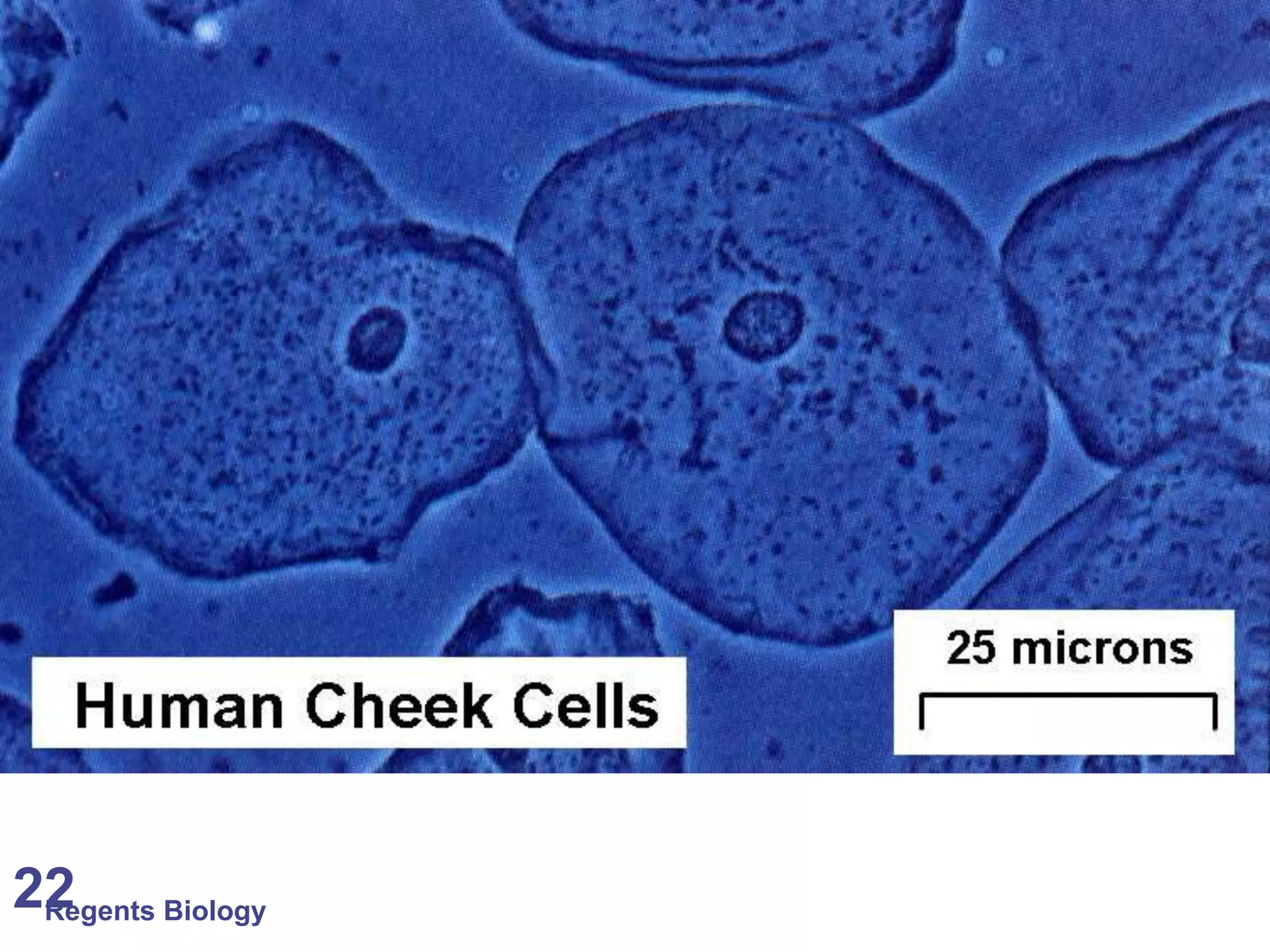
Regents Biology 22
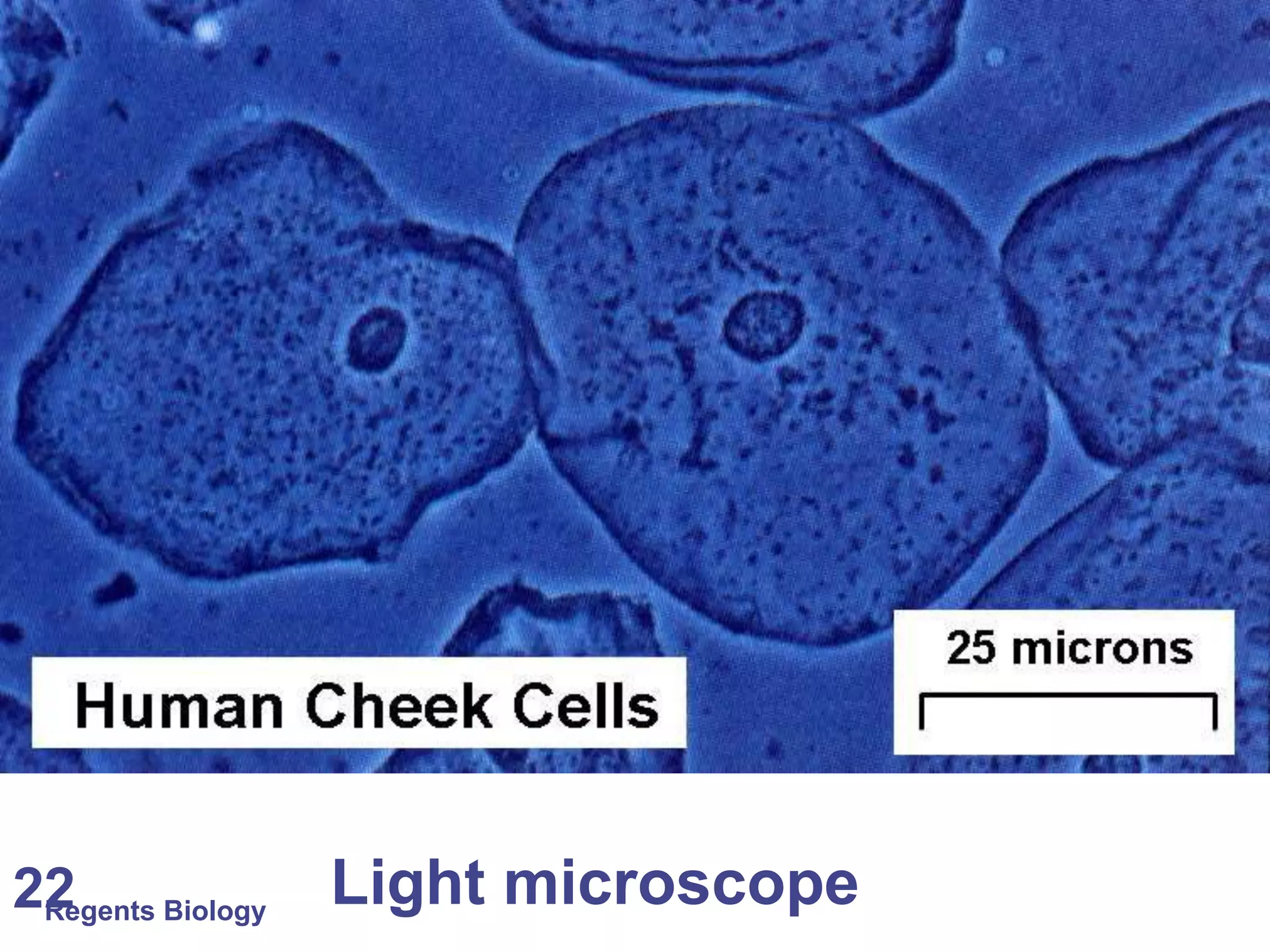
Regents Biology 22 Light microscope
Regents Biology 23 
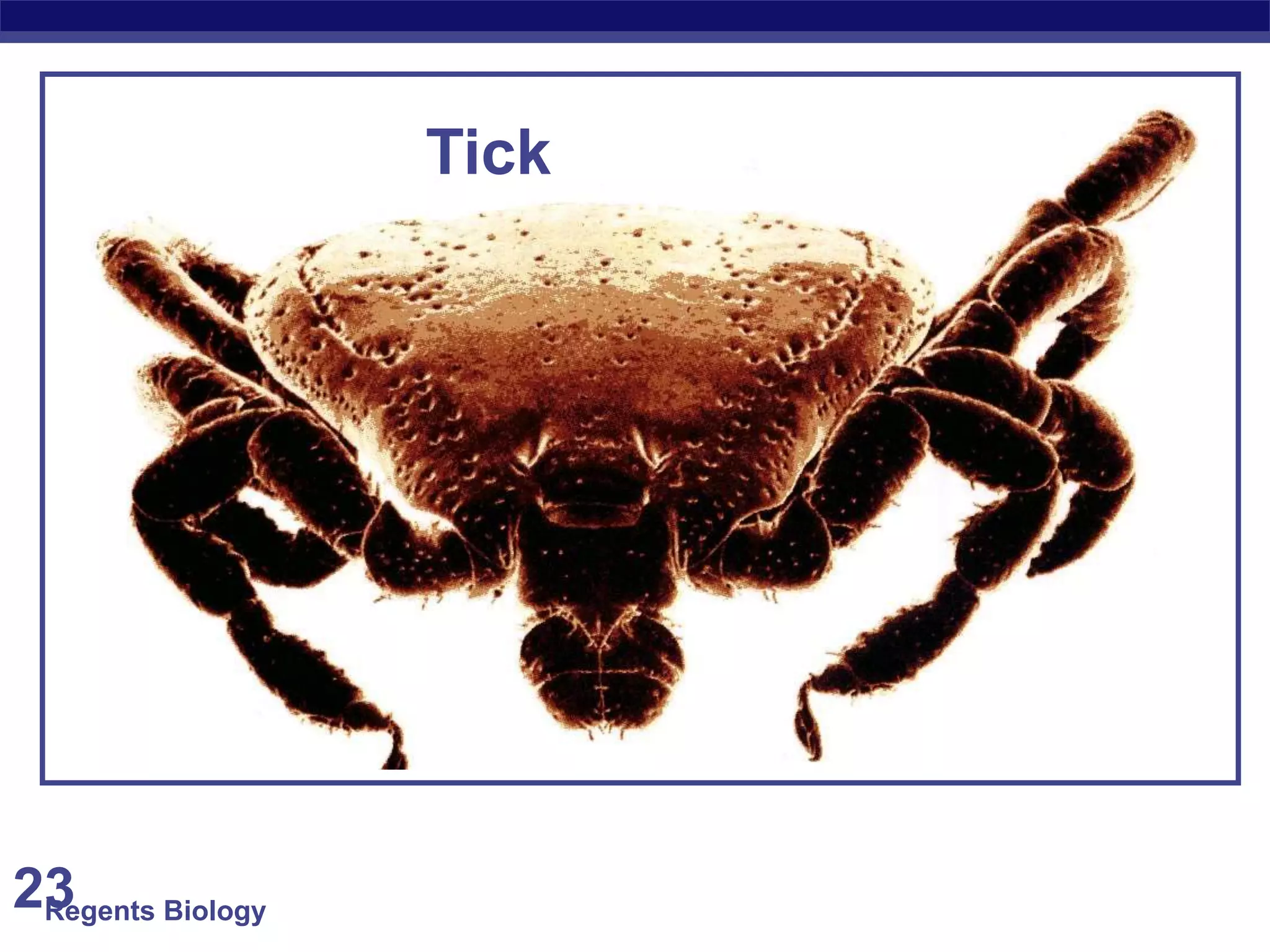
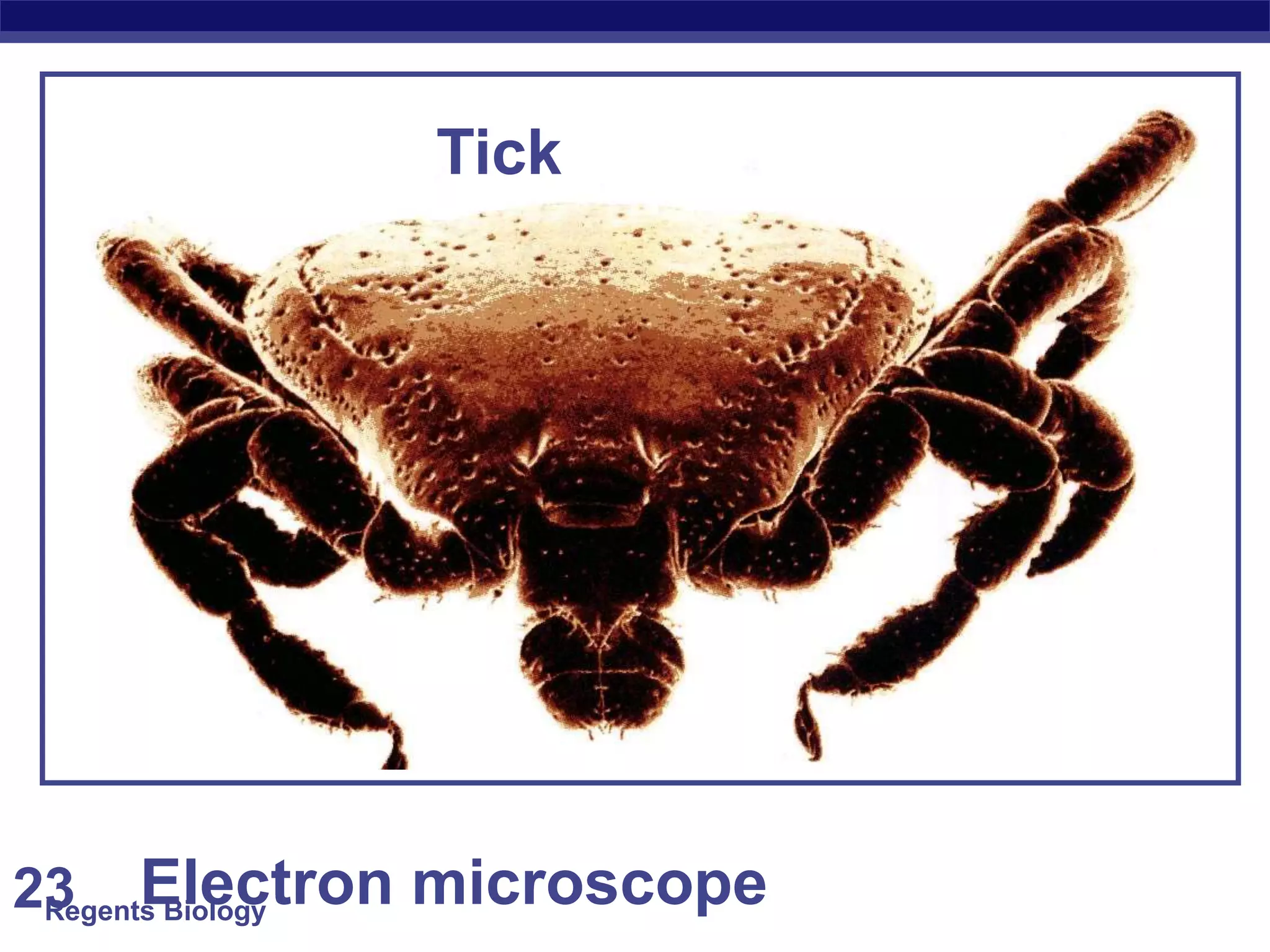
Tick
Tick 
Regents Biology 23 Electron microscope
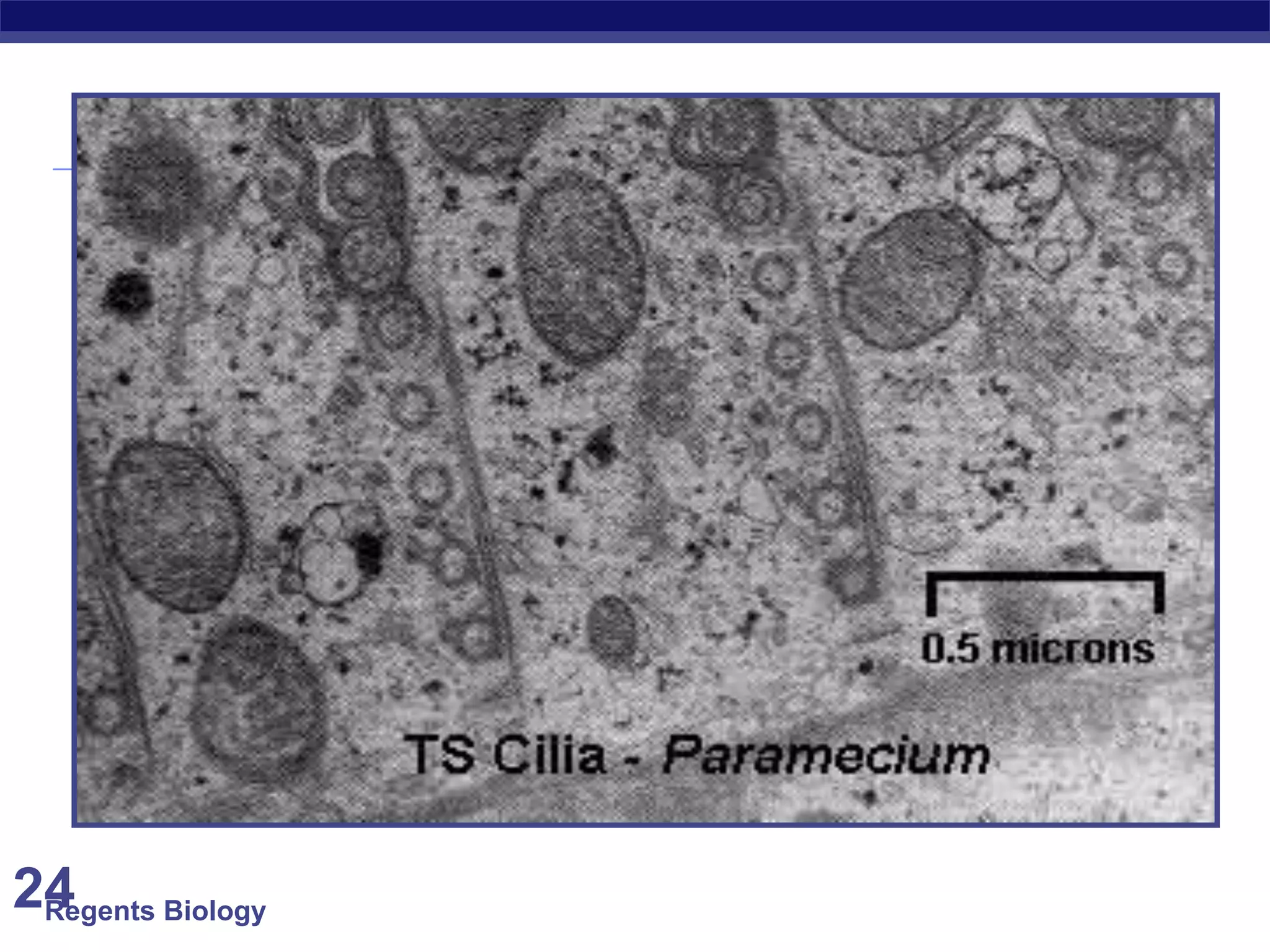
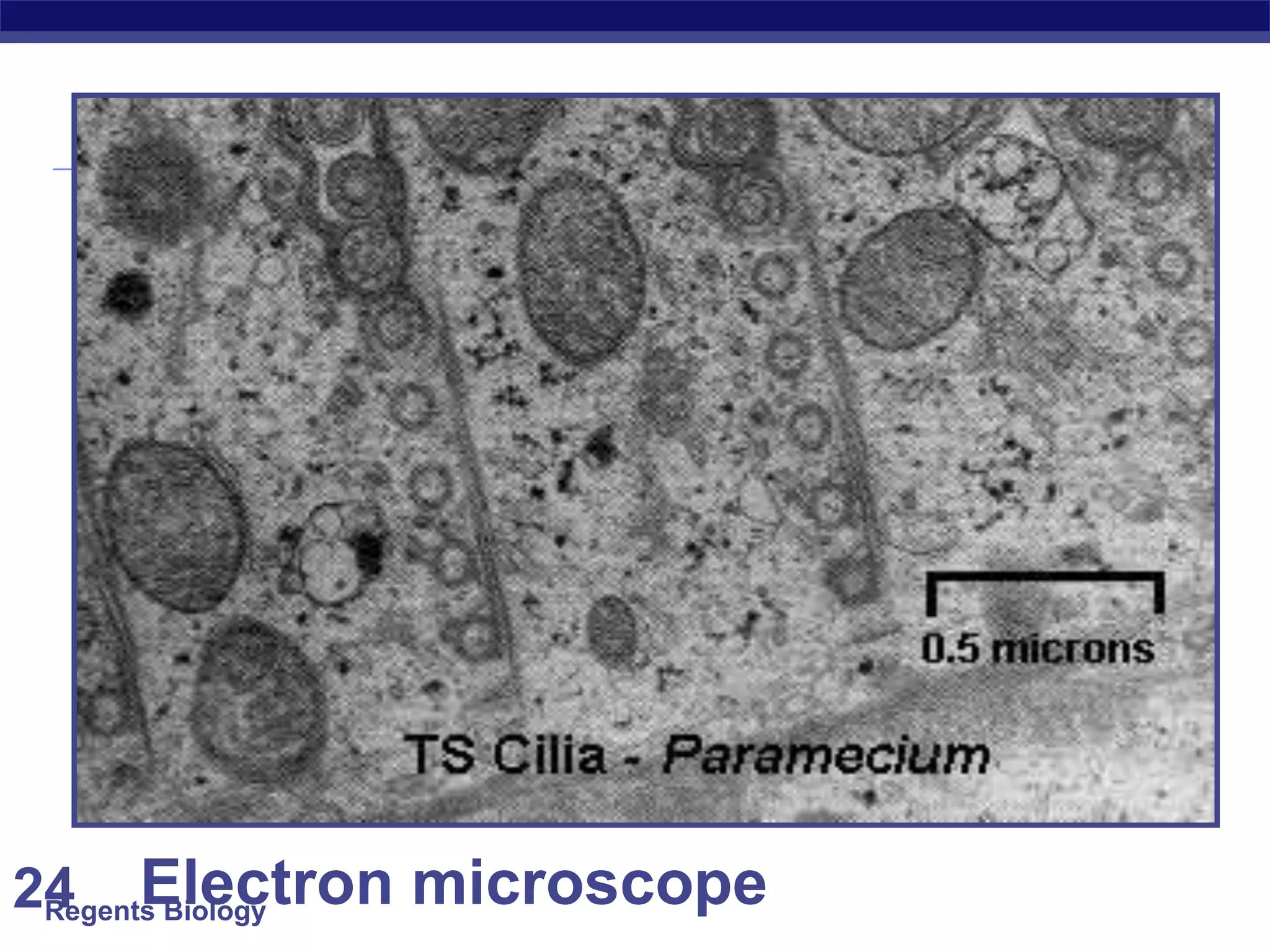
Regents Biology 24
Regents Biology 24 Electron microscope
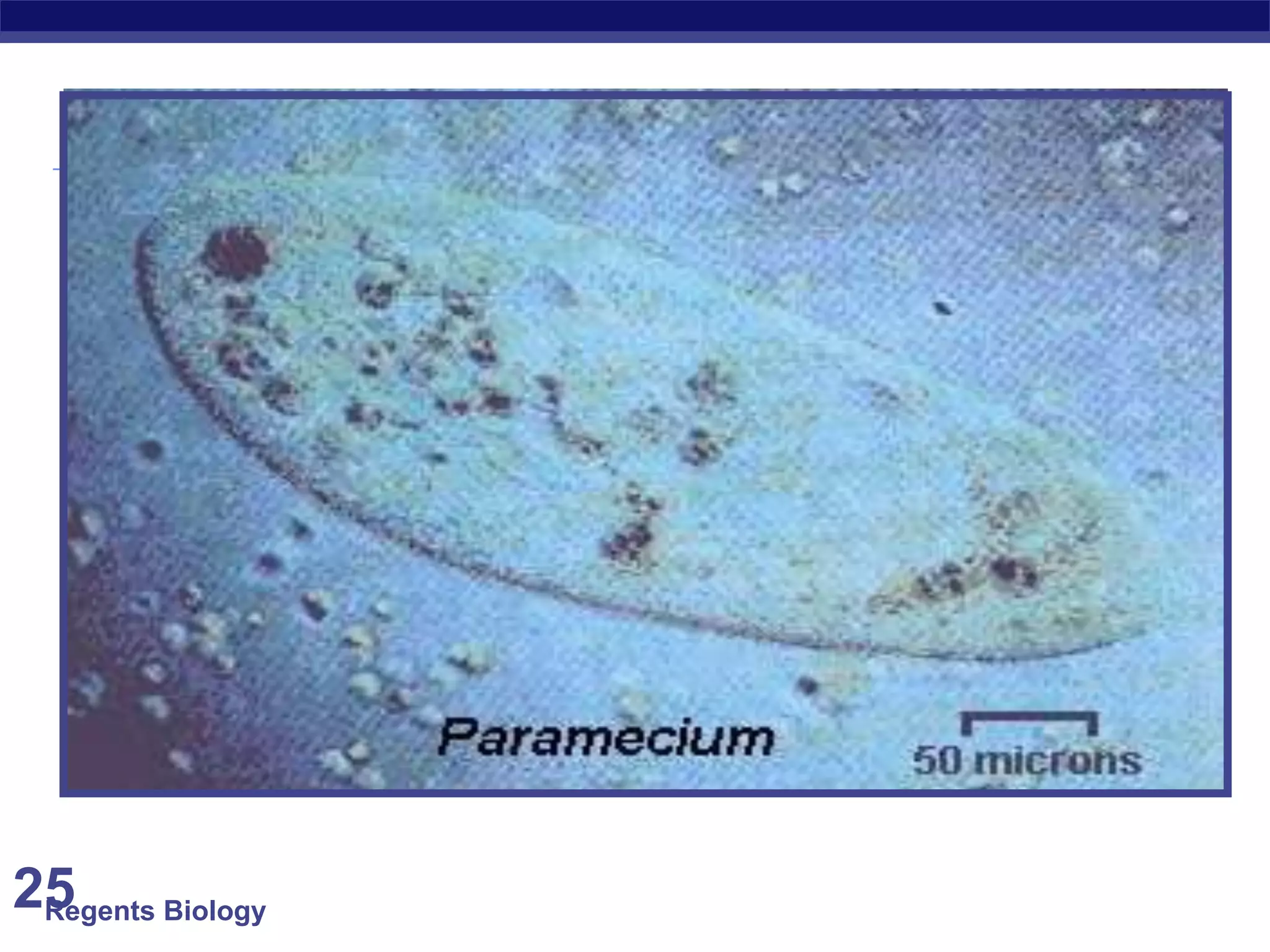
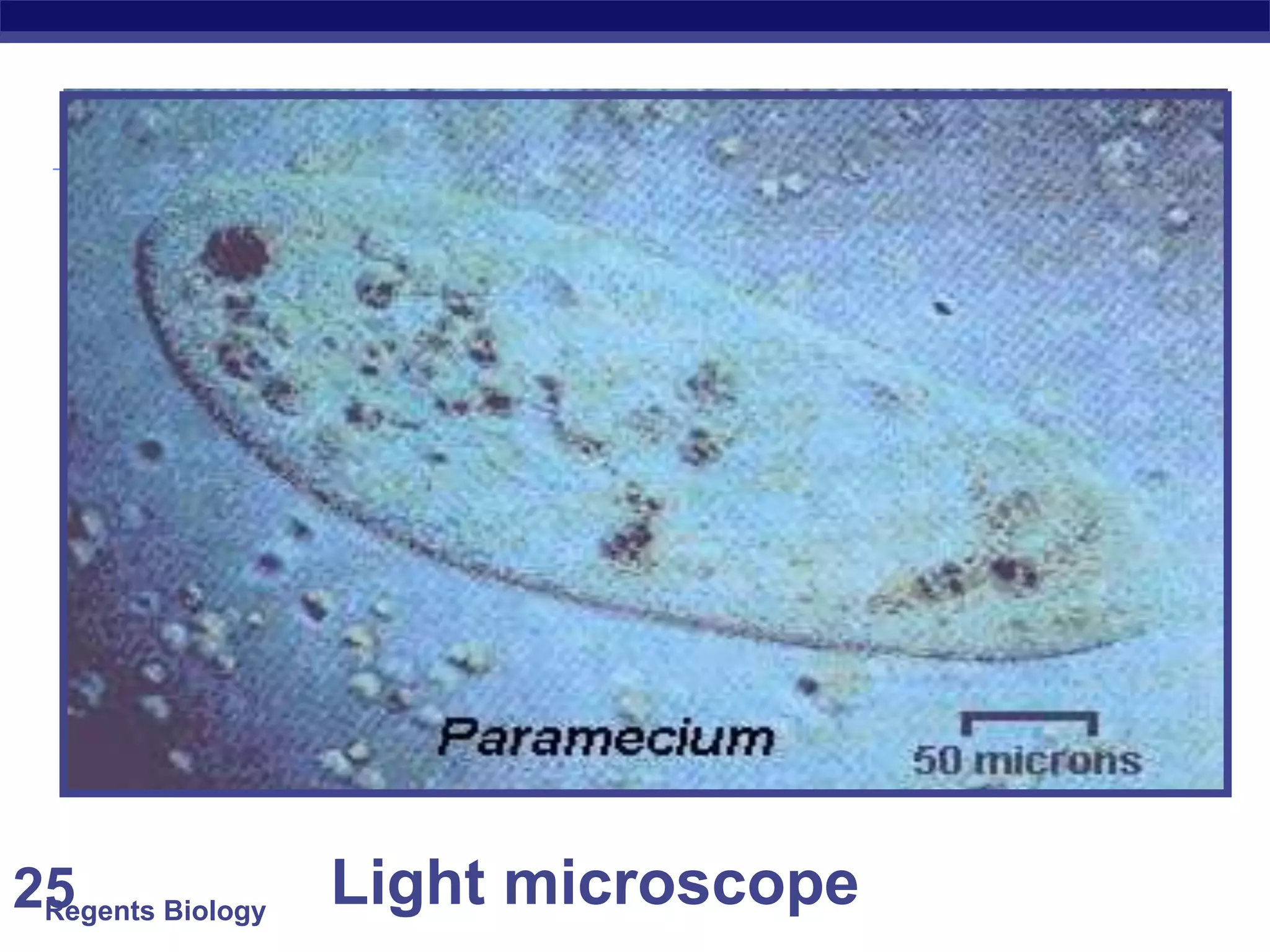
Regents Biology 25
Regents Biology 25 Light microscope
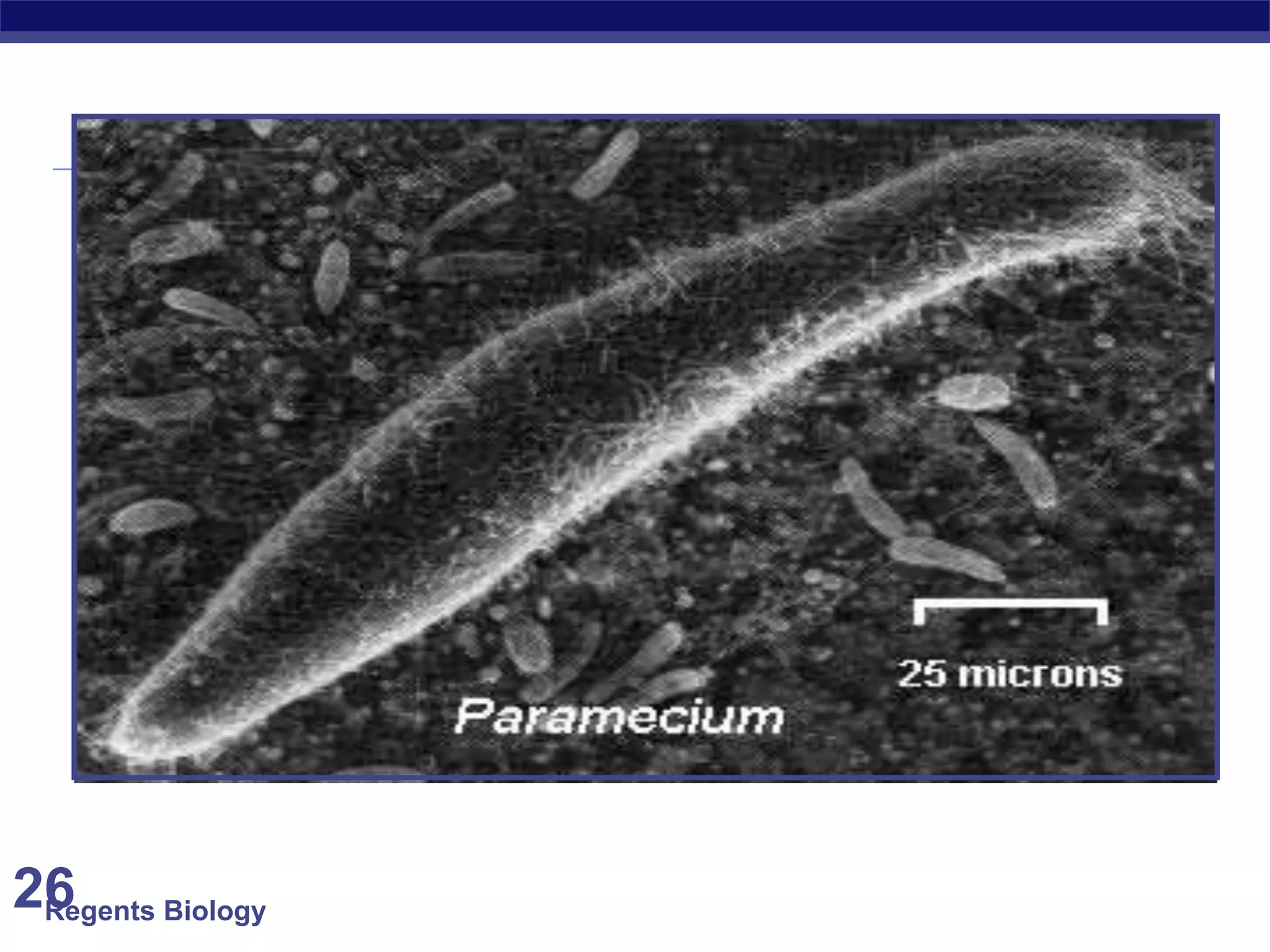
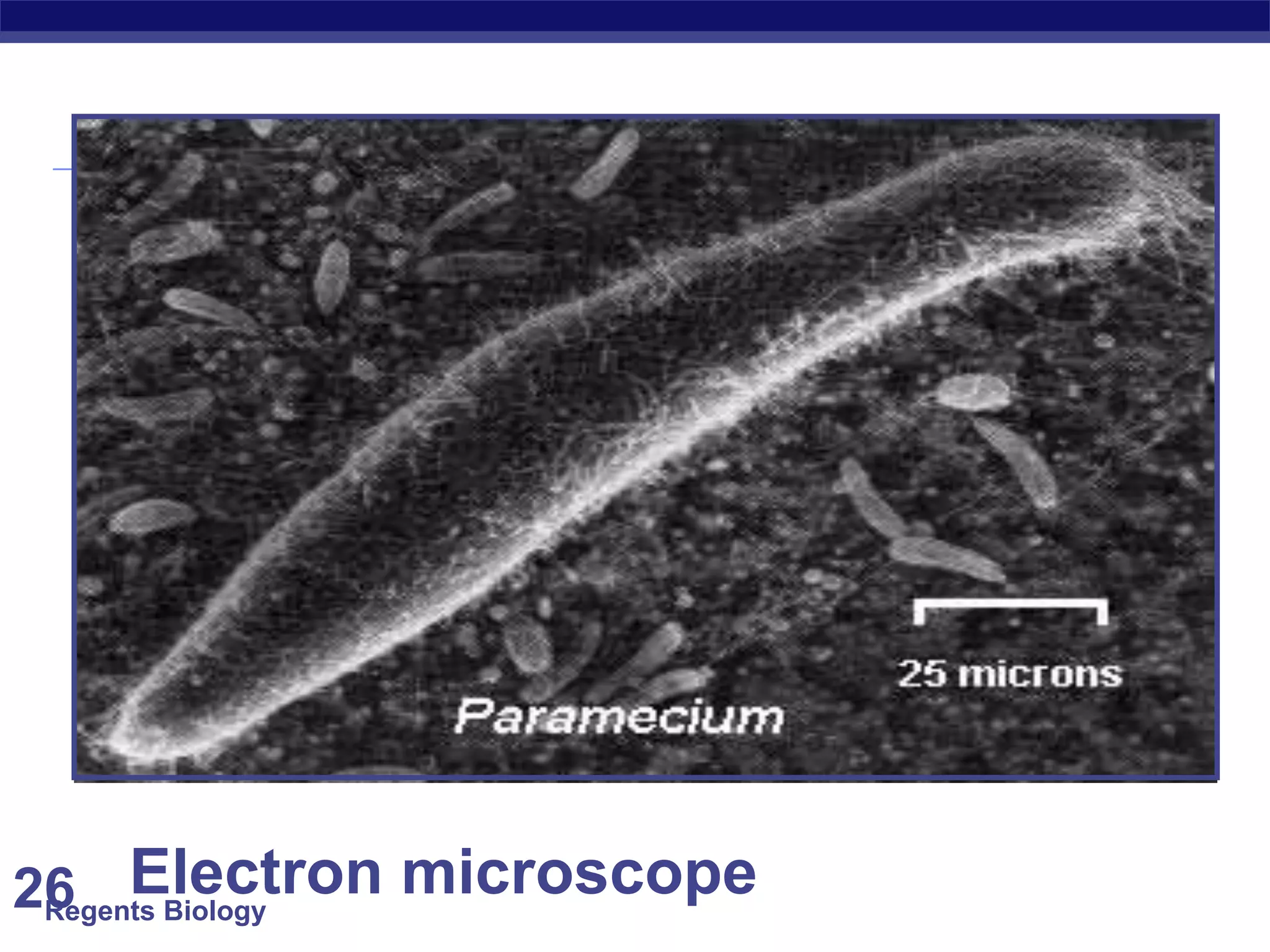
Regents Biology 26
Regents Biology 26 Electron microscope
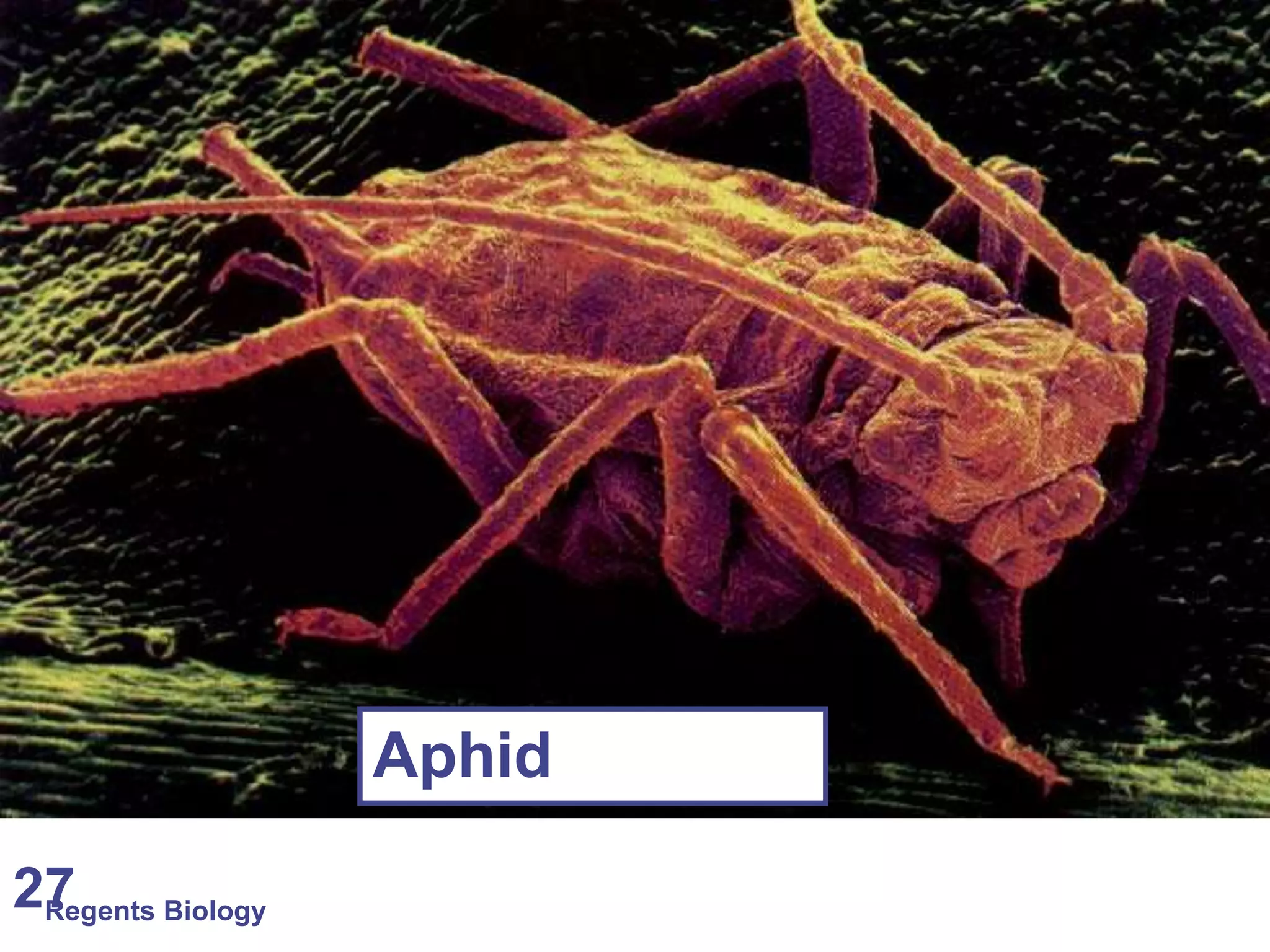
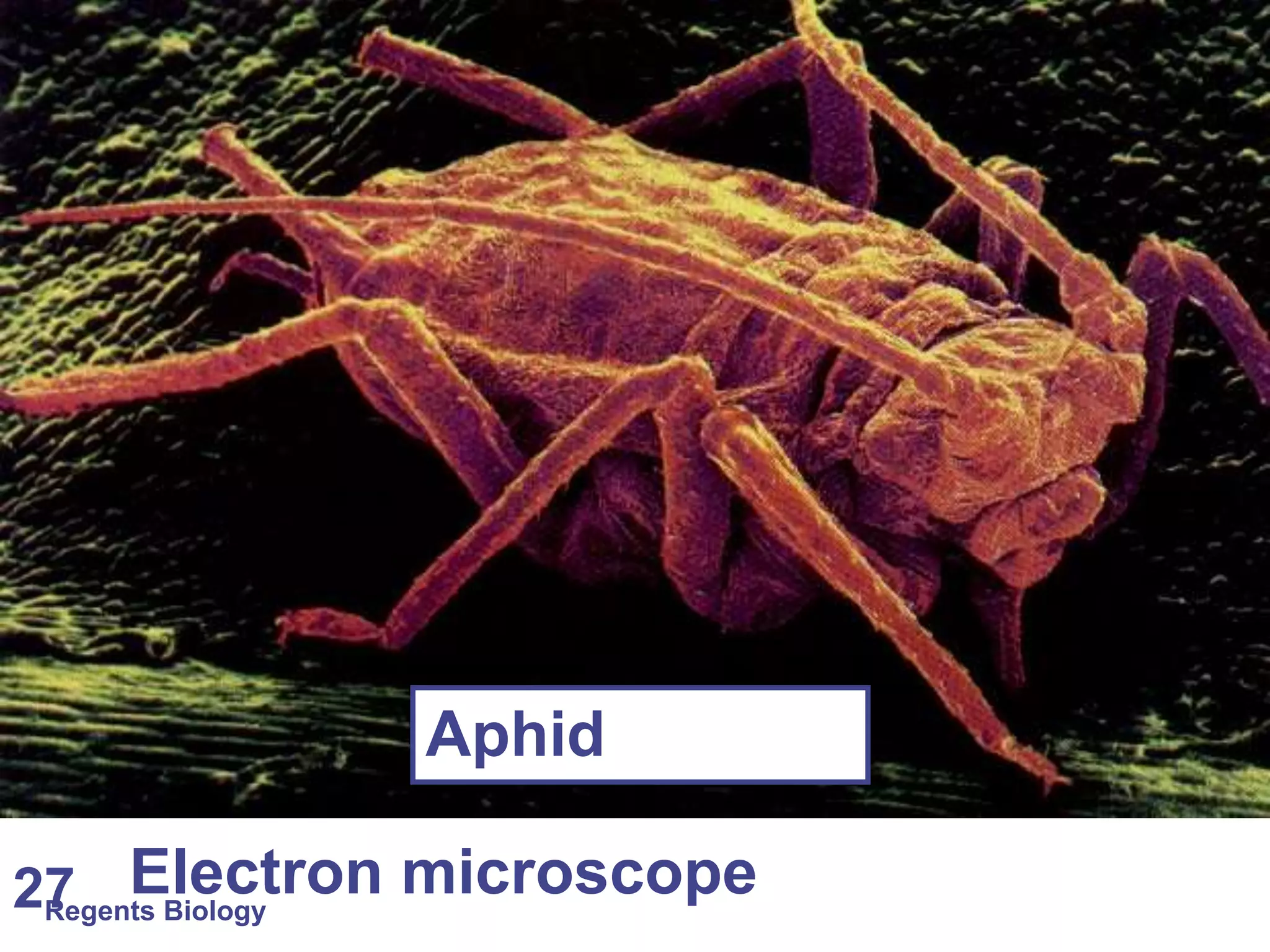
Regents Biology 27 
Aphid
Aphid 
Regents Biology 27 Electron microscope
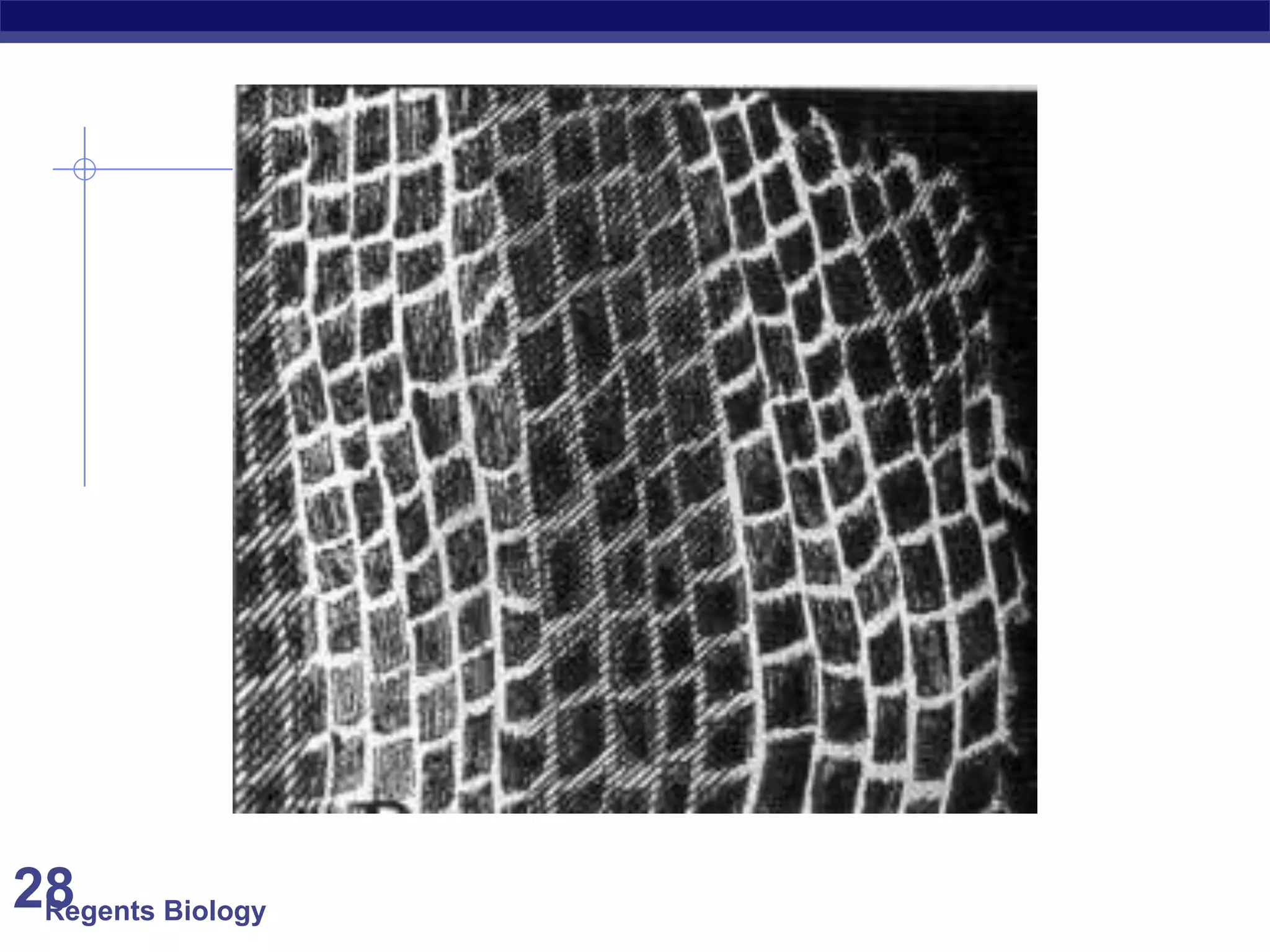
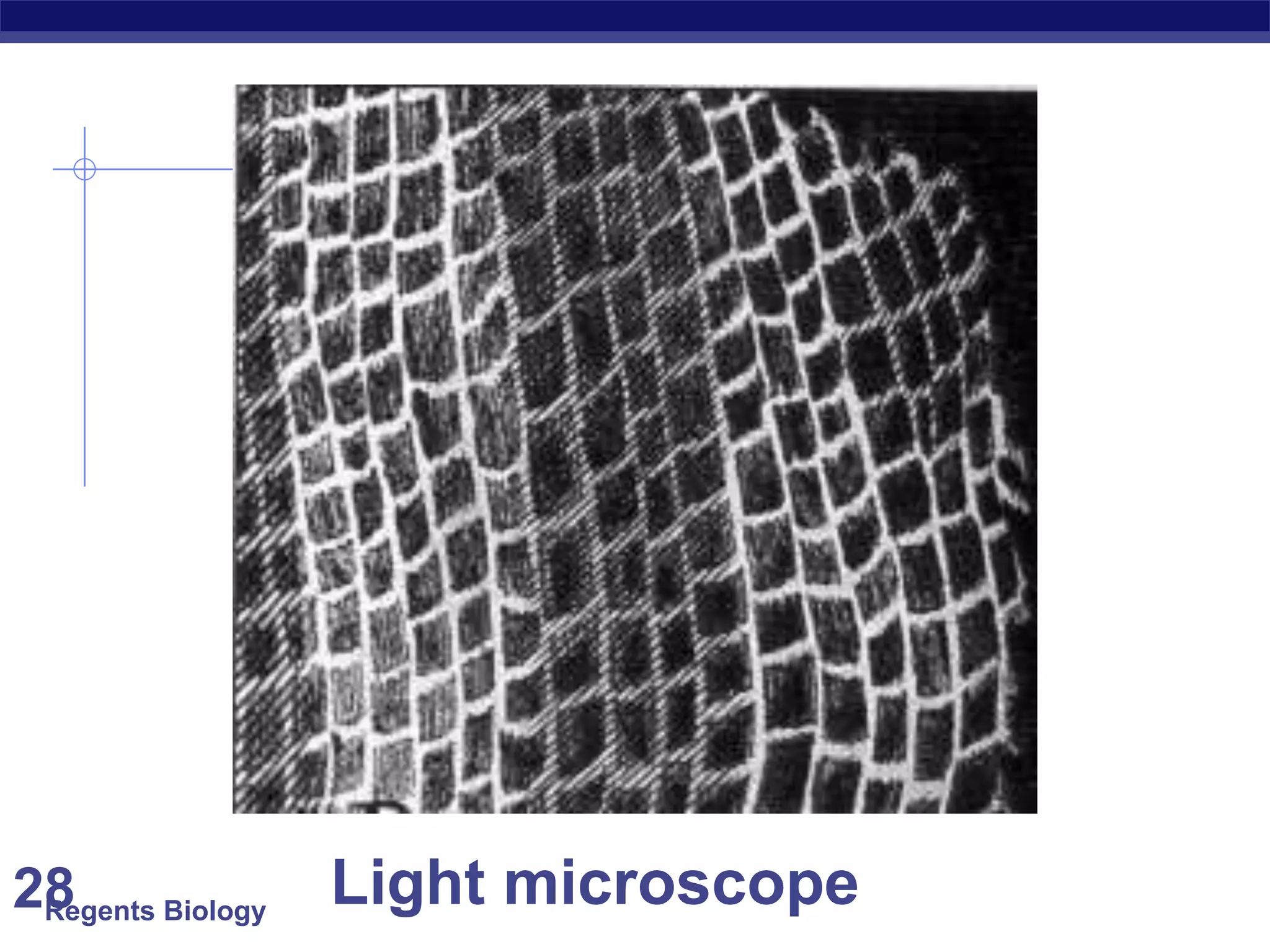
Regents Biology 28
Regents Biology 28 Light microscope
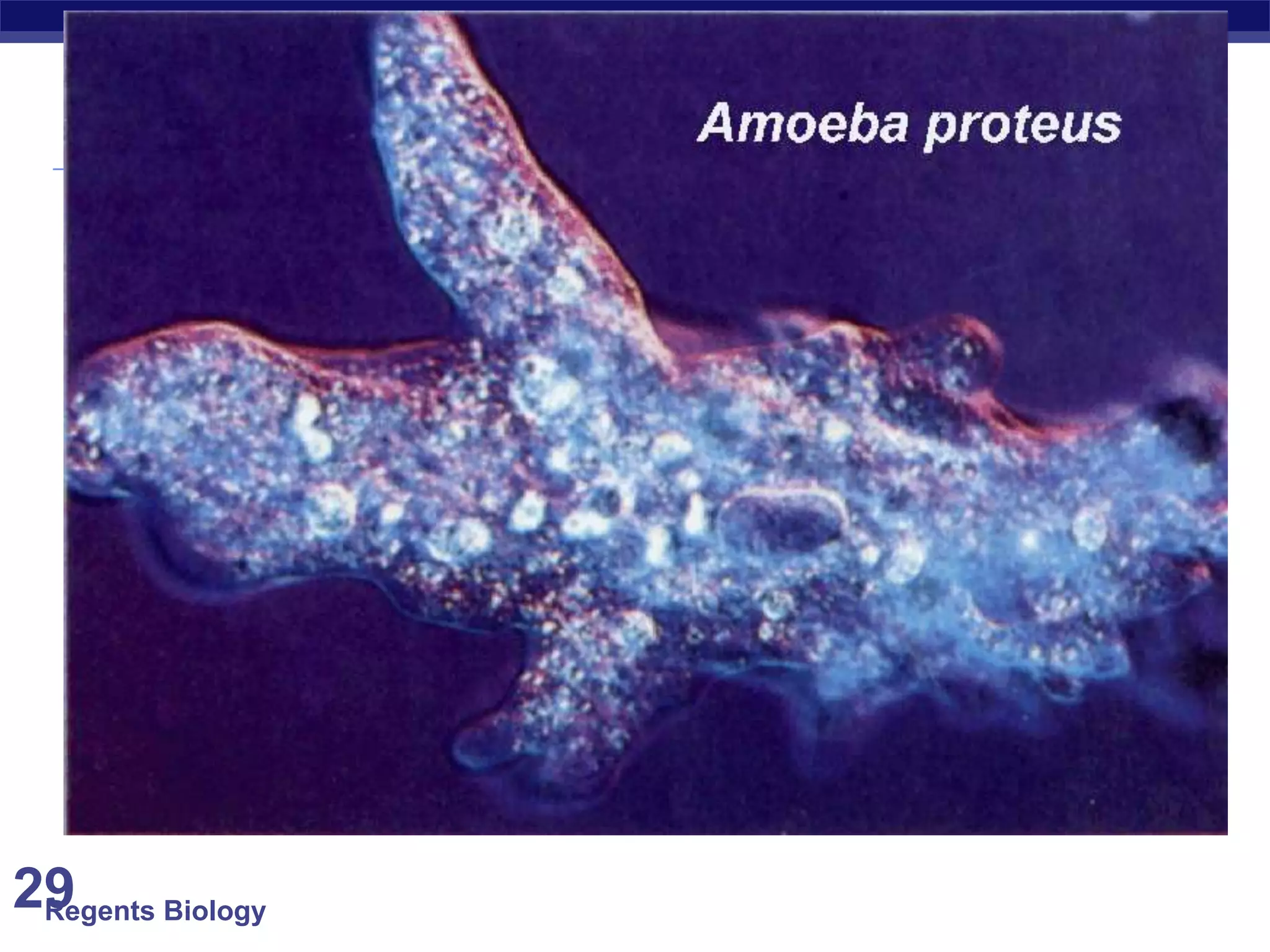
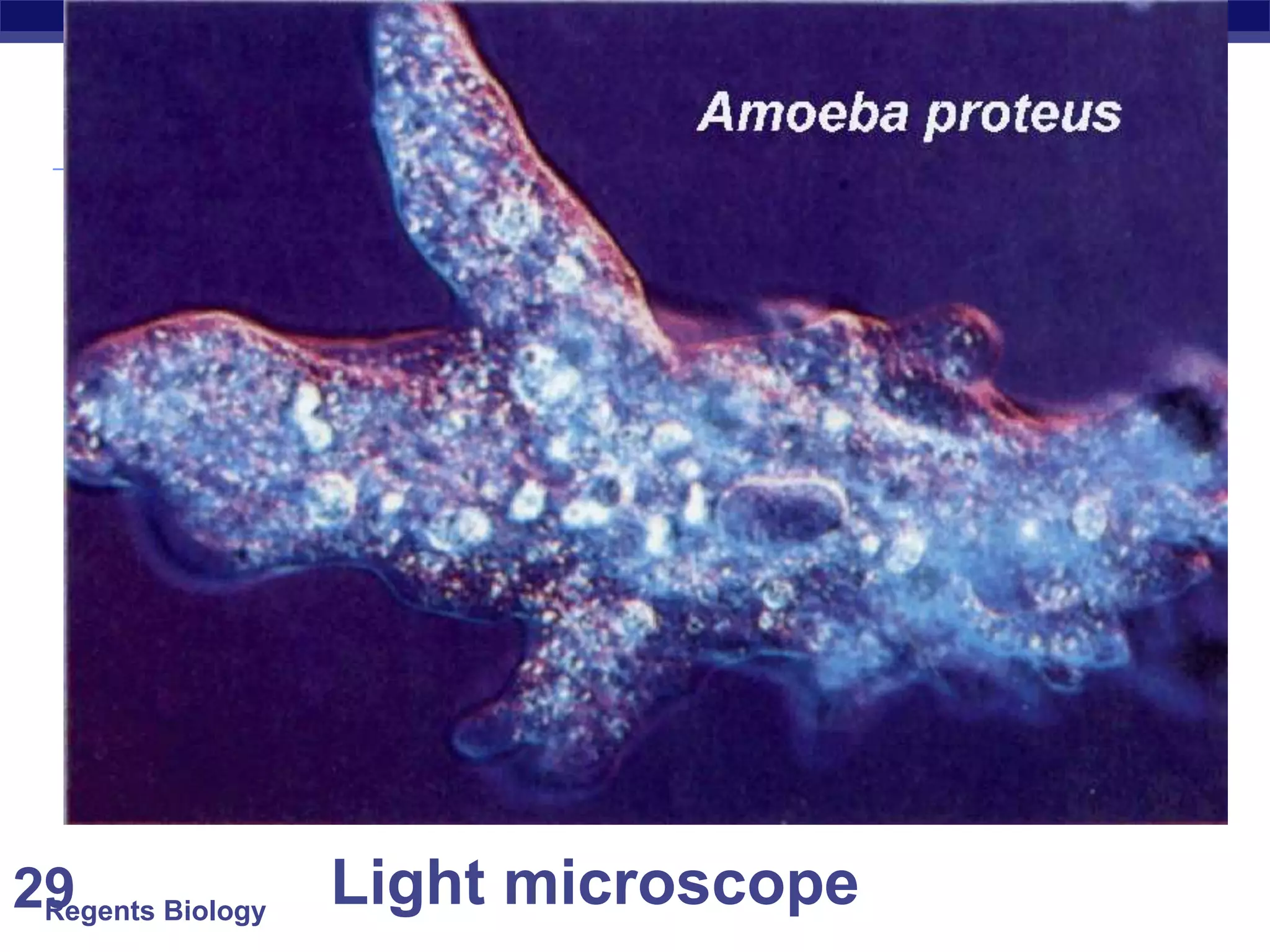
Regents Biology 29
Regents Biology 29 Light microscope
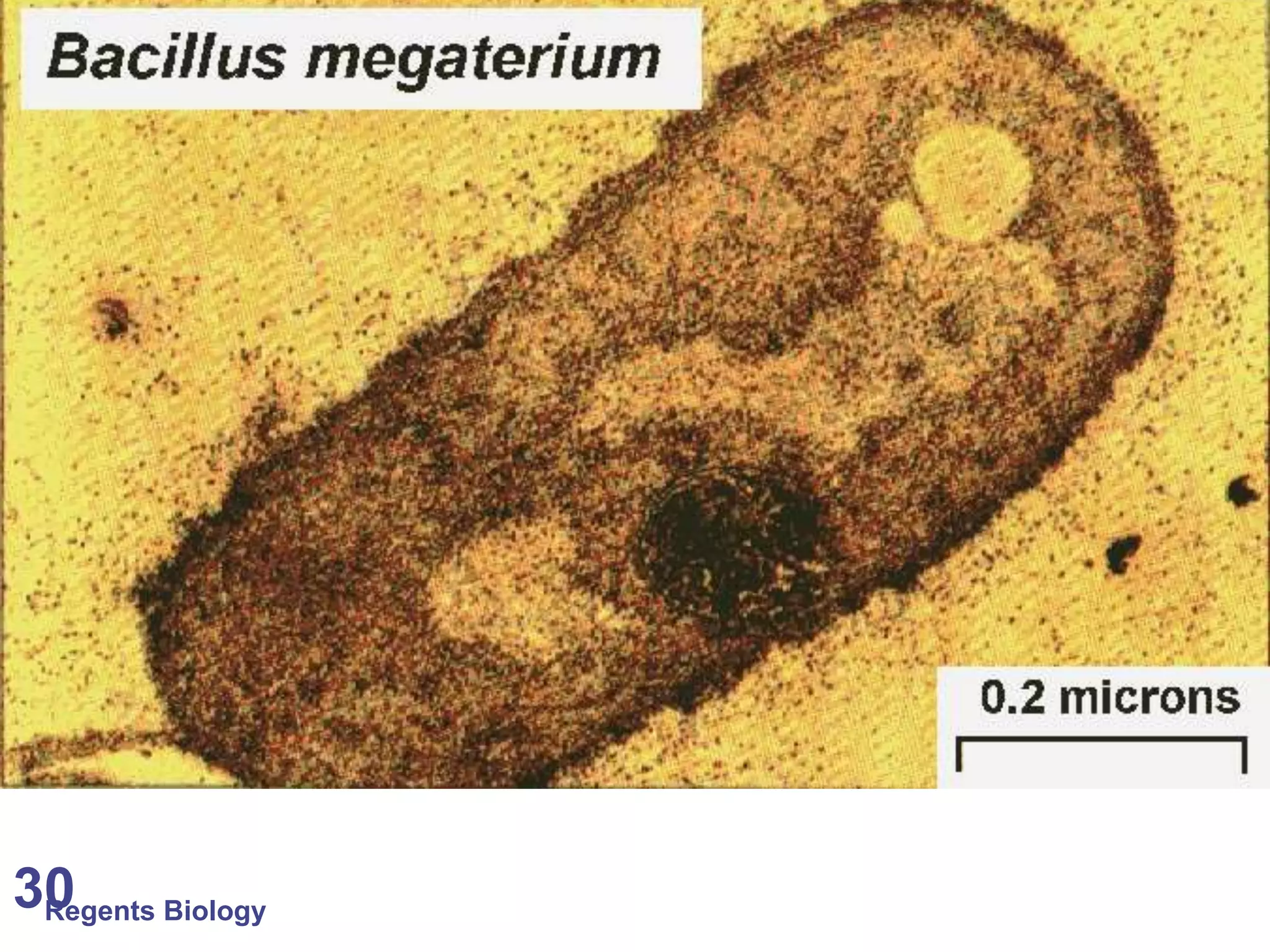
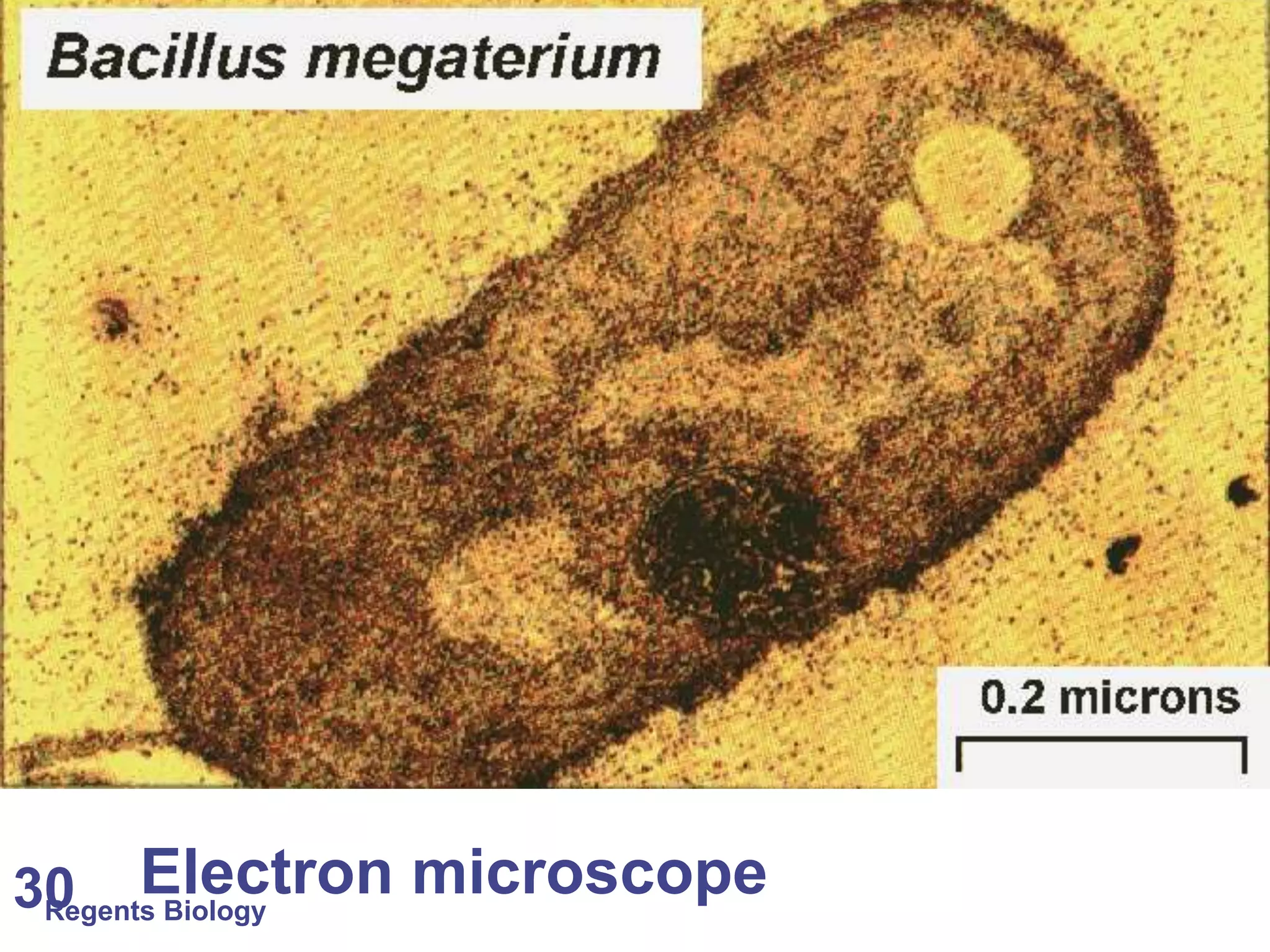
Regents Biology 30
Regents Biology 30 Electron microscope
Regents Biology 31
Regents Biology 31 Electron microscope
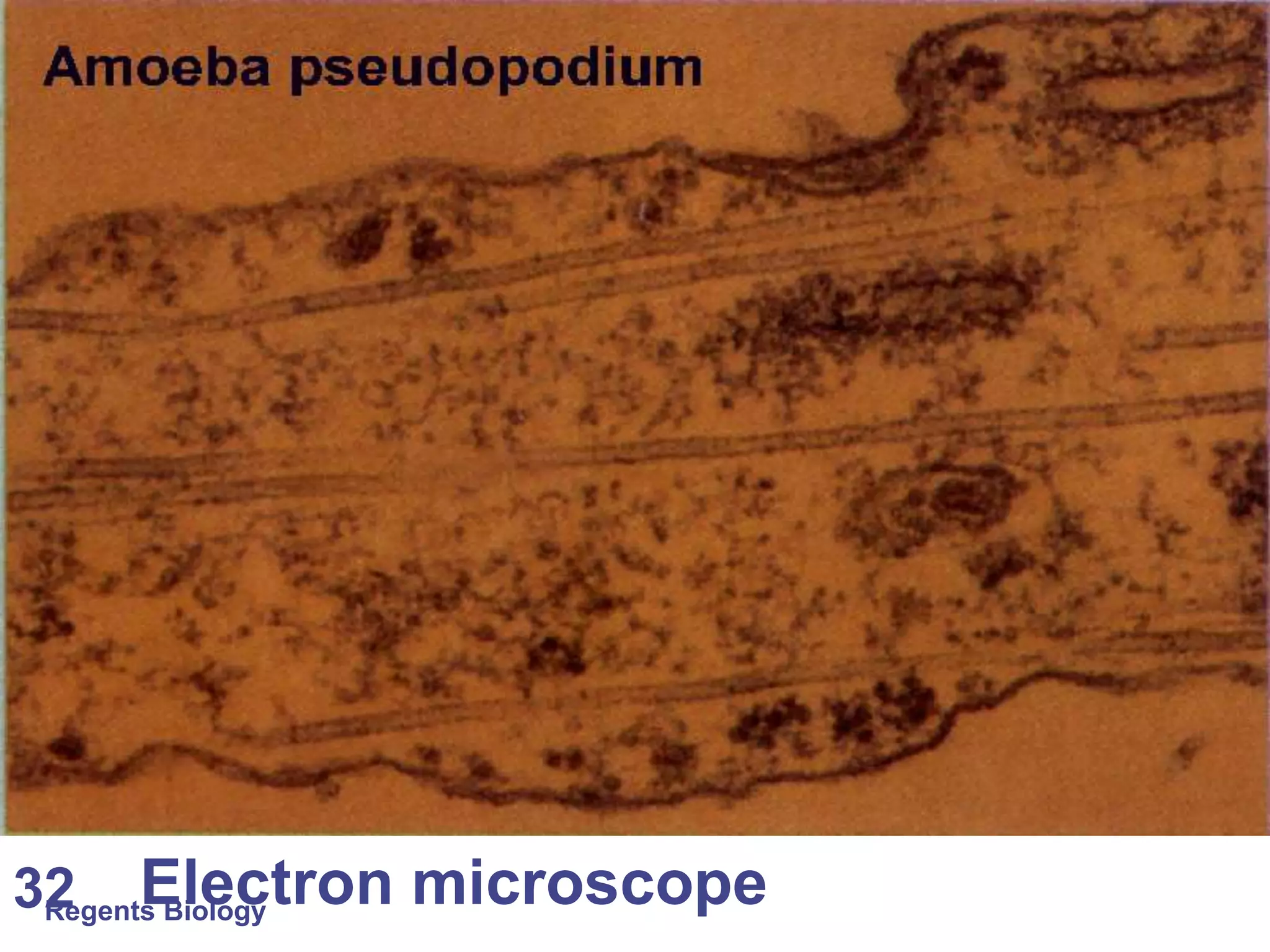
Regents Biology 32
Regents Biology 32 Electron microscope
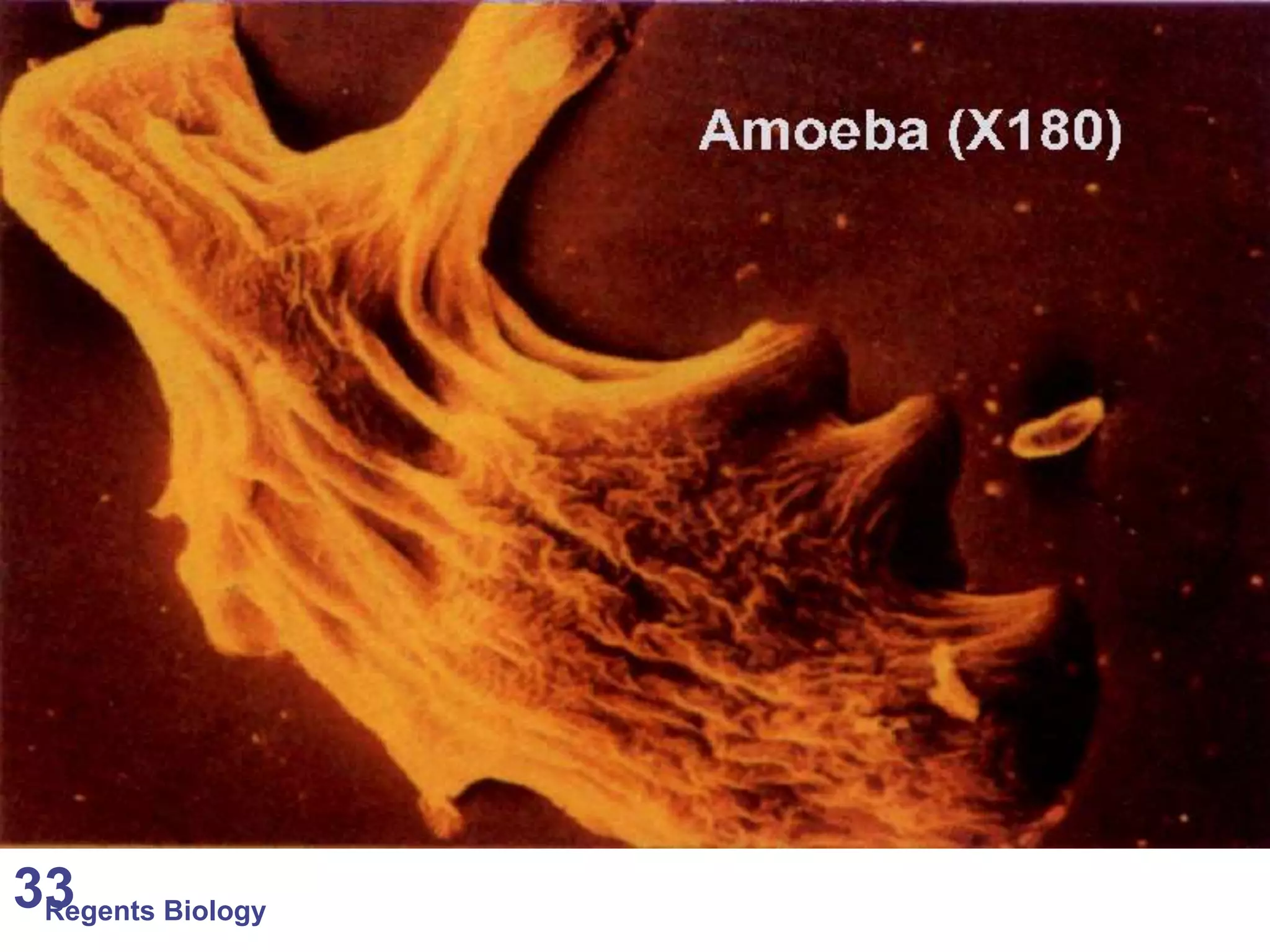
Regents Biology 33
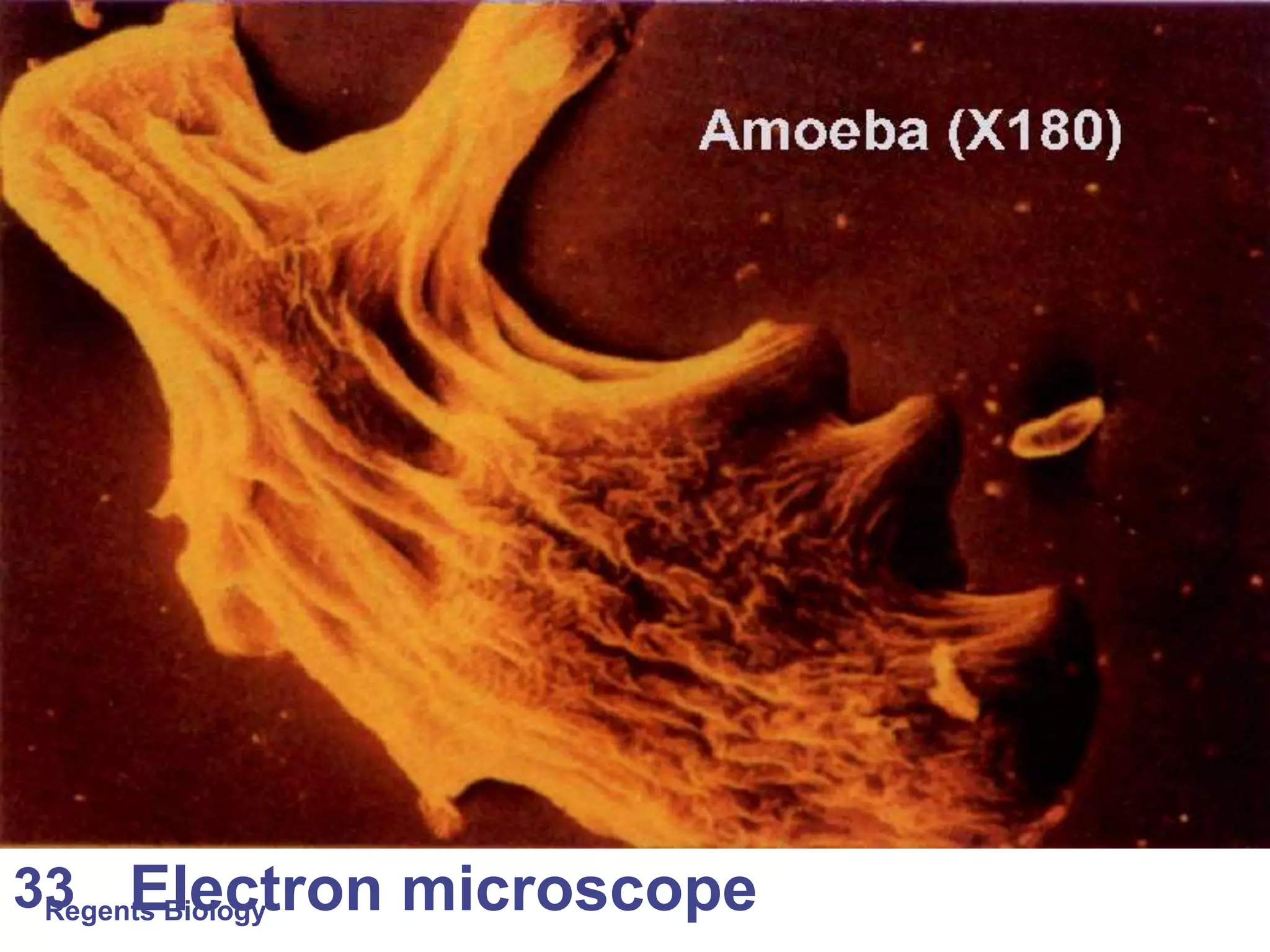
Regents Biology 33 Electron microscope
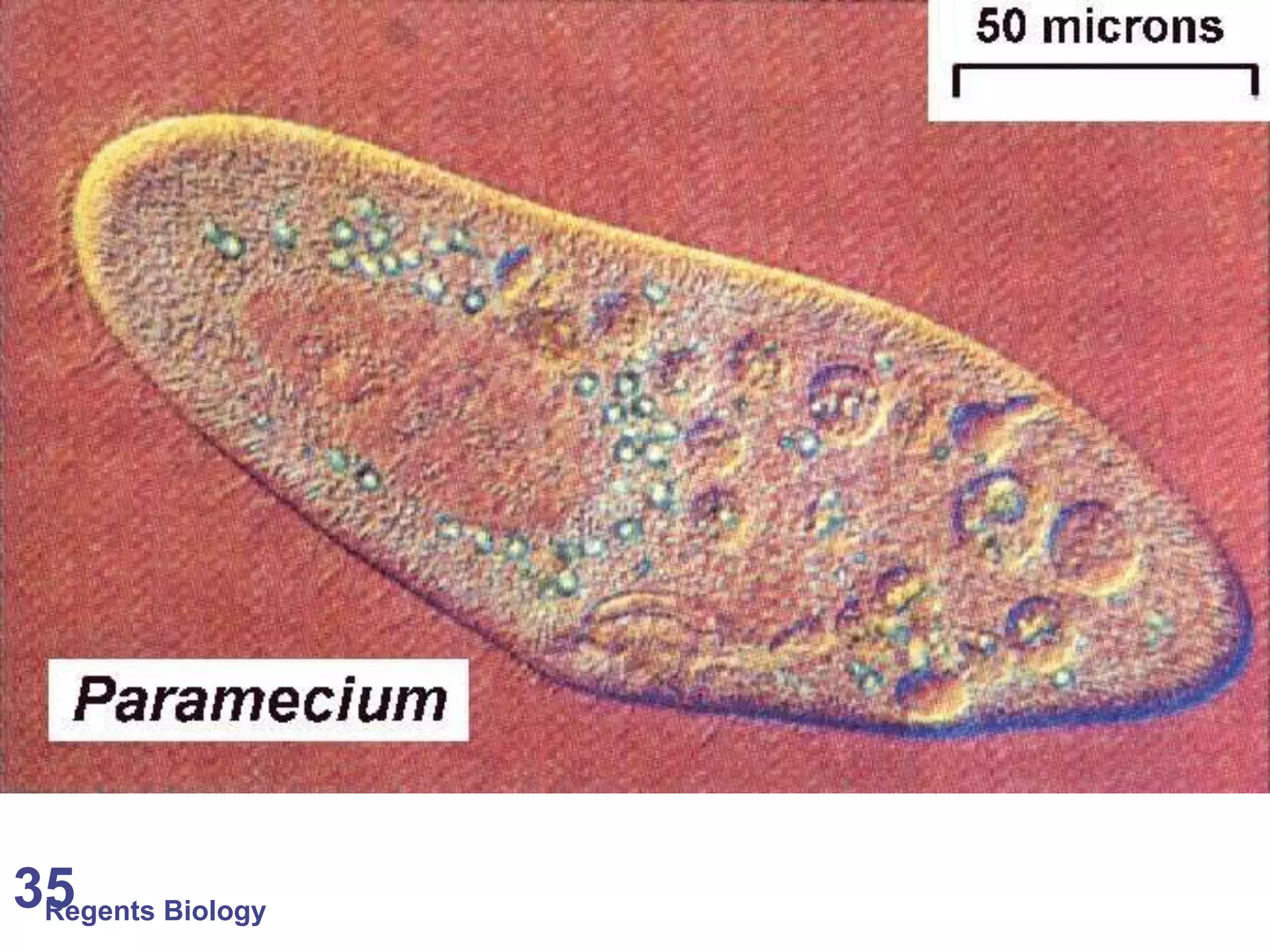
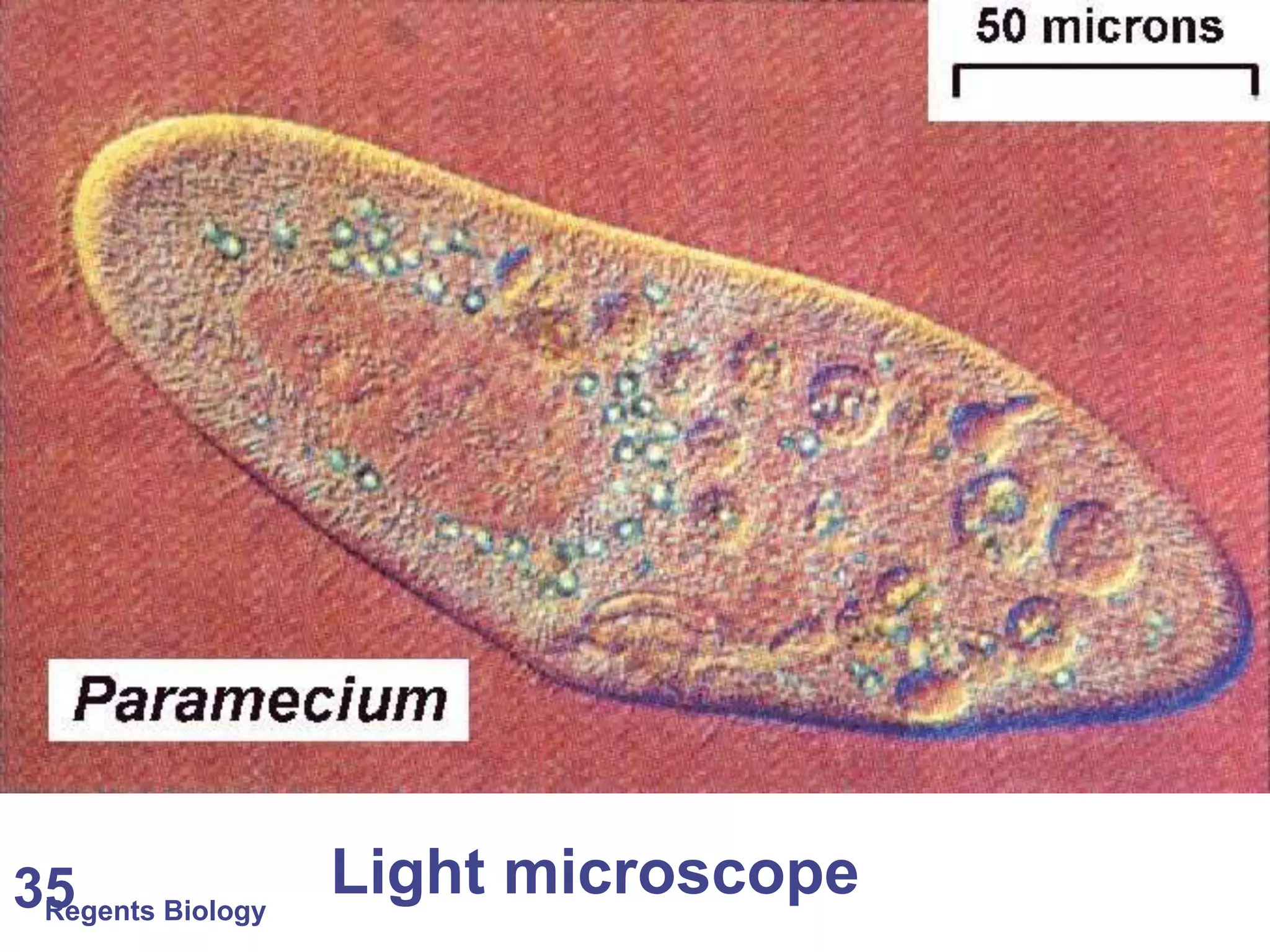
Regents Biology 35
Regents Biology 35 Light microscope
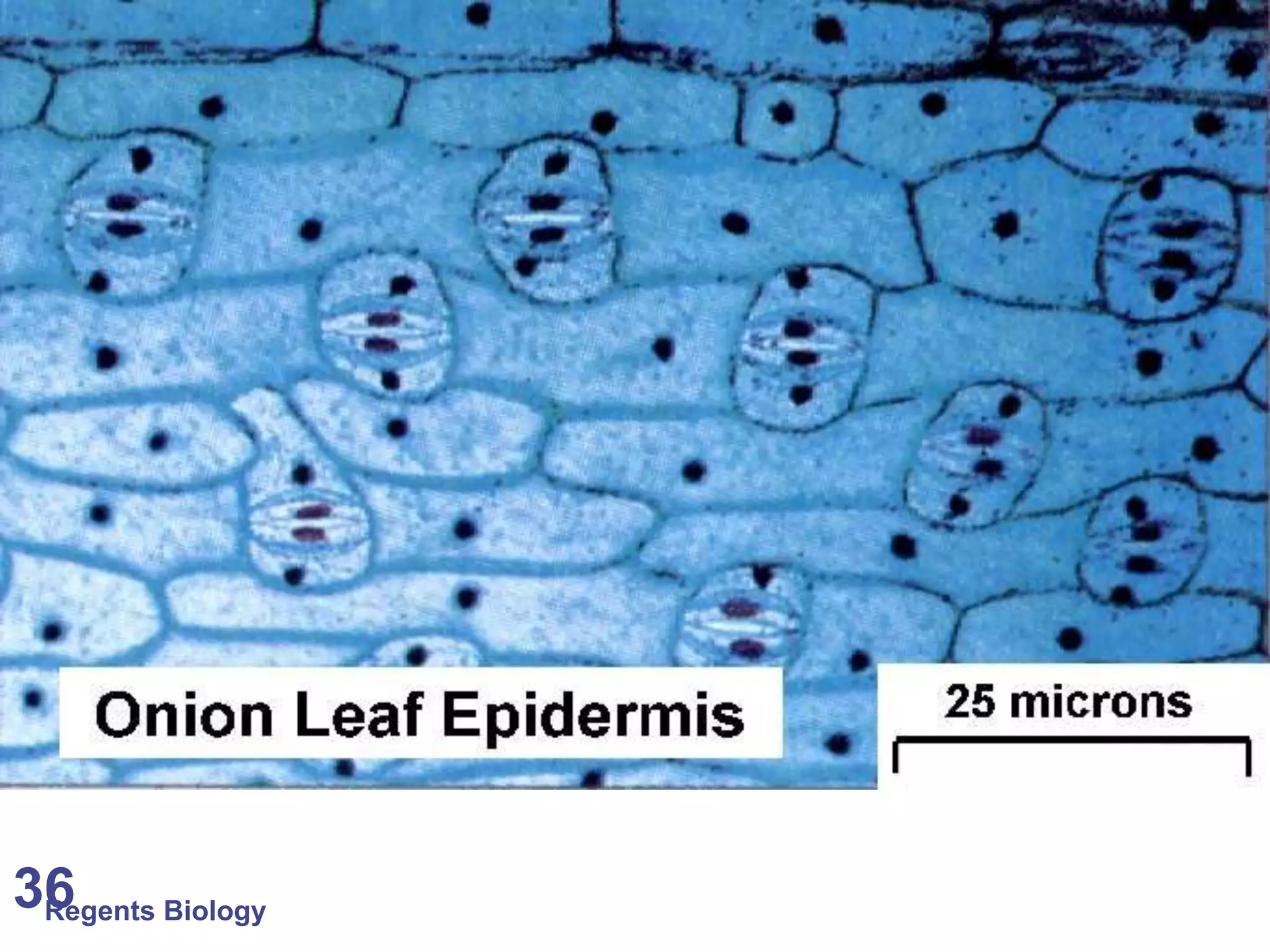
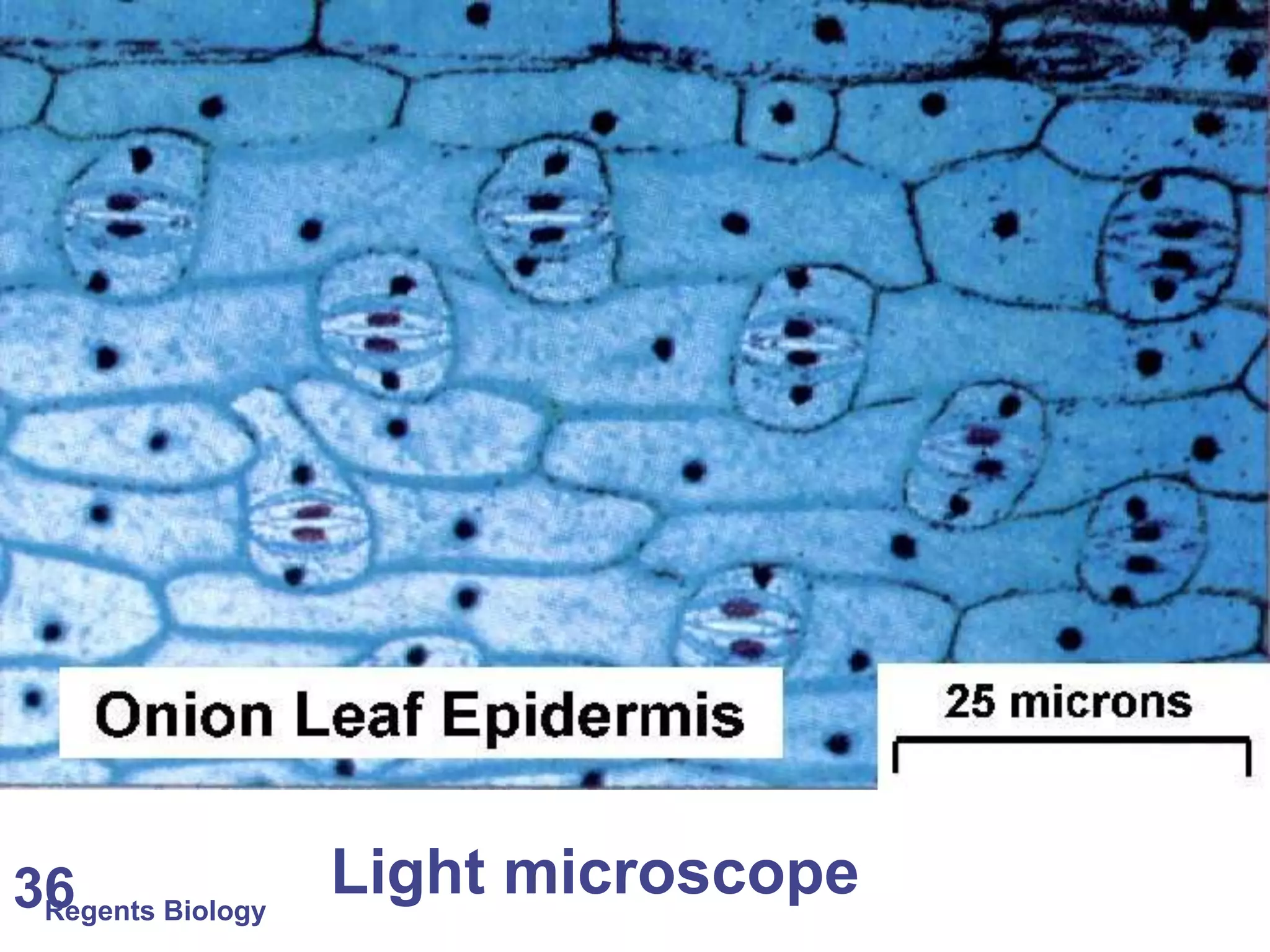
Regents Biology 36
Regents Biology 36 Light microscope
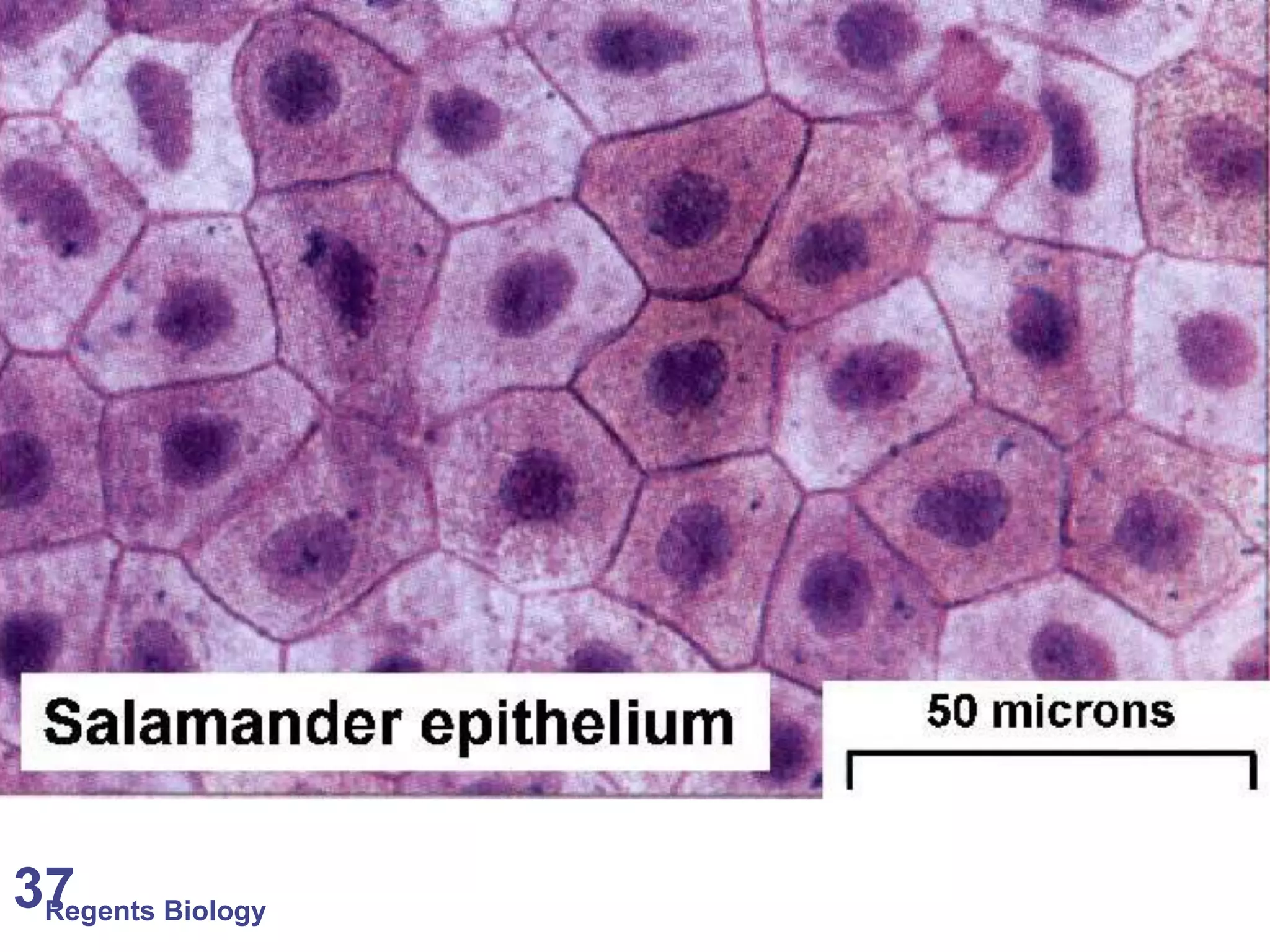
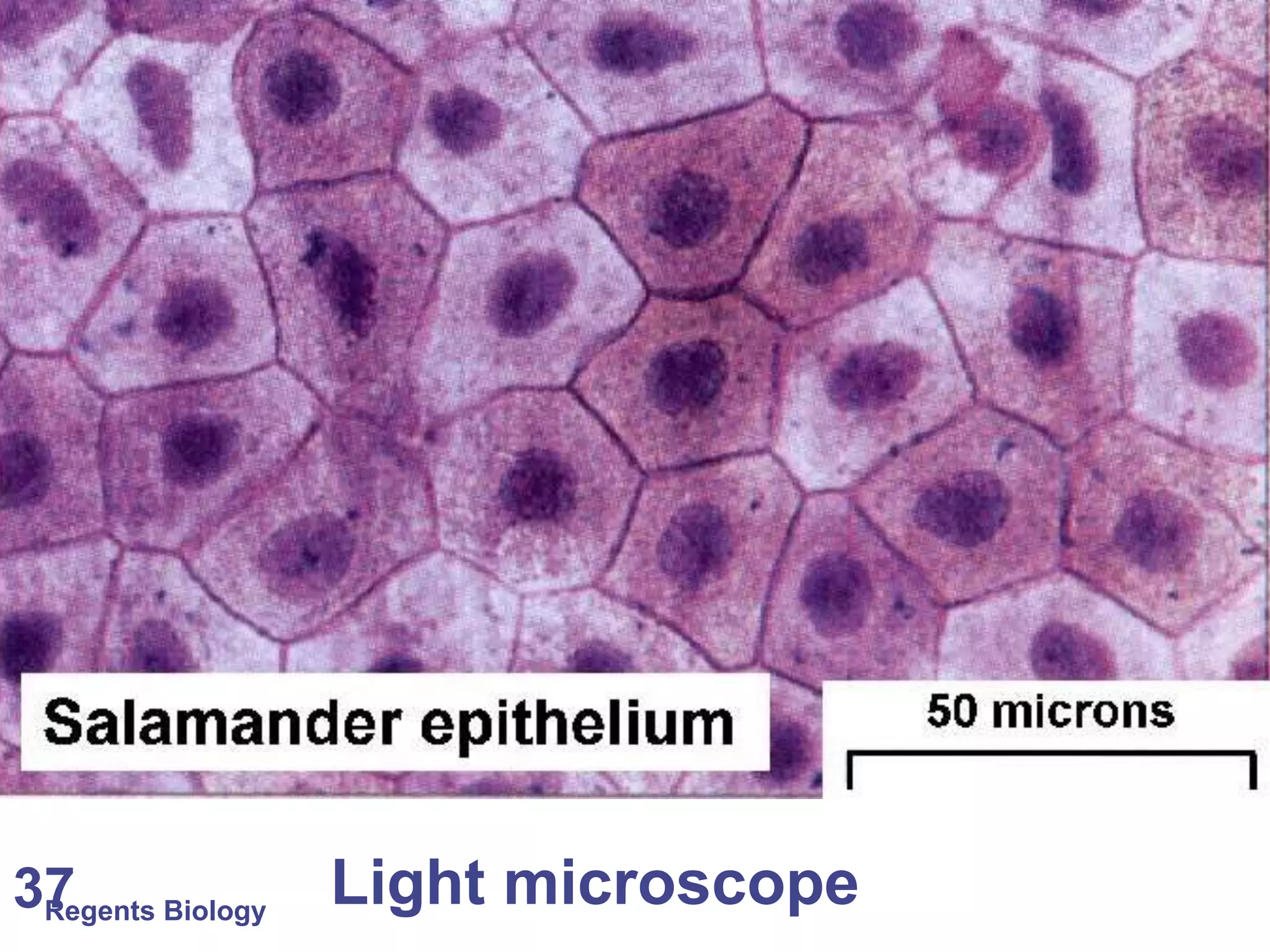
Regents Biology 37
Regents Biology 37 Light microscope
THE END! 
Regents Biology
Magnification 
Magnification = ocular lens x objective lens 
A microscope has an eyepiece lens with a power 
of 20X. The objective lens being used has a 
power of 10X. What is the total magnification? 
Regents Biology
Using Scale Bars 
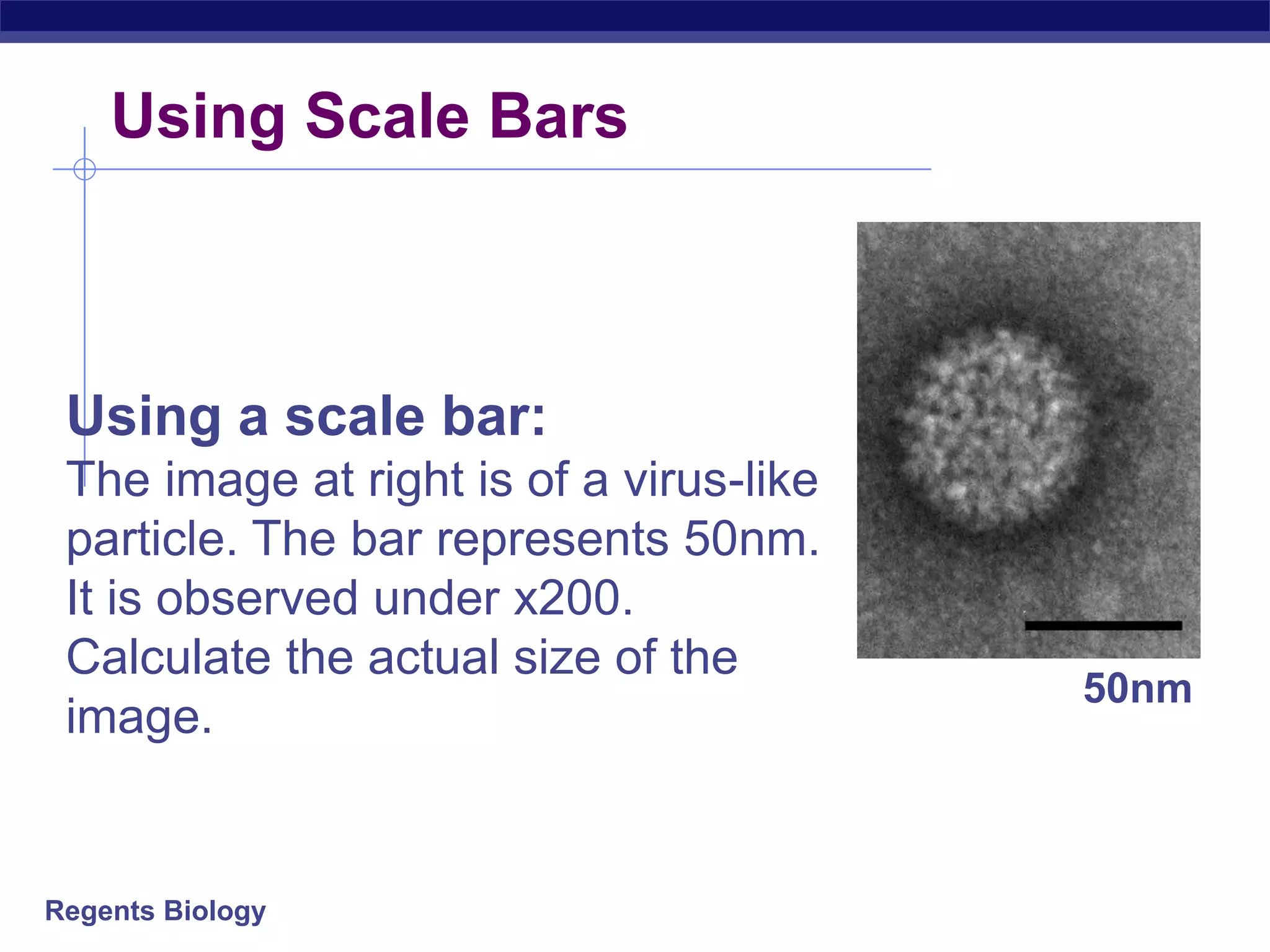
Using a scale bar: 
The image at right is of a virus-like 
particle. The bar represents 50nm. 
It is observed under x200. 
Calculate the actual size of the 
image. 
Regents Biology 
50nm
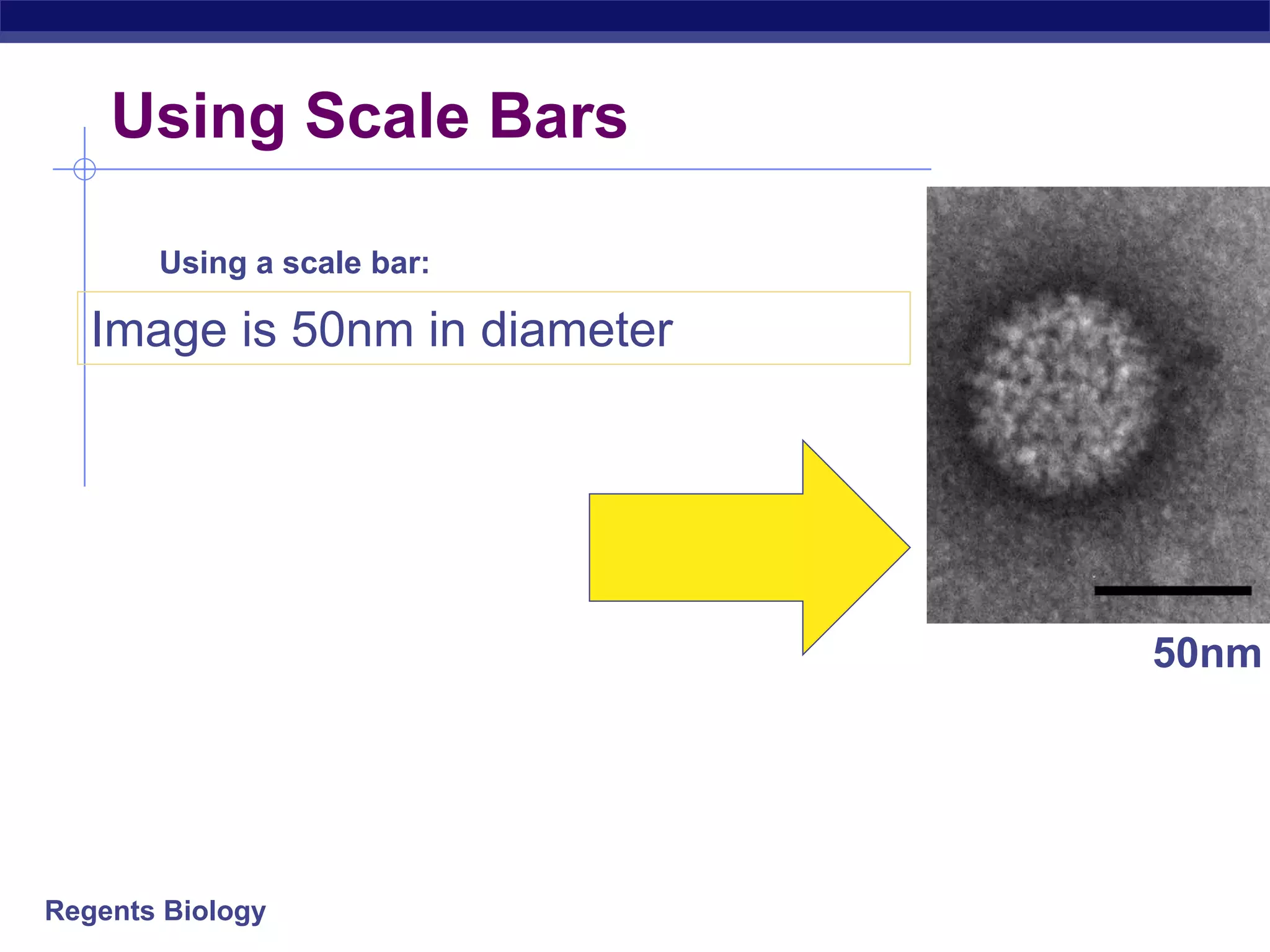
Using a scale bar: 
Image is 50nm in diameter 
Regents Biology 
50nm 
Using Scale Bars
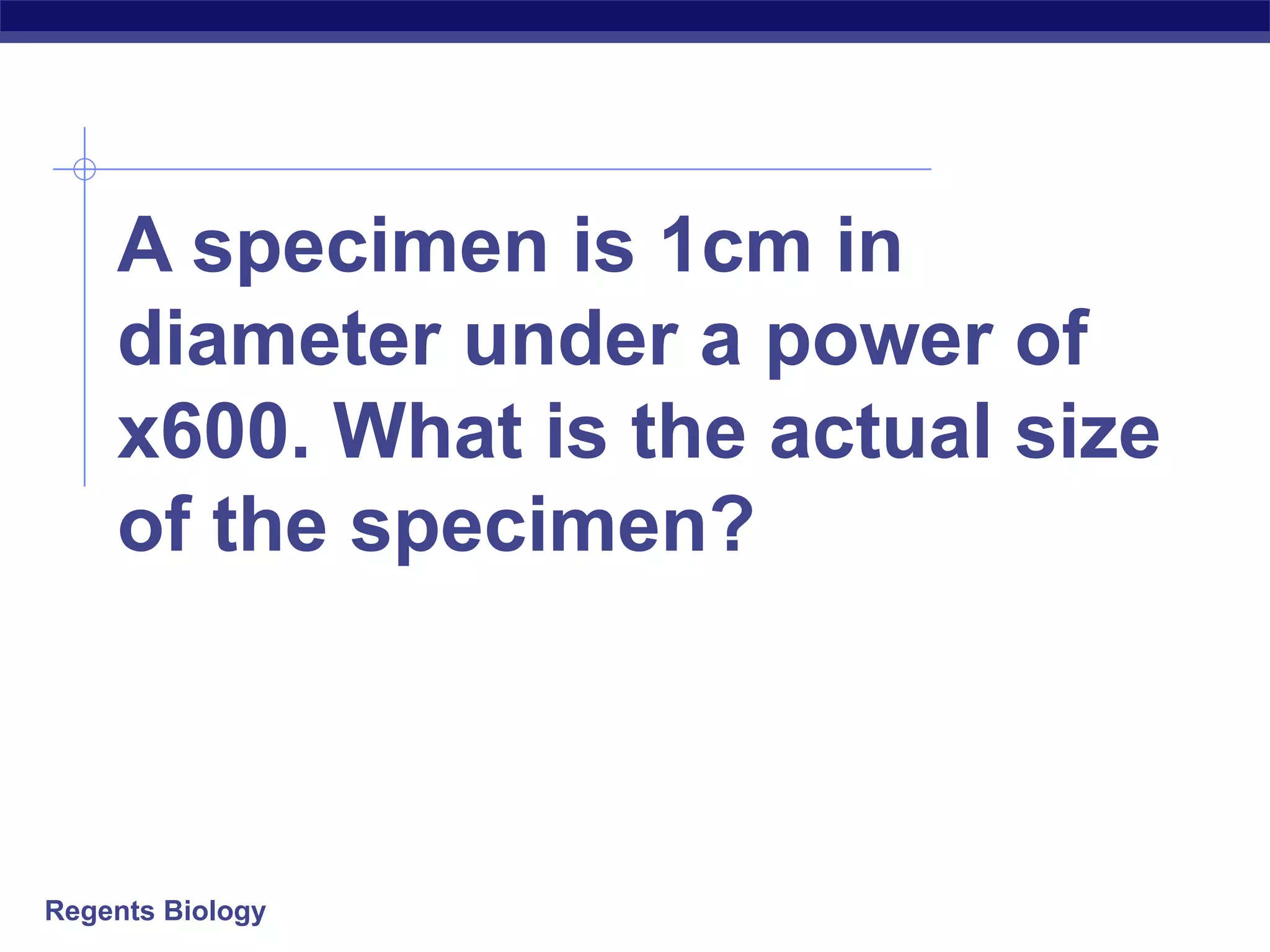
A specimen is 1cm in 
diameter under a power of 
x600. What is the actual size 
of the specimen? 
Regents Biology
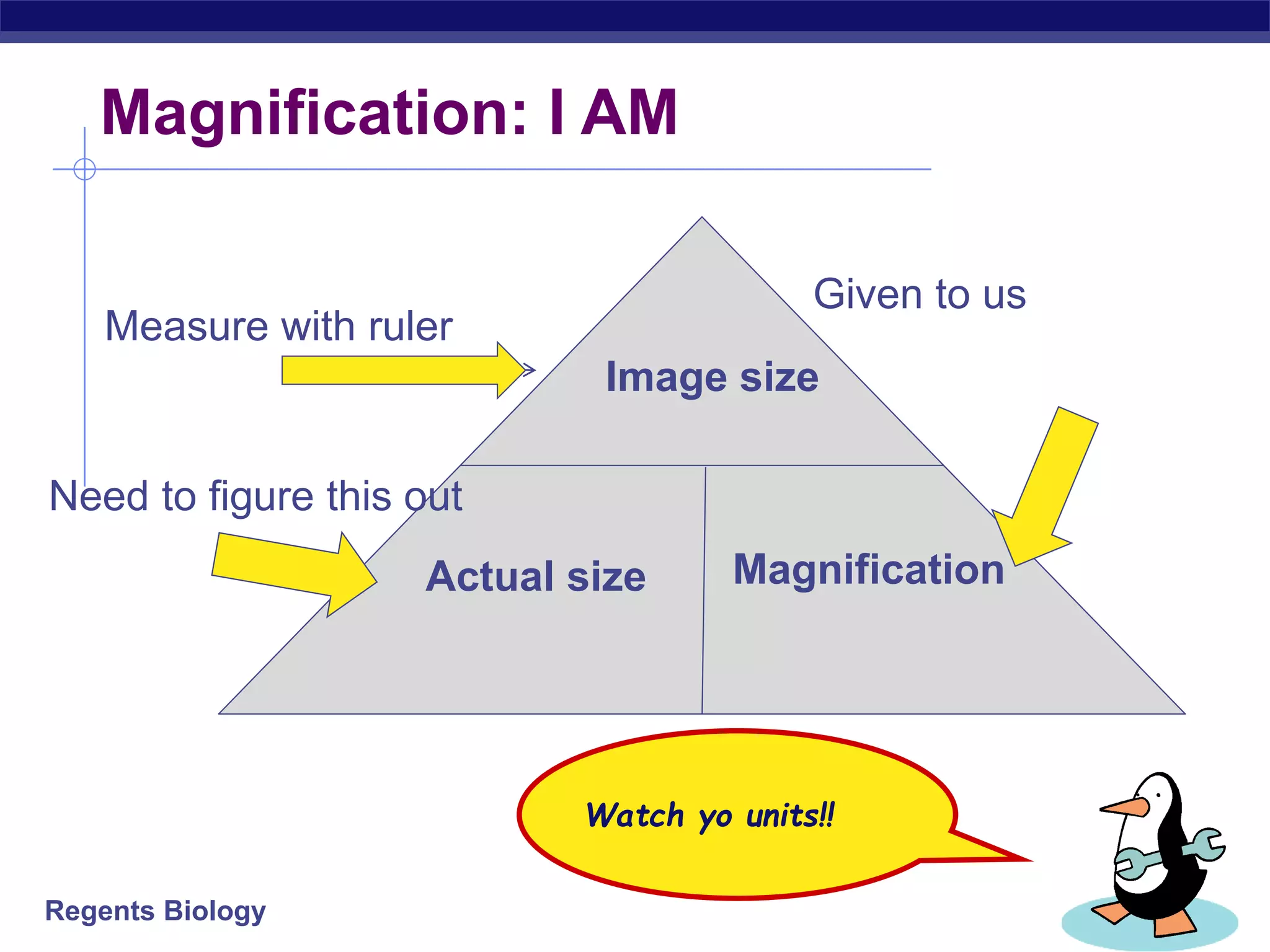
Magnification: I AM 
Regents Biology 
Image size 
Actual size Magnification 
Watch yo units!! 
Measure with ruler 
Need to figure this out 
Given to us
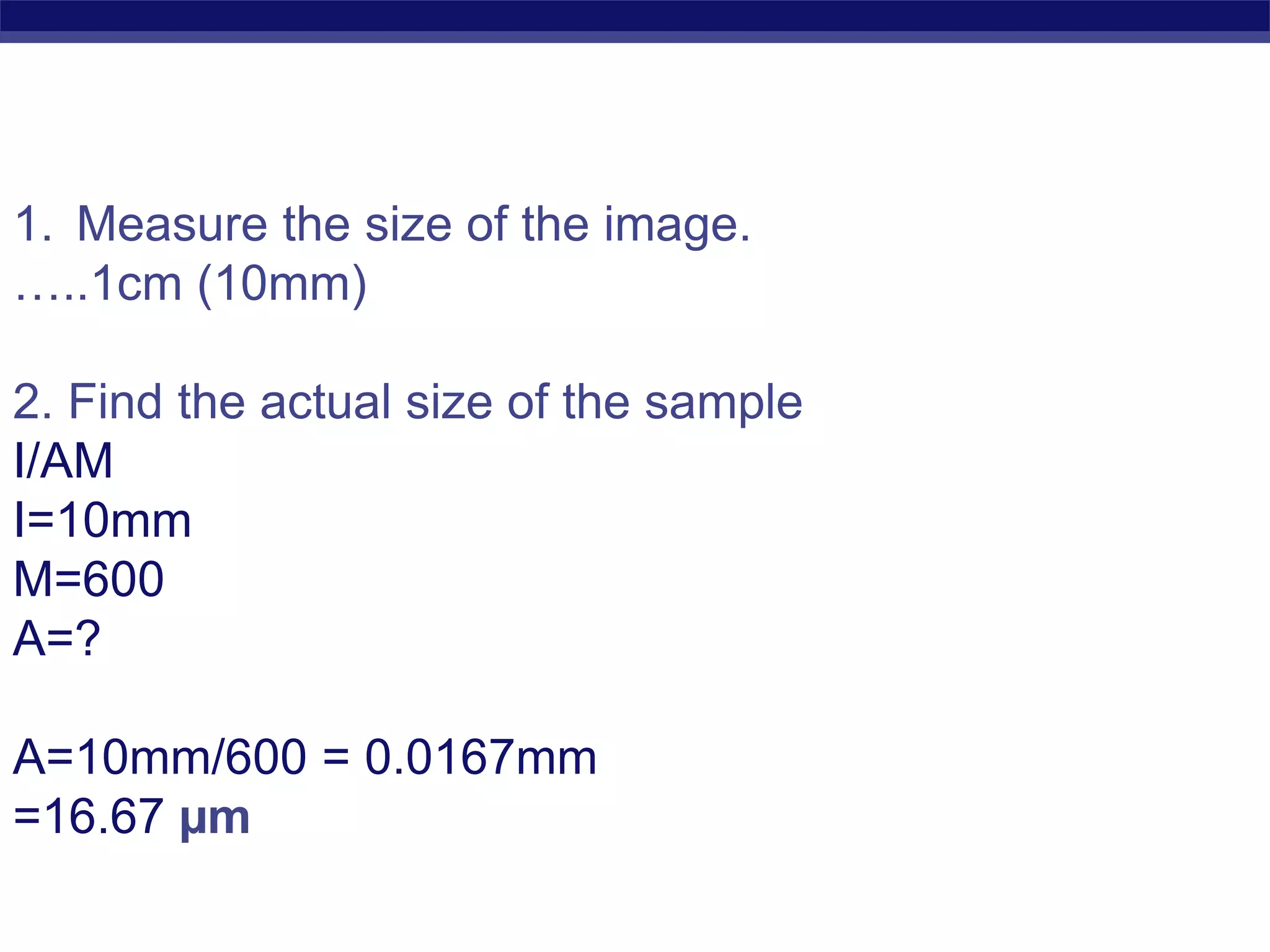
1. Measure the size of the image. 
…..1cm (10mm) 
2. Find the actual size of the sample 
I/AM 
I=10mm 
M=600 
A=? 
A=10mm/600 = 0.0167mm 
=16.67 μm 
Regents Biology
Your Turn! 
Regents Biology

Magnification and microscopes

Editor's Notes

  • #2 Lesson 5-7 Practical 1
  • #3 Technology and science are often used interchangably, but this requires some clarification. Technology emerged before science. Materials were used to produce and used long before there was an understanding that different materials had different properties that could be used for different purposes. Modern science often is the opposite. Scientific understanding is often the basis for technological development. These developments in technology in turn drive developments in science. So technology applies the question: “does it work?” to its pursuit. Science is less bothered by the knowledge for the sake of knowledge Desprite their mutual dependence, they are based on different values. Science: evidence, rationality and the quest for deeper understanding Tech: practical, appropriare and useful and an increasing emphasis on sustainability
  • #4 Technology and science are often used interchangably, but this requires some clarification. Technology emerged before science. Materials were used to produce and used long before there was an understanding that different materials had different properties that could be used for different purposes. Modern science often is the opposite. Scientific understanding is often the basis for technological development. These developments in technology in turn drive developments in science. Both electron and light microscopes are technical devices which are used for visualizing structures that are too small to see with the unaided eye, and both types have relevant areas of applications in biology and the materials sciences. And this is pretty much it. The method of visualizing the structures is very different. Electron Microscopes use electrons and not photons (light rays) for visualization. The first electron microscope was constructed in 1931, compared to optical microscopes they are a very recent invention.
  • #6 http://learn.genetics.utah.edu/content/cells/scale/
  • #13 Anything below 1 micron requires an electron microscope. But there are STILL things we can’t see clearly with EM, like cell membranes!
  • #57 Calculation and drawing practice and homework Lesson 7 Use microscopes to observe samples. Practical 1.