HUMAN RESOURSE MANAGEMENT
SELECTION AND SELECTION PROCESS
Suresh Kumar Prajapati
P G Collège of Nursing
Gwalior
SELECTION
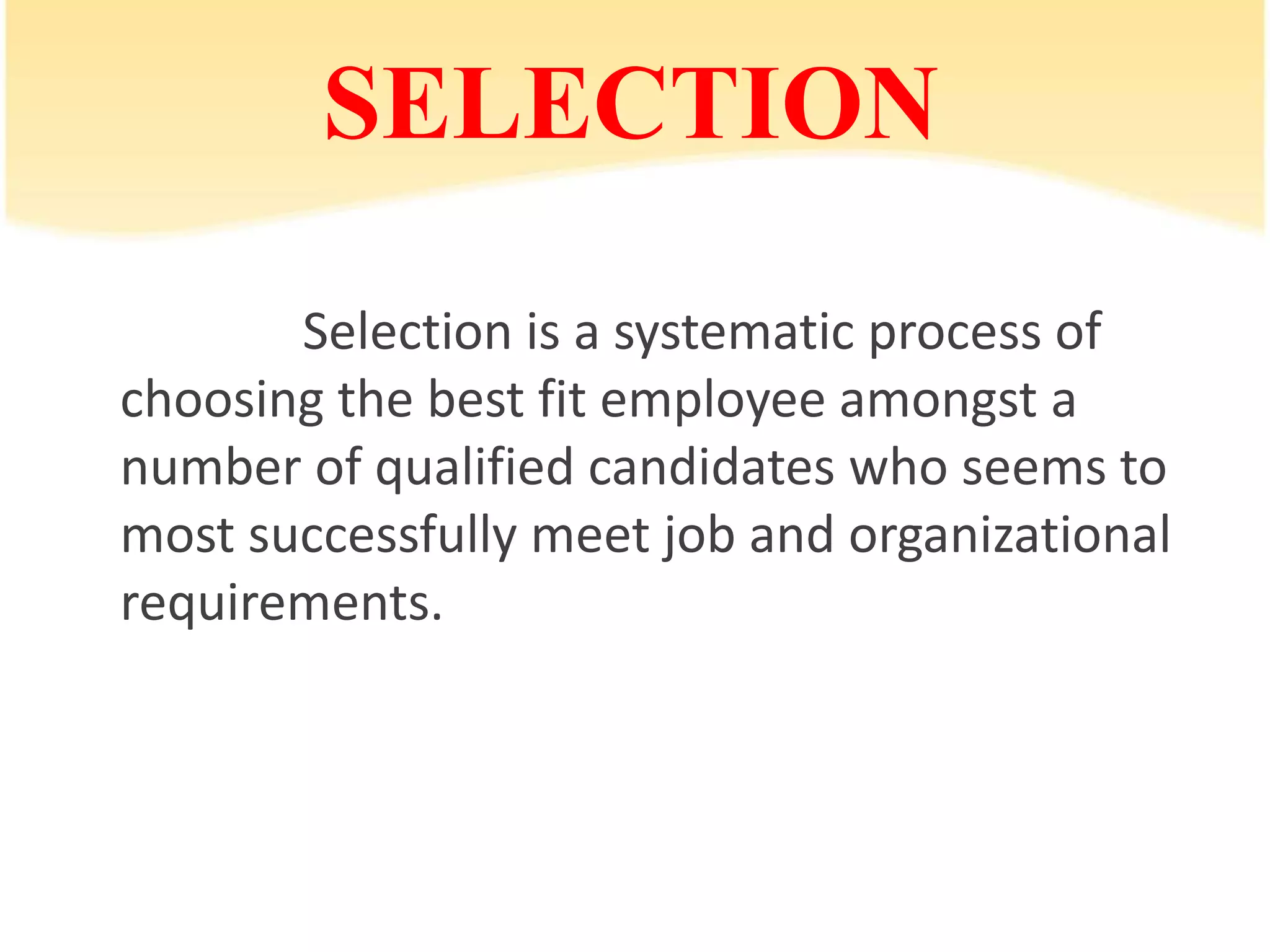
Selection is a systematic process of
choosing the best fit employee amongst a
number of qualified candidates who seems to
most successfully meet job and organizational
requirements.
SELECTION
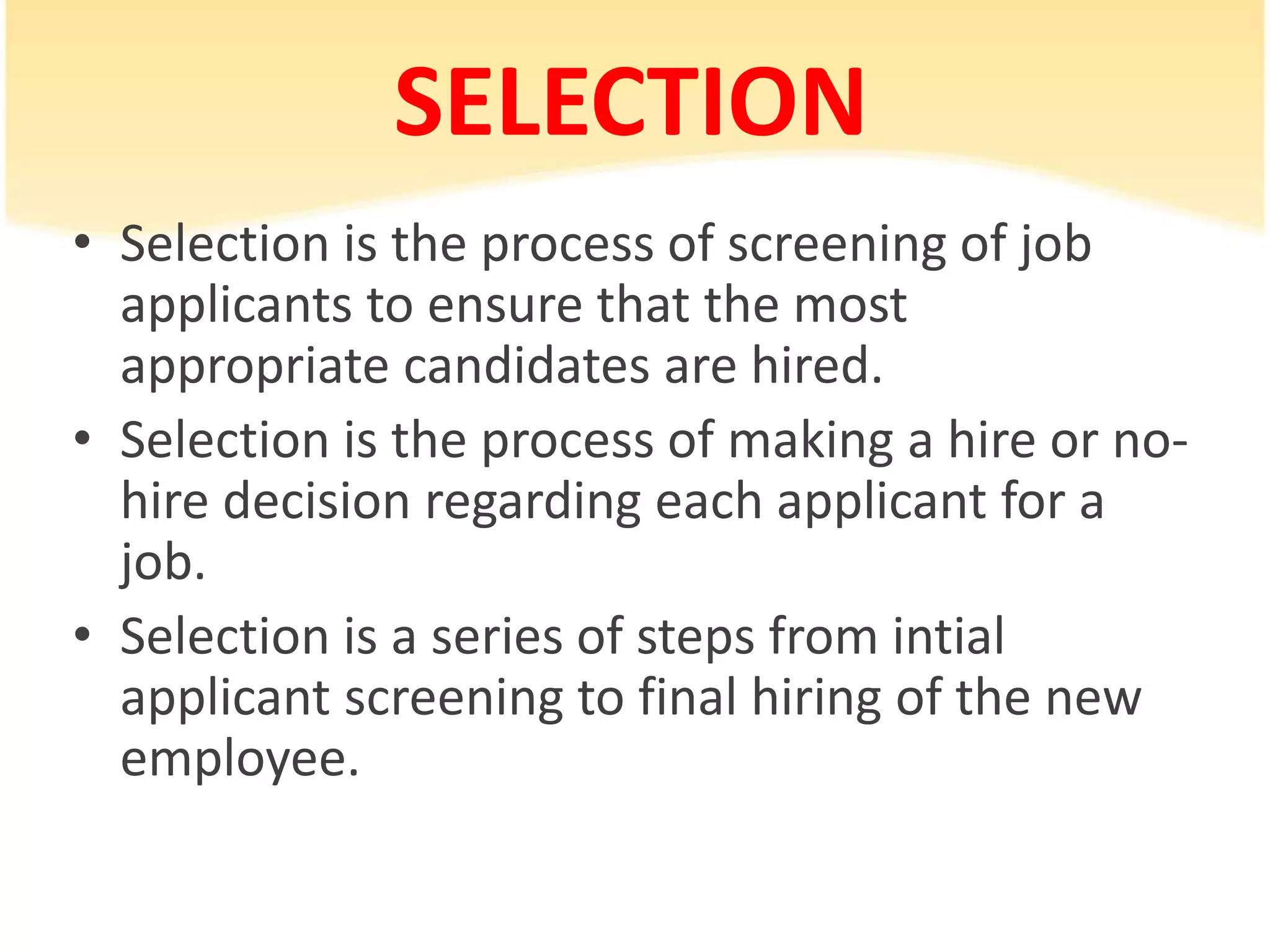
• Selection is the process of screening of job
applicants to ensure that the most
appropriate candidates are hired.
• Selection is the process of making a hire or no-
hire decision regarding each applicant for a
job.
• Selection is a series of steps from intial
applicant screening to final hiring of the new
employee.
OBJECTIVES OF SELECTION
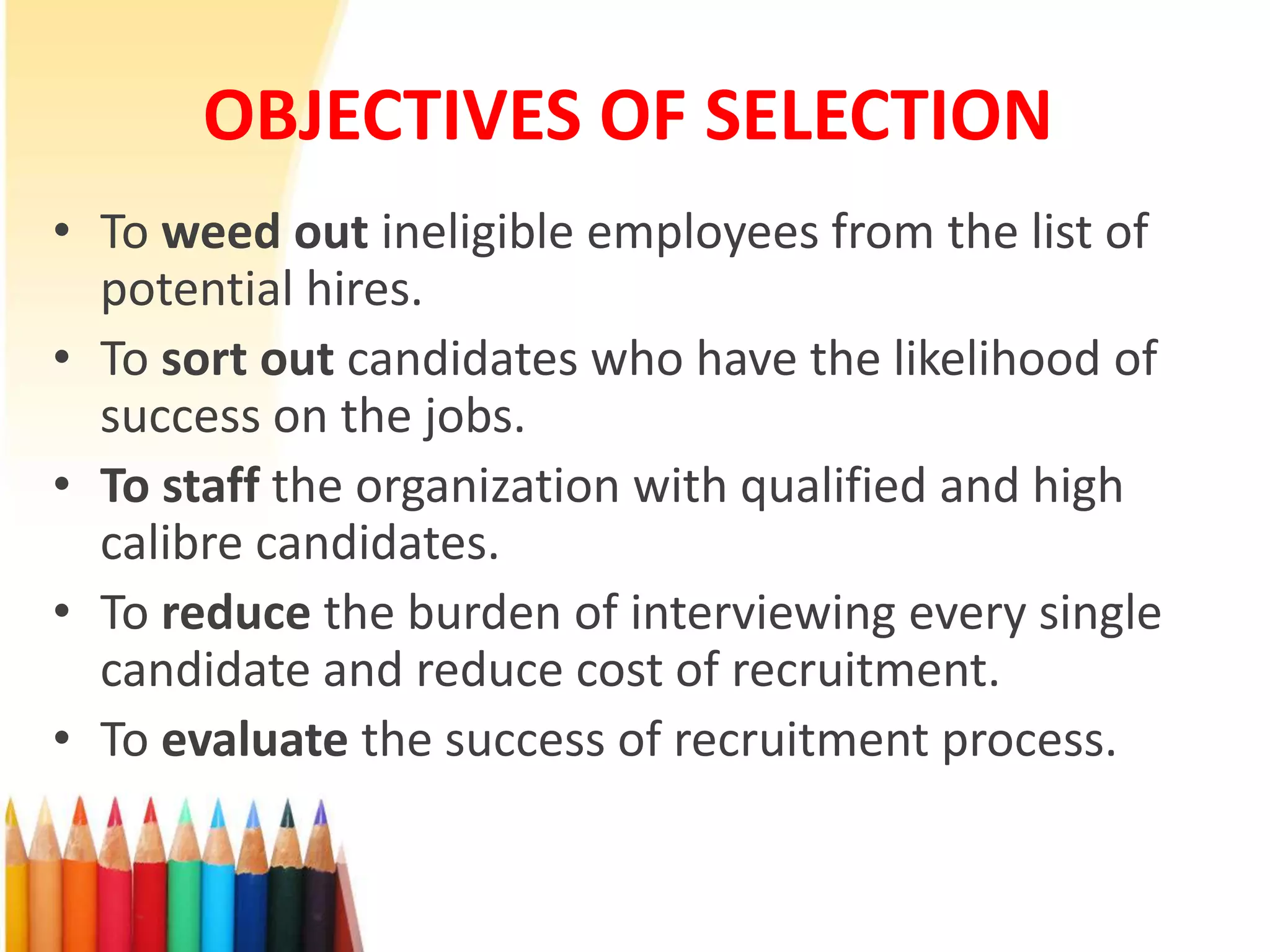
• To weed out ineligible employees from the list of
potential hires.
• To sort out candidates who have the likelihood of
success on the jobs.
• To staff the organization with qualified and high
calibre candidates.
• To reduce the burden of interviewing every single
candidate and reduce cost of recruitment.
• To evaluate the success of recruitment process.
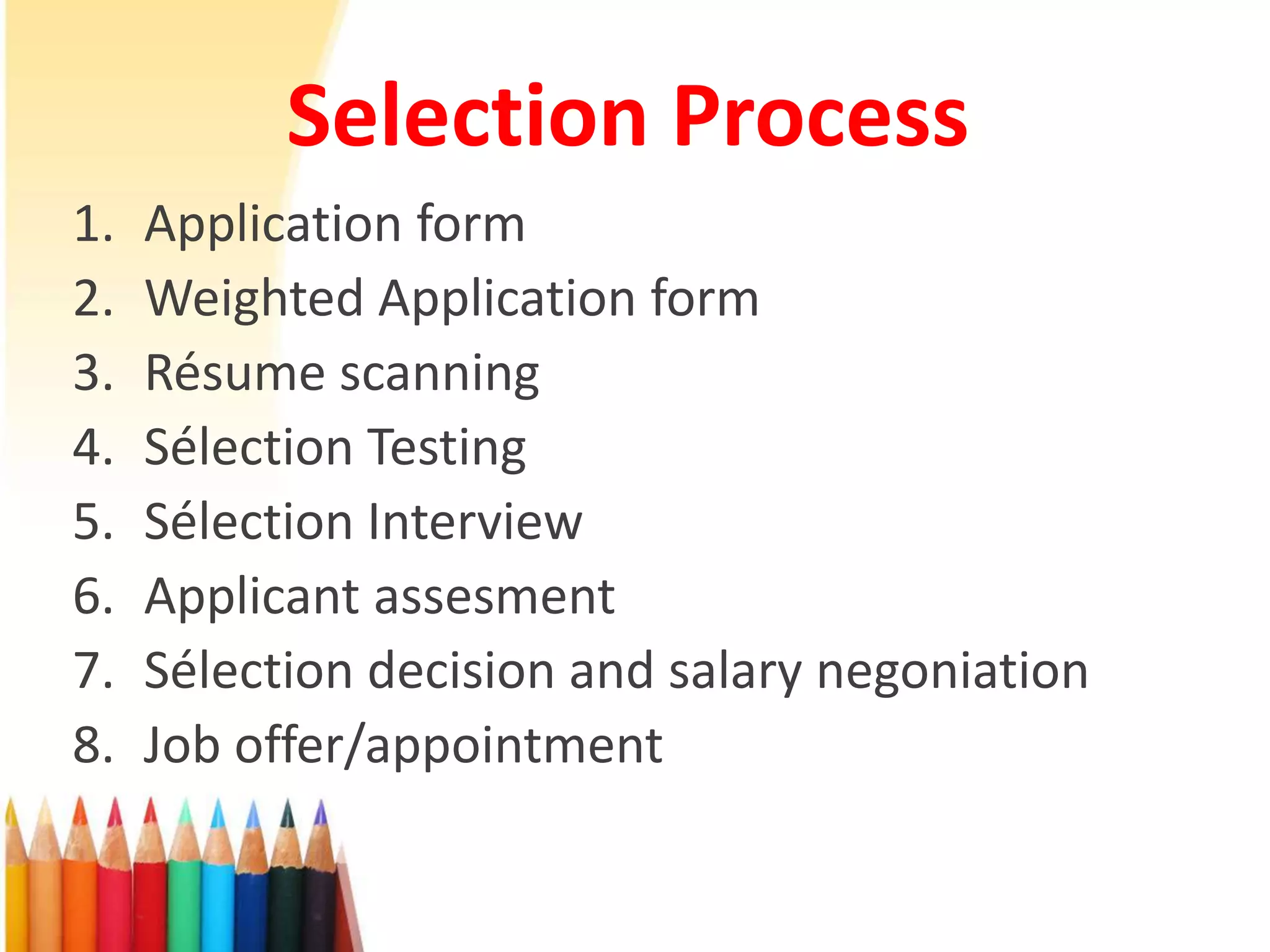
Selection Process
1. Application form
2. Weighted Application form
3. Résume scanning
4. Sélection Testing
5. Sélection Interview
6. Applicant assesment
7. Sélection decision and salary negoniation
8. Job offer/appointment
Application Blank
• It is the most common method used to collect
information on various aspects of applicant’s
academic, social, demographic, work-related
background and references.
• Job seekers may exaggerate, or overstate their
qualifactions on a resume.so they are asked to
translate specific resume meterial into a
standardized application form.
Weighted Application Blank
• To make the application form more job –
related,some organizations assign numeric
values or weights to responses provided by
applicants.
• The items that have strong relationship to job
performance are given high scores.
RESUME SCANING
• Once the recruitment process comes to an
end, recruiters start screening application by
matching resume information with position
requirements.
• After matching, applications failing to match
job requirements are rejected and only those
meeting the criteria are kept.It is called
shortlisting of resume’s.
Selection Testing
• A test is a standardised, objective measure of a
person’s behaviour, performance or attitude.
• Commonly used tests:
a) Inteligence test
b) Aptitude test
c) Personality test
d) Achievement test
e) Simulation test
f) Assessment test
Selection Interview
• Is the oral examination of candidates for
employment.
• It is designed to predict the job performance on the
basis of applicant’s oral response’s to oral inquirie’s.
• Different Types :
a) Non-directive interview
b) Directive or structured interview
c) Situational interview
d) Behavioural interview
e) Stress interview
f) Panel interview
Applicant assessment
• All shortlisted candidates who have been
interviewed are scored according to their
performance and merit.
• Their present compensation and expectations
are evaluvated in terms of budgets,critically of
the position or skill and the abilty of the
organization to pay.
• Those candidates who are on the higher side of
the compensation range of the organization are
kept in the waiting list.
Selection decision and salary
negoniation
• Recruiters at this stage have already finalized
the name of the candidate for potential job
offer.The HR department negotiates the salary
with the candidate and other terms and
conditions that the organization can offer to
the candidate.
Job Offer
• If the salary negotiation is succesful then the
HR department issues a job offer to the
selected candidate specifying the date, venue
and other important information about the
candiadte’s joining.The letter carrying the
selection information is called ‘Offer Letter’ or
Letter of Intent.
BIBLIOGRAPHY
• HUMAN RESOURSE MANAGEMENT –TEXT
AND CASES – VSP RAO.2ND EDITION.
• MANAGING HUMAN RESOURSES AND
INDUSTRIAL RELATIONS – TAPOMOY DEB.
• ARMSTRONG’S HANDBOOK OF HUMAN
RESOURSE MANAGEMENT PRACTICE.- Michael
Armstrong – 11th EDITION

Selection & selection process

  • 1.
    HUMAN RESOURSE MANAGEMENT SELECTIONAND SELECTION PROCESS Suresh Kumar Prajapati P G Collège of Nursing Gwalior
  • 2.
    SELECTION Selection is asystematic process of choosing the best fit employee amongst a number of qualified candidates who seems to most successfully meet job and organizational requirements.
  • 3.
    SELECTION • Selection isthe process of screening of job applicants to ensure that the most appropriate candidates are hired. • Selection is the process of making a hire or no- hire decision regarding each applicant for a job. • Selection is a series of steps from intial applicant screening to final hiring of the new employee.
  • 4.
    OBJECTIVES OF SELECTION •To weed out ineligible employees from the list of potential hires. • To sort out candidates who have the likelihood of success on the jobs. • To staff the organization with qualified and high calibre candidates. • To reduce the burden of interviewing every single candidate and reduce cost of recruitment. • To evaluate the success of recruitment process.
  • 5.
    Selection Process 1. Applicationform 2. Weighted Application form 3. Résume scanning 4. Sélection Testing 5. Sélection Interview 6. Applicant assesment 7. Sélection decision and salary negoniation 8. Job offer/appointment
  • 6.
    Application Blank • Itis the most common method used to collect information on various aspects of applicant’s academic, social, demographic, work-related background and references. • Job seekers may exaggerate, or overstate their qualifactions on a resume.so they are asked to translate specific resume meterial into a standardized application form.
  • 7.
    Weighted Application Blank •To make the application form more job – related,some organizations assign numeric values or weights to responses provided by applicants. • The items that have strong relationship to job performance are given high scores.
  • 8.
    RESUME SCANING • Oncethe recruitment process comes to an end, recruiters start screening application by matching resume information with position requirements. • After matching, applications failing to match job requirements are rejected and only those meeting the criteria are kept.It is called shortlisting of resume’s.
  • 9.
    Selection Testing • Atest is a standardised, objective measure of a person’s behaviour, performance or attitude. • Commonly used tests: a) Inteligence test b) Aptitude test c) Personality test d) Achievement test e) Simulation test f) Assessment test
  • 10.
    Selection Interview • Isthe oral examination of candidates for employment. • It is designed to predict the job performance on the basis of applicant’s oral response’s to oral inquirie’s. • Different Types : a) Non-directive interview b) Directive or structured interview c) Situational interview d) Behavioural interview e) Stress interview f) Panel interview
  • 11.
    Applicant assessment • Allshortlisted candidates who have been interviewed are scored according to their performance and merit. • Their present compensation and expectations are evaluvated in terms of budgets,critically of the position or skill and the abilty of the organization to pay. • Those candidates who are on the higher side of the compensation range of the organization are kept in the waiting list.
  • 12.
    Selection decision andsalary negoniation • Recruiters at this stage have already finalized the name of the candidate for potential job offer.The HR department negotiates the salary with the candidate and other terms and conditions that the organization can offer to the candidate.
  • 13.
    Job Offer • Ifthe salary negotiation is succesful then the HR department issues a job offer to the selected candidate specifying the date, venue and other important information about the candiadte’s joining.The letter carrying the selection information is called ‘Offer Letter’ or Letter of Intent.
  • 14.
    BIBLIOGRAPHY • HUMAN RESOURSEMANAGEMENT –TEXT AND CASES – VSP RAO.2ND EDITION. • MANAGING HUMAN RESOURSES AND INDUSTRIAL RELATIONS – TAPOMOY DEB. • ARMSTRONG’S HANDBOOK OF HUMAN RESOURSE MANAGEMENT PRACTICE.- Michael Armstrong – 11th EDITION