Modularity and evolvability Cells Language Software Scientific process Pedro Beltrao http://pbeltrao.blogspot.com Creative Commons Attribution-ShareAlike 2.5
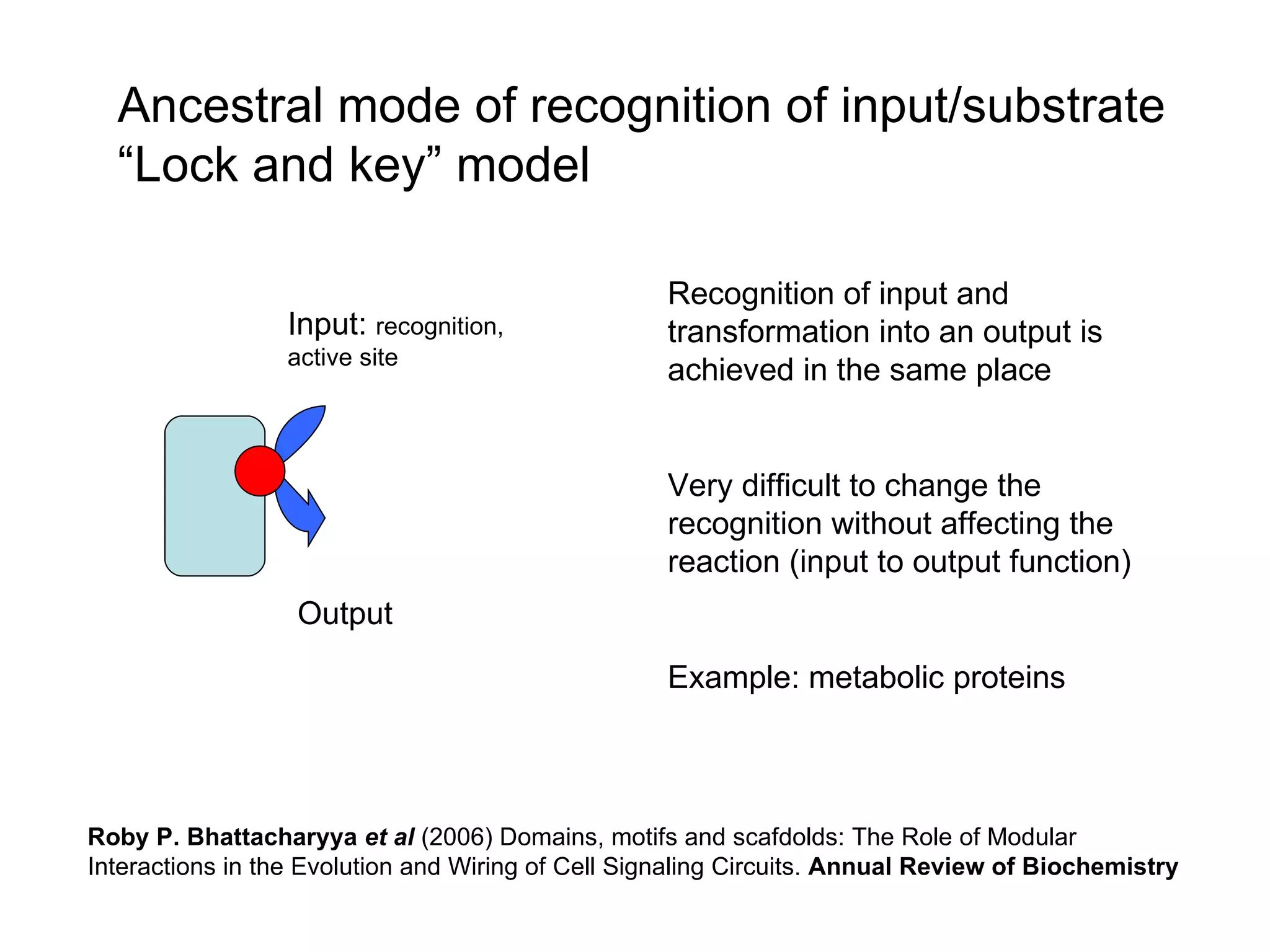
Recognition of input and transformation into an output is achieved in the same place Very difficult to change the recognition without affecting the reaction (input to output function) Example: metabolic proteins Ancestral mode of recognition of input/substrate “Lock and key” model Roby P. Bhattacharyya  et al  (2006) Domains, motifs and scafdolds: The Role of Modular Interactions in the Evolution and Wiring of Cell Signaling Circuits.  Annual Review of Biochemistry Input:  recognition, active site Output
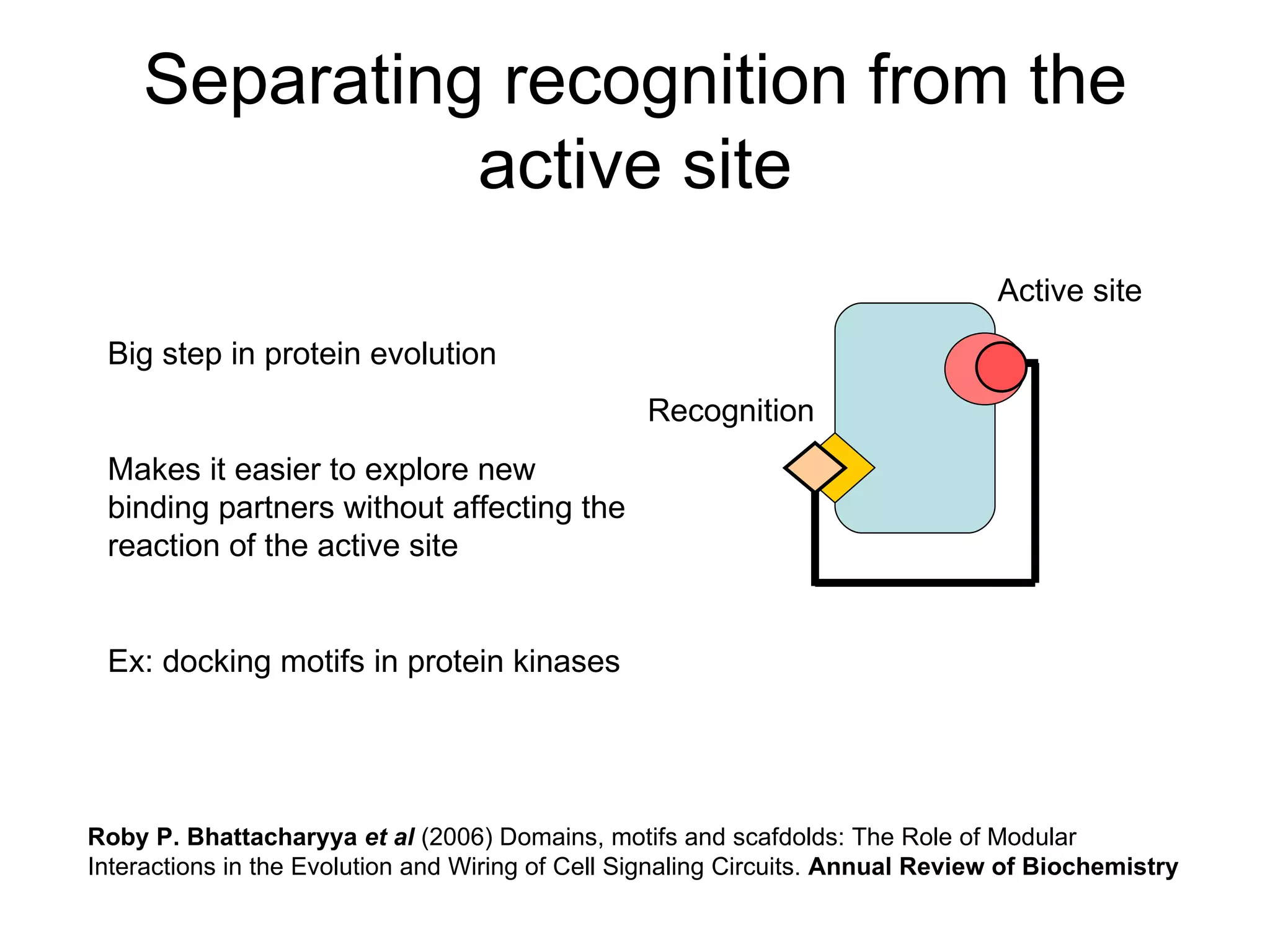
Separating recognition from the active site Big step in protein evolution Makes it easier to explore new binding partners without affecting the reaction of the active site Ex: docking motifs in protein kinases  Roby P. Bhattacharyya  et al  (2006) Domains, motifs and scafdolds: The Role of Modular Interactions in the Evolution and Wiring of Cell Signaling Circuits.  Annual Review of Biochemistry Recognition Active site
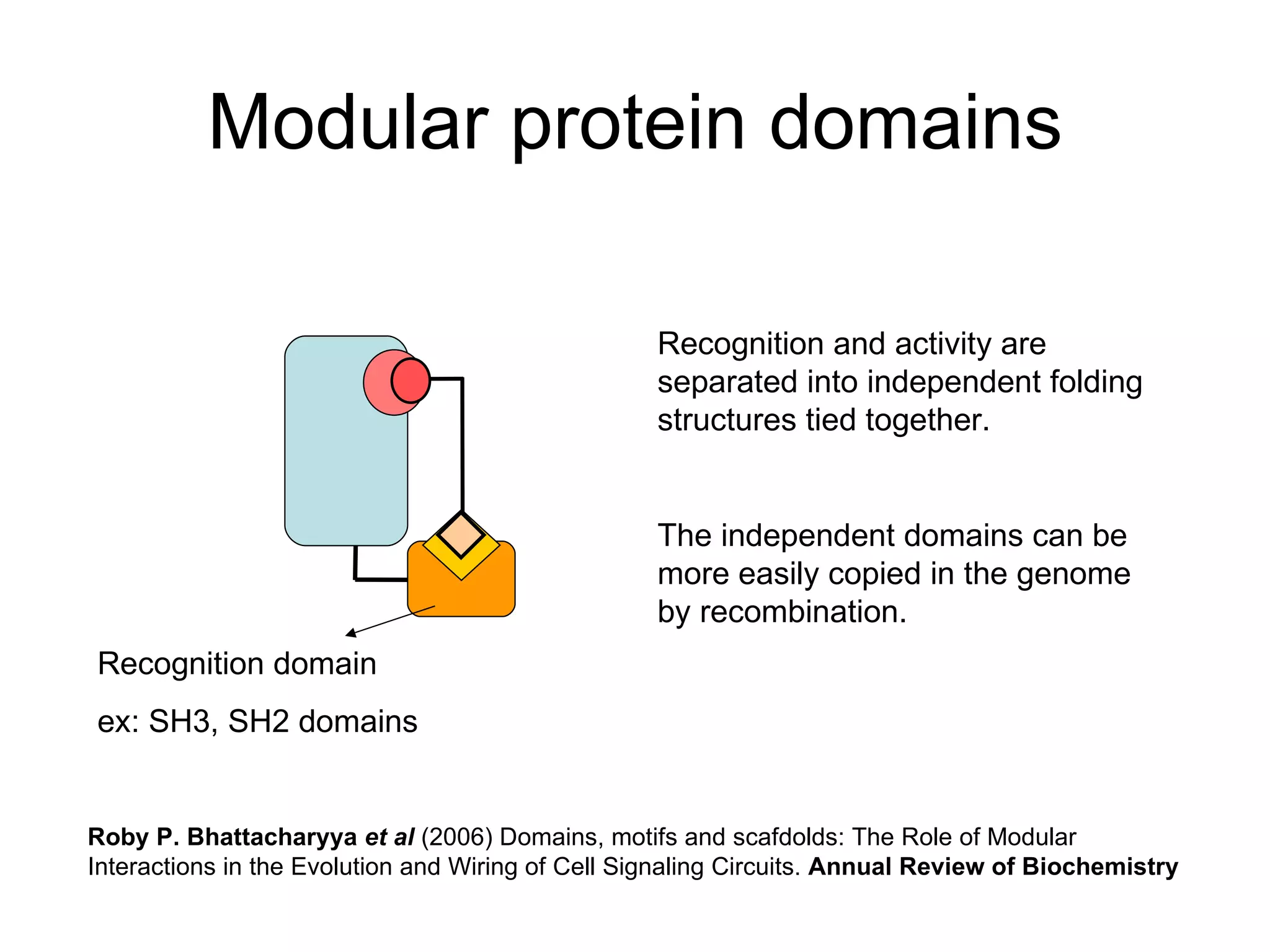
Modular protein domains Recognition and activity are separated into independent folding structures tied together. The independent domains can be more easily copied in the genome by recombination. Recognition domain ex: SH3, SH2 domains Roby P. Bhattacharyya  et al  (2006) Domains, motifs and scafdolds: The Role of Modular Interactions in the Evolution and Wiring of Cell Signaling Circuits.  Annual Review of Biochemistry
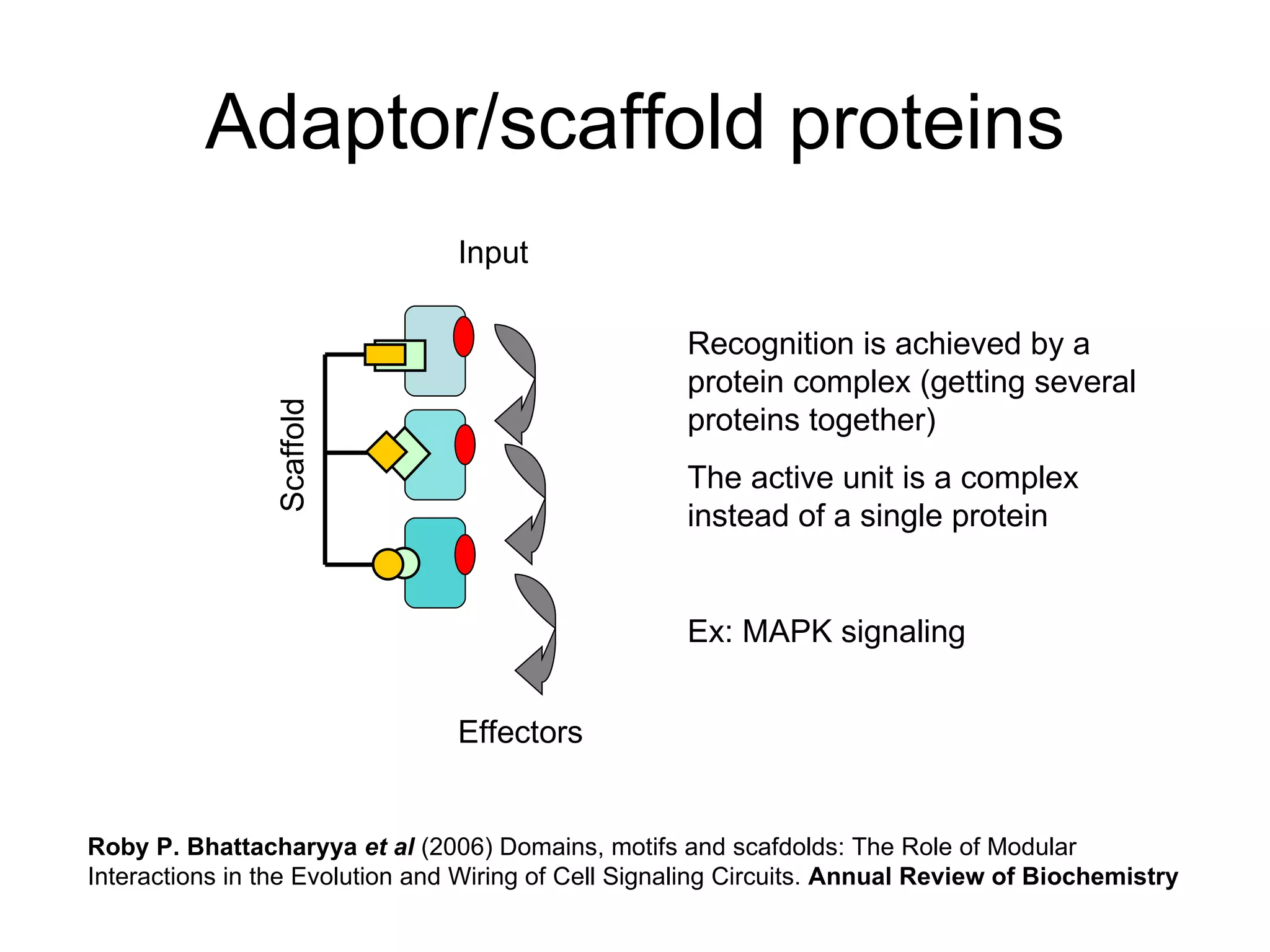
Adaptor/scaffold proteins Recognition is achieved by a protein complex (getting several proteins together) The active unit is a complex instead of a single protein Ex: MAPK signaling  Effectors Input Roby P. Bhattacharyya  et al  (2006) Domains, motifs and scafdolds: The Role of Modular Interactions in the Evolution and Wiring of Cell Signaling Circuits.  Annual Review of Biochemistry Scaffold
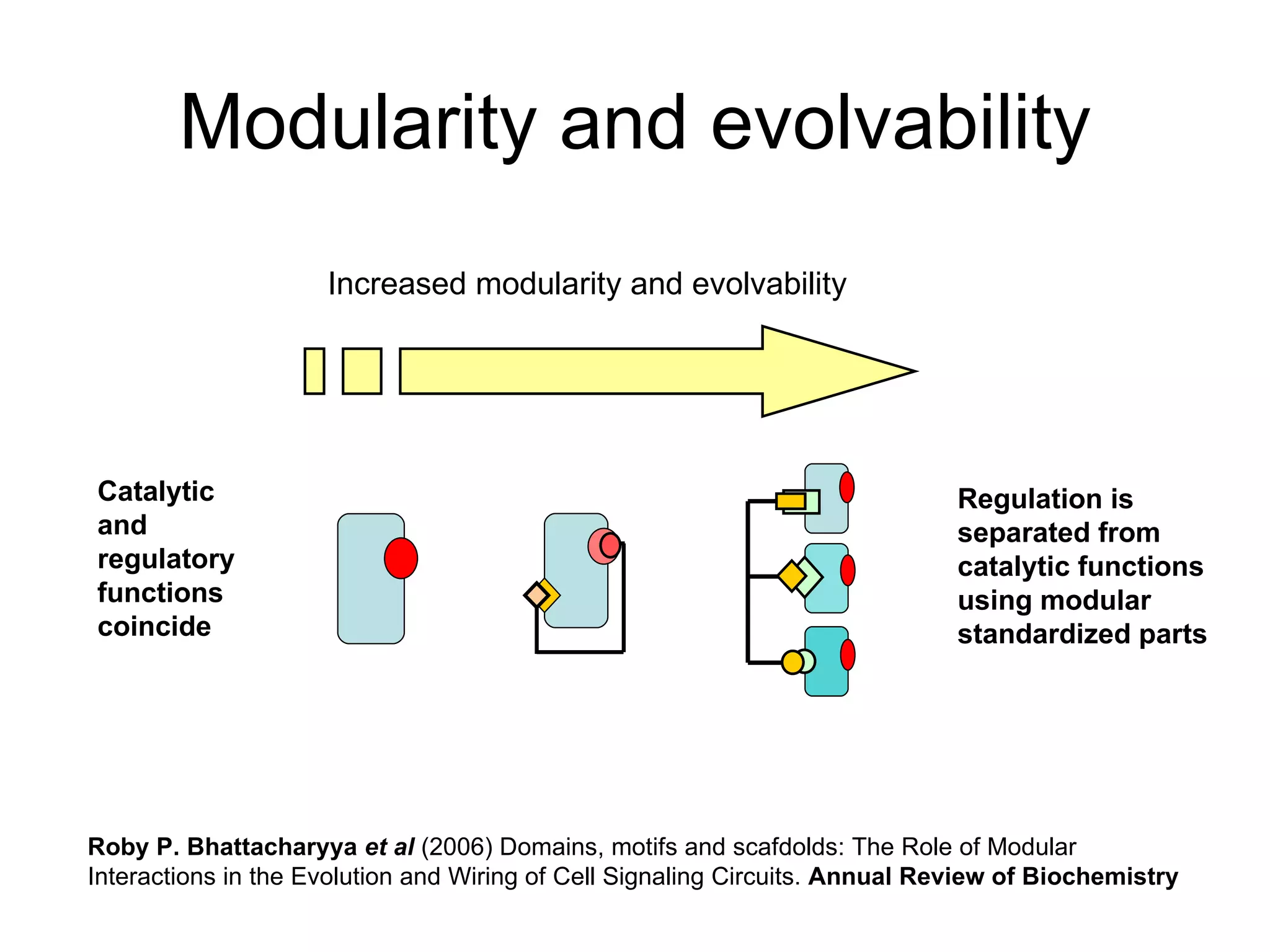
Modularity and evolvability Roby P. Bhattacharyya  et al  (2006) Domains, motifs and scafdolds: The Role of Modular Interactions in the Evolution and Wiring of Cell Signaling Circuits.  Annual Review of Biochemistry Catalytic and regulatory functions coincide Regulation is separated from catalytic functions using modular standardized parts Increased modularity and evolvability
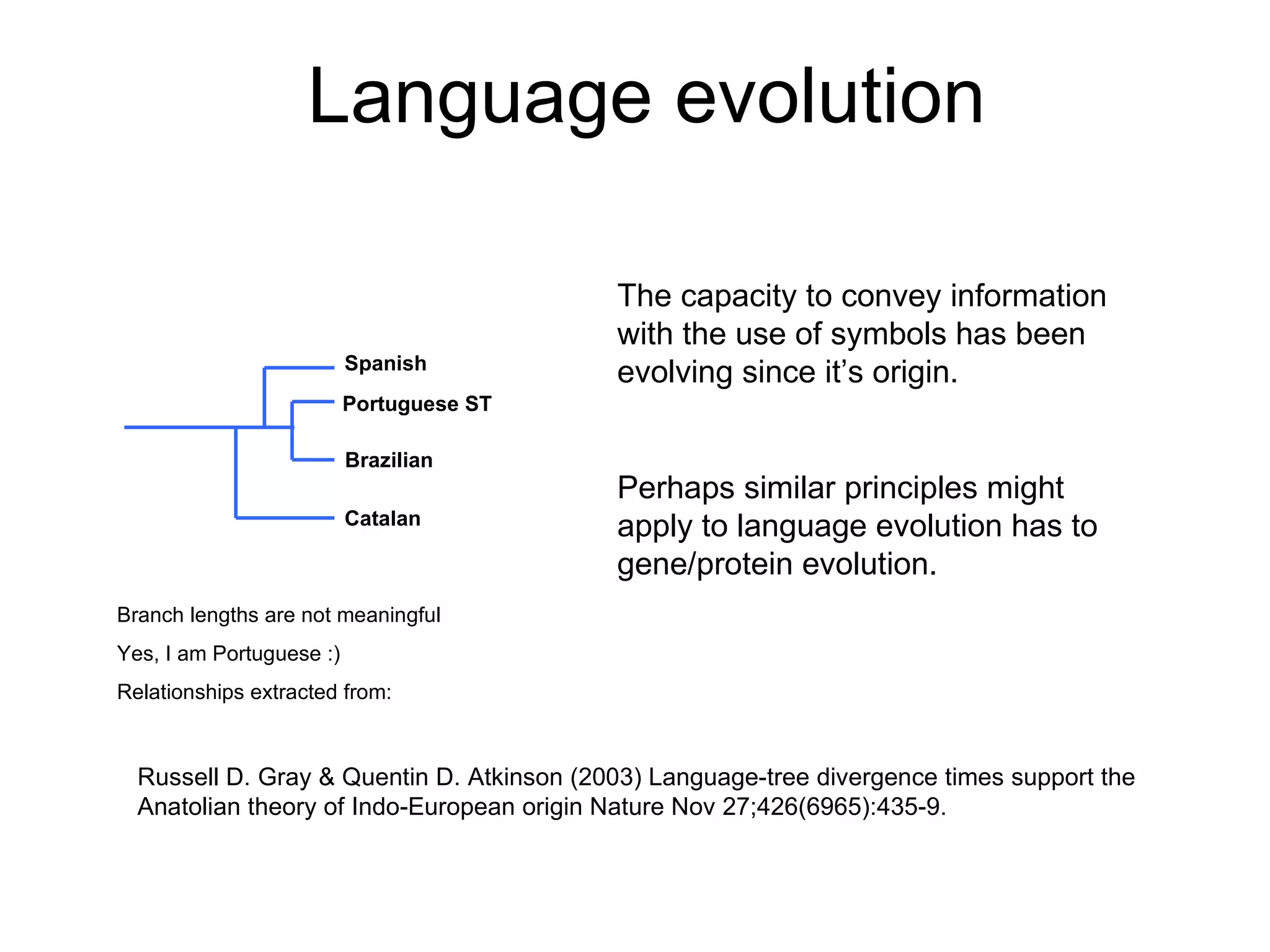
Language evolution Russell D. Gray & Quentin D. Atkinson (2003) Language-tree divergence times support the Anatolian theory of Indo-European origin Nature Nov 27;426(6965):435-9.  Portuguese ST Brazilian Spanish Catalan Branch lengths are not meaningful Yes, I am Portuguese :) Relationships extracted from: The capacity to convey information with the use of symbols has been evolving since it’s origin. Perhaps similar principles might apply to language evolution has to gene/protein evolution.
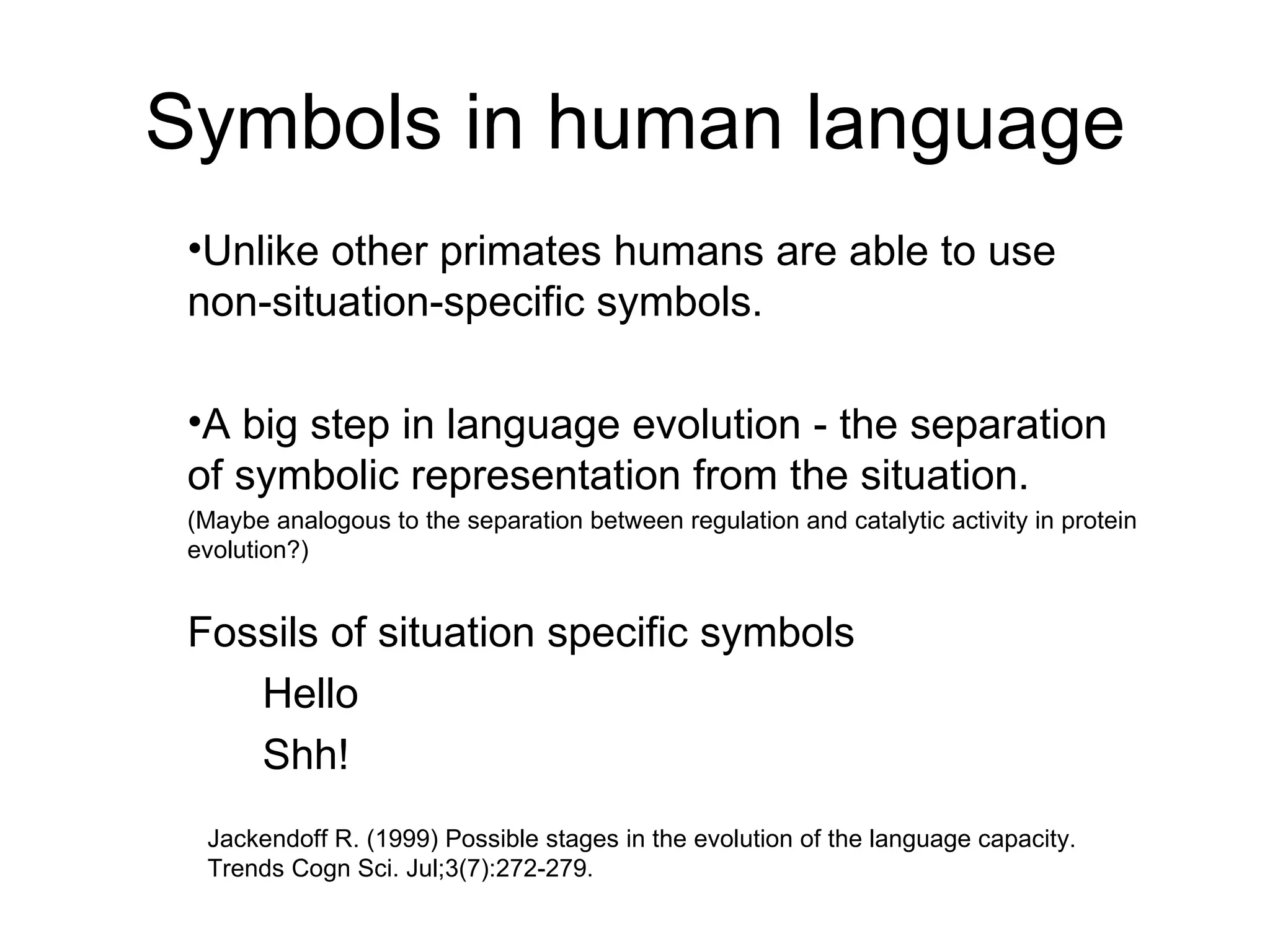
Symbols in human language Unlike other primates humans are able to use non-situation-specific symbols. A big step in language evolution - the separation of symbolic representation from the situation. (Maybe analogous to the separation between regulation and catalytic activity in protein evolution?) Fossils of situation specific symbols Hello Shh! Jackendoff R. (1999) Possible stages in the evolution of the language capacity.  Trends Cogn Sci. Jul;3(7):272-279.
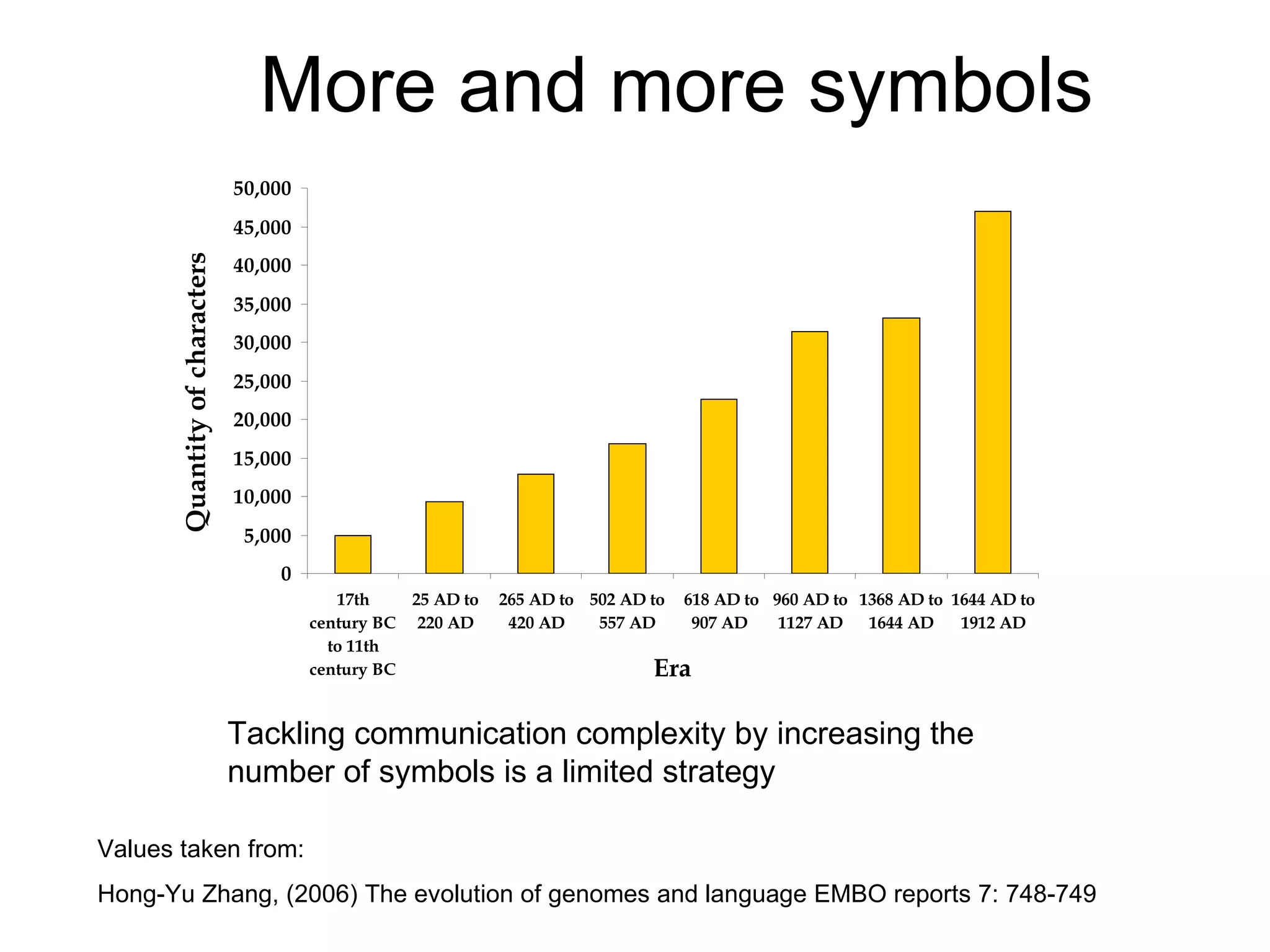
More and more symbols Values taken from: Hong-Yu Zhang, (2006) The evolution of genomes and language EMBO reports 7: 748-749 Tackling communication complexity by increasing the number of symbols is a limited strategy
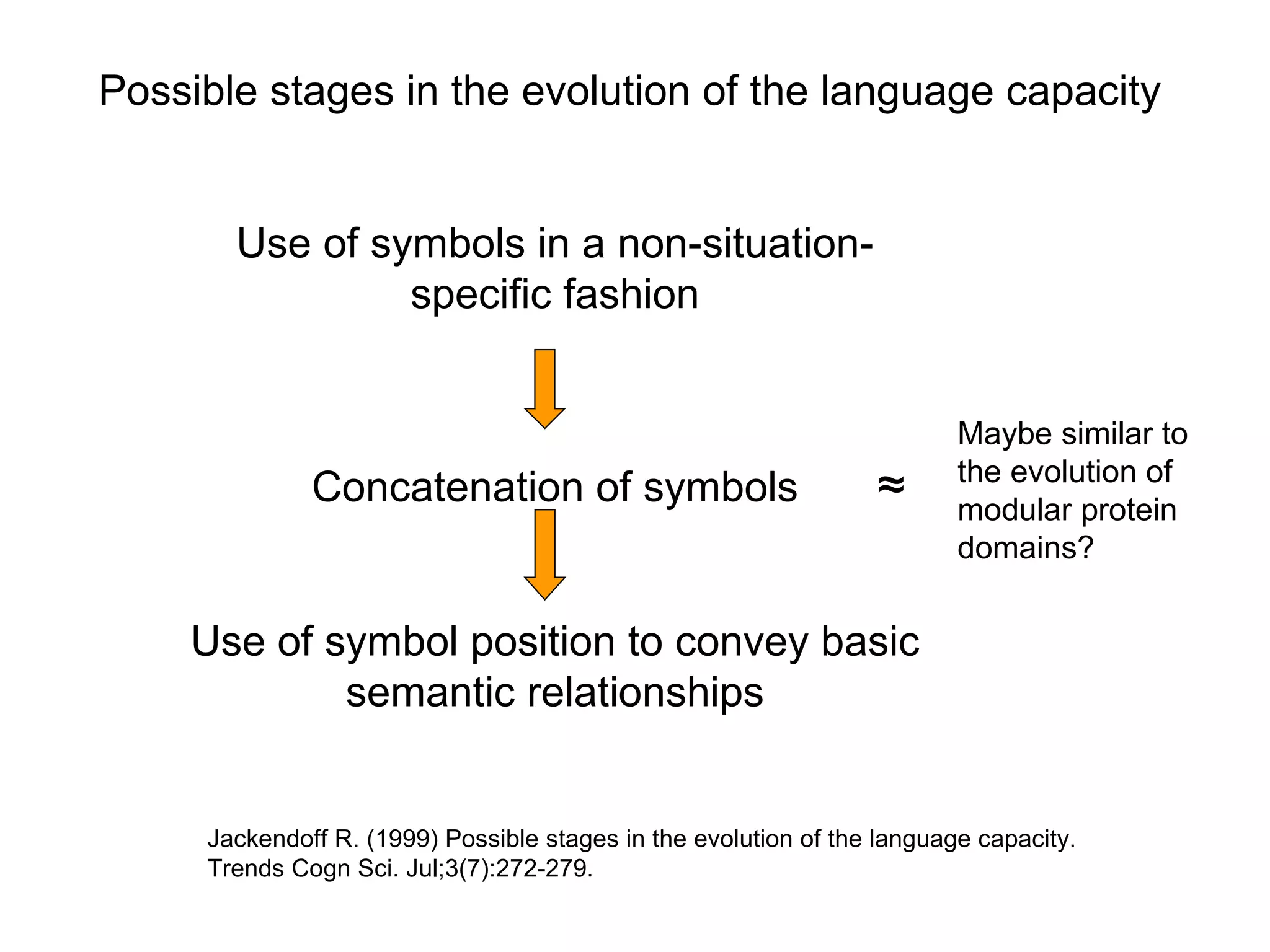
Use of symbols in a non-situation-specific fashion Concatenation of symbols Use of symbol position to convey basic semantic relationships Maybe similar to the evolution of modular protein domains? ≈ Jackendoff R. (1999) Possible stages in the evolution of the language capacity.  Trends Cogn Sci. Jul;3(7):272-279. Possible stages in the evolution of the language capacity
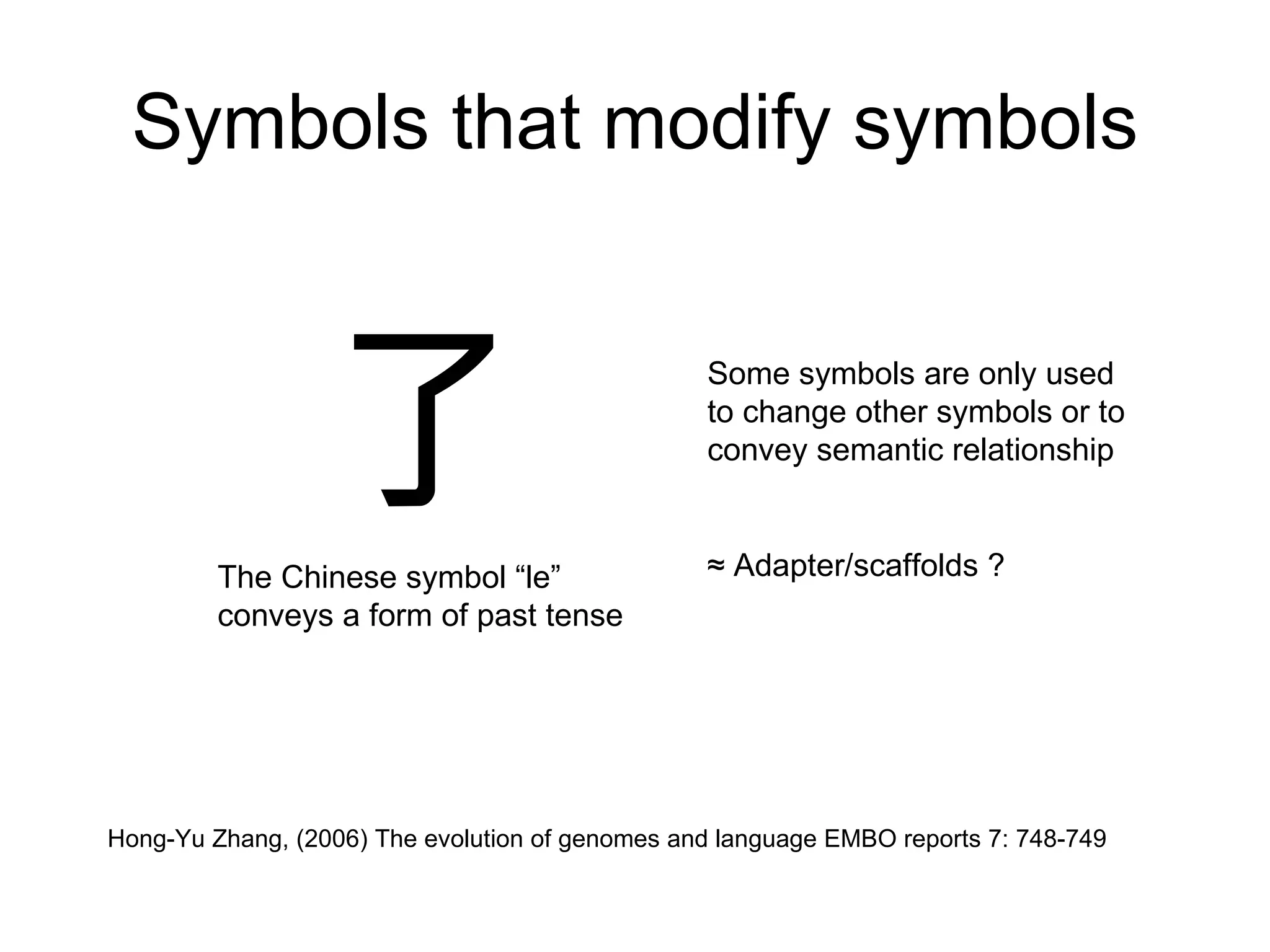
Symbols that modify symbols Some symbols are only used to change other symbols or to convey semantic relationship  ≈ Adapter/scaffolds ?  Hong-Yu Zhang, (2006) The evolution of genomes and language EMBO reports 7: 748-749 了 The Chinese symbol “le” conveys a form of past tense
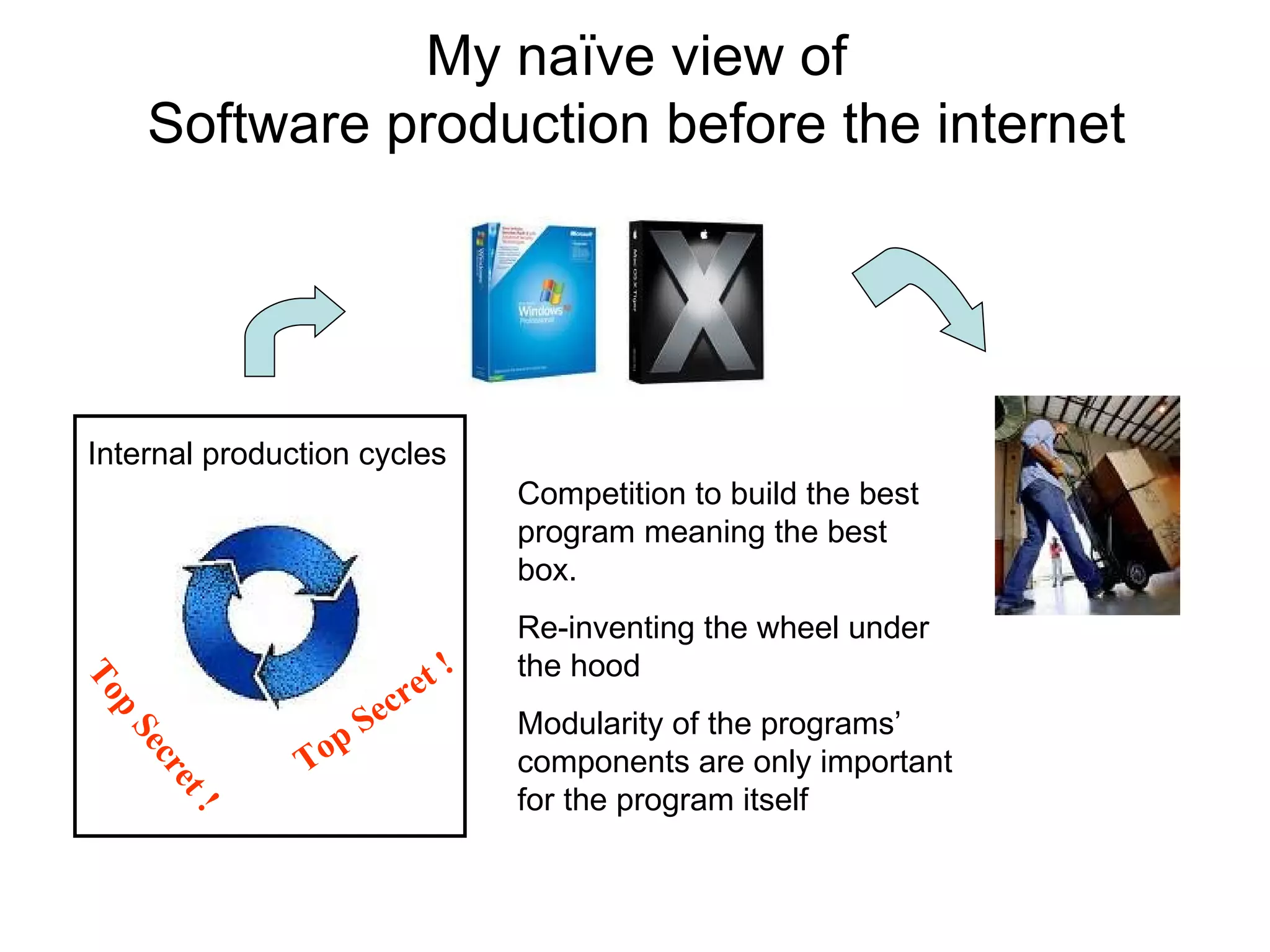
My naïve view of Software production before the internet Internal production cycles Top Secret ! Top Secret ! Competition to build the best program meaning the best box. Re-inventing the wheel under the hood Modularity of the programs’ components are only important for the program itself
Modularity and evolvability   Software on the internet Distribution on the web Modules are open and can be worked on by anyone (APIs, Mashups) Make your own program, copy paste/clone application. Duplication and evolution of apps.  Reduces the attrition to innovate = higher evolvability
Scientific communication We compete to produce scientific manuscript accepted in peer-reviewed journals The competition exists because there is limited resources and limited attention of fellow scientists.  Competition is usually seen as a good thing, it keeps us from wasting resources
The scooping problem Because we compete to produce accepted papers, research agenda and current results are hidden.  It is possible to spend two-three years doing exactly the same thing as many other scientists. The first to publish gets the reward.  This leads to a big waste of resources
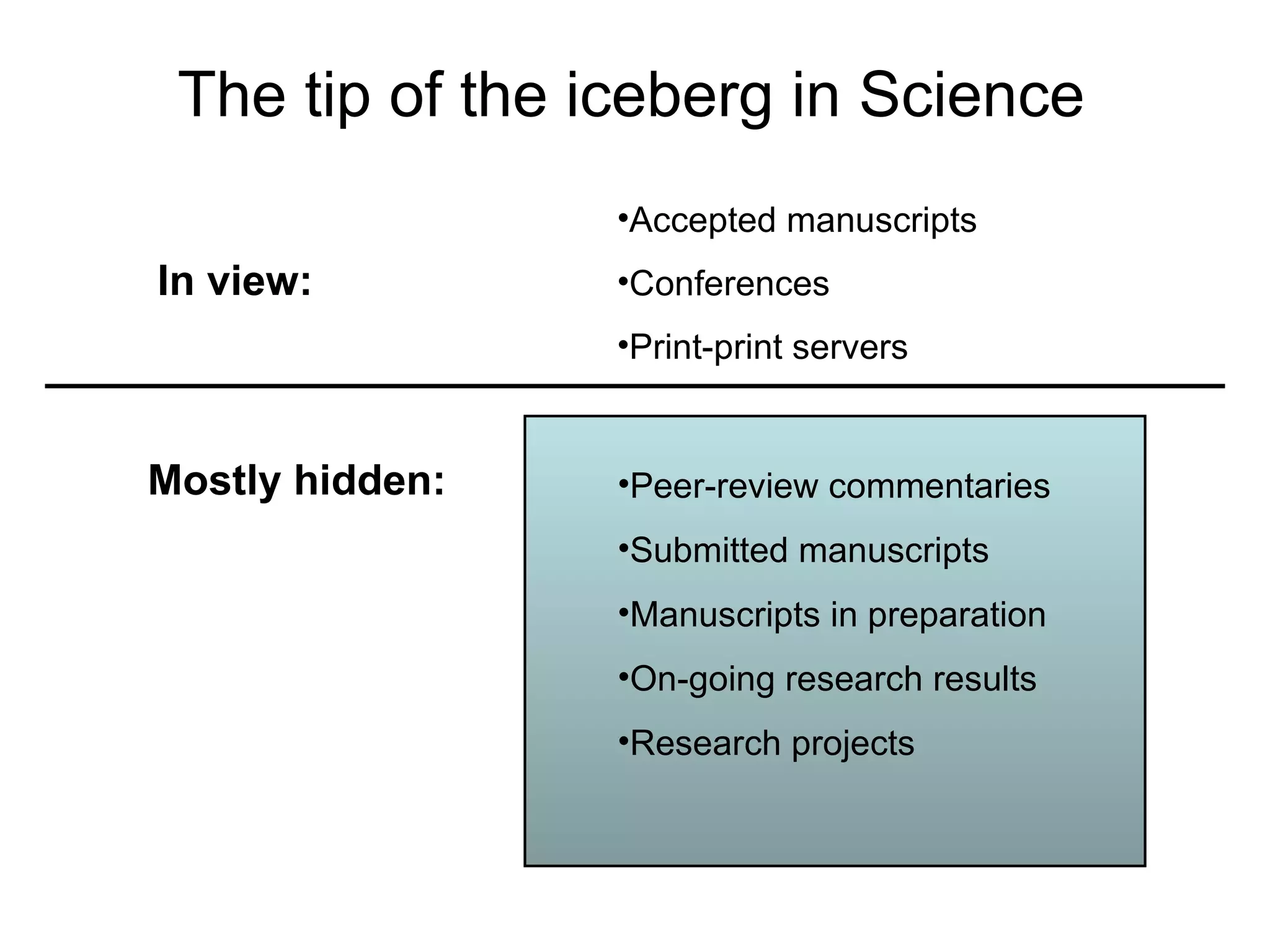
Peer-review commentaries Submitted manuscripts Manuscripts in preparation On-going research results Research projects Accepted manuscripts Conferences Print-print servers Mostly hidden: In view: The tip of the iceberg in Science
Why is the process mostly hidden?  Scientific journals did all the steps of science publishing before the digital era.  Registration   Certification Awareness Archiving   Rewarding The digital revolution allows for an increase in modularity of scientific communication Van de Sompel, H., Payette, S., Erickson, J., Lagoze, C., Warner, S.  D-Lib Magazine  10, doi:10.1045/september2004-vandesompel (2004).
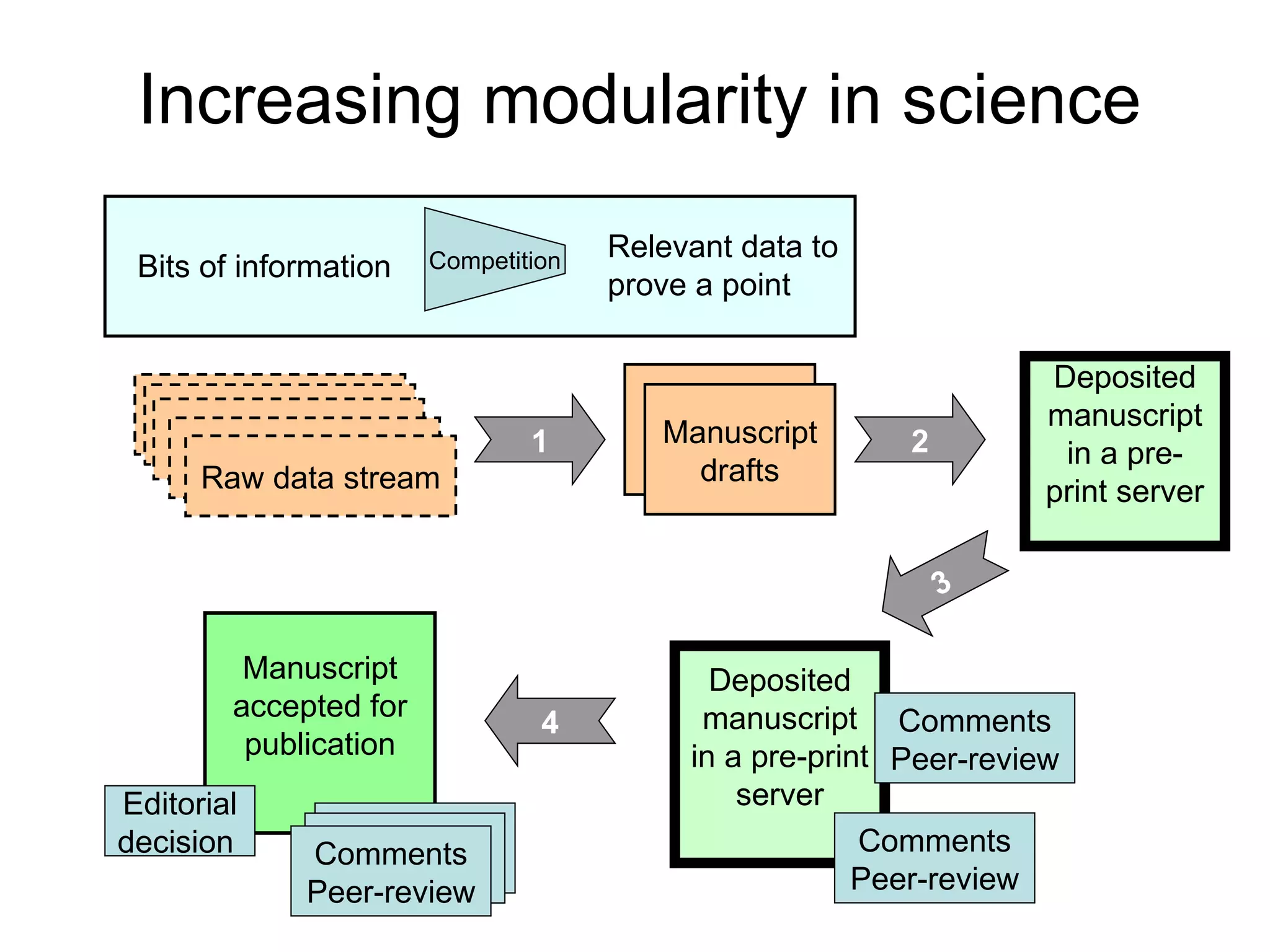
Raw data stream Raw data stream Raw data stream 1 Manuscript Deposited manuscript in a pre-print server Deposited manuscript in a pre-print server Manuscript drafts Raw data stream Raw data stream Comments Peer-review  Comments Peer-review  Manuscript accepted for publication Comments Peer-review  Comments Peer-review  Comments Peer-review  Editorial decision  2 3 4 Competition Bits of information Relevant data to prove a point Increasing modularity in science
Open science utopia ?  We should enable the publication of faster and finer grain scientific content. (blogs, wikis, database journals, etc) The small communications that best prove a point would be used in manuscripts. All contributing scientists would be authors  Everyone should be able to join a research agenda if the contribution is adequate
Modularity and evolvability In evolving systems modularity is tied to potential to generate (phenotypic) diversity (evolvability)  The internet allows for an increase in modularity of the scientific process. We are currently wasting resources by hiding most of current research We should increase the modularity and transparency in science

Modularity and evolvability

  • 1.
    Modularity and evolvabilityCells Language Software Scientific process Pedro Beltrao http://pbeltrao.blogspot.com Creative Commons Attribution-ShareAlike 2.5
  • 2.
    Recognition of inputand transformation into an output is achieved in the same place Very difficult to change the recognition without affecting the reaction (input to output function) Example: metabolic proteins Ancestral mode of recognition of input/substrate “Lock and key” model Roby P. Bhattacharyya et al (2006) Domains, motifs and scafdolds: The Role of Modular Interactions in the Evolution and Wiring of Cell Signaling Circuits. Annual Review of Biochemistry Input: recognition, active site Output
  • 3.
    Separating recognition fromthe active site Big step in protein evolution Makes it easier to explore new binding partners without affecting the reaction of the active site Ex: docking motifs in protein kinases Roby P. Bhattacharyya et al (2006) Domains, motifs and scafdolds: The Role of Modular Interactions in the Evolution and Wiring of Cell Signaling Circuits. Annual Review of Biochemistry Recognition Active site
  • 4.
    Modular protein domainsRecognition and activity are separated into independent folding structures tied together. The independent domains can be more easily copied in the genome by recombination. Recognition domain ex: SH3, SH2 domains Roby P. Bhattacharyya et al (2006) Domains, motifs and scafdolds: The Role of Modular Interactions in the Evolution and Wiring of Cell Signaling Circuits. Annual Review of Biochemistry
  • 5.
    Adaptor/scaffold proteins Recognitionis achieved by a protein complex (getting several proteins together) The active unit is a complex instead of a single protein Ex: MAPK signaling Effectors Input Roby P. Bhattacharyya et al (2006) Domains, motifs and scafdolds: The Role of Modular Interactions in the Evolution and Wiring of Cell Signaling Circuits. Annual Review of Biochemistry Scaffold
  • 6.
    Modularity and evolvabilityRoby P. Bhattacharyya et al (2006) Domains, motifs and scafdolds: The Role of Modular Interactions in the Evolution and Wiring of Cell Signaling Circuits. Annual Review of Biochemistry Catalytic and regulatory functions coincide Regulation is separated from catalytic functions using modular standardized parts Increased modularity and evolvability
  • 7.
    Language evolution RussellD. Gray & Quentin D. Atkinson (2003) Language-tree divergence times support the Anatolian theory of Indo-European origin Nature Nov 27;426(6965):435-9. Portuguese ST Brazilian Spanish Catalan Branch lengths are not meaningful Yes, I am Portuguese :) Relationships extracted from: The capacity to convey information with the use of symbols has been evolving since it’s origin. Perhaps similar principles might apply to language evolution has to gene/protein evolution.
  • 8.
    Symbols in humanlanguage Unlike other primates humans are able to use non-situation-specific symbols. A big step in language evolution - the separation of symbolic representation from the situation. (Maybe analogous to the separation between regulation and catalytic activity in protein evolution?) Fossils of situation specific symbols Hello Shh! Jackendoff R. (1999) Possible stages in the evolution of the language capacity. Trends Cogn Sci. Jul;3(7):272-279.
  • 9.
    More and moresymbols Values taken from: Hong-Yu Zhang, (2006) The evolution of genomes and language EMBO reports 7: 748-749 Tackling communication complexity by increasing the number of symbols is a limited strategy
  • 10.
    Use of symbolsin a non-situation-specific fashion Concatenation of symbols Use of symbol position to convey basic semantic relationships Maybe similar to the evolution of modular protein domains? ≈ Jackendoff R. (1999) Possible stages in the evolution of the language capacity. Trends Cogn Sci. Jul;3(7):272-279. Possible stages in the evolution of the language capacity
  • 11.
    Symbols that modifysymbols Some symbols are only used to change other symbols or to convey semantic relationship ≈ Adapter/scaffolds ? Hong-Yu Zhang, (2006) The evolution of genomes and language EMBO reports 7: 748-749 了 The Chinese symbol “le” conveys a form of past tense
  • 12.
    My naïve viewof Software production before the internet Internal production cycles Top Secret ! Top Secret ! Competition to build the best program meaning the best box. Re-inventing the wheel under the hood Modularity of the programs’ components are only important for the program itself
  • 13.
    Modularity and evolvability Software on the internet Distribution on the web Modules are open and can be worked on by anyone (APIs, Mashups) Make your own program, copy paste/clone application. Duplication and evolution of apps. Reduces the attrition to innovate = higher evolvability
  • 14.
    Scientific communication Wecompete to produce scientific manuscript accepted in peer-reviewed journals The competition exists because there is limited resources and limited attention of fellow scientists. Competition is usually seen as a good thing, it keeps us from wasting resources
  • 15.
    The scooping problemBecause we compete to produce accepted papers, research agenda and current results are hidden. It is possible to spend two-three years doing exactly the same thing as many other scientists. The first to publish gets the reward. This leads to a big waste of resources
  • 16.
    Peer-review commentaries Submittedmanuscripts Manuscripts in preparation On-going research results Research projects Accepted manuscripts Conferences Print-print servers Mostly hidden: In view: The tip of the iceberg in Science
  • 17.
    Why is theprocess mostly hidden? Scientific journals did all the steps of science publishing before the digital era. Registration Certification Awareness Archiving Rewarding The digital revolution allows for an increase in modularity of scientific communication Van de Sompel, H., Payette, S., Erickson, J., Lagoze, C., Warner, S. D-Lib Magazine 10, doi:10.1045/september2004-vandesompel (2004).
  • 18.
    Raw data streamRaw data stream Raw data stream 1 Manuscript Deposited manuscript in a pre-print server Deposited manuscript in a pre-print server Manuscript drafts Raw data stream Raw data stream Comments Peer-review Comments Peer-review Manuscript accepted for publication Comments Peer-review Comments Peer-review Comments Peer-review Editorial decision 2 3 4 Competition Bits of information Relevant data to prove a point Increasing modularity in science
  • 19.
    Open science utopia? We should enable the publication of faster and finer grain scientific content. (blogs, wikis, database journals, etc) The small communications that best prove a point would be used in manuscripts. All contributing scientists would be authors Everyone should be able to join a research agenda if the contribution is adequate
  • 20.
    Modularity and evolvabilityIn evolving systems modularity is tied to potential to generate (phenotypic) diversity (evolvability) The internet allows for an increase in modularity of the scientific process. We are currently wasting resources by hiding most of current research We should increase the modularity and transparency in science