Download as PDF, PPTX


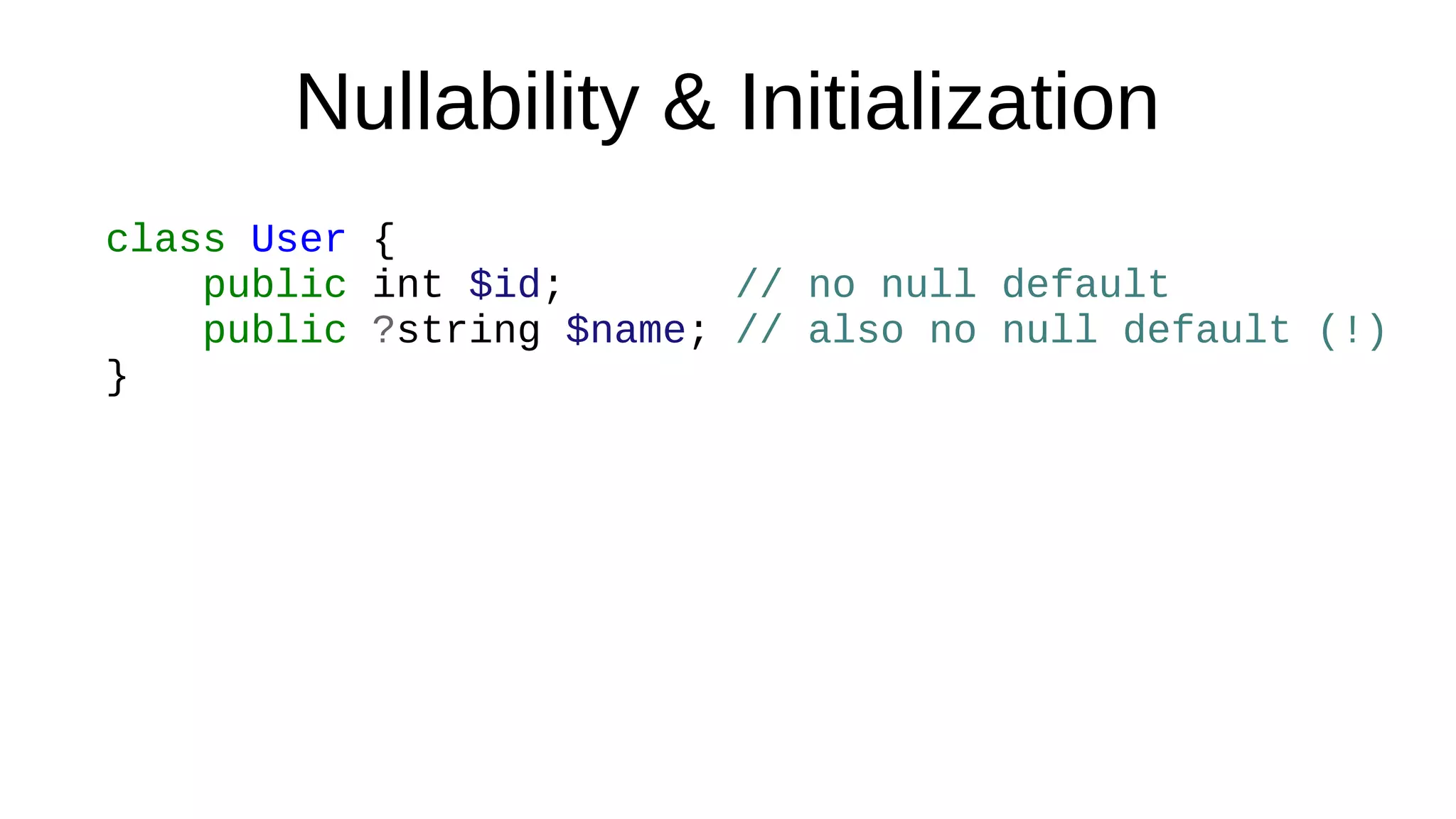
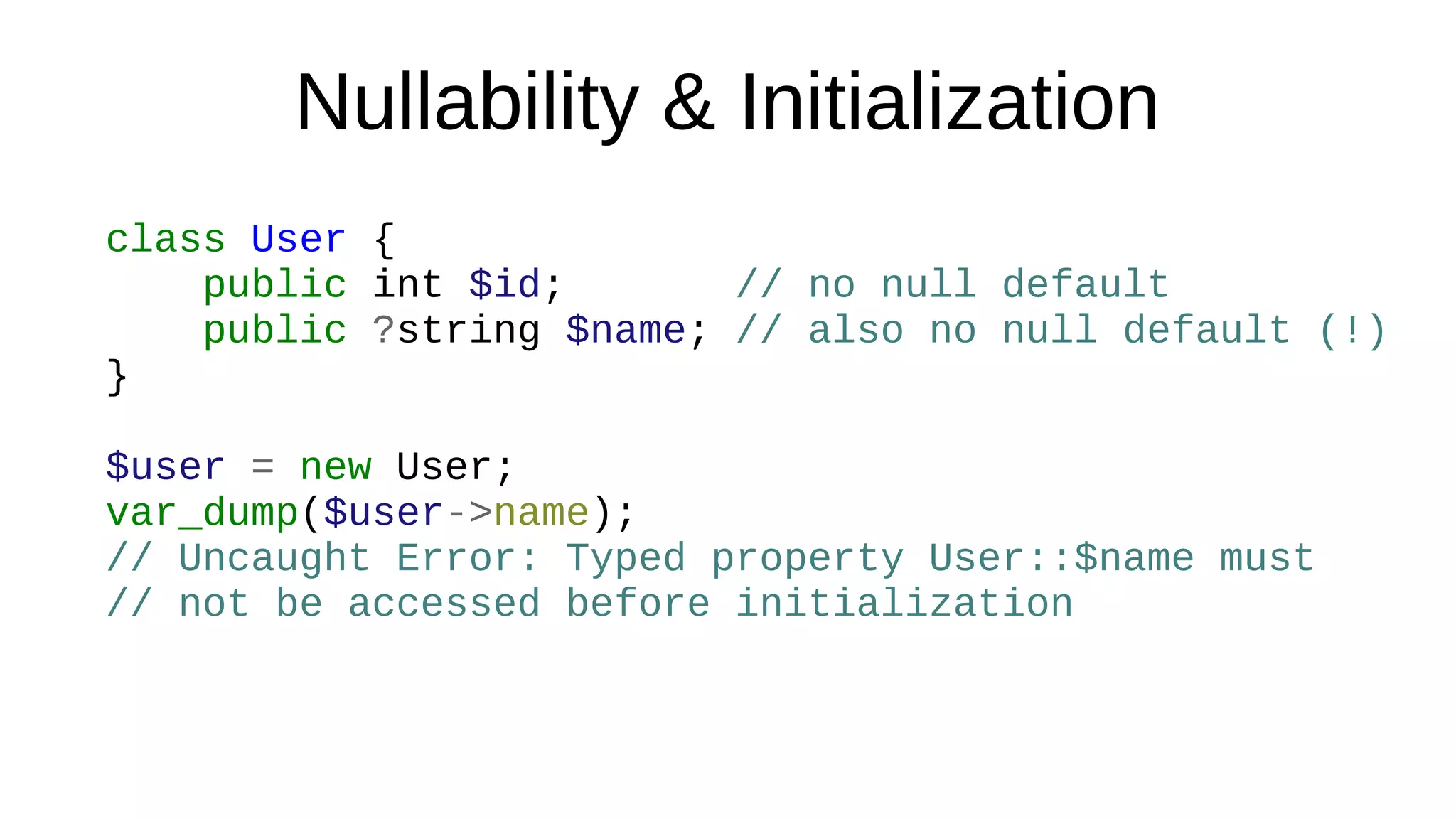
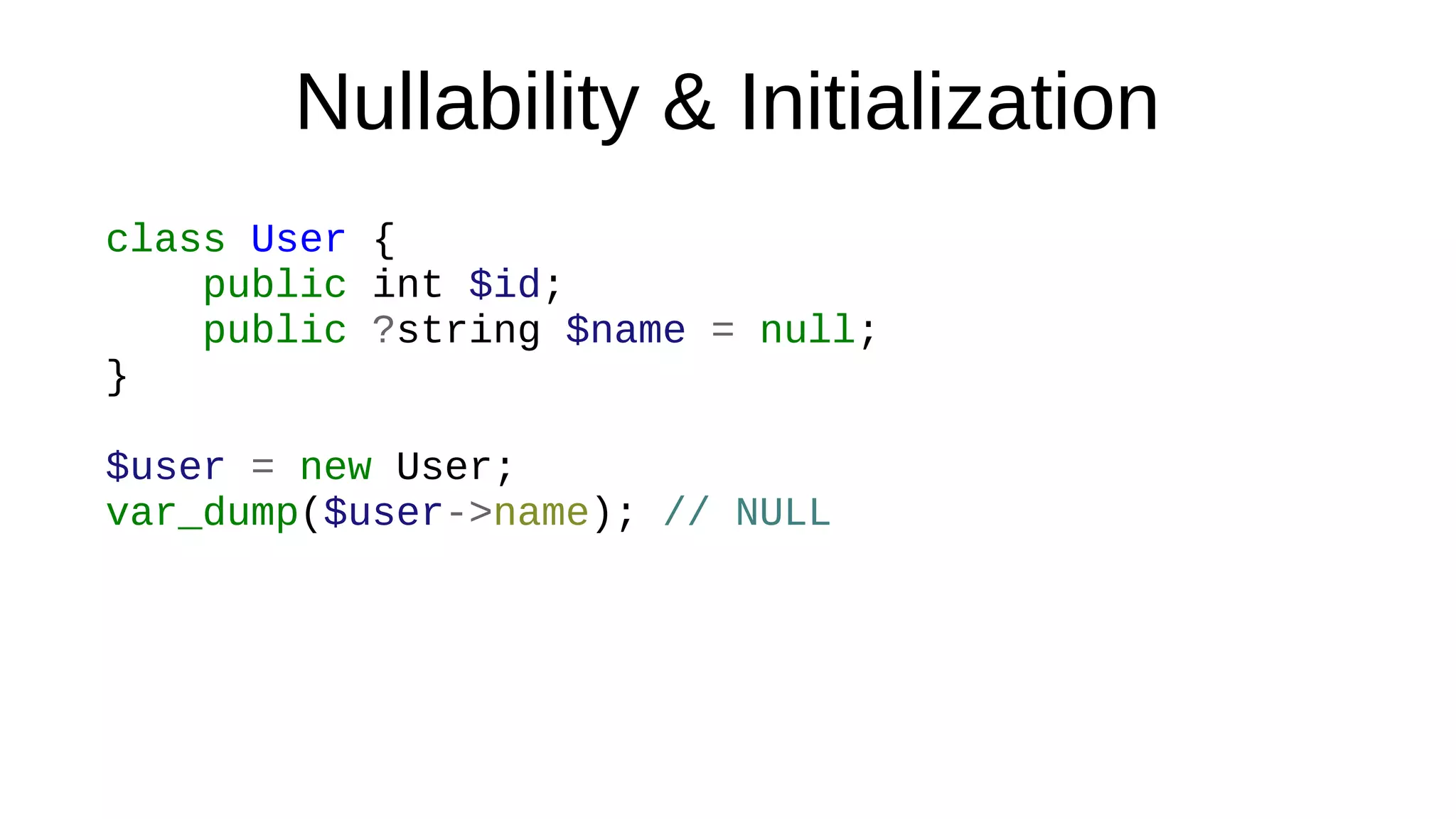
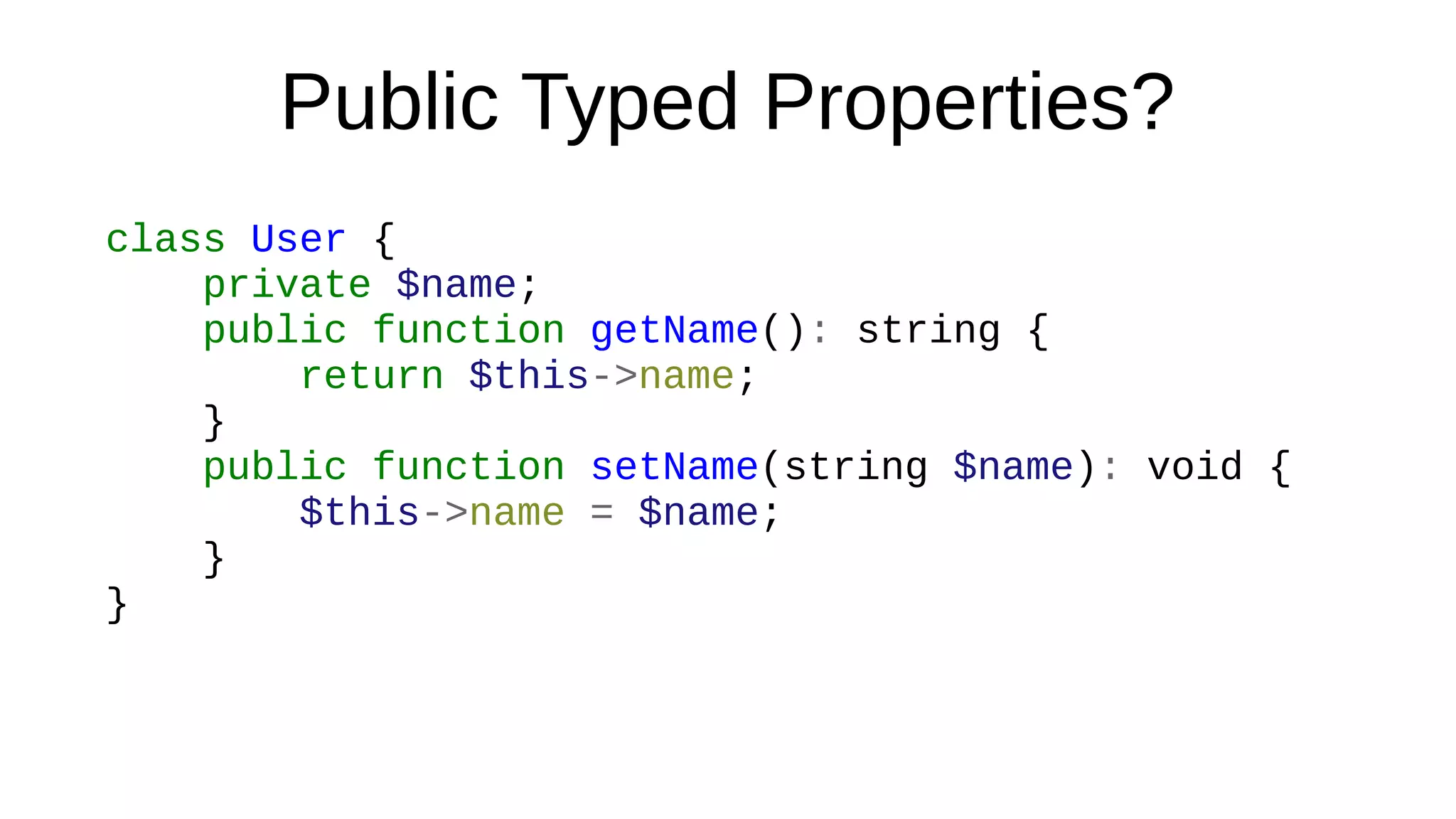
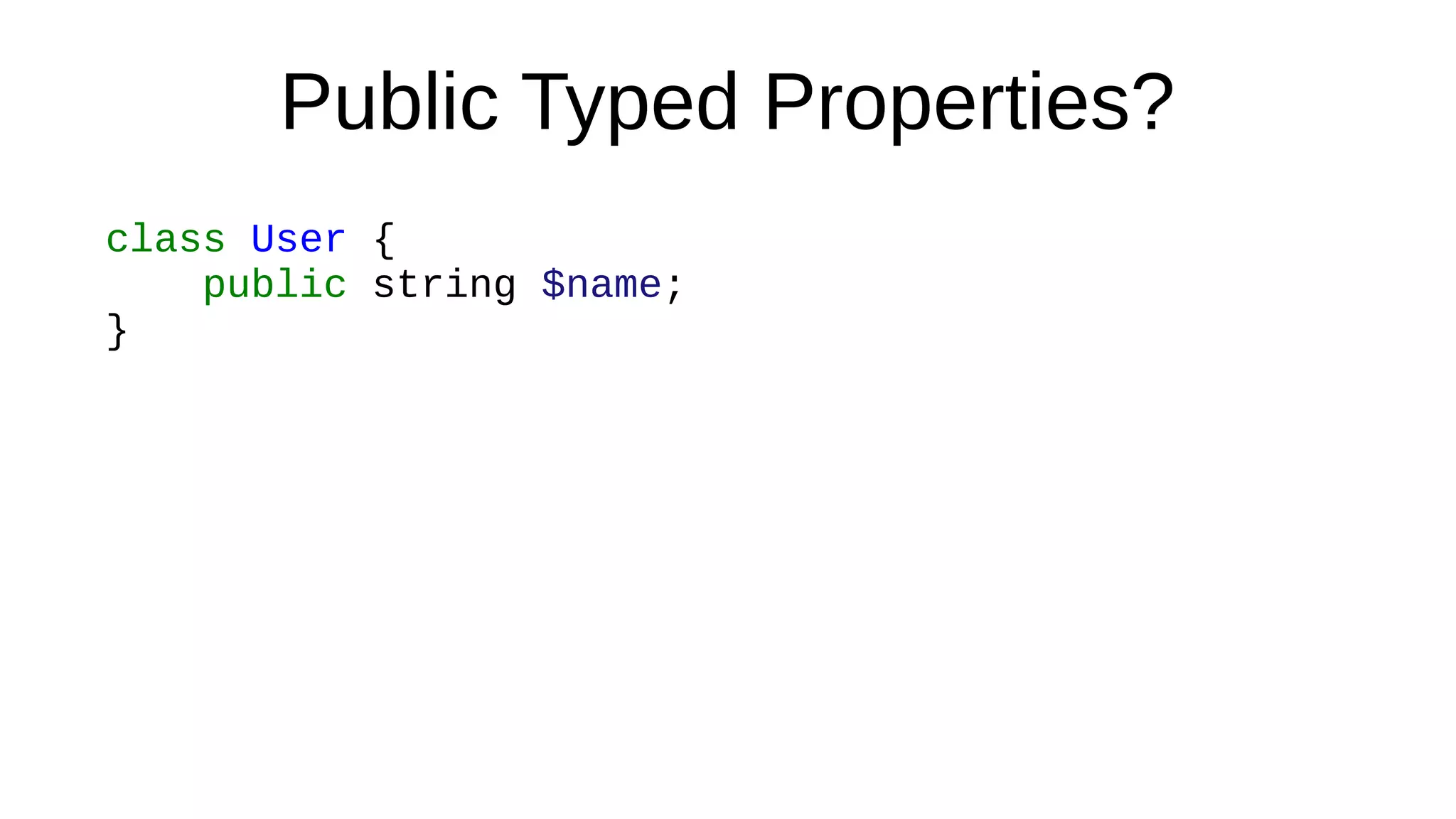
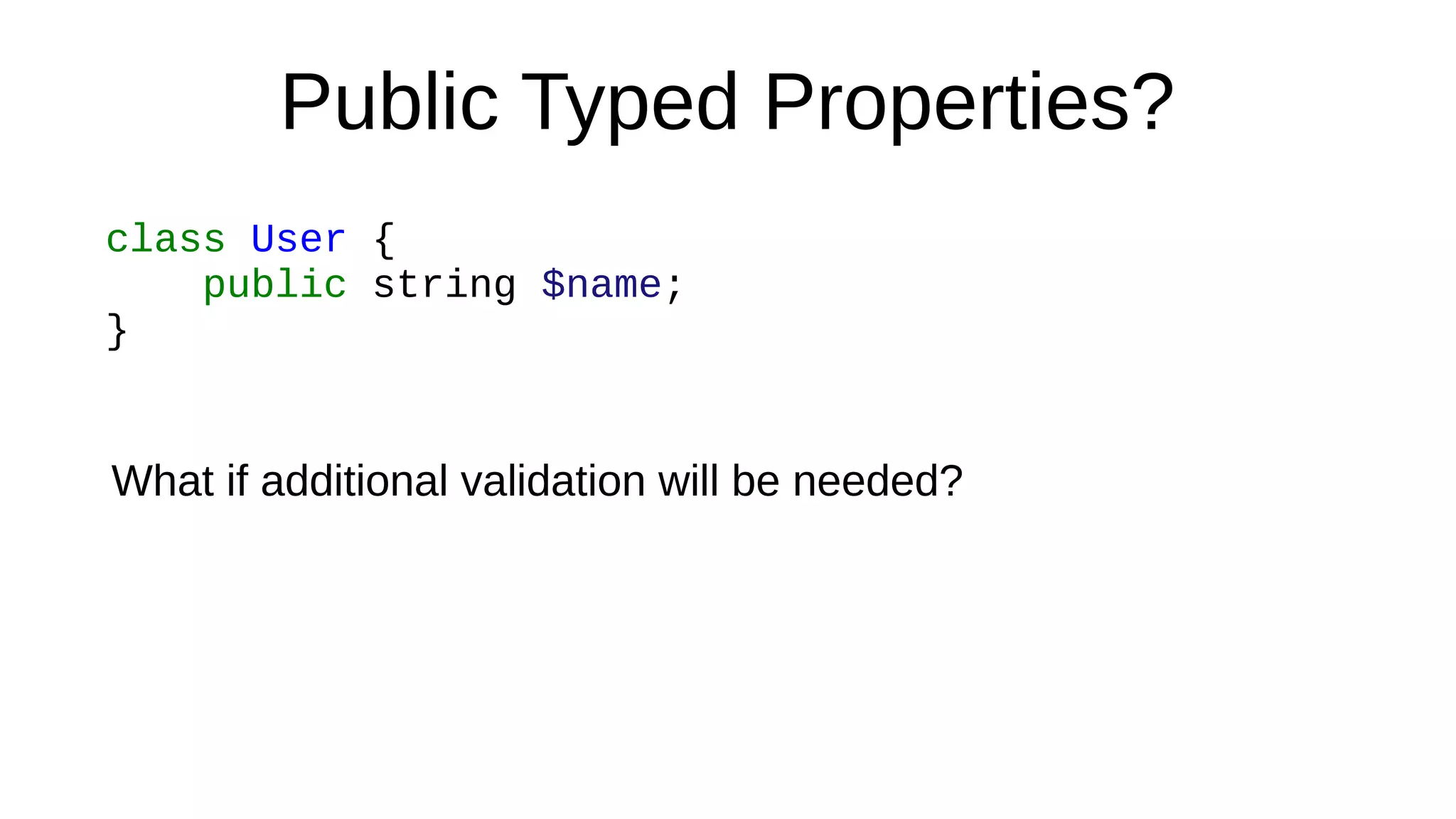
![Typed Properties
class User {
public int $id;
public string $name;
}
$user = new User;
$user->id = 42;
$user->name = [];
// Uncaught TypeError: Typed property User::$name
// must be string, array used](https://image.slidesharecdn.com/presentationnikita-190519190251/75/Typed-Properties-and-more-What-s-coming-in-PHP-7-4-7-2048.jpg)
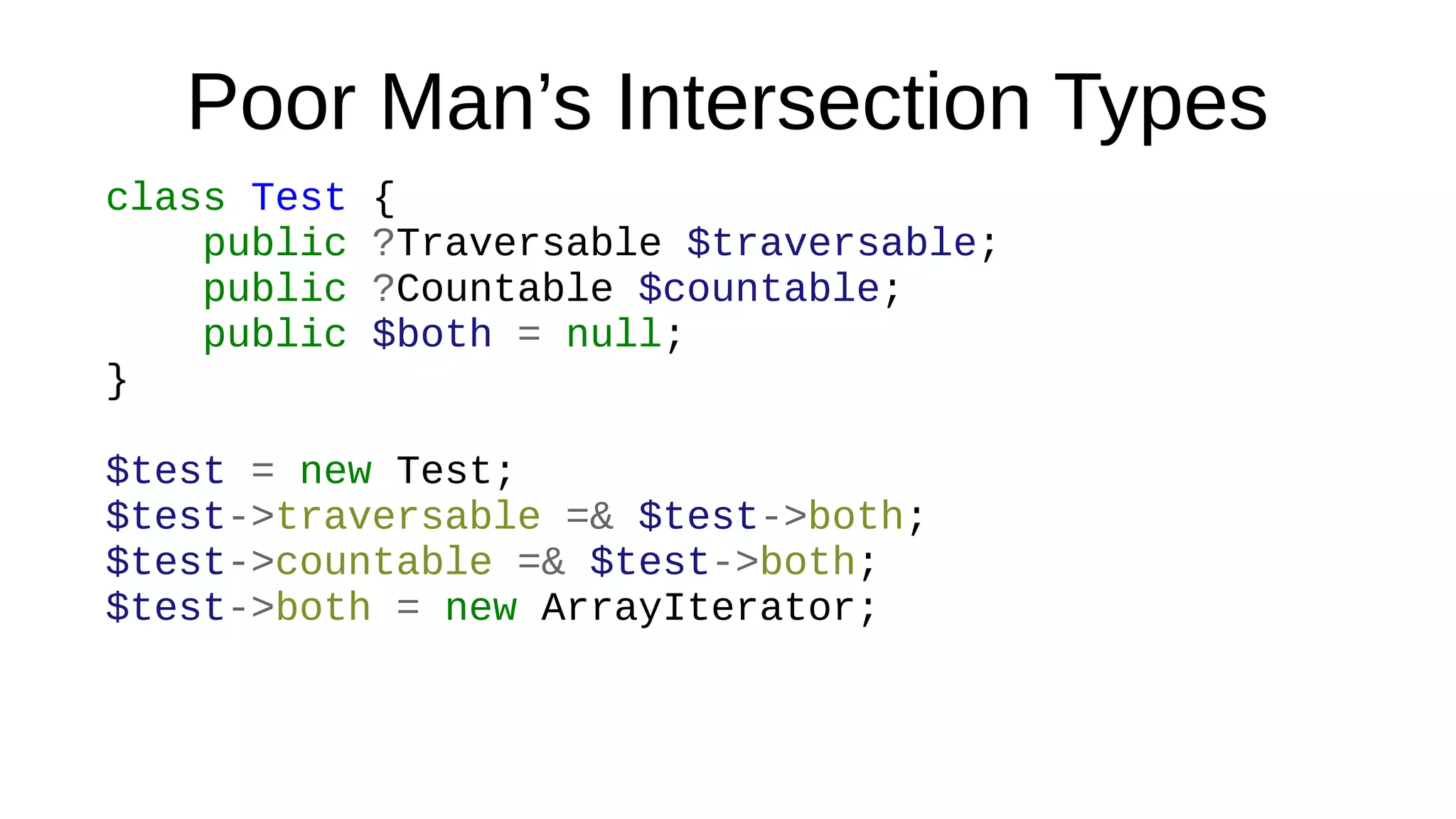
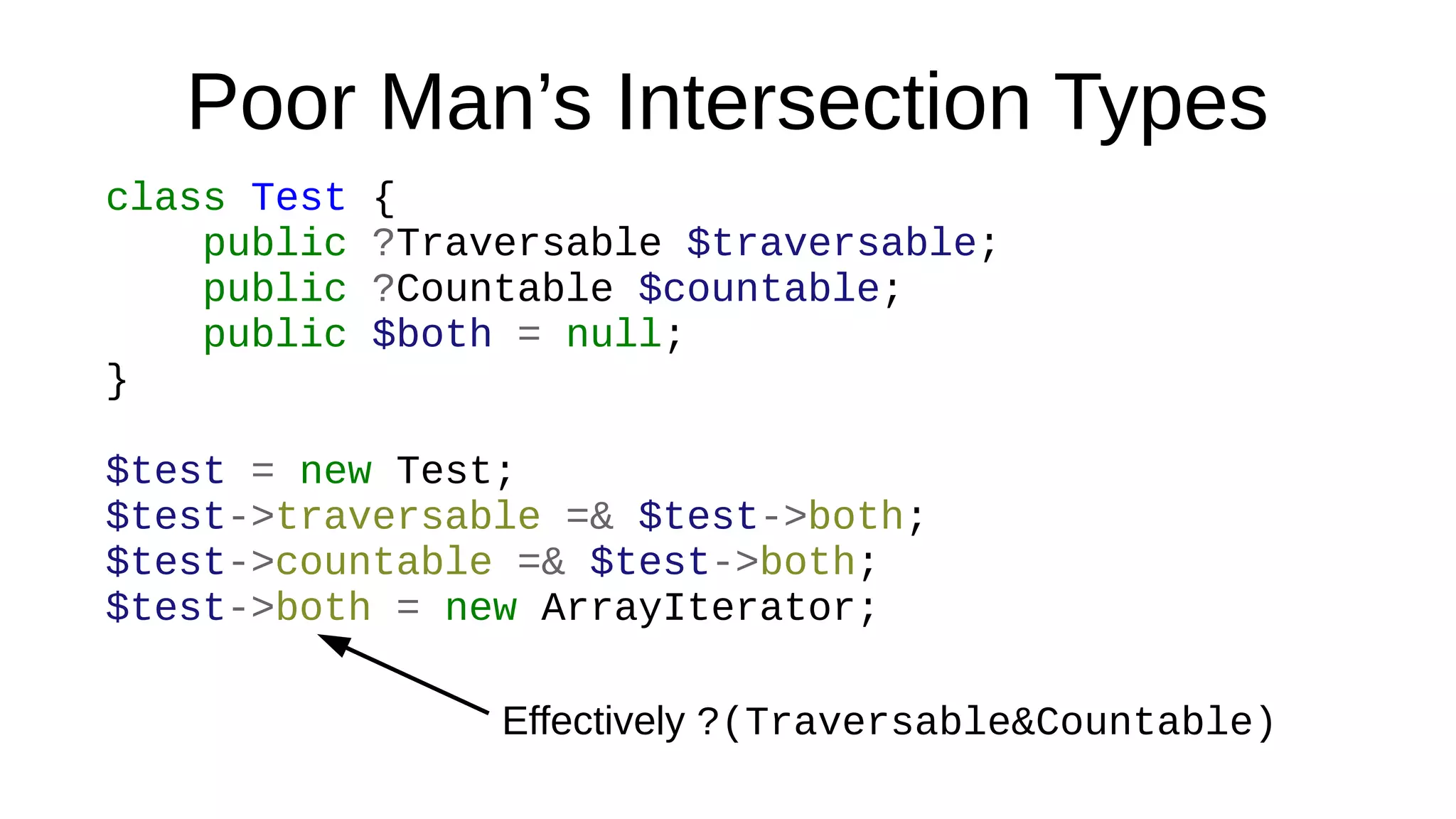
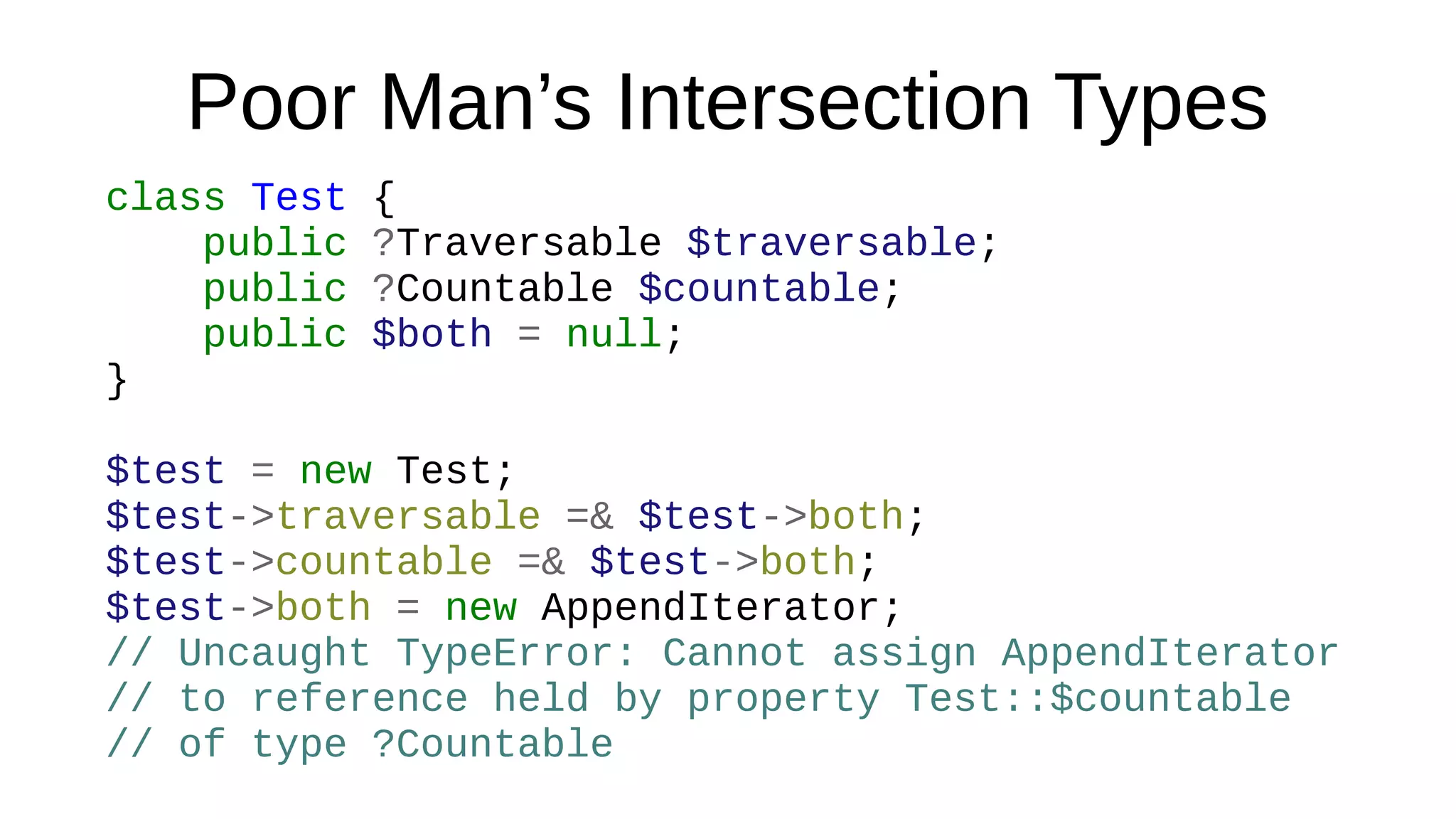
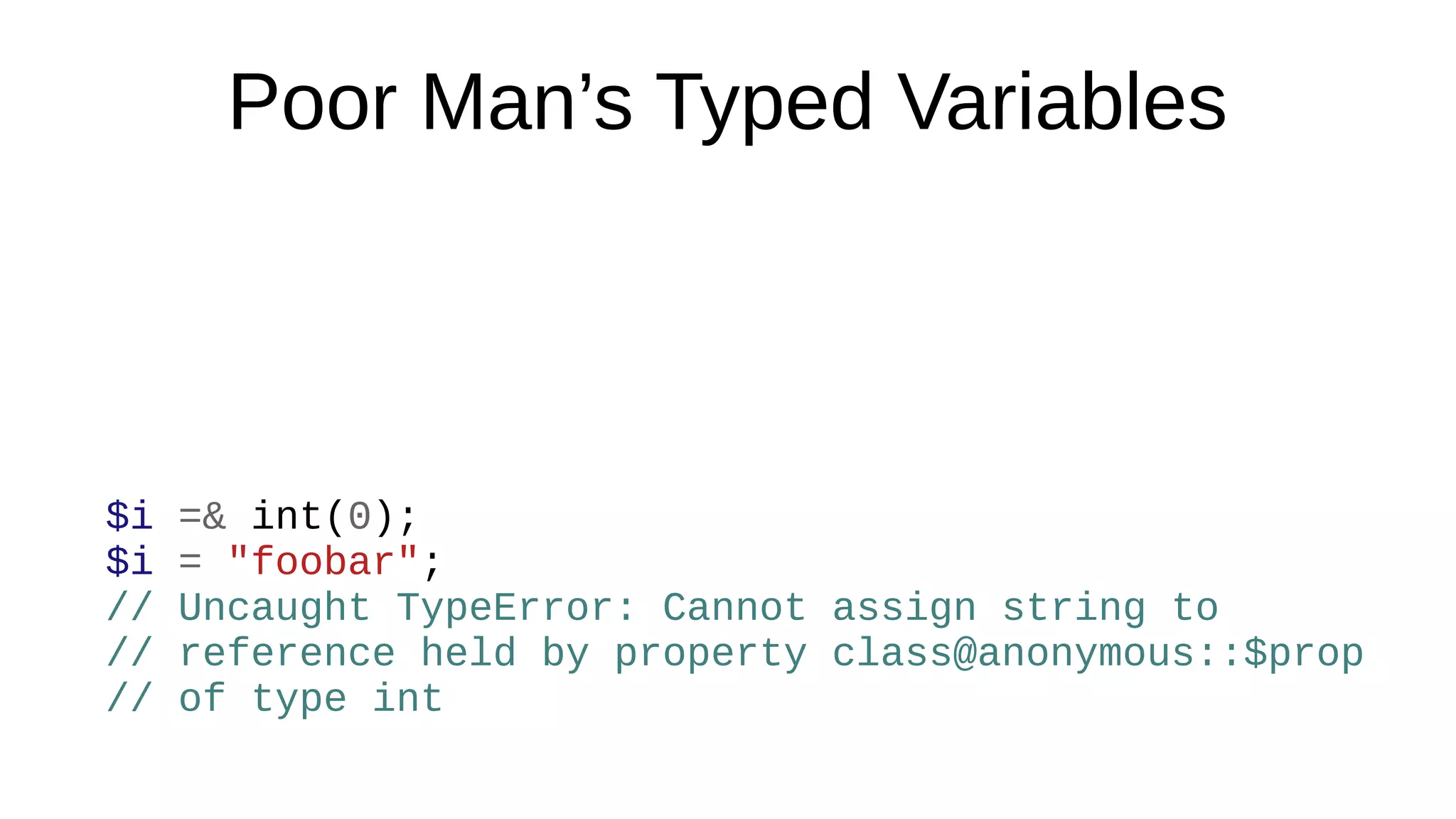
![Poor Man’s Typed Variables
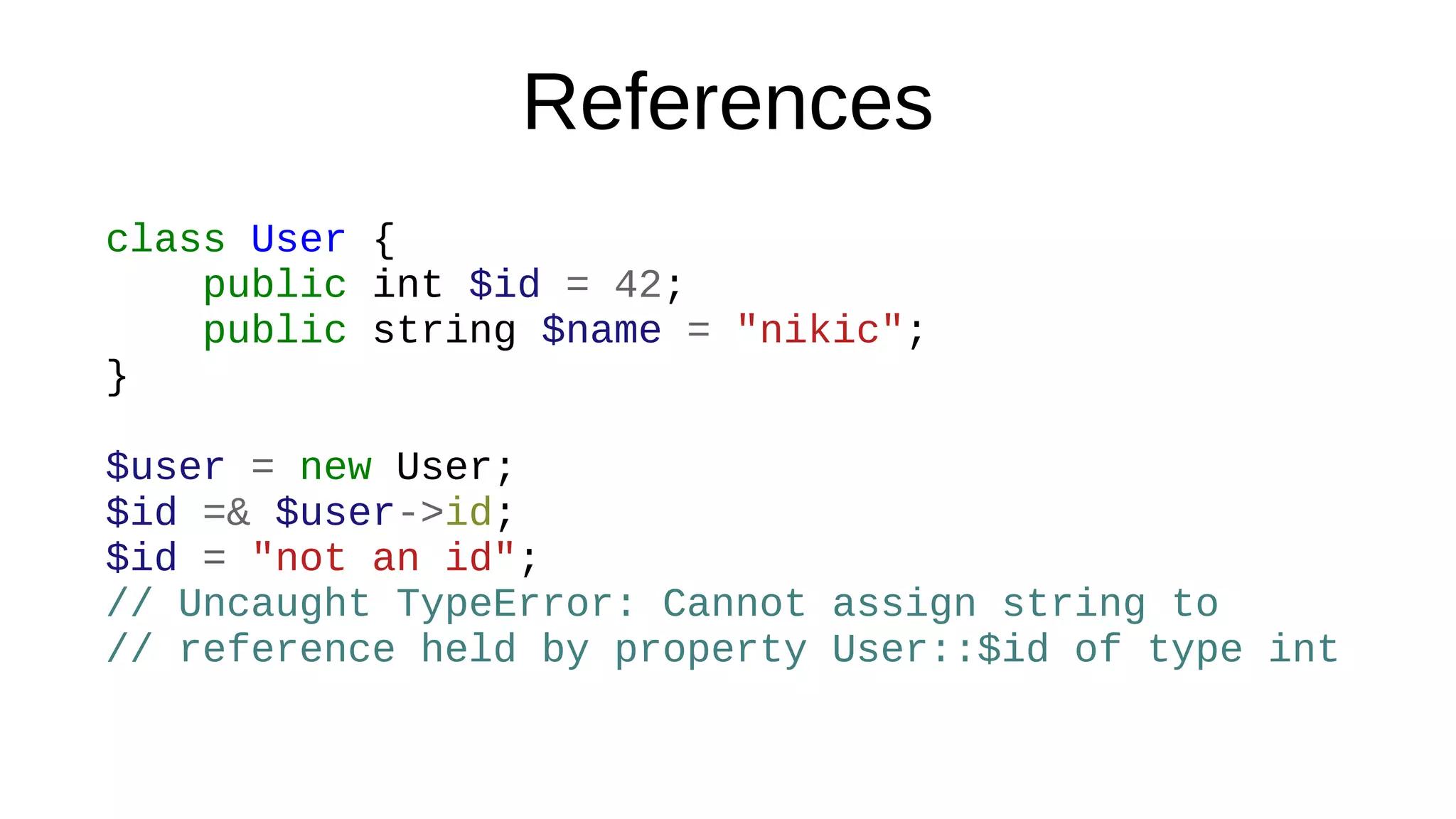
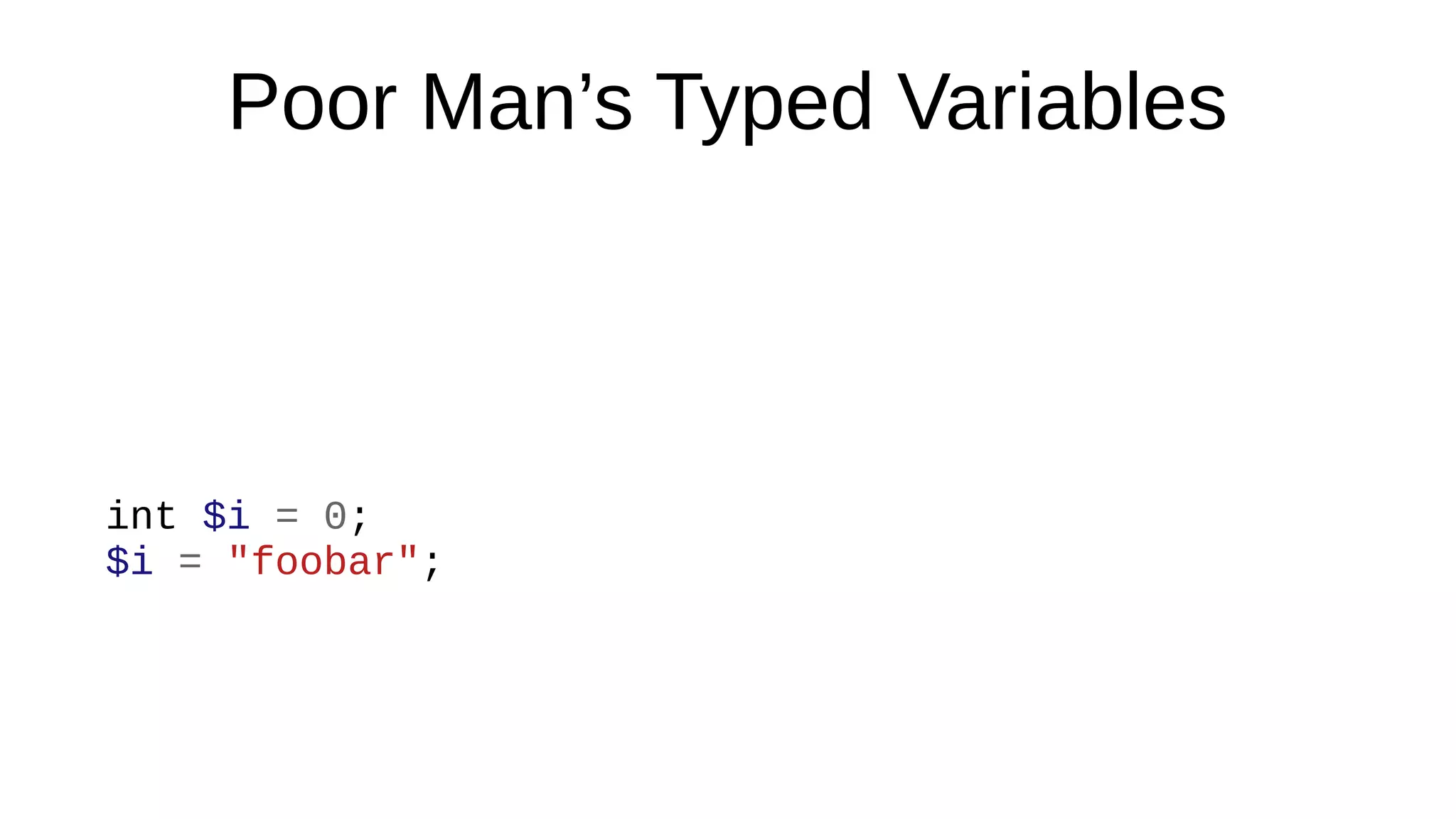
function &int(int $i) {
$obj = new class { public int $prop; };
$obj->prop = $i;
$GLOBALS['huge_memory_leak'][] = $obj;
return $obj->prop;
}
$i =& int(0);
$i = "foobar";
// Uncaught TypeError: Cannot assign string to
// reference held by property class@anonymous::$prop
// of type int](https://image.slidesharecdn.com/presentationnikita-190519190251/75/Typed-Properties-and-more-What-s-coming-in-PHP-7-4-17-2048.jpg)
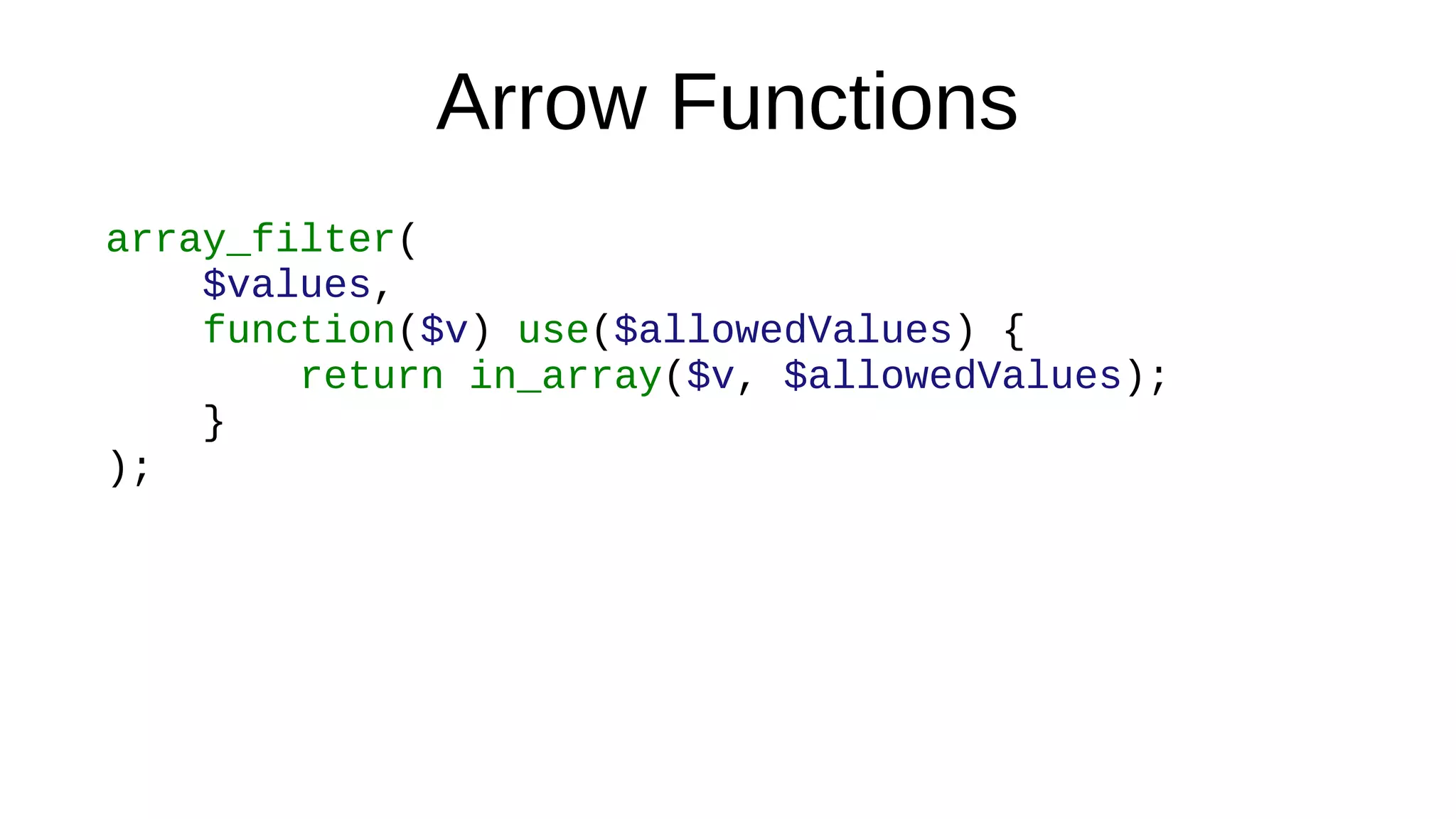
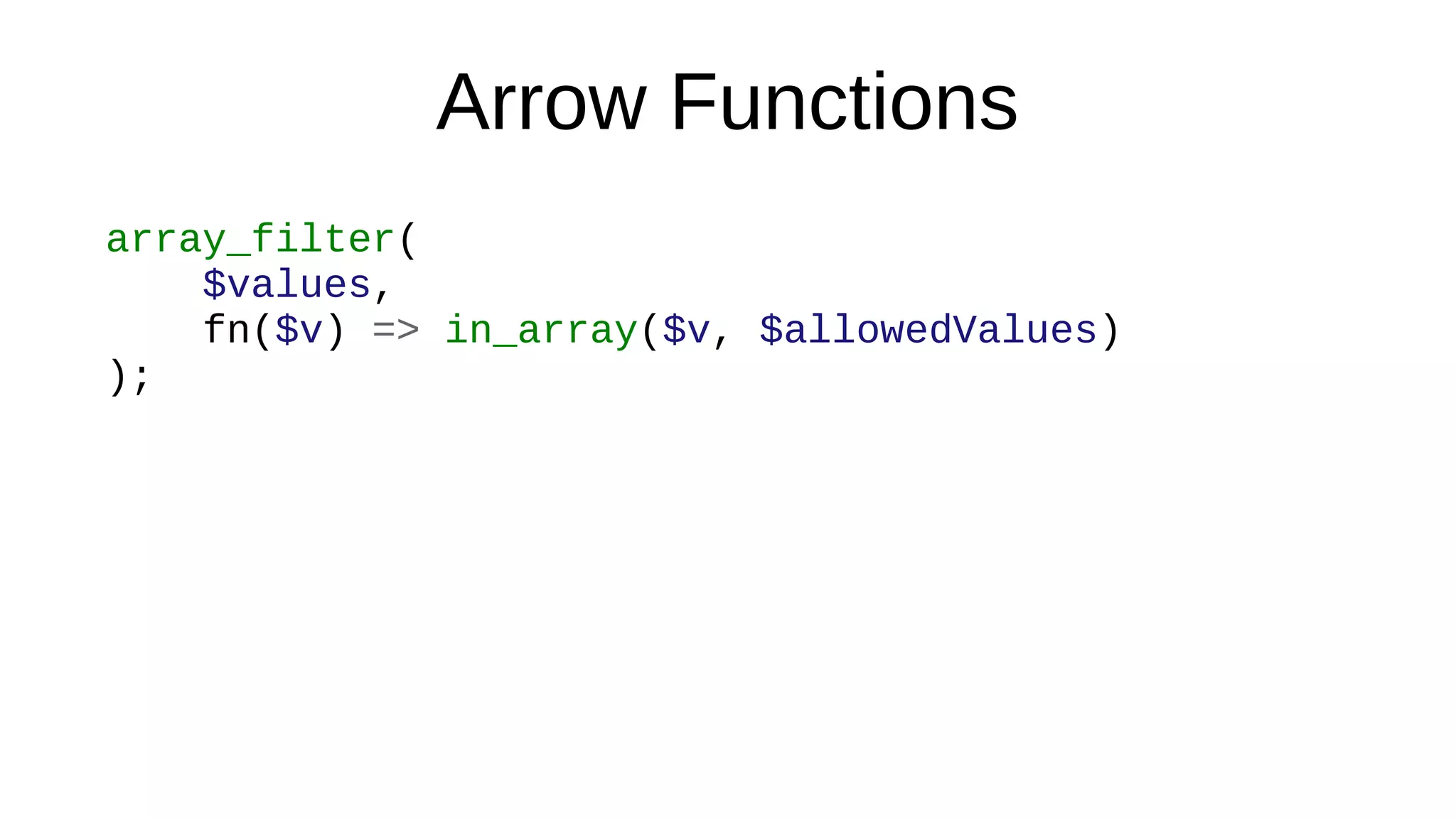
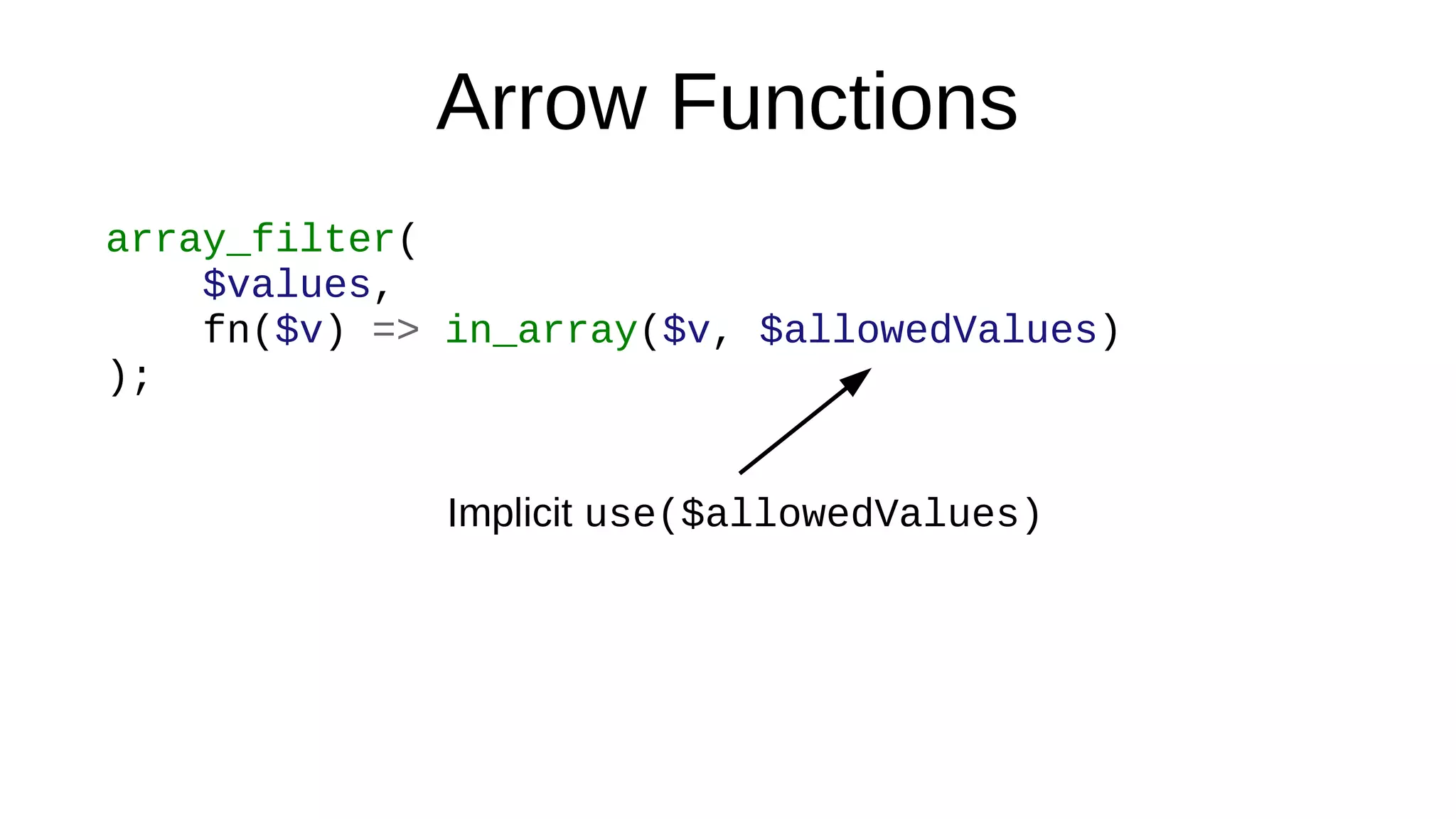
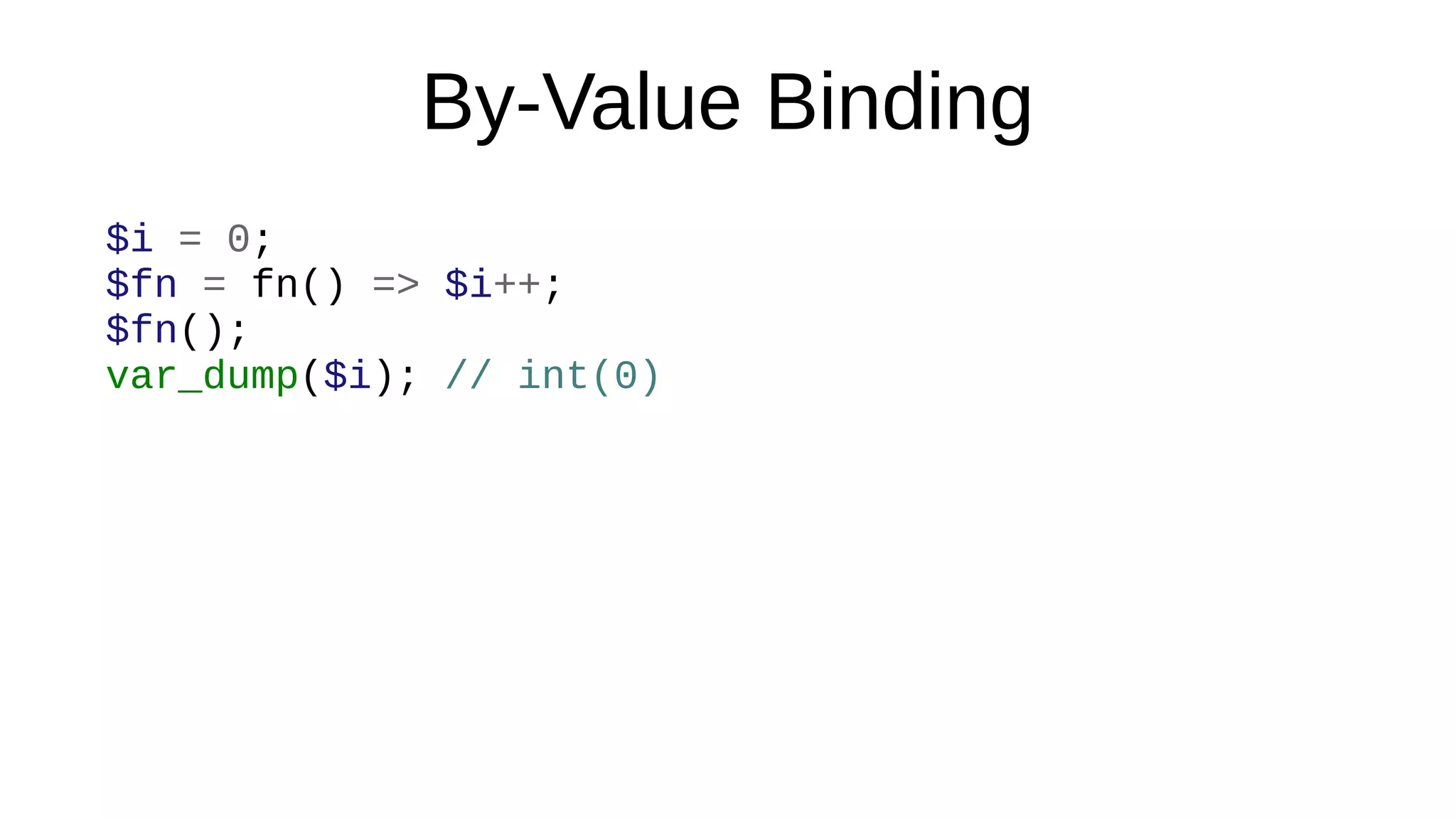
![By-Value Binding
$fns = [];
foreach ([1, 2, 3] as $i) {
$fns[] = fn() => $i;
}
foreach ($fns as $fn) {
echo $fn() . " ";
}
// Prints: 1 2 3
// Not: 3 3 3 (would happen with by-reference)](https://image.slidesharecdn.com/presentationnikita-190519190251/75/Typed-Properties-and-more-What-s-coming-in-PHP-7-4-26-2048.jpg)
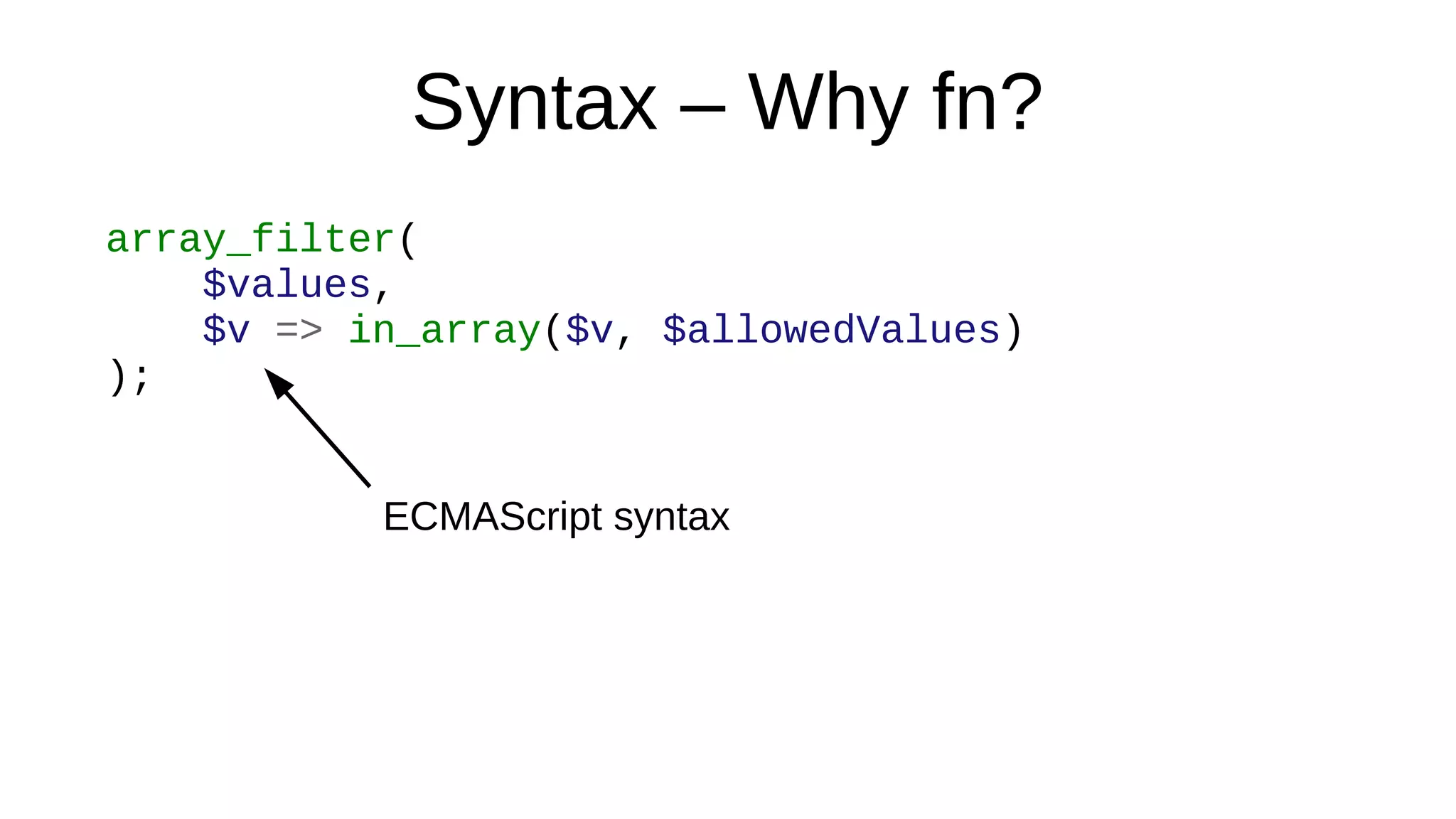
![Syntax – Array Ambiguity
$array = [
$a => $a + $b,
$x => $x * $y,
];
Array of arrow functions?
Or just a key-value map?](https://image.slidesharecdn.com/presentationnikita-190519190251/75/Typed-Properties-and-more-What-s-coming-in-PHP-7-4-28-2048.jpg)
![Syntax – Parsing
// Looks like: Assignment expression
($x = [42] + ["foobar"]) => $x;
// Looks like: Constant lookup + bitwise and
(Type &$x) => $x;
// Looks like: Ternary operator
$a ? ($b): Type => $c : $d;](https://image.slidesharecdn.com/presentationnikita-190519190251/75/Typed-Properties-and-more-What-s-coming-in-PHP-7-4-29-2048.jpg)
![Syntax – Parsing
// Looks like: Assignment expression
($x = [42] + ["foobar"]) => $x;
// Looks like: Constant lookup + bitwise and
(Type &$x) => $x;
// Looks like: Ternary operator
$a ? ($b): Type => $c : $d;
Need special handling starting at (
But only know it’s an arrow function at =>](https://image.slidesharecdn.com/presentationnikita-190519190251/75/Typed-Properties-and-more-What-s-coming-in-PHP-7-4-30-2048.jpg)
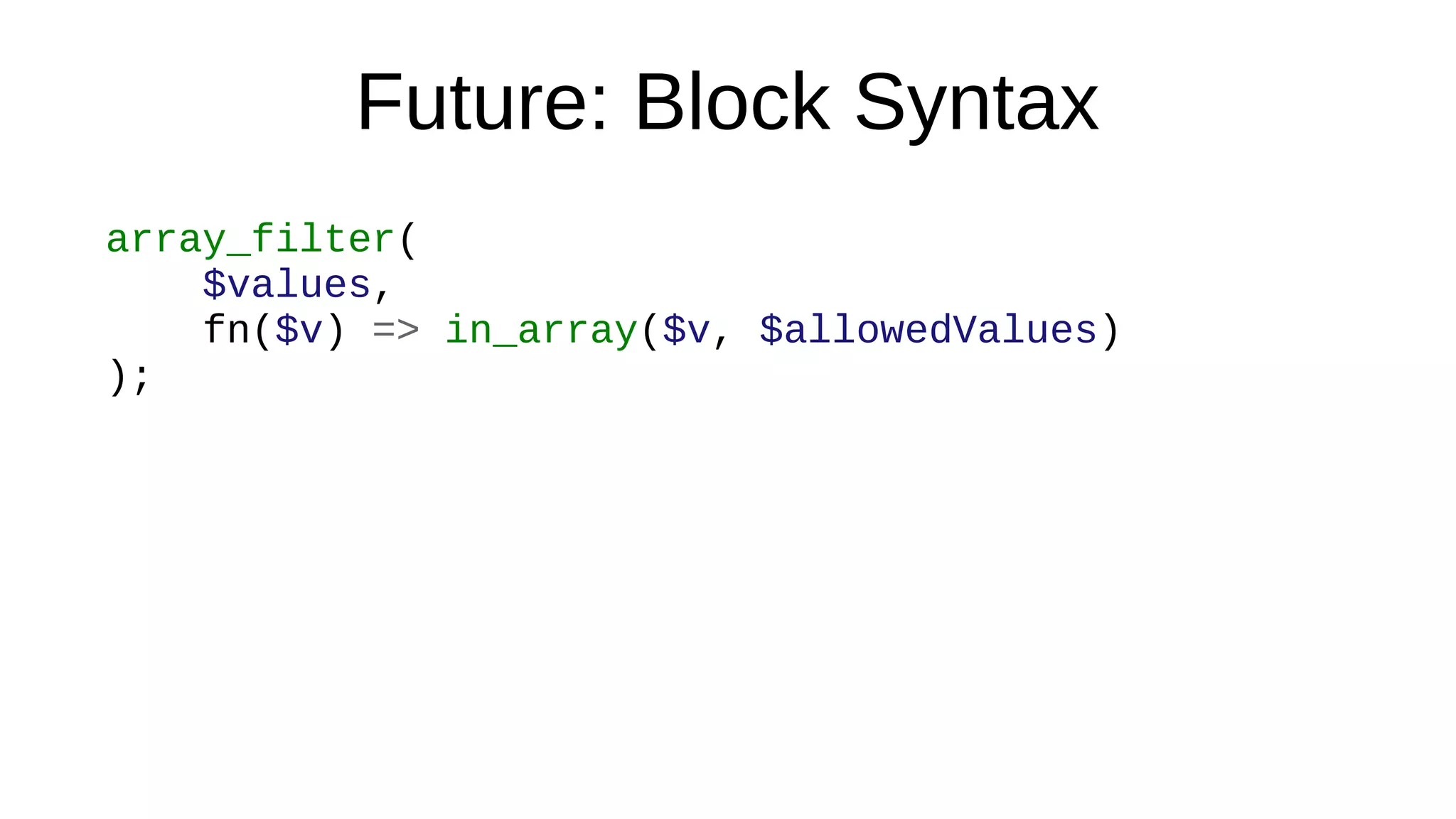
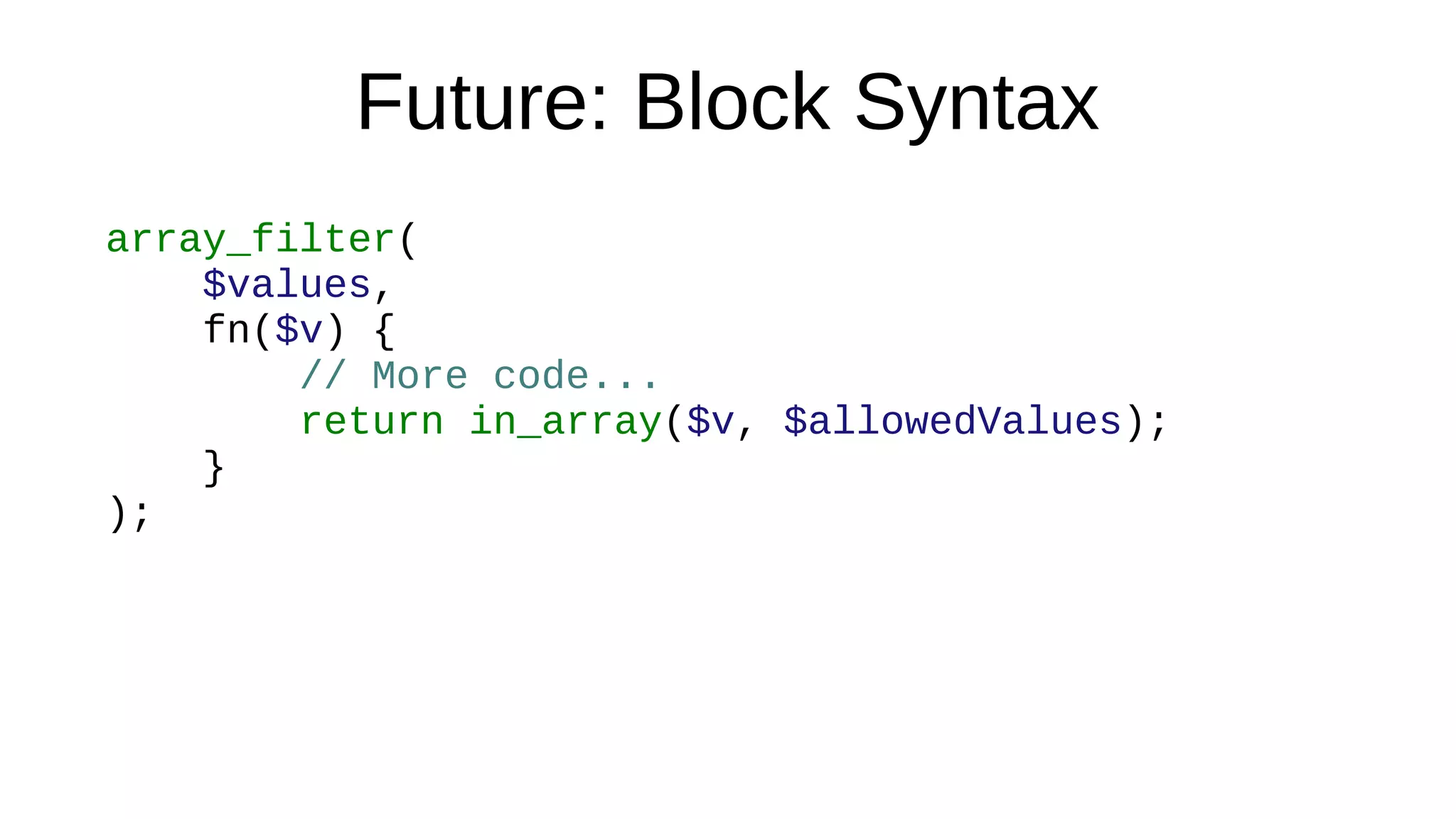
![??=
$options["something"] ??= new DefaultObject;
// Roughly equivalent to:
$options["something"] =
$options["something"] ?? new DefaultObject;](https://image.slidesharecdn.com/presentationnikita-190519190251/75/Typed-Properties-and-more-What-s-coming-in-PHP-7-4-41-2048.jpg)
![??=
$options["something"] ??= new DefaultObject;
Only created if $options["something"] is null](https://image.slidesharecdn.com/presentationnikita-190519190251/75/Typed-Properties-and-more-What-s-coming-in-PHP-7-4-42-2048.jpg)
![Array spread operator
$array = [3, 4, 5];
return call(1, 2, ...$array); // call(1, 2, 3, 4, 5)
$array = [3, 4, 5];
return [1, 2, ...$array]; // [1, 2, 3, 4, 5]](https://image.slidesharecdn.com/presentationnikita-190519190251/75/Typed-Properties-and-more-What-s-coming-in-PHP-7-4-43-2048.jpg)
![Array spread operator
$array = new ArrayIterator([1, 2, 3]);
return call(1, 2, ...$array); // call(1, 2, 3, 4, 5)
$array = new ArrayIterator([1, 2, 3]);
return [1, 2, ...$array]; // [1, 2, 3, 4, 5]](https://image.slidesharecdn.com/presentationnikita-190519190251/75/Typed-Properties-and-more-What-s-coming-in-PHP-7-4-44-2048.jpg)
![Array spread operator
$array = ['y' => 'b', 'z' => 'c'];
return ['x' => 'a', ...$array];
// Uncaught Error: Cannot unpack array with
// string keys](https://image.slidesharecdn.com/presentationnikita-190519190251/75/Typed-Properties-and-more-What-s-coming-in-PHP-7-4-45-2048.jpg)
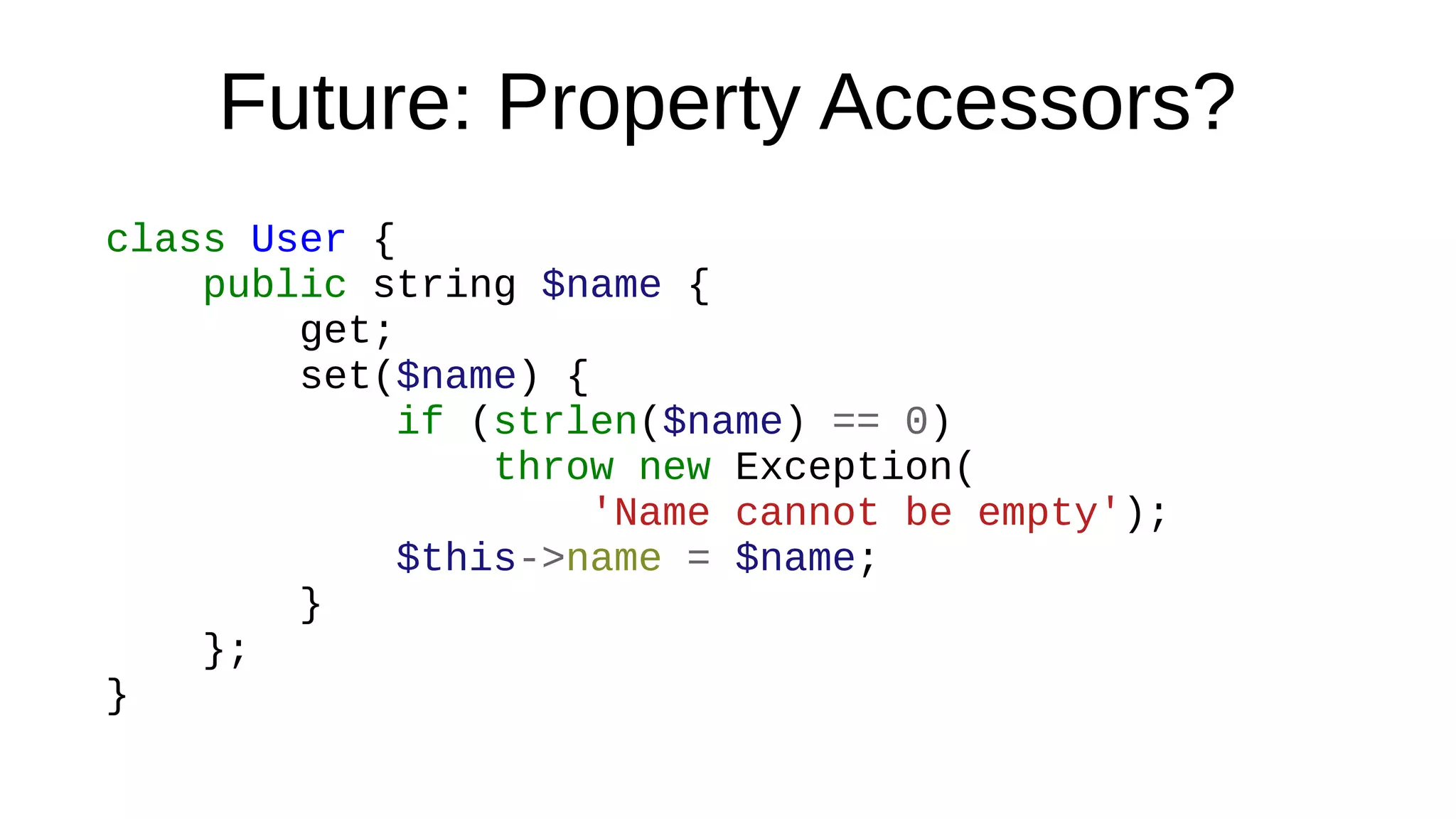
![Future: … in destructuring
[$head, ...$tail] = $array;](https://image.slidesharecdn.com/presentationnikita-190519190251/75/Typed-Properties-and-more-What-s-coming-in-PHP-7-4-46-2048.jpg)
![Future: … in destructuring
$array = [2 => 2, 1 => 1, 0 => 0];
[$head, ...$tail] = $array;
What happens?](https://image.slidesharecdn.com/presentationnikita-190519190251/75/Typed-Properties-and-more-What-s-coming-in-PHP-7-4-47-2048.jpg)
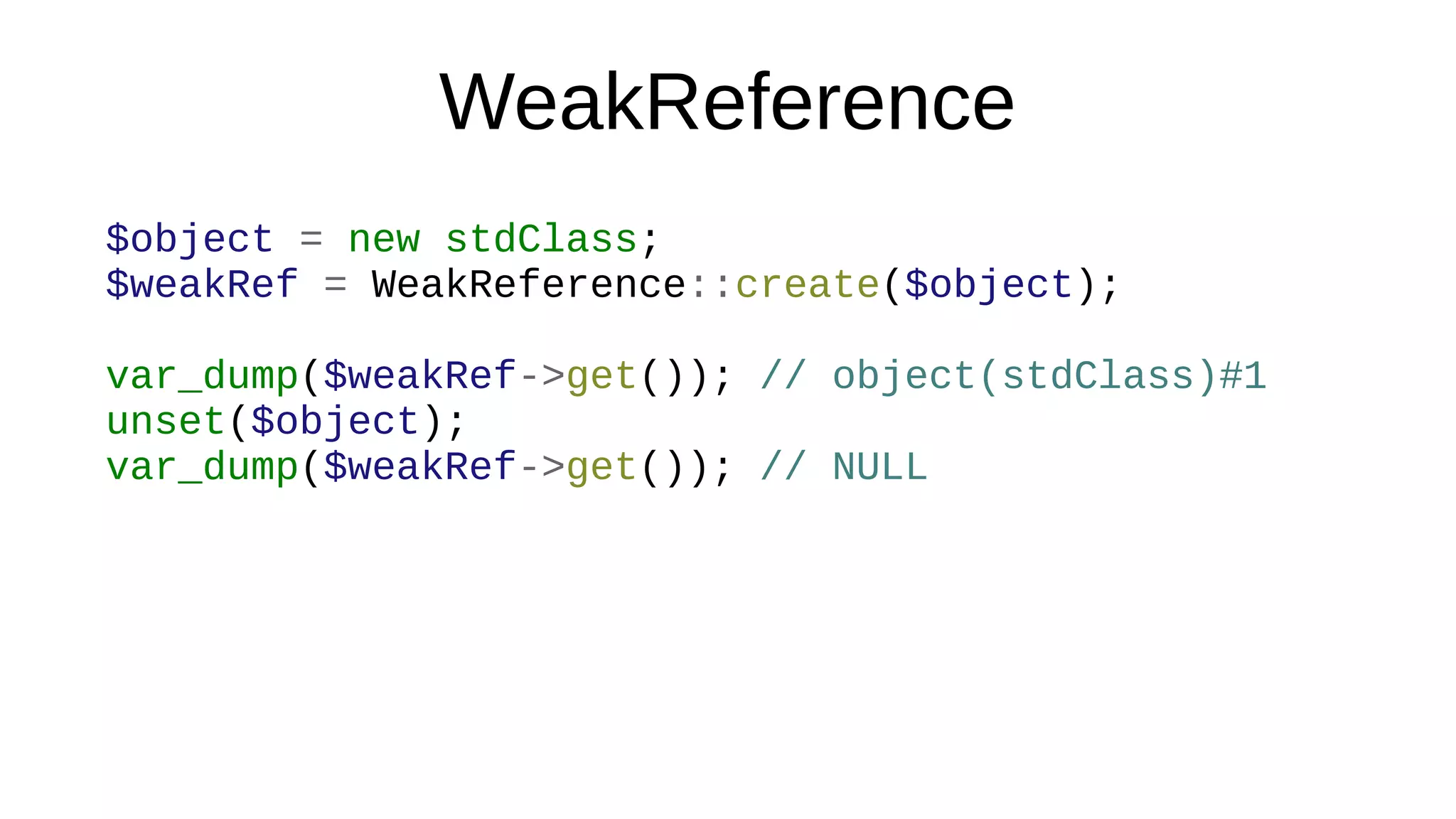
![WeakReference
$this->data[get_object_id($object)]
= [WeakReference::create($object), $data];](https://image.slidesharecdn.com/presentationnikita-190519190251/75/Typed-Properties-and-more-What-s-coming-in-PHP-7-4-49-2048.jpg)
![WeakReference
$this->data[get_object_id($object)]
= [WeakReference::create($object), $data];
Will be reused once
object is destroyed](https://image.slidesharecdn.com/presentationnikita-190519190251/75/Typed-Properties-and-more-What-s-coming-in-PHP-7-4-50-2048.jpg)
![WeakReference
$this->data[get_object_id($object)]
= [WeakReference::create($object), $data];
Will be reused once
object is destroyed
Check $weakRef->get() != null
to know whether the entry is still valid](https://image.slidesharecdn.com/presentationnikita-190519190251/75/Typed-Properties-and-more-What-s-coming-in-PHP-7-4-51-2048.jpg)
![WeakReference
$this->data[get_object_id($object)]
= [WeakReference::create($object), $data];
Will be reused once
object is destroyed
Check $weakRef->get() != null
to know whether the entry is still valid
Problem: Doesn’t keep $object alive, but keeps dead cache entry](https://image.slidesharecdn.com/presentationnikita-190519190251/75/Typed-Properties-and-more-What-s-coming-in-PHP-7-4-52-2048.jpg)
![Future: WeakMap
$this->data = new WeakMap();
$this->data[$object] = $data;
Does not keep $object alive; immediately
drops cache entry when object destroyed](https://image.slidesharecdn.com/presentationnikita-190519190251/75/Typed-Properties-and-more-What-s-coming-in-PHP-7-4-53-2048.jpg)
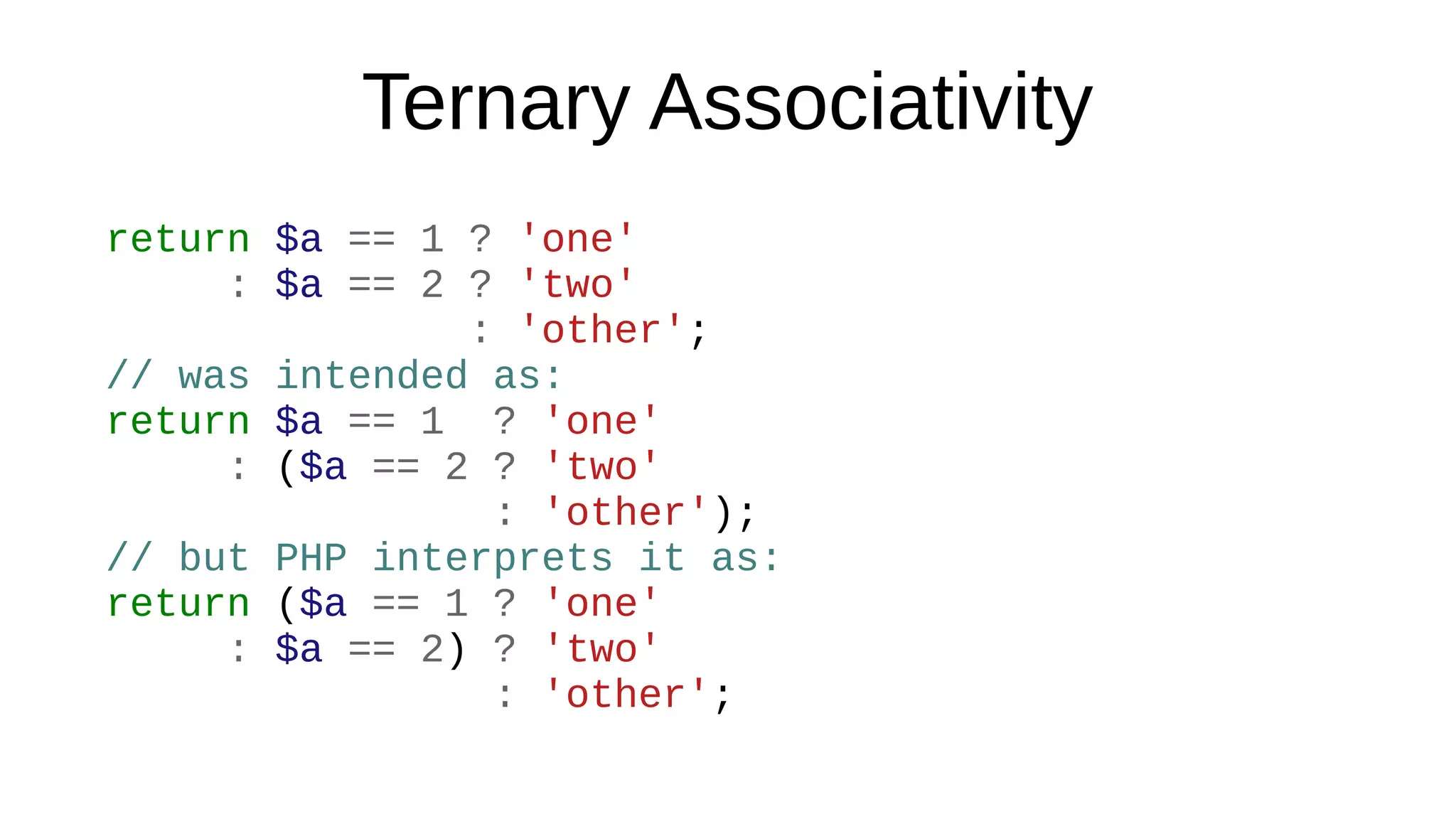
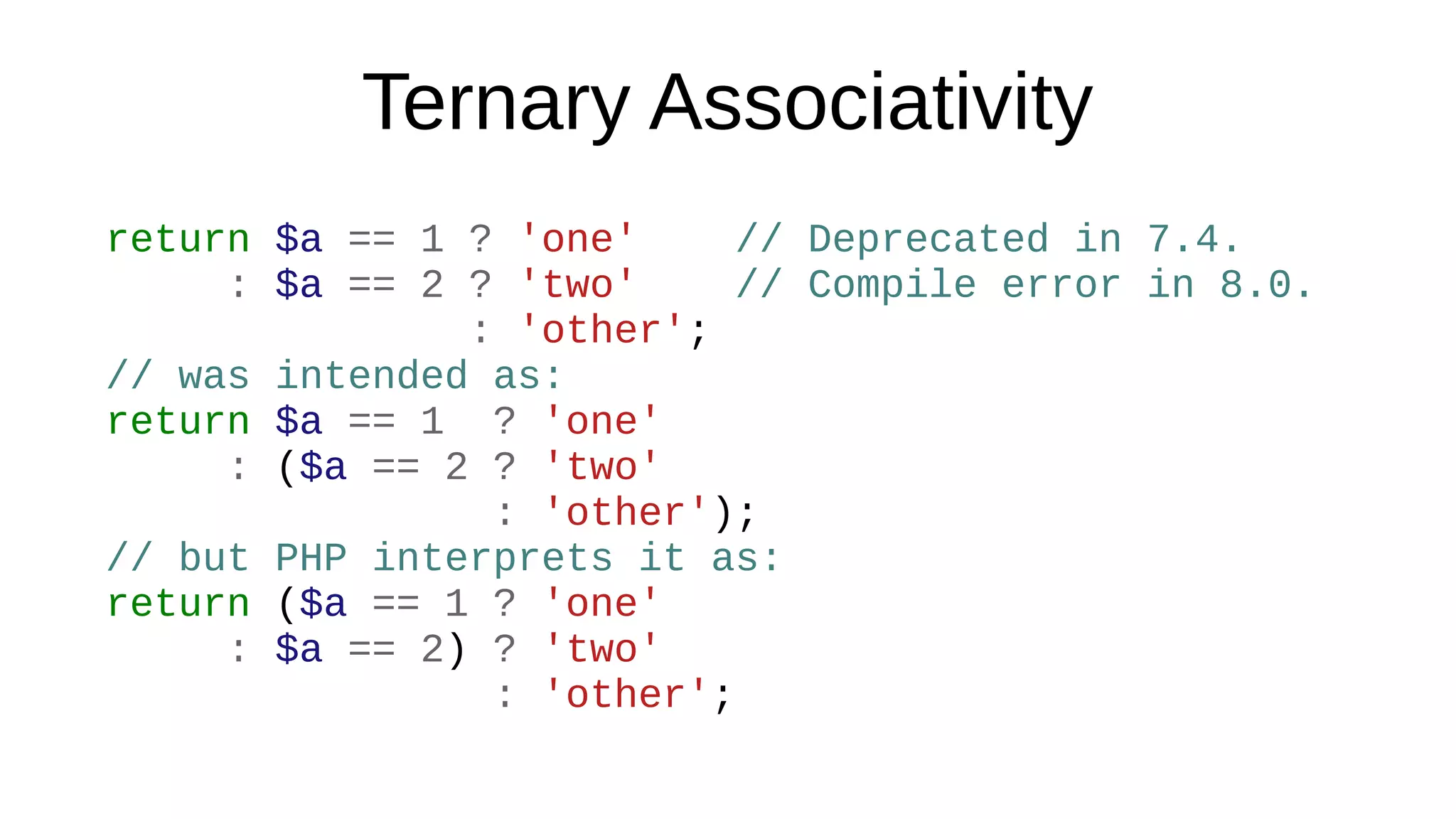
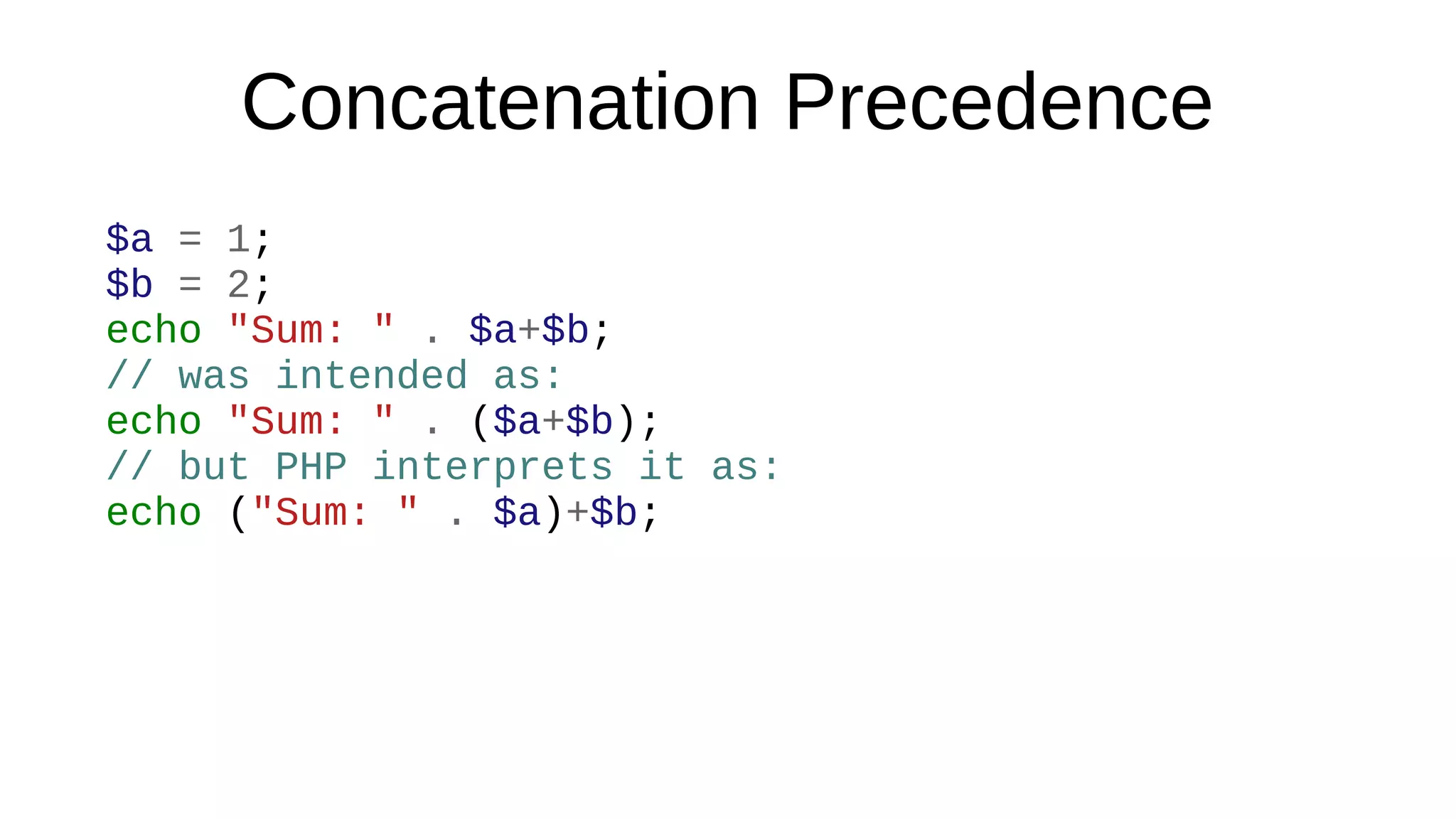
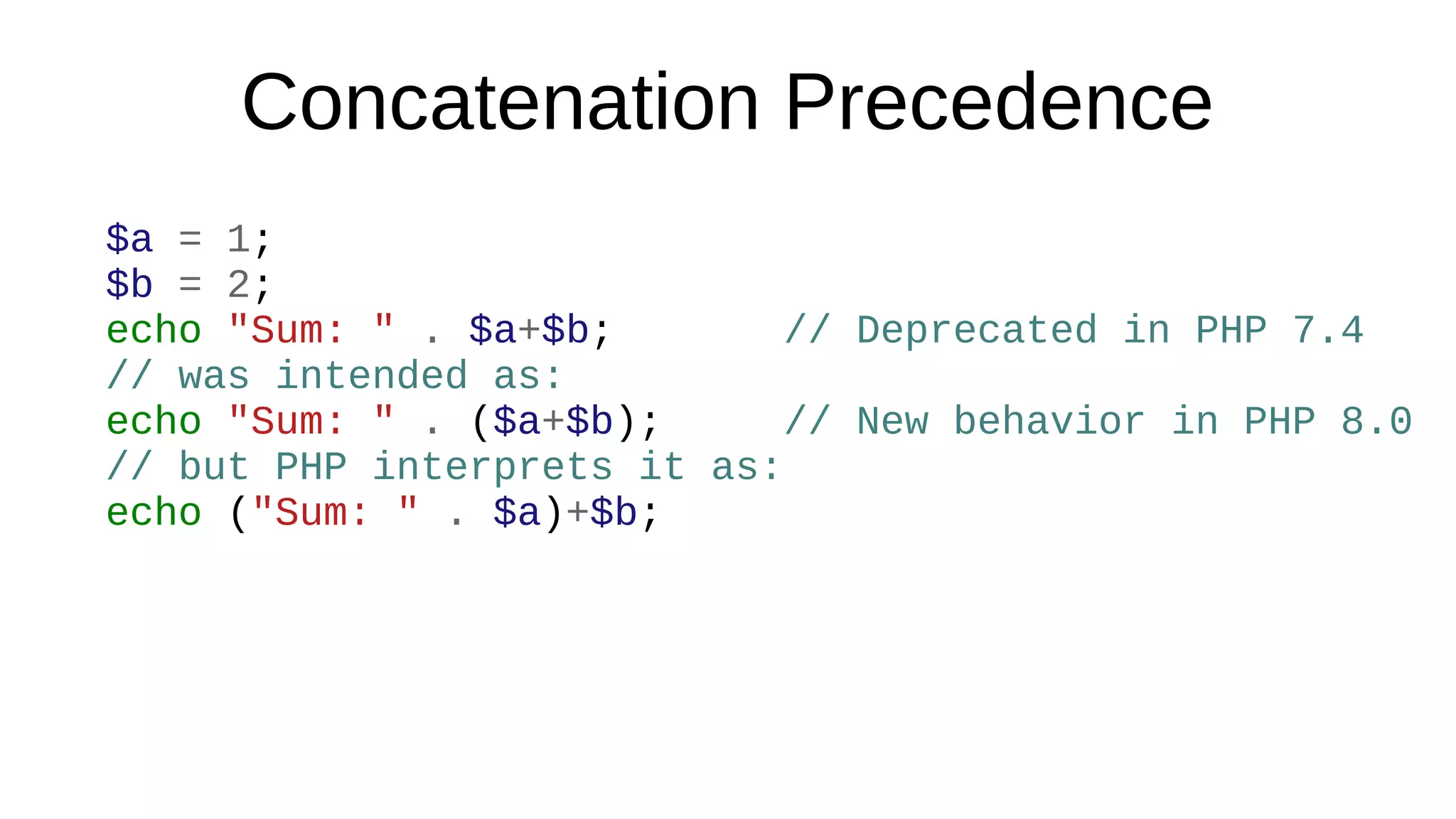
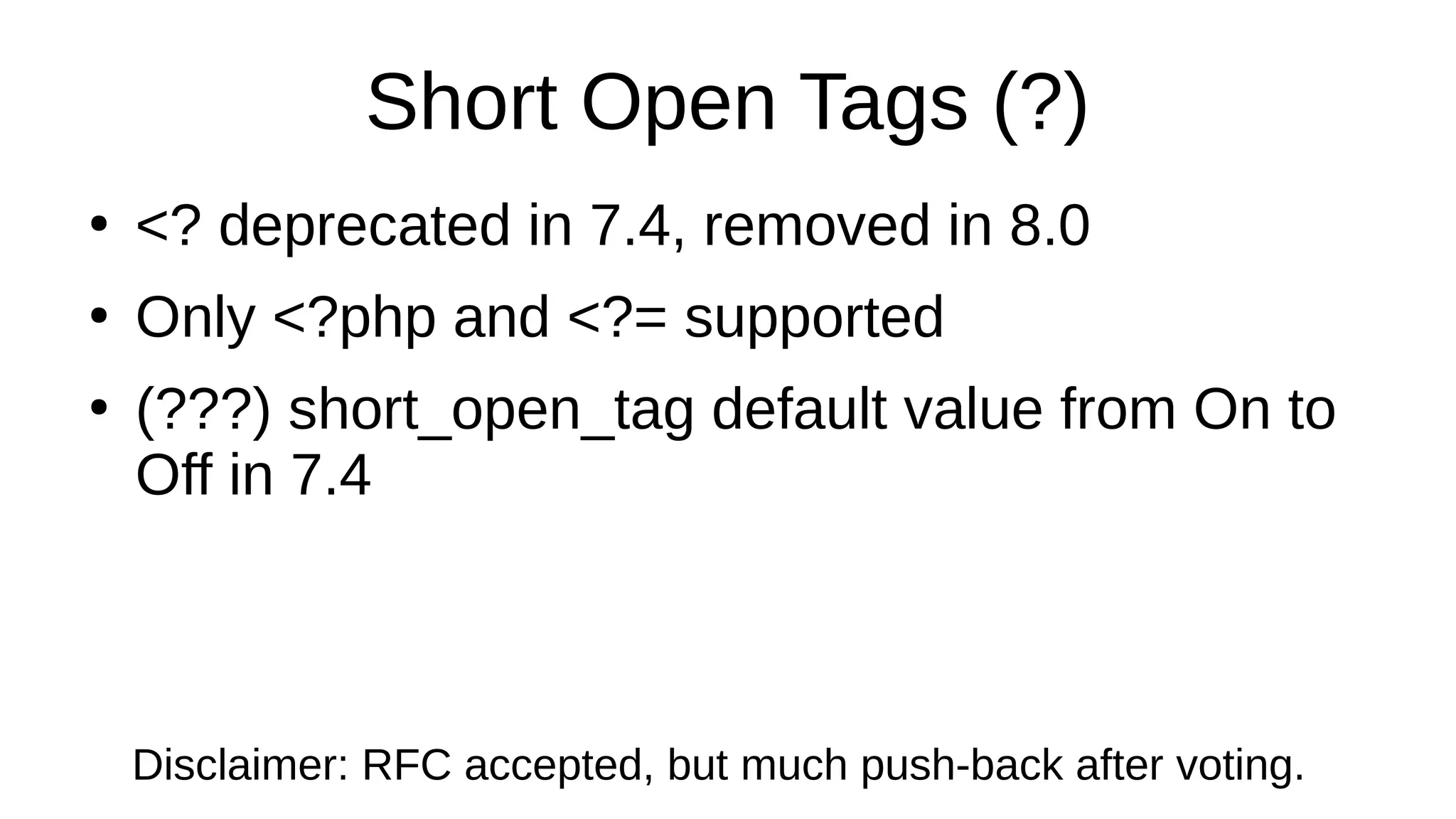


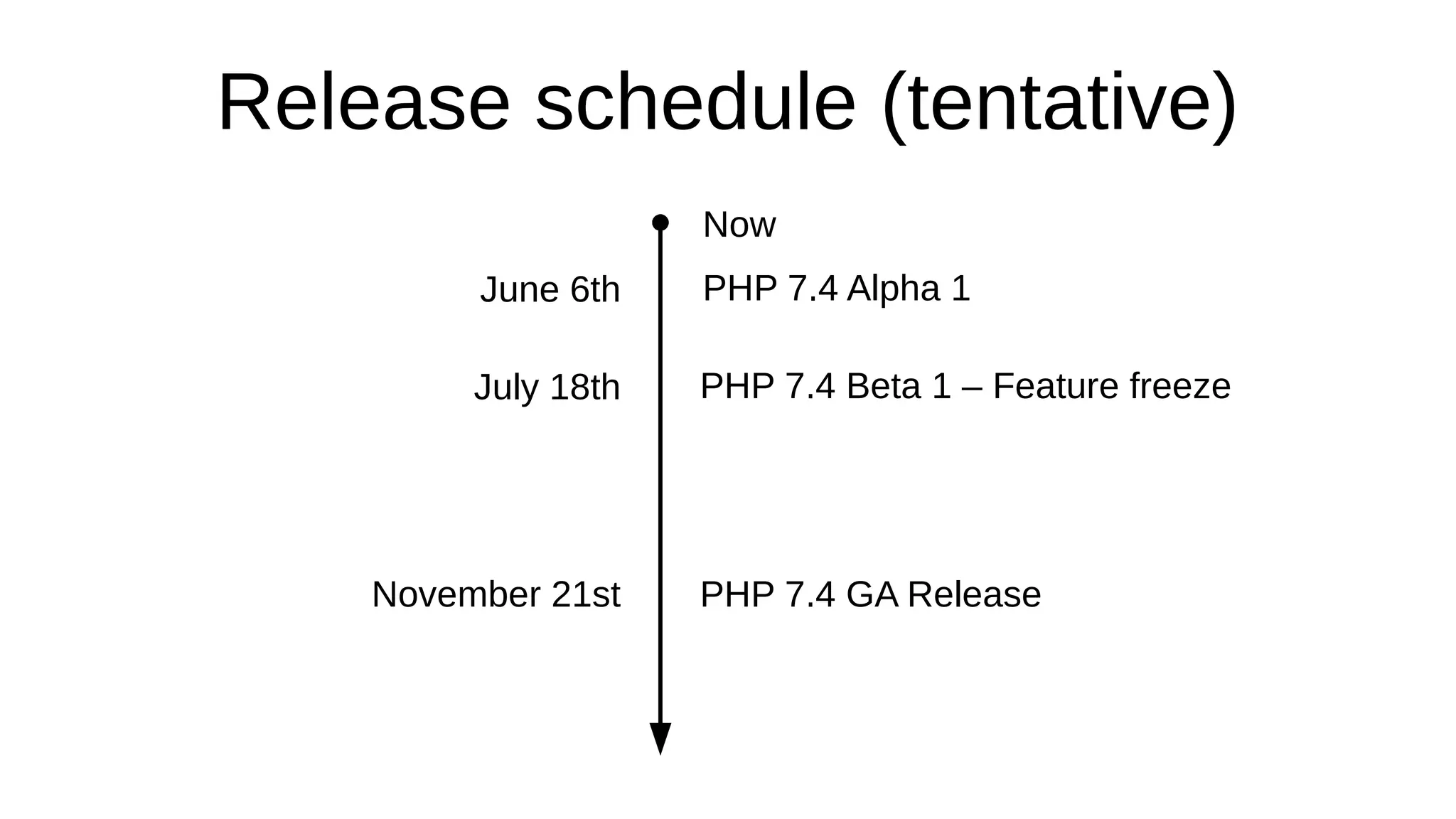
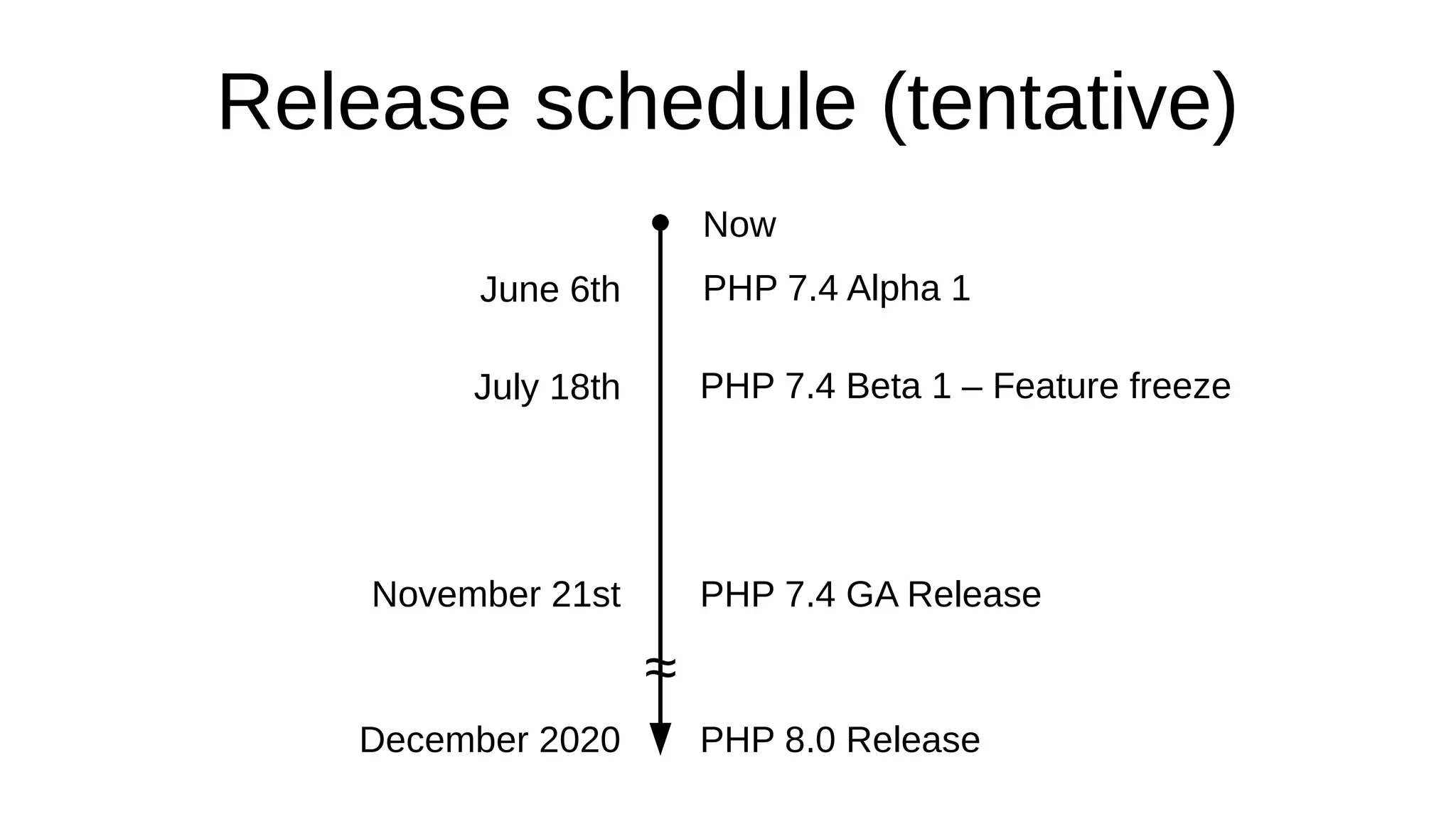
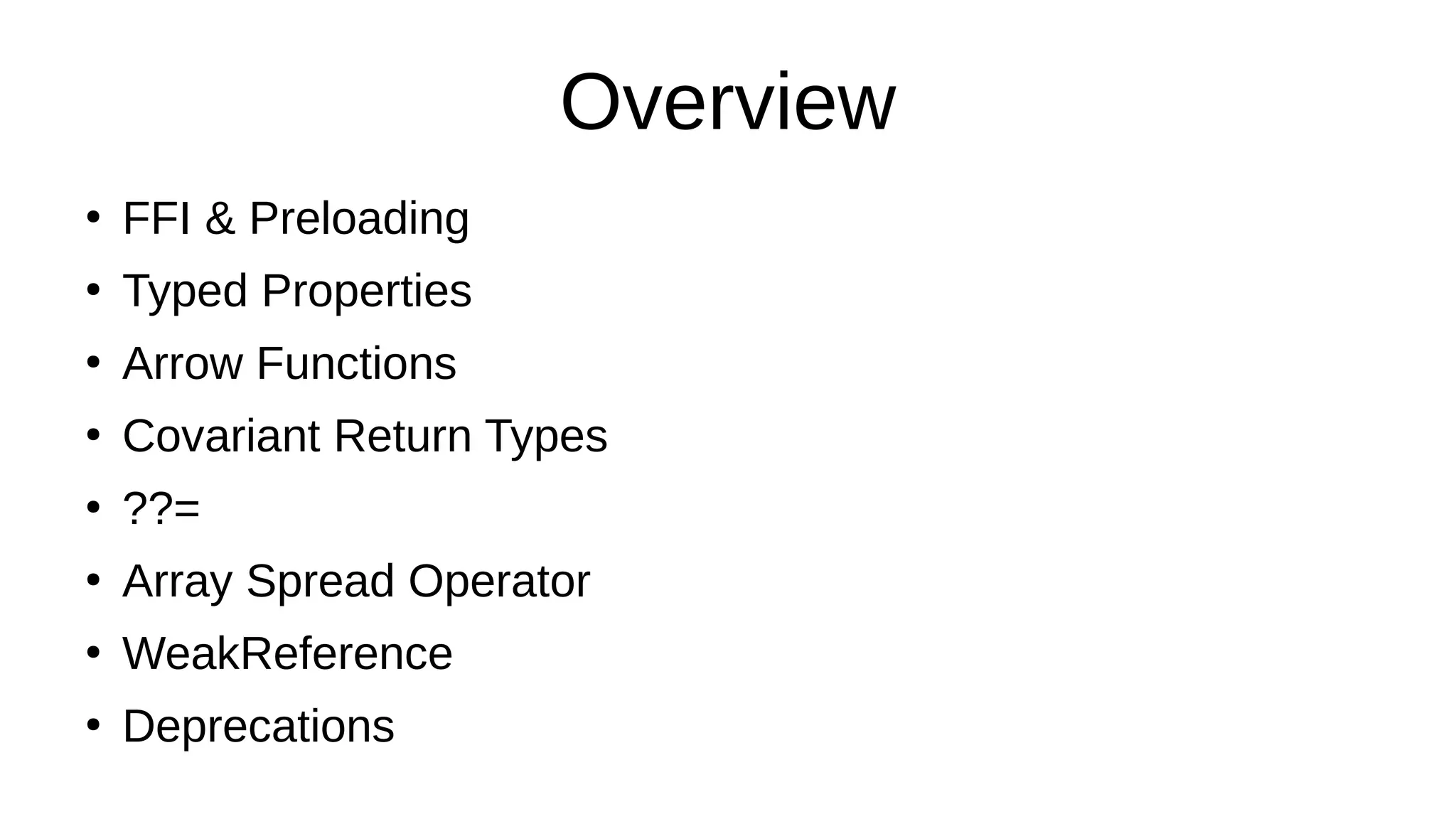
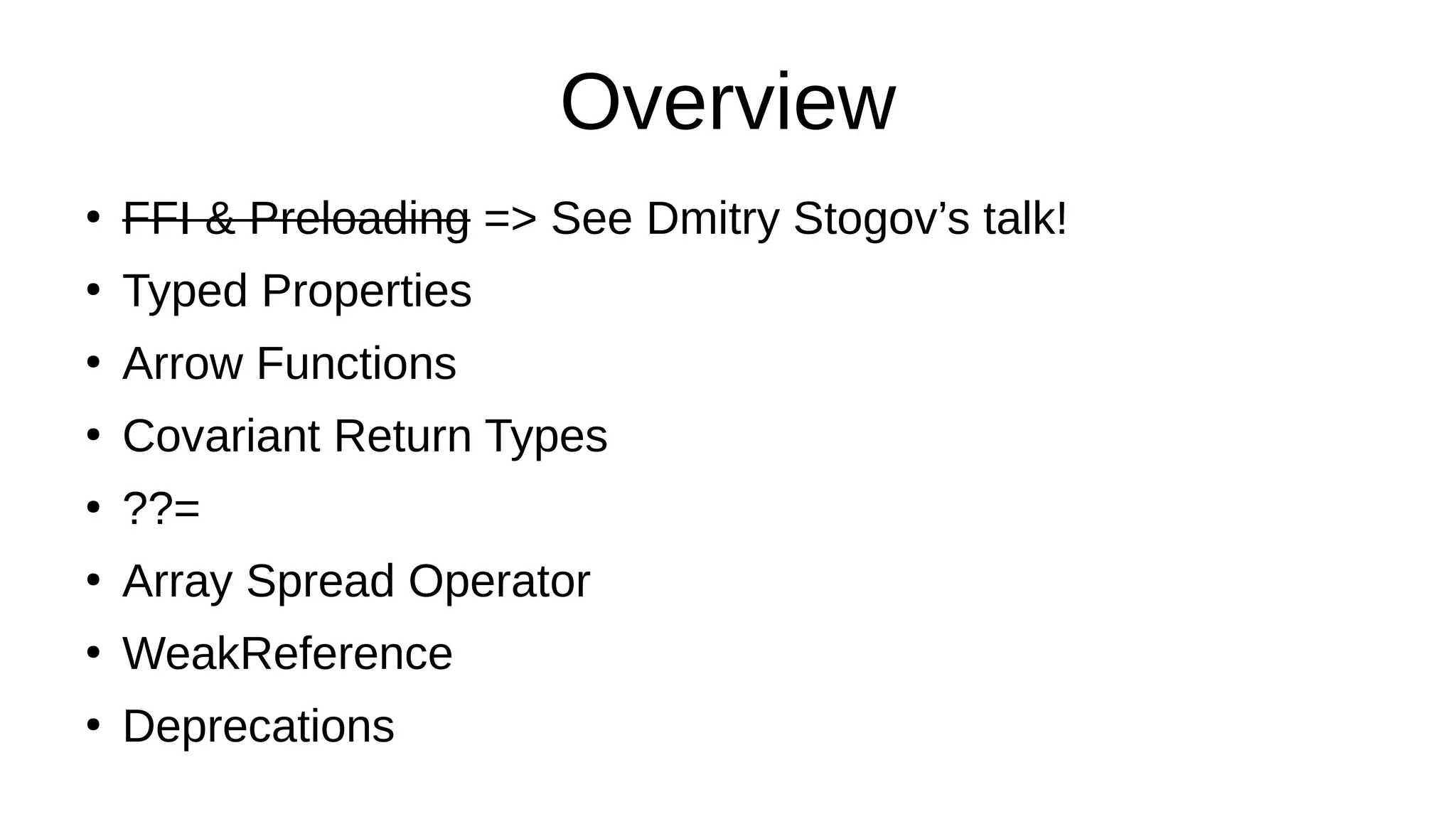
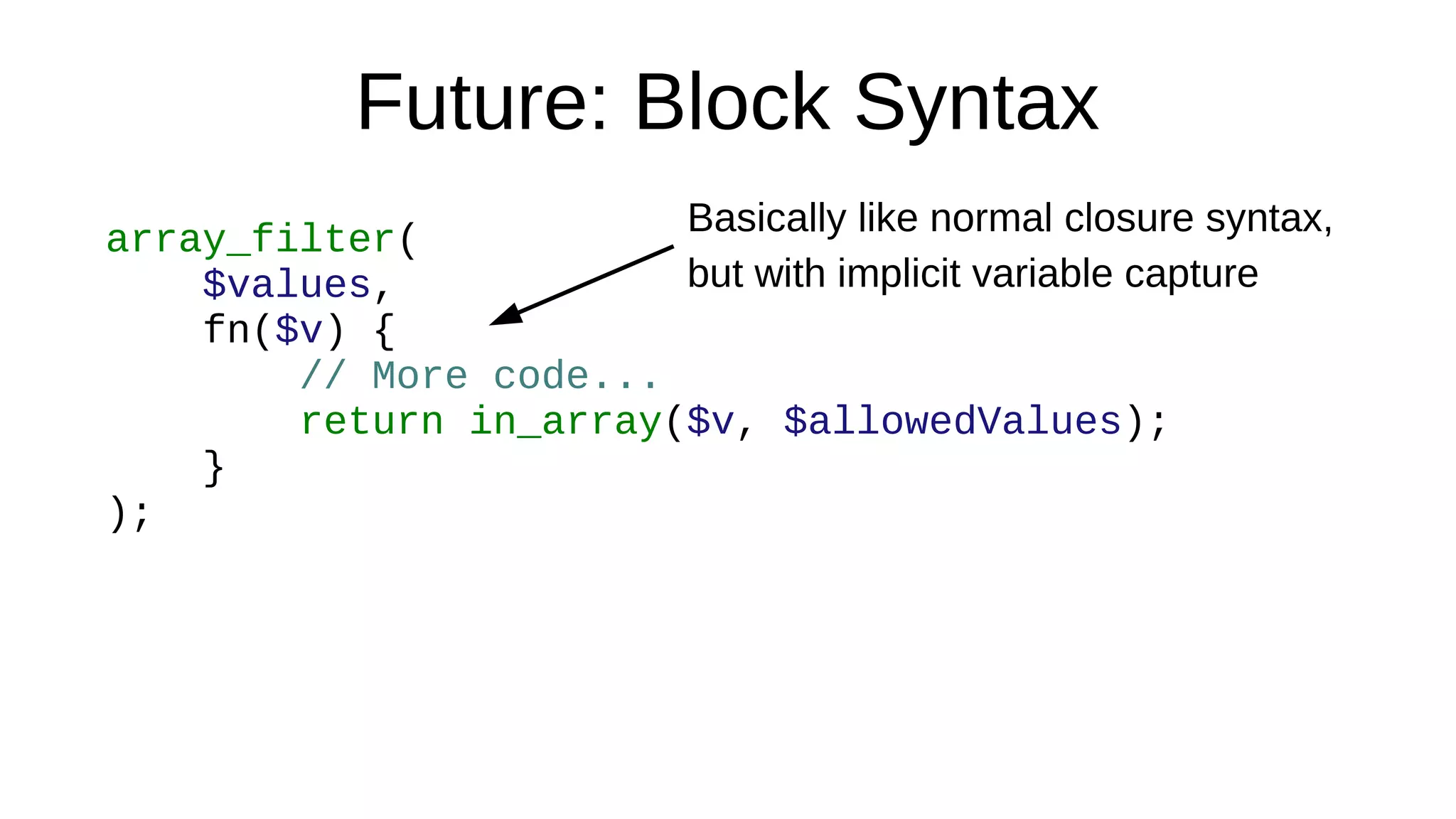
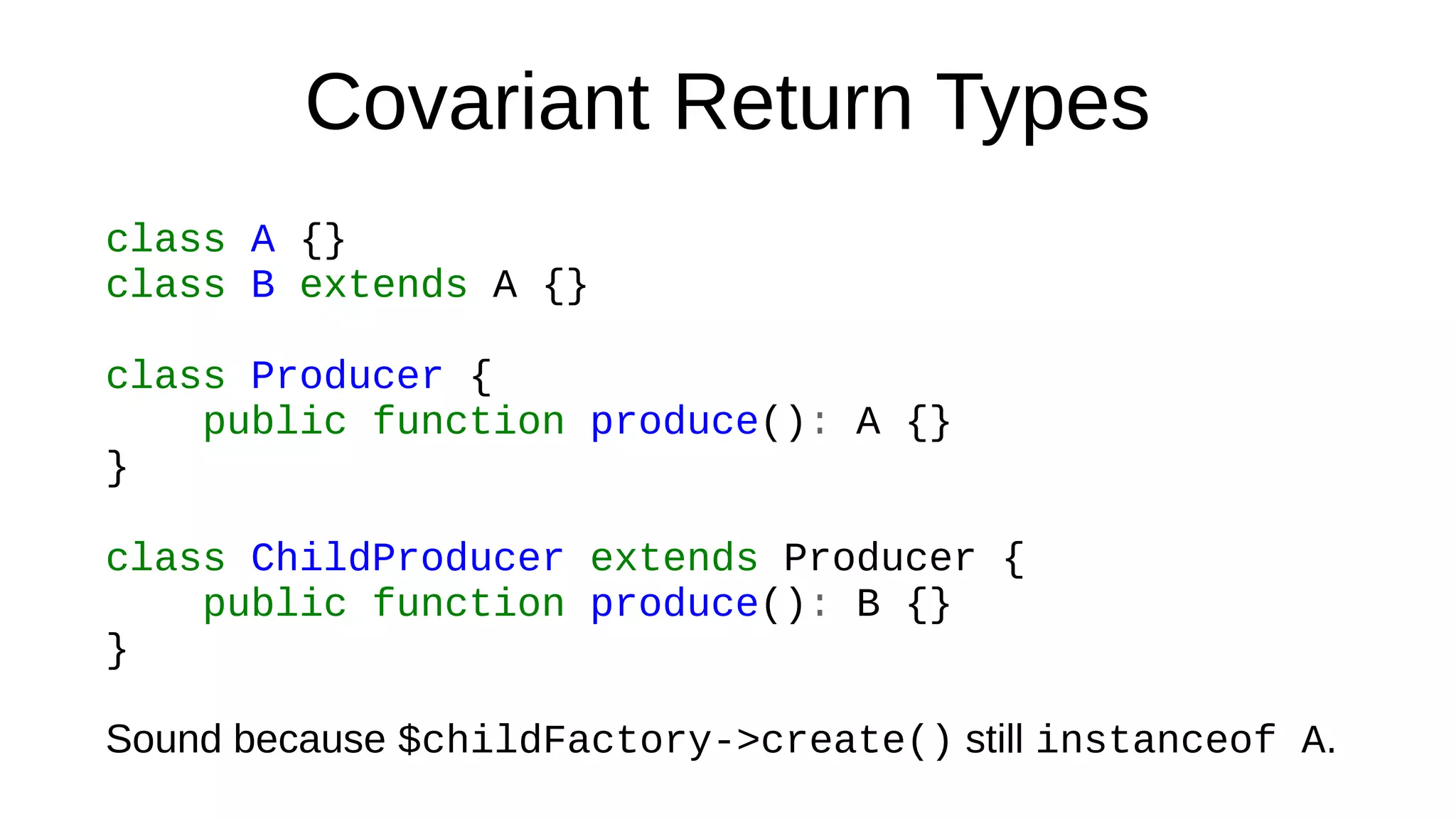
The document summarizes new features coming in PHP 7.4, including typed properties, arrow functions, the nullsafe operator, and array spread syntax. It also discusses future language features like property accessors and generics. Some deprecations are noted, such as changes to ternary operator and concatenation precedence to avoid ambiguity.


![Diving into HHVM Extensions (php[tek] 2016)](https://cdn.slidesharecdn.com/ss_thumbnails/160525-divingintohhvmextensionsphptek2016-16x10-160525201430-thumbnail.jpg?width=640&height=640&fit=bounds)


![Vibe Coding vs. Spec-Driven Development [Free Meetup]](https://cdn.slidesharecdn.com/ss_thumbnails/vibecodingvsspecdrivendevelopment-251209105622-43f455e7-thumbnail.jpg?width=640&height=640&fit=bounds)


