Indicator 1.04 – Employ marketing
information to develop a marketing plan

             Marketing
              Part II
THE MARKETING MIX REVIEW
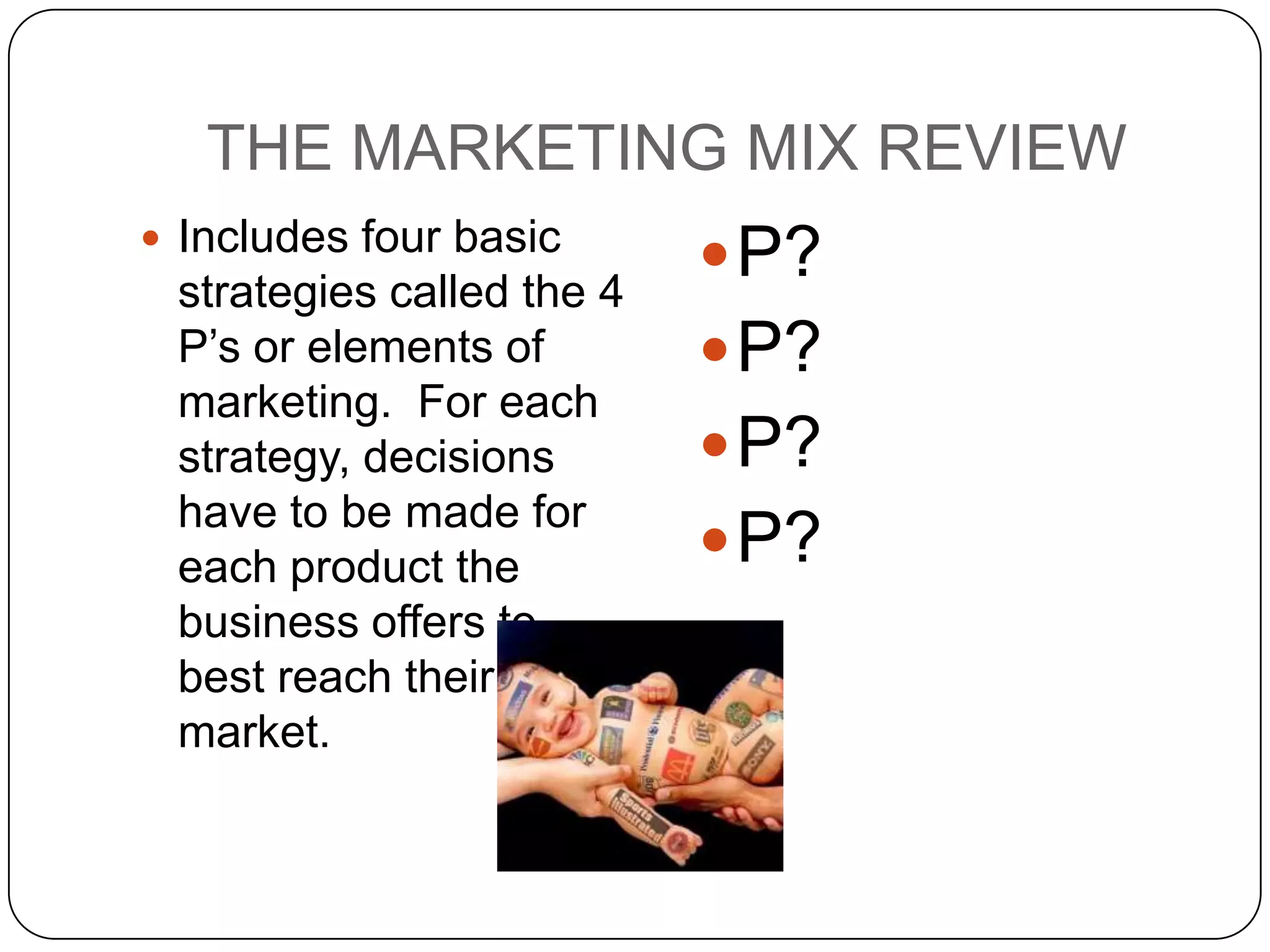
 Includes four basic
                            P?
 strategies called the 4
 P’s or elements of         P?
 marketing. For each
 strategy, decisions        P?
 have to be made for
 each product the           P?
 business offers to
 best reach their target
 market.
WHY ARE MARKETING
STRATEGIES IMPORTANT IN THE
MARKETING MIX?
 Marketing plan is created with marketing
 strategies for the marketing mix. Marketing
 strategies are important because they are the
 framework of conducting business. They
 guide the allocation of a business’s resources.
 It unites the marketing activities throughout
 the business and everyone is on the same
 page. Eliminates chaos and confusion.
What is a Market?
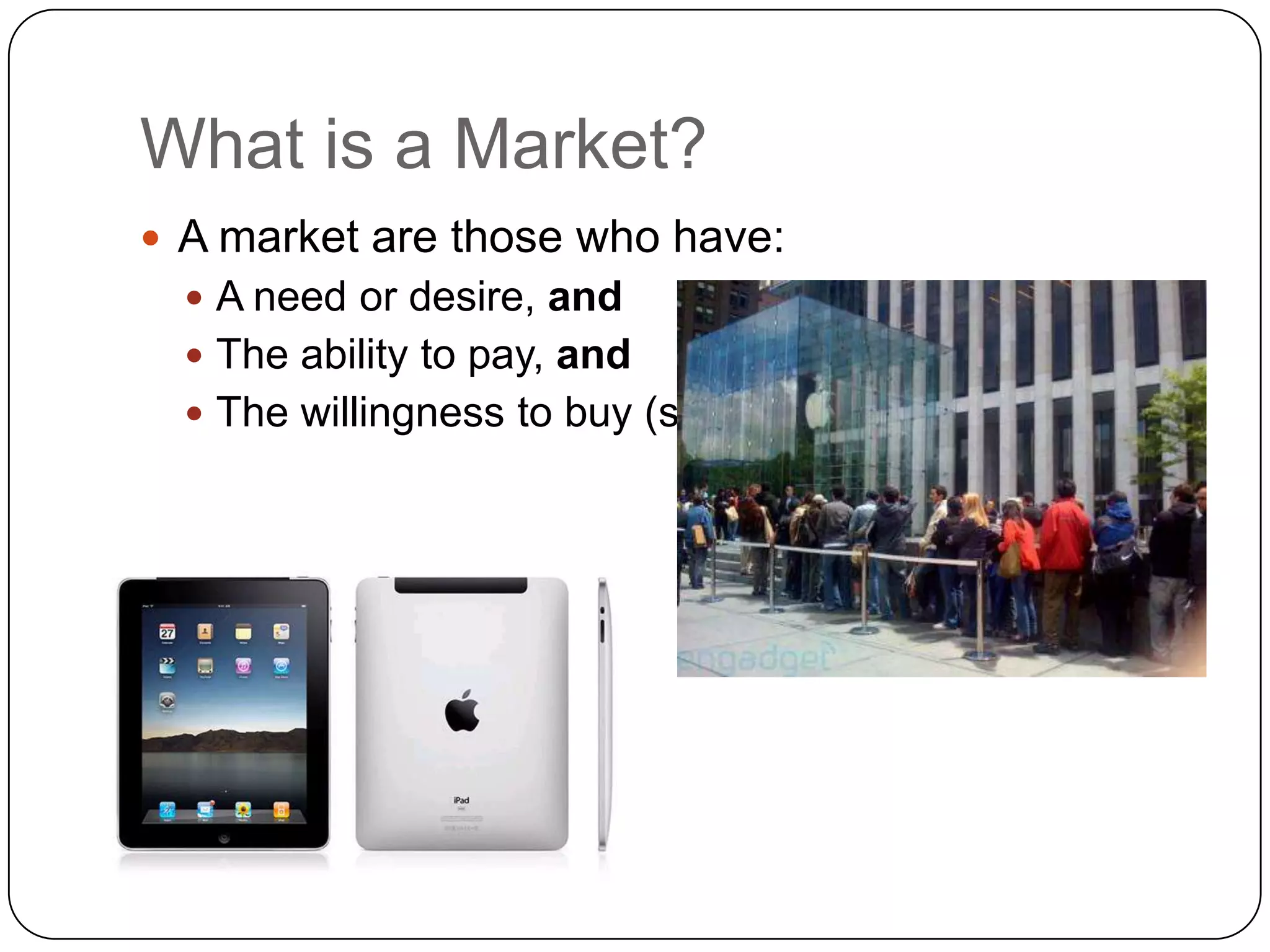
 A market are those who have:
   A need or desire, and
   The ability to pay, and
   The willingness to buy (soon)
MASS MARKETING
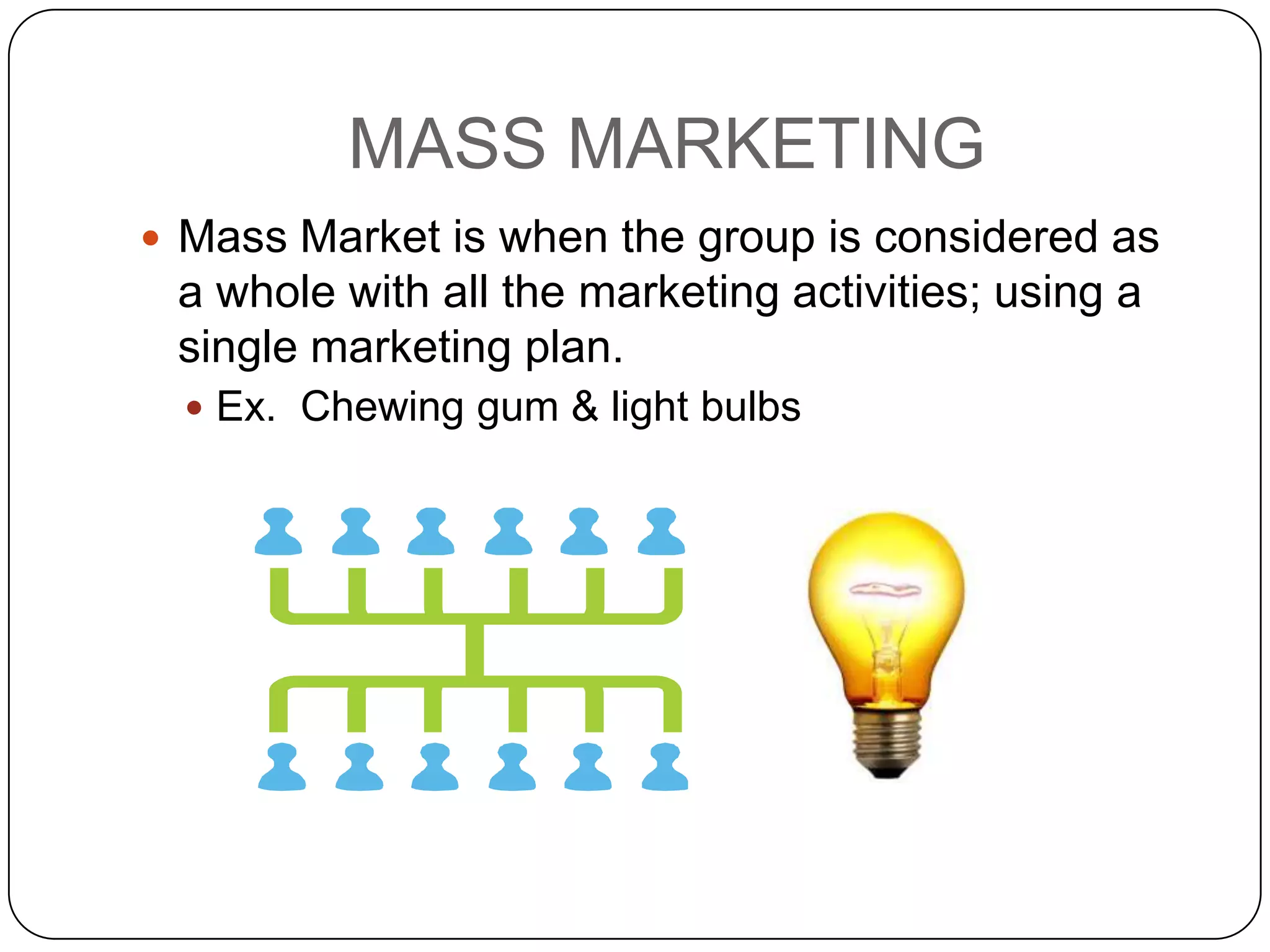
 Mass Market is when the group is considered as
 a whole with all the marketing activities; using a
 single marketing plan.
   Ex. Chewing gum & light bulbs
MASS MARKETING
 Advantages                       Disadvantages:
   Don’t have to pay for            Diversity of the
      the production of similar         audience
      products                         Unable to track return,
     Can price and distribute          low response rates
      one type of product              Nonpersonal
      more easily than many            Beliefs that everyone is
      Can send one                     the same
      promotional message to           Low profit margins
      everyone
                                       High competition
     Easier to manage, cost
      effective
     Predictable response
      rates
     Easy to set up.
WHAT IS A TARGET MARKET?
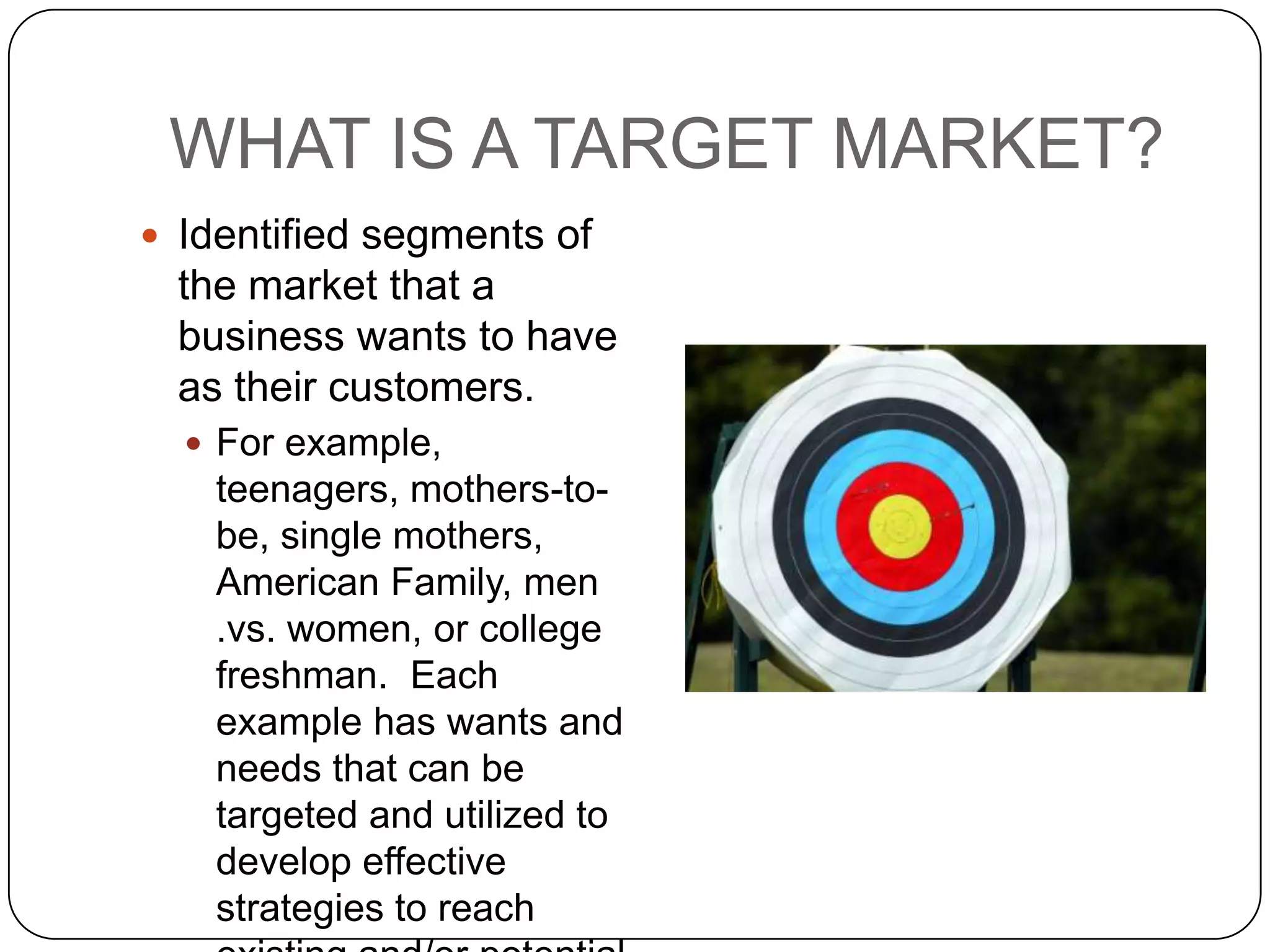
 Identified segments of
  the market that a
  business wants to have
  as their customers.
   For example,
    teenagers, mothers-to-
    be, single mothers,
    American Family, men
    .vs. women, or college
    freshman. Each
    example has wants and
    needs that can be
    targeted and utilized to
    develop effective
    strategies to reach
TARGET MARKET
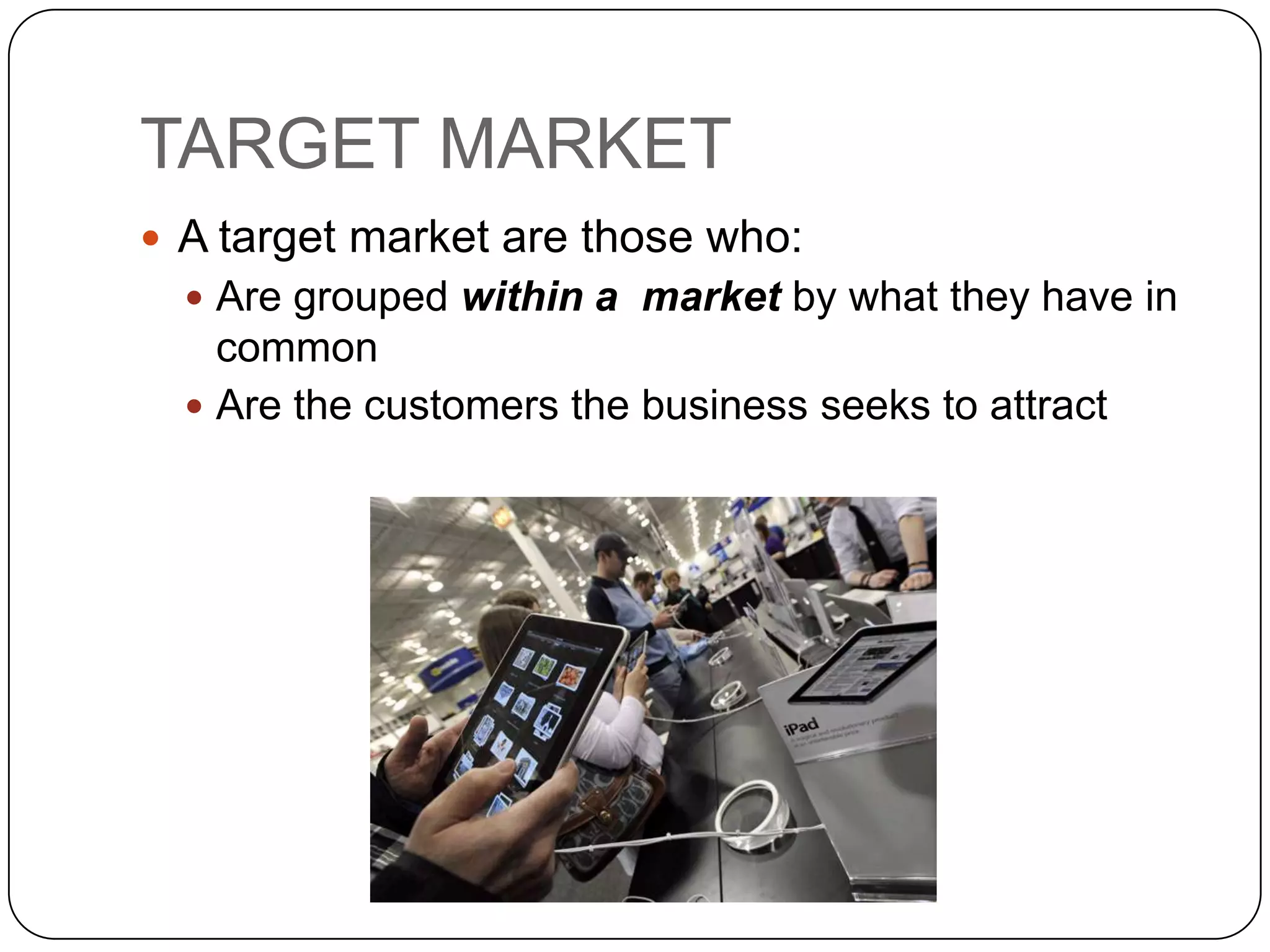
 A target market are those who:
   Are grouped within a market by what they have in
    common
   Are the customers the business seeks to attract
IMPORTANCE OF TARGET
      MARKETS
           A target market
           represents the people
           most likely to buy
           what you sell. These
           people have
           something in common
           that solidifies their
           desire for your
           product or service.
           And that something
           distinguishes them
           from the market at
           large.
Importance of Target Markets
 Every customer belongs to a number of markets
 Customers are targeted in the consumer
  market, and businesses are targeted in the
  industrial market
 The same customer or business can be included
  in more than one target market
 Markets usually change over time
SEGMENTATION
 Market Segmentation    Market segment is a
 is the process of       subgroup of a larger
 dividing a larger       market that share one
 market into smaller     or more
 parts.                  characteristics.
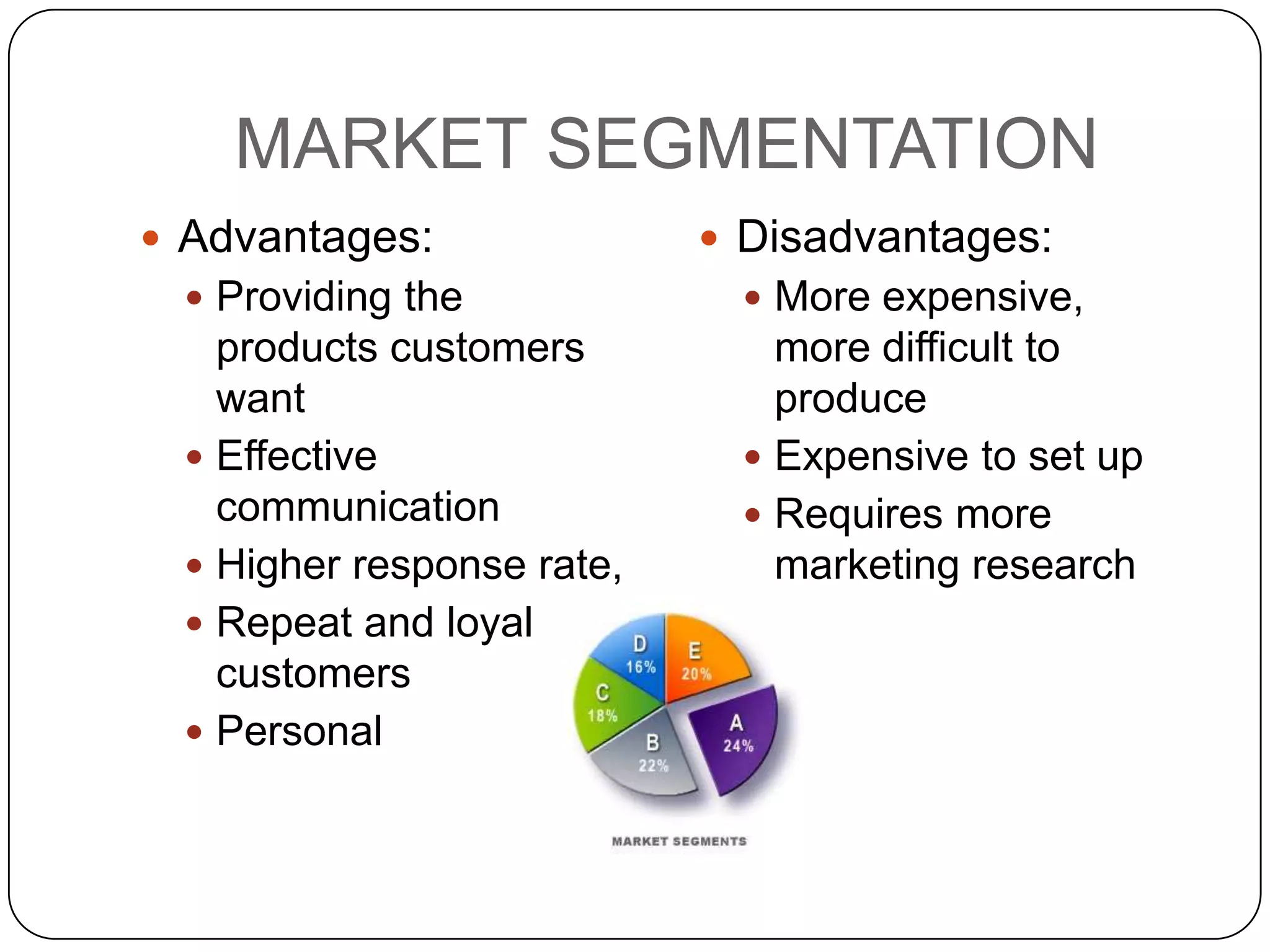
MARKET SEGMENTATION
 Advantages:               Disadvantages:
  Providing the              More expensive,
   products customers          more difficult to
   want                        produce
  Effective                  Expensive to set up
   communication              Requires more
  Higher response rate,       marketing research
  Repeat and loyal
   customers
  Personal
WHY IS MARKET SEGMENTATION
     BEING USED MORE?
 Better matching of customer’s needs
 Better profits & opportunities for growth
 Repeat customers
 Target market communication
 More businesses operating globally creates more
  competition & greater market share via market
  segments
 It is more efficient in the long run.
4 TYPES OF MARKET
   SEGMENTATION


 Demographic
 Psychographic
  Geographic
   Behavioral
DEMOGRAPHIC
             SEGMENTATION
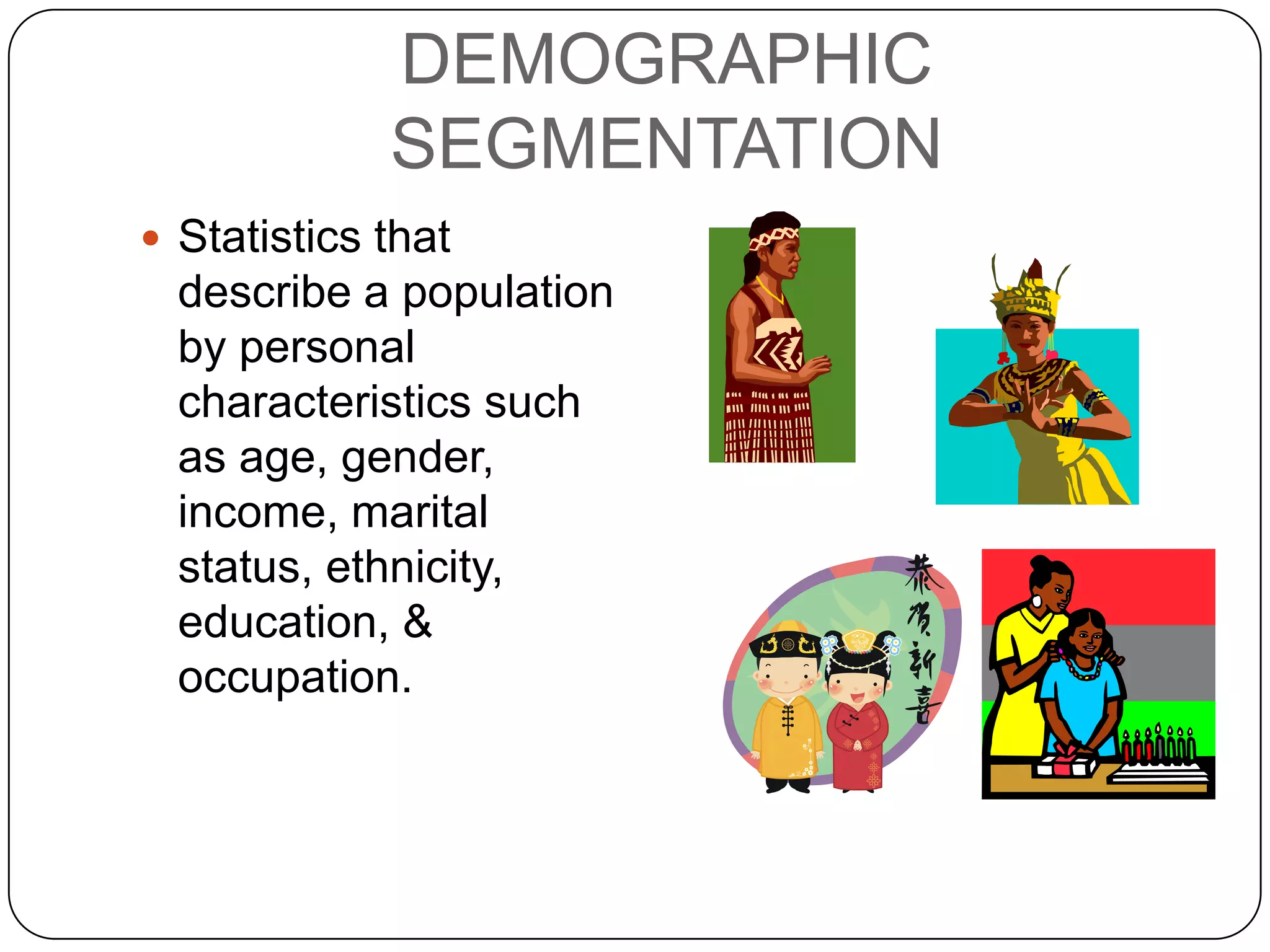
 Statistics that
  describe a population
  by personal
  characteristics such
  as age, gender,
  income, marital
  status, ethnicity,
  education, &
  occupation.
DEMOGRAPHIC Example:
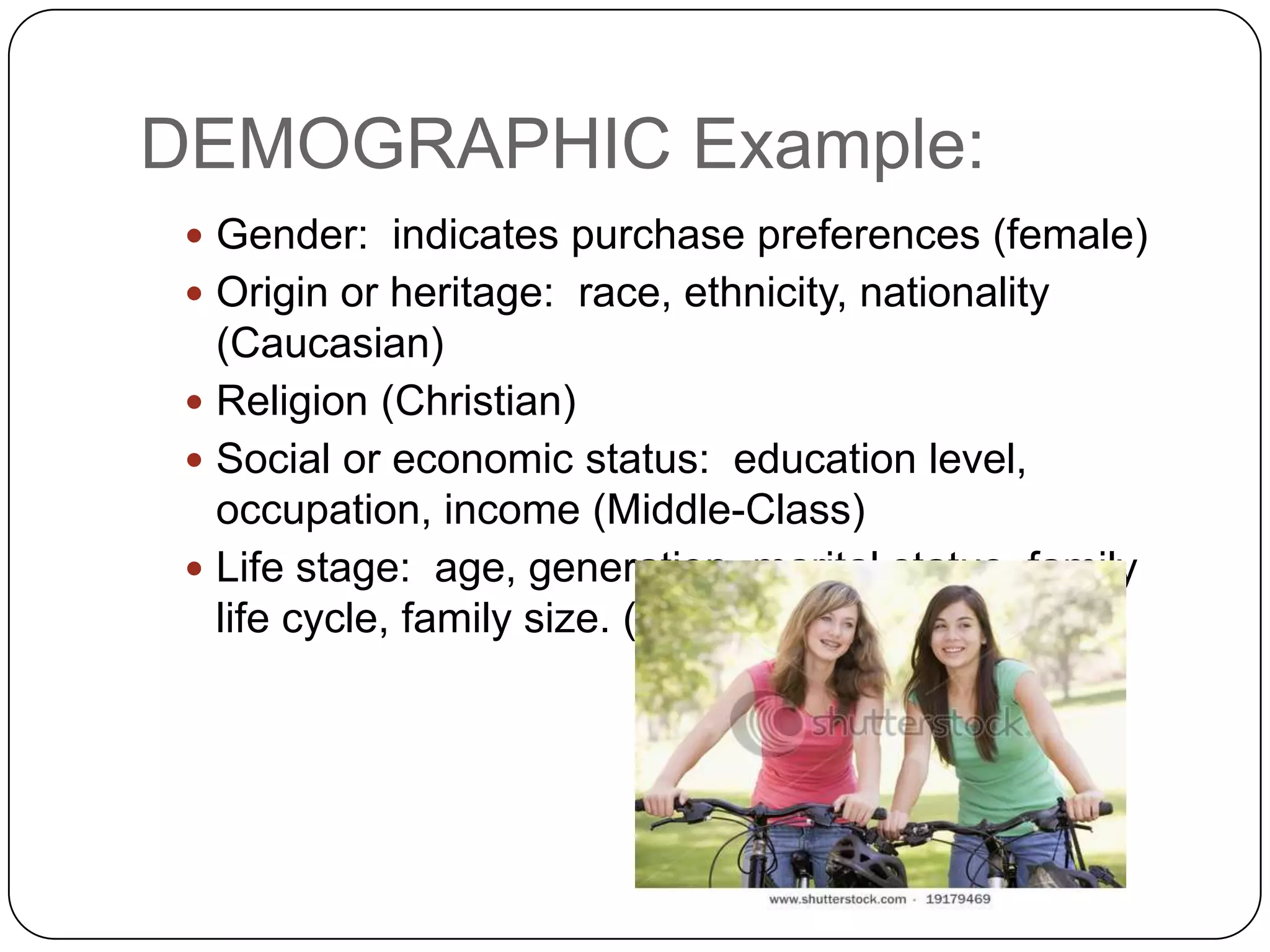
  Gender: indicates purchase preferences (female)
  Origin or heritage: race, ethnicity, nationality
   (Caucasian)
  Religion (Christian)
  Social or economic status: education level,
   occupation, income (Middle-Class)
  Life stage: age, generation, marital status, family
   life cycle, family size. (Teens)
PSYCHOGRAPHIC
            SEGMENTATION
 Defined: Markets            Characteristics reflect
 divided by social and         consumer buying
 psychological                 behaviors. The
 characteristics.              characteristics are
 (Lifestyles, morals, valu     Interests, Habits, Activiti
 es, & interests)              es, Lifestyles, Opinions,
                                & Hobbies. These
                               reflect who your
                               customers are.
                               Businesses that use
                               Marketing principles to
                               guide their decision
                               making must evaluate
                               and reevaluate their
                               customer’s wants and
                               needs continuously to
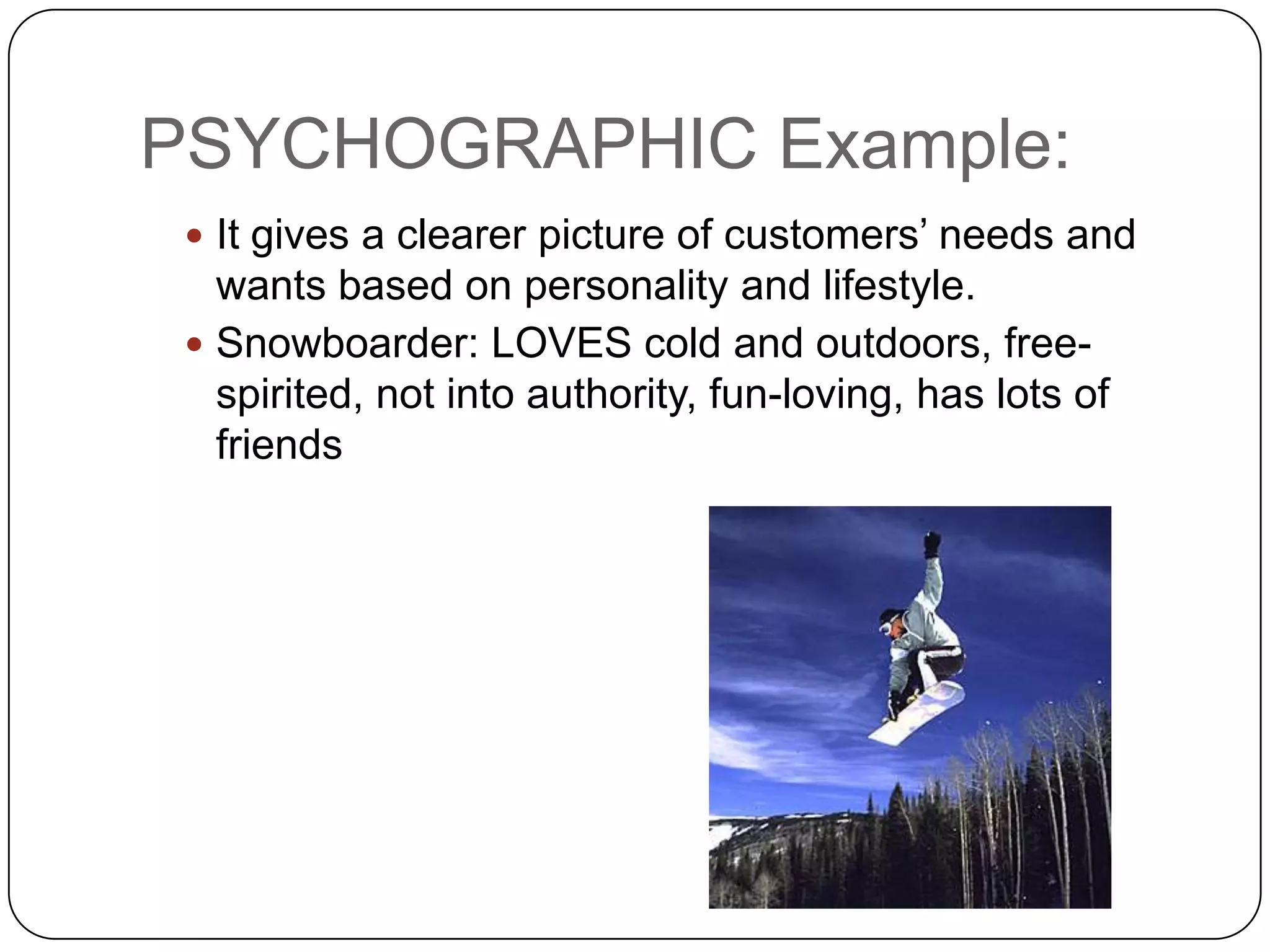
PSYCHOGRAPHIC Example:
  It gives a clearer picture of customers’ needs and
   wants based on personality and lifestyle.
  Snowboarder: LOVES cold and outdoors, free-
   spirited, not into authority, fun-loving, has lots of
   friends
GEOGRAPHIC SEGMENTATION
 Markets divided by    It is valuable
 where the customer      information because
 lives.                  businesses can tailor
                         their product mix
                         based on location.
                         Characteristics are
                         nations, states, region
                         s, counties, cities, or
                         neighborhoods.
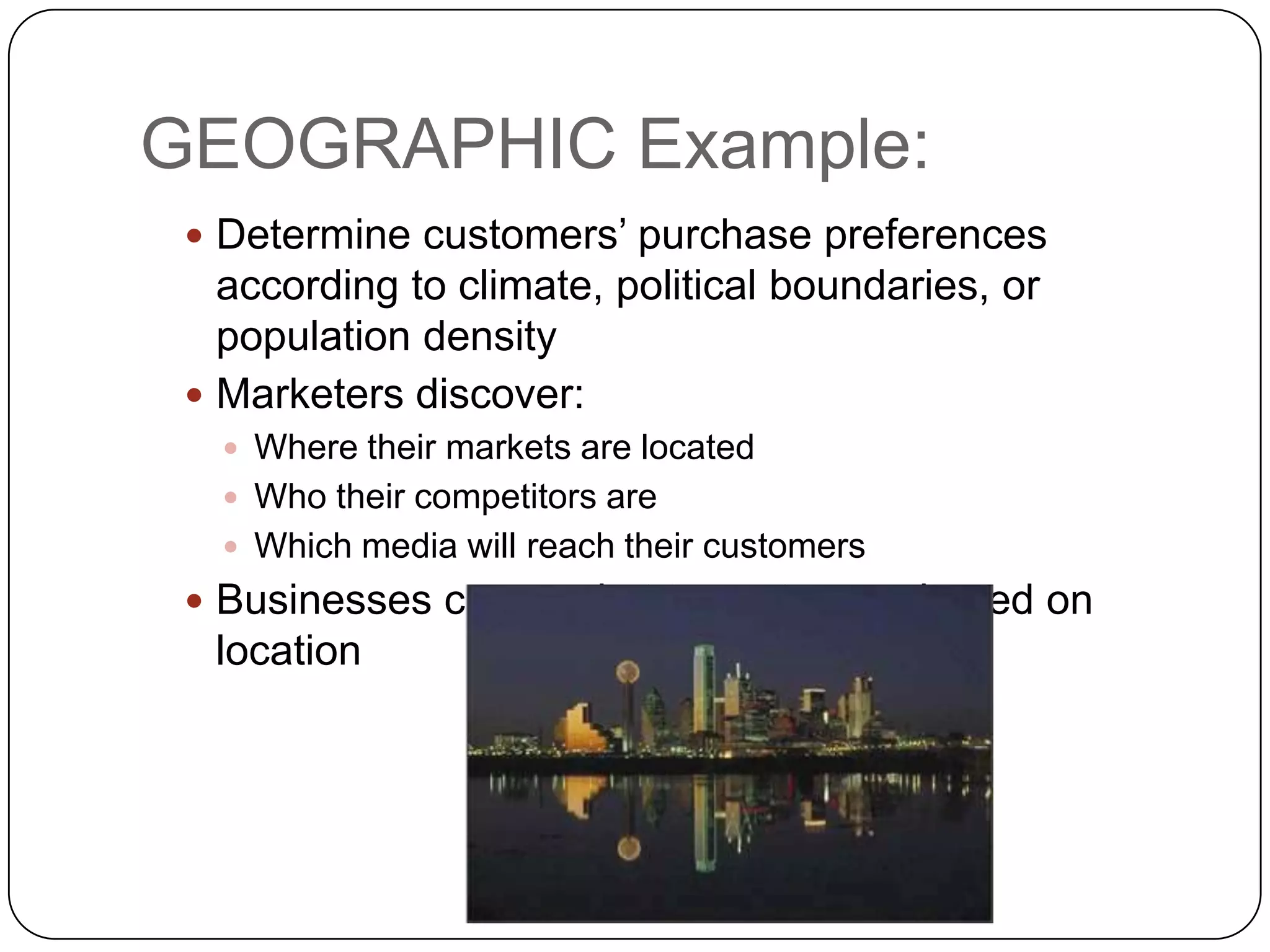
GEOGRAPHIC Example:
  Determine customers’ purchase preferences
   according to climate, political boundaries, or
   population density
  Marketers discover:
    Where their markets are located
    Who their competitors are
    Which media will reach their customers
  Businesses can market to customers based on
  location
BEHAVORIAL SEGMENTATION
 Segmenting a market    Types of behavioral
 base on the way         segmentation:
 customers use a            Product Benefits
 product or behave
                            Usage
 toward a product.
 (How a consumer            Loyalty
 responsdsto a              Occasions
 product.)
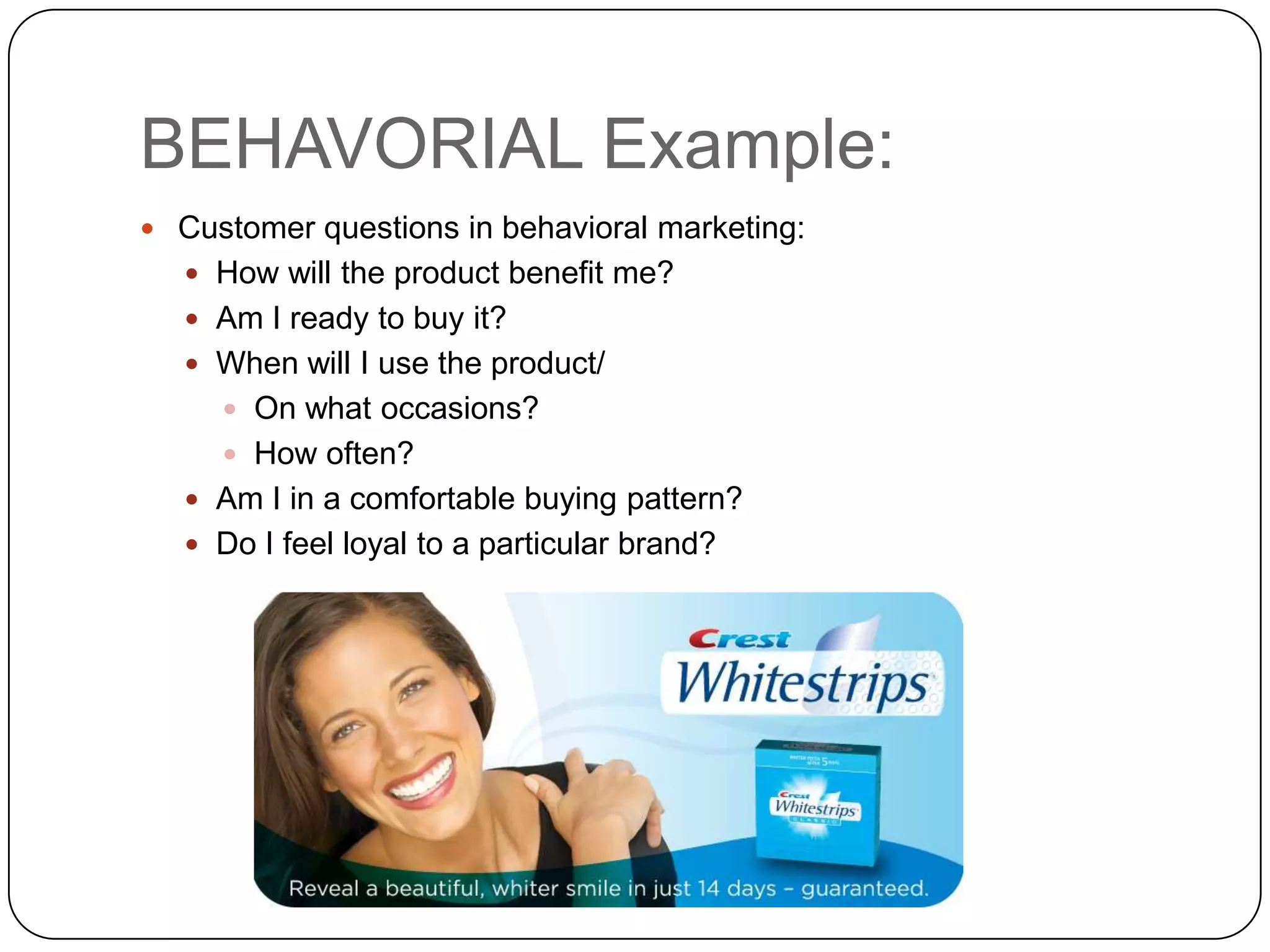
BEHAVORIAL Example:
 Customer questions in behavioral marketing:
    How will the product benefit me?
    Am I ready to buy it?
    When will I use the product/
      On what occasions?
      How often?
    Am I in a comfortable buying pattern?
    Do I feel loyal to a particular brand?
ACTIVITY
 Choose a partner!
 Cut out ads from magazines for 3 products of
  your choice.
 Create a small poster with the products listing the
  target market the product and ad are designed to
  attract.
 For EACH product – you need to identify the following
  market segmentation for that product:
   Demographics
   Geographics
   Psychographics
   Behavioral
 You may use the internet to research product

Marketing 1.04 part_2_fall_2012

  • 1.
    Indicator 1.04 –Employ marketing information to develop a marketing plan Marketing Part II
  • 2.
    THE MARKETING MIXREVIEW  Includes four basic  P? strategies called the 4 P’s or elements of  P? marketing. For each strategy, decisions  P? have to be made for each product the  P? business offers to best reach their target market.
  • 3.
    WHY ARE MARKETING STRATEGIESIMPORTANT IN THE MARKETING MIX?  Marketing plan is created with marketing strategies for the marketing mix. Marketing strategies are important because they are the framework of conducting business. They guide the allocation of a business’s resources. It unites the marketing activities throughout the business and everyone is on the same page. Eliminates chaos and confusion.
  • 4.
    What is aMarket?  A market are those who have:  A need or desire, and  The ability to pay, and  The willingness to buy (soon)
  • 5.
    MASS MARKETING  MassMarket is when the group is considered as a whole with all the marketing activities; using a single marketing plan.  Ex. Chewing gum & light bulbs
  • 6.
    MASS MARKETING  Advantages  Disadvantages:  Don’t have to pay for  Diversity of the the production of similar audience products  Unable to track return,  Can price and distribute low response rates one type of product  Nonpersonal more easily than many  Beliefs that everyone is  Can send one the same promotional message to  Low profit margins everyone  High competition  Easier to manage, cost effective  Predictable response rates  Easy to set up.
  • 7.
    WHAT IS ATARGET MARKET?  Identified segments of the market that a business wants to have as their customers.  For example, teenagers, mothers-to- be, single mothers, American Family, men .vs. women, or college freshman. Each example has wants and needs that can be targeted and utilized to develop effective strategies to reach
  • 8.
    TARGET MARKET  Atarget market are those who:  Are grouped within a market by what they have in common  Are the customers the business seeks to attract
  • 9.
    IMPORTANCE OF TARGET MARKETS  A target market represents the people most likely to buy what you sell. These people have something in common that solidifies their desire for your product or service. And that something distinguishes them from the market at large.
  • 10.
    Importance of TargetMarkets  Every customer belongs to a number of markets  Customers are targeted in the consumer market, and businesses are targeted in the industrial market  The same customer or business can be included in more than one target market  Markets usually change over time
  • 11.
    SEGMENTATION  Market Segmentation  Market segment is a is the process of subgroup of a larger dividing a larger market that share one market into smaller or more parts. characteristics.
  • 12.
    MARKET SEGMENTATION  Advantages:  Disadvantages:  Providing the  More expensive, products customers more difficult to want produce  Effective  Expensive to set up communication  Requires more  Higher response rate, marketing research  Repeat and loyal customers  Personal
  • 13.
    WHY IS MARKETSEGMENTATION BEING USED MORE?  Better matching of customer’s needs  Better profits & opportunities for growth  Repeat customers  Target market communication  More businesses operating globally creates more competition & greater market share via market segments  It is more efficient in the long run.
  • 14.
    4 TYPES OFMARKET SEGMENTATION Demographic Psychographic Geographic Behavioral
  • 15.
    DEMOGRAPHIC SEGMENTATION  Statistics that describe a population by personal characteristics such as age, gender, income, marital status, ethnicity, education, & occupation.
  • 16.
    DEMOGRAPHIC Example: Gender: indicates purchase preferences (female)  Origin or heritage: race, ethnicity, nationality (Caucasian)  Religion (Christian)  Social or economic status: education level, occupation, income (Middle-Class)  Life stage: age, generation, marital status, family life cycle, family size. (Teens)
  • 17.
    PSYCHOGRAPHIC SEGMENTATION  Defined: Markets  Characteristics reflect divided by social and consumer buying psychological behaviors. The characteristics. characteristics are (Lifestyles, morals, valu Interests, Habits, Activiti es, & interests) es, Lifestyles, Opinions, & Hobbies. These reflect who your customers are. Businesses that use Marketing principles to guide their decision making must evaluate and reevaluate their customer’s wants and needs continuously to
  • 18.
    PSYCHOGRAPHIC Example: It gives a clearer picture of customers’ needs and wants based on personality and lifestyle.  Snowboarder: LOVES cold and outdoors, free- spirited, not into authority, fun-loving, has lots of friends
  • 19.
    GEOGRAPHIC SEGMENTATION  Marketsdivided by  It is valuable where the customer information because lives. businesses can tailor their product mix based on location. Characteristics are nations, states, region s, counties, cities, or neighborhoods.
  • 20.
    GEOGRAPHIC Example: Determine customers’ purchase preferences according to climate, political boundaries, or population density  Marketers discover:  Where their markets are located  Who their competitors are  Which media will reach their customers  Businesses can market to customers based on location
  • 21.
    BEHAVORIAL SEGMENTATION  Segmentinga market  Types of behavioral base on the way segmentation: customers use a  Product Benefits product or behave  Usage toward a product. (How a consumer  Loyalty responsdsto a  Occasions product.)
  • 22.
    BEHAVORIAL Example:  Customerquestions in behavioral marketing:  How will the product benefit me?  Am I ready to buy it?  When will I use the product/  On what occasions?  How often?  Am I in a comfortable buying pattern?  Do I feel loyal to a particular brand?
  • 23.
    ACTIVITY  Choose apartner!  Cut out ads from magazines for 3 products of your choice.  Create a small poster with the products listing the target market the product and ad are designed to attract.  For EACH product – you need to identify the following market segmentation for that product:  Demographics  Geographics  Psychographics  Behavioral  You may use the internet to research product