Behaviorism: Its all in the action


           Created by:
Jen, Linda, Melissa, Moriah, Pam
Participant Directions
s   In order to learn about the behaviorist
    theory you will follow this PowerPoint
    presentation, answering the questions
    with 100% accuracy.
s   Answer the questions as you go,and
    take the quiz at the end.
Behaviorist Theory
s   Definition

s   Scientists who studied the
    behaviorist theory

s   Key concepts

s   Classroom examples

s   Advantages/disadvantages
Advantages and Disadvantages
      of the behaviorist theory
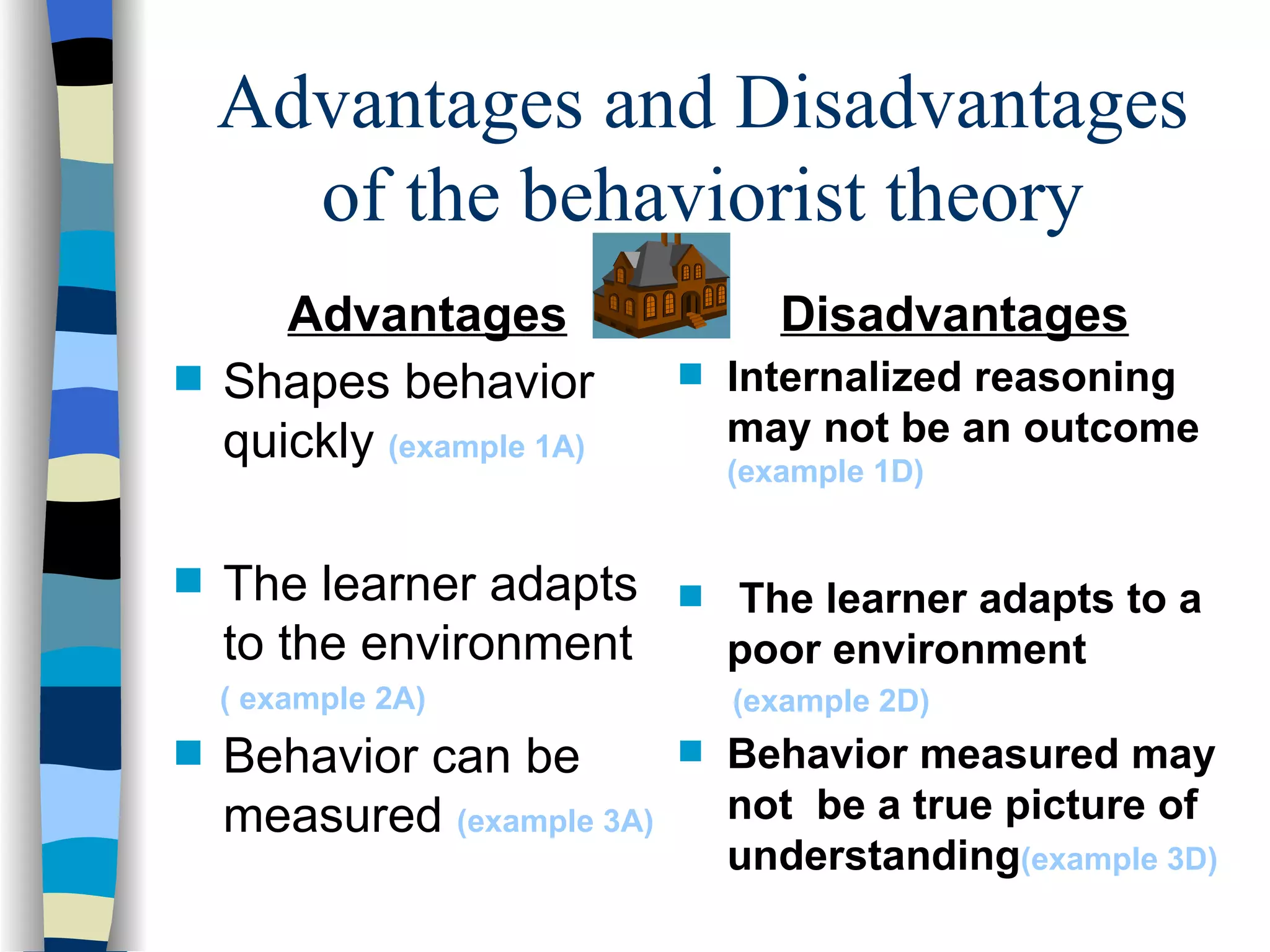
       Advantages                  Disadvantages
s   Shapes behavior         s   Internalized reasoning
    quickly (example 1A)        may not be an outcome
                                (example 1D)


s   The learner adapts      s   The learner adapts to a
    to the environment          poor environment
    ( example 2A)               (example 2D)
s   Behavior can be         s   Behavior measured may
    measured (example 3A)       not be a true picture of
                                understanding(example 3D)
Example of Advantage and
           Disadvantage 1
               Shapes behavior quickly:
s   Every time a student would arrive to class on time the teacher would
    give the student (on time points.) These points could be used to
    purchase a watch from the school store.


             Behavior is not internalized:
s   A student may act respectful but not feel respect towards a teacher.
Example of Advantage and
           Disadvantage 2
    The learner adapts to the environment
s   The class has been trained to write a half page every day. They are
    reinforced with a smiley sticker


The learner adapts to a poor environment
s   A student adapts to a classroom where the other students’ behaviors
    are negative and destructive to the learning environment.
Example Advantage and
Disadvantage 3
              Behavior can be measured
s   Students can take tests to measure whether they can answer the
    questions correctly.


    Behavior measured may not be a true
           picture of understanding
s   Taking a true or false test with the assurance of retaking it until the
    student gets it right can lead to guessing for the correct answers.
Quiz
    Advantages/Disadvantages
s A disadvantage to the behaviorist
  theory is that students can learn
  behaviors quickly.
True / False
s An advantage to the behaviorist theory
  is: All students learn the best using this
  theory.
True / False
Wrong try again
Correct move on to the next
         question
Correct!
Ready to learn more?
Who are the Behaviorists?
s   Ivan Pavlov    Click on picture
s   John Watson
s   B.F. Skinner
You too can be trained!


                     Back to
                   Behaviorists
Who are these Behaviorists?
    s     Ivan Pavlov                                    s     In 1903 he published his
                                                               results calling this a
             – 1849-1936                                       "conditioned reflex,"different
    s     Pavlov wanted to see if                              from an innate reflex, such
          external stimuli could                               as yanking a hand back from
          affect the salivation process                        a flame, in that it had to be
             –    he rang a bell at the same time he           learned.
                  gave the experimental dogs food.
             –    After a while, the dogs -- which
                                                         s     Pavlov called this learning
                  before only salivated when they saw          process “conditioning”
                  and ate their food -- would begin to
                  salivate when the bell rang, even if   s     He thought that conditioned
                  no food were present.                        reflexes could explain the
                                                               behavior of people.
                                                             Quiz                 Back to
                                                             yourself
http://llanes.panam.edu/edul6300/Behaviorists.html                              Behaviorists
Who are these Behaviorists?
    s     John Watson                                s     All animals, he believed,
                                                                    were extremely
             – 1878 - 1958                                 complex machines that
    s     Watson was inspired by                           responded to situations
          Pavlov                                           according to their "wiring," or
    s     He studied the behavior of                       nerve pathways that were
          children and concluded that                      conditioned by experience.
          humans were simply more                    s     In 1913, he published an
          complicated than animals                         article outlining his ideas
          but operated on the same                           –      disagreed with Freud
                                                             –      dismissed heredity as a significant
          principles.                                               factor in shaping human behavior.


                                                         Quiz                            Back to
                                                         yourself
http://llanes.panam.edu/edul6300/Behaviorists.html                                     Behaviorists
Who are these Behaviorists?
                                                     s    He used operant
    s     B.F. Skinner                                    conditioning
             – 1904 - 1990                                  – the rewarding of a partial
    s     Skinner developed                                   behavior or a random act
                                                              that approaches the desired
          behavioral studies of rats
                                                              behavior.
          that automatically reward
          behavior.
                                                     s    Skinner believed other all
                                                          complicated tasks could be
    s     He wrote The Behavior of
                                                          broken down and taught.
          Organisms and began his
          novel Walden II, about a
                                                     s    He developed machines so
          commune where behaviorist                       students could learn bit by
          principles created a new kind                   bit, uncovering answers for
          of utopia.                                      an immediate "reward."

                                                         Quiz                  Back to
                                                         yourself
http://llanes.panam.edu/edul6300/Behaviorists.html                           Behaviorists
Quiz Yourself on the
Behaviorists!
1. Pavlov began his studies by
       a. Seeing if children liked cookies
       b. Teaching dogs to salivate at the ring of a bell
       c. Developing a theory on behaviorism


                                                      Back to
                                                    Behaviorists
Quiz Yourself on the
Behaviorists!
2. Watson felt that
        a. Heredity was important in shaping human
           behavior.
        b. Animals responded to situations according to
their      conditioned experience.
        c. That Freud had all the answers


                                                     Back to
                                                   Behaviorists
Quiz Yourself on the
Behaviorists!
1. Skinner used _____ to teach a behavior
       a. stimulous
       b. pidgeons
       c. operant conditioning


                                              Back to
                                            Behaviorists
Opps!


You need to go back and read
again!


                                 Back to
                               Behaviorists
Great!
You get an “A”


                   Back to
                 Behaviorists
Key Concepts
s   Classical Conditioning

    – Stimulus-Response

    – Action causes response


    – The bell rings to start class and all students quiet
      down and focus attention on the teacher.
Key Concepts cont.
s   Operant Conditioning

    – Stimulus-Response-Reinforcer :

    – Specific action causes a desired response when
      reinforced


    – Students work very hard on mastering their times
      tables and teacher gives free pass to skip the
      math homework for that night.
Quiz Time!
s   Pick the best answer to that describes
    each term:
s   Mrs. Smith flashes the lights to get her
    students attention. The students
    immediately stop what they are doing and
    look her way


     –   A. Operant Conditioning

     –   B. Classical Conditioning
AWESOME!


 Click the picture to go on.
OOPS! Try Again!


          Click Here
QUIZ TIME!
s   Mr. Lee gives his students a
    free choice of how they will
    complete their reading
    assignment after they have
    completed the read-aloud
    portion as a whole class and
    behaved very well.

    –   Classical Conditioning

    –   Operant Conditioning
WOW!


 Click the picture to go on.
OH NO! Try Again!


          Click Here
Behavior what?
s   Think back to your
    Language Arts
    days--what is the
    main word here in
    behaviorism?
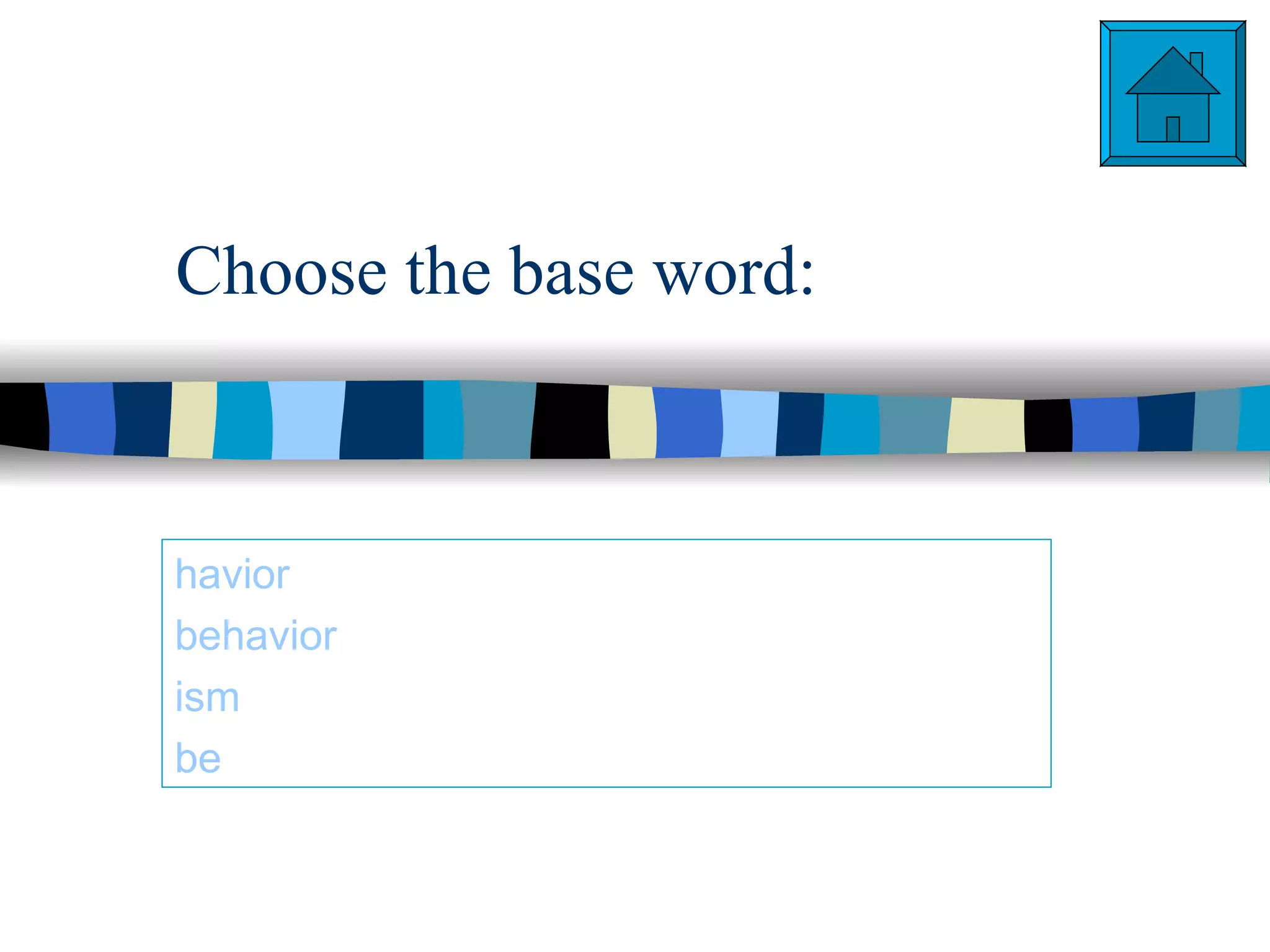
Choose the base word:


havior
behavior
ism
be
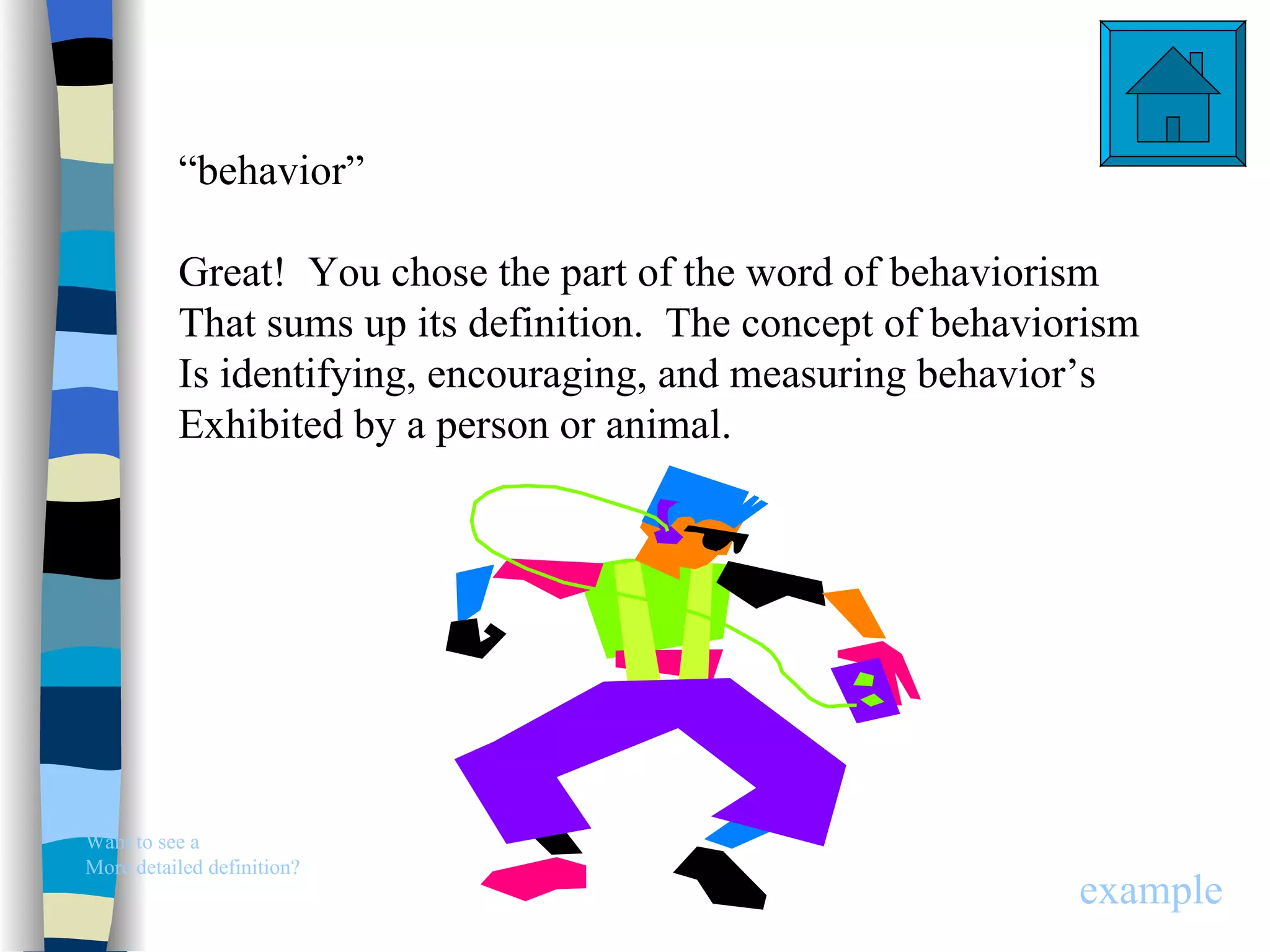
“behavior”

          Great! You chose the part of the word of behaviorism
          That sums up its definition. The concept of behaviorism
          Is identifying, encouraging, and measuring behavior’s
          Exhibited by a person or animal.


Want to see a
More detailed definition?
                                                             example
“ism”

This is not the part of the word you
Need to concentrate on. Choose again.
“be”


This part of the word behaviorism doesn’t quite get to the
Core of the word. Please choose again.
“Havior”

This is not what you want to focus on.

Choose again!
Internet Web Sites:


Click here if you like to take quizzes
To learn definitions.

 Click here to read information about John Watson,
 Who is believed to be the “Father of Behaviorism”

 Click here to read a detailed definition of
 Behaviorism from the Stanford Encyclopedia
 Of Philosophy.
Behavior Modification

Here is a series of steps that a “behaviorist” might
Use to get a person to change their behavior.

1.   Choose a behavior goal for a particular person.
2.   Determine what motivates this particular person.
3.   Break the behavior down into several small steps.
4.   Implement these steps and record the results.
5.   Evaluate the progress and revise the steps as needed.
Congratulations! You now have a preliminary
Understanding of what “behaviorism” means.


 Please click here to read about key
 Concepts of Behaviorism.

 Please click here to learn about the people who
 Promoted behaviorism.

 Please click here to see examples of
 Behaviorism used in a school classroom setting.
 Please click here to read advantages and
 Disadvantages of the behaviorist approach.
Examples of Behaviorism in the
         Classroom
               s   The Computer Lab
               s   Reading
               s   Math

               s   Final Quiz
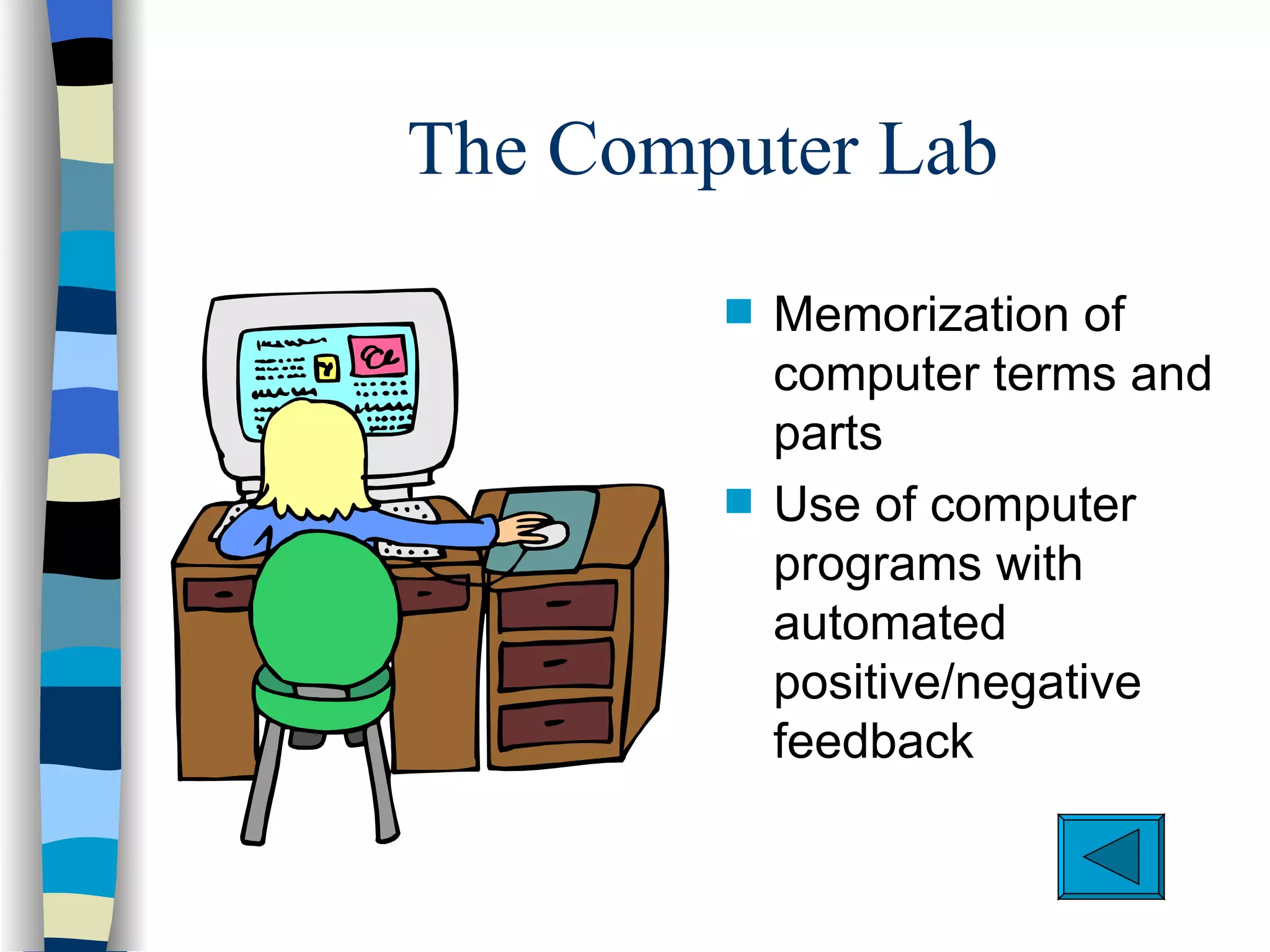
The Computer Lab
        s   Memorization of
            computer terms and
            parts
        s   Use of computer
            programs with
            automated
            positive/negative
            feedback
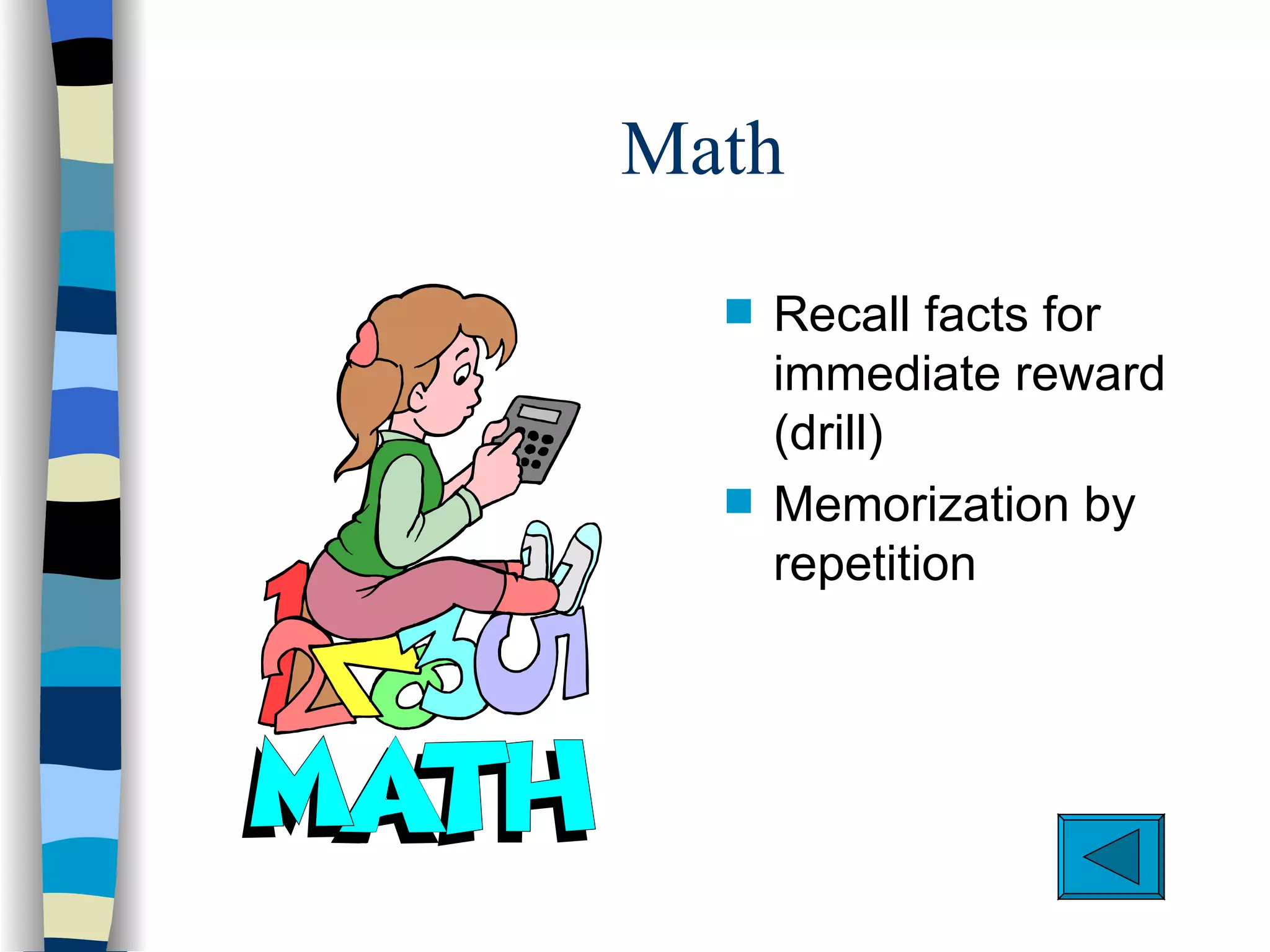
Math
  s   Recall facts for
      immediate reward
      (drill)
  s   Memorization by
      repetition
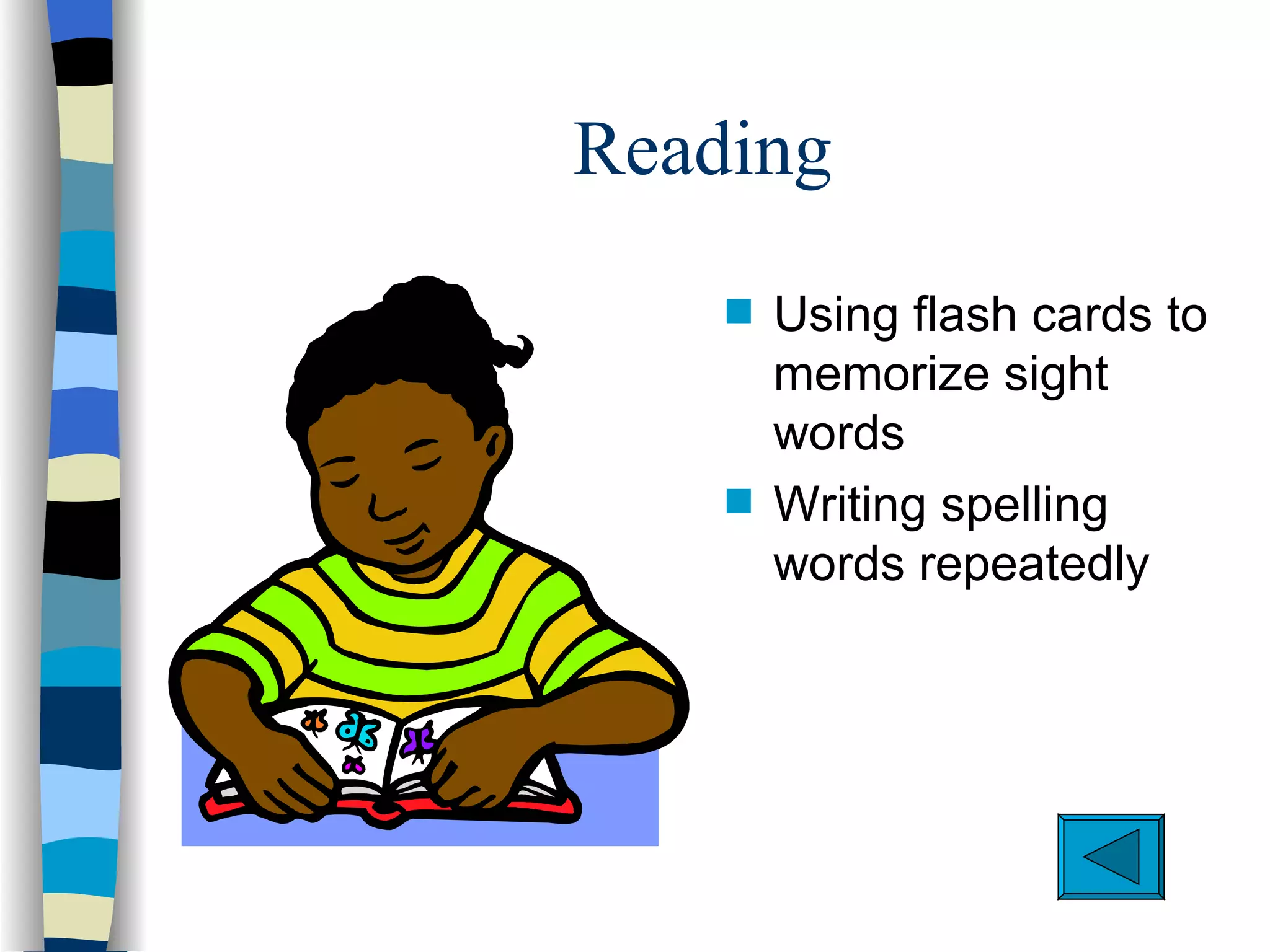
Reading
    s   Using flash cards to
        memorize sight
        words
    s   Writing spelling
        words repeatedly
Which of the following is NOT an example of
Behaviorism in the classroom?

s   Use of computer programs with
    automated positive/negative feedback
s   Using phonics to sound out words
s   Writing spelling words repeatedly
s    Recall facts for immediate reward
    (drill)
s   Using phonics to
    sound out words is
    an application of
    prior knowledge to
    decode new
    material. This is not
    a conditioned
    response.
s   Behaviorism often
    incorporates
    conditioned
    responses, which
    may be learned
    through
    memorization,
    repetition, or
    automatic feedback.

Behaviorism

  • 1.
    Behaviorism: Its allin the action Created by: Jen, Linda, Melissa, Moriah, Pam
  • 2.
    Participant Directions s In order to learn about the behaviorist theory you will follow this PowerPoint presentation, answering the questions with 100% accuracy. s Answer the questions as you go,and take the quiz at the end.
  • 3.
    Behaviorist Theory s Definition s Scientists who studied the behaviorist theory s Key concepts s Classroom examples s Advantages/disadvantages
  • 4.
    Advantages and Disadvantages of the behaviorist theory Advantages Disadvantages s Shapes behavior s Internalized reasoning quickly (example 1A) may not be an outcome (example 1D) s The learner adapts s The learner adapts to a to the environment poor environment ( example 2A) (example 2D) s Behavior can be s Behavior measured may measured (example 3A) not be a true picture of understanding(example 3D)
  • 5.
    Example of Advantageand Disadvantage 1 Shapes behavior quickly: s Every time a student would arrive to class on time the teacher would give the student (on time points.) These points could be used to purchase a watch from the school store. Behavior is not internalized: s A student may act respectful but not feel respect towards a teacher.
  • 6.
    Example of Advantageand Disadvantage 2 The learner adapts to the environment s The class has been trained to write a half page every day. They are reinforced with a smiley sticker The learner adapts to a poor environment s A student adapts to a classroom where the other students’ behaviors are negative and destructive to the learning environment.
  • 7.
    Example Advantage and Disadvantage3 Behavior can be measured s Students can take tests to measure whether they can answer the questions correctly. Behavior measured may not be a true picture of understanding s Taking a true or false test with the assurance of retaking it until the student gets it right can lead to guessing for the correct answers.
  • 8.
    Quiz Advantages/Disadvantages s A disadvantage to the behaviorist theory is that students can learn behaviors quickly. True / False s An advantage to the behaviorist theory is: All students learn the best using this theory. True / False
  • 9.
  • 10.
    Correct move onto the next question
  • 11.
  • 12.
    Who are theBehaviorists? s Ivan Pavlov Click on picture s John Watson s B.F. Skinner
  • 13.
    You too canbe trained! Back to Behaviorists
  • 14.
    Who are theseBehaviorists? s Ivan Pavlov s In 1903 he published his results calling this a – 1849-1936 "conditioned reflex,"different s Pavlov wanted to see if from an innate reflex, such external stimuli could as yanking a hand back from affect the salivation process a flame, in that it had to be – he rang a bell at the same time he learned. gave the experimental dogs food. – After a while, the dogs -- which s Pavlov called this learning before only salivated when they saw process “conditioning” and ate their food -- would begin to salivate when the bell rang, even if s He thought that conditioned no food were present. reflexes could explain the behavior of people. Quiz Back to yourself http://llanes.panam.edu/edul6300/Behaviorists.html Behaviorists
  • 15.
    Who are theseBehaviorists? s John Watson s All animals, he believed, were extremely – 1878 - 1958 complex machines that s Watson was inspired by responded to situations Pavlov according to their "wiring," or s He studied the behavior of nerve pathways that were children and concluded that conditioned by experience. humans were simply more s In 1913, he published an complicated than animals article outlining his ideas but operated on the same – disagreed with Freud – dismissed heredity as a significant principles. factor in shaping human behavior. Quiz Back to yourself http://llanes.panam.edu/edul6300/Behaviorists.html Behaviorists
  • 16.
    Who are theseBehaviorists? s He used operant s B.F. Skinner conditioning – 1904 - 1990 – the rewarding of a partial s Skinner developed behavior or a random act that approaches the desired behavioral studies of rats behavior. that automatically reward behavior. s Skinner believed other all complicated tasks could be s He wrote The Behavior of broken down and taught. Organisms and began his novel Walden II, about a s He developed machines so commune where behaviorist students could learn bit by principles created a new kind bit, uncovering answers for of utopia. an immediate "reward." Quiz Back to yourself http://llanes.panam.edu/edul6300/Behaviorists.html Behaviorists
  • 17.
    Quiz Yourself onthe Behaviorists! 1. Pavlov began his studies by a. Seeing if children liked cookies b. Teaching dogs to salivate at the ring of a bell c. Developing a theory on behaviorism Back to Behaviorists
  • 18.
    Quiz Yourself onthe Behaviorists! 2. Watson felt that a. Heredity was important in shaping human behavior. b. Animals responded to situations according to their conditioned experience. c. That Freud had all the answers Back to Behaviorists
  • 19.
    Quiz Yourself onthe Behaviorists! 1. Skinner used _____ to teach a behavior a. stimulous b. pidgeons c. operant conditioning Back to Behaviorists
  • 20.
    Opps! You need togo back and read again! Back to Behaviorists
  • 21.
    Great! You get an“A” Back to Behaviorists
  • 22.
    Key Concepts s Classical Conditioning – Stimulus-Response – Action causes response – The bell rings to start class and all students quiet down and focus attention on the teacher.
  • 23.
    Key Concepts cont. s Operant Conditioning – Stimulus-Response-Reinforcer : – Specific action causes a desired response when reinforced – Students work very hard on mastering their times tables and teacher gives free pass to skip the math homework for that night.
  • 24.
    Quiz Time! s Pick the best answer to that describes each term: s Mrs. Smith flashes the lights to get her students attention. The students immediately stop what they are doing and look her way – A. Operant Conditioning – B. Classical Conditioning
  • 25.
    AWESOME! Click thepicture to go on.
  • 26.
  • 27.
    QUIZ TIME! s Mr. Lee gives his students a free choice of how they will complete their reading assignment after they have completed the read-aloud portion as a whole class and behaved very well. – Classical Conditioning – Operant Conditioning
  • 28.
    WOW! Click thepicture to go on.
  • 29.
    OH NO! TryAgain! Click Here
  • 30.
    Behavior what? s Think back to your Language Arts days--what is the main word here in behaviorism?
  • 31.
    Choose the baseword: havior behavior ism be
  • 32.
    “behavior” Great! You chose the part of the word of behaviorism That sums up its definition. The concept of behaviorism Is identifying, encouraging, and measuring behavior’s Exhibited by a person or animal. Want to see a More detailed definition? example
  • 33.
    “ism” This is notthe part of the word you Need to concentrate on. Choose again.
  • 34.
    “be” This part ofthe word behaviorism doesn’t quite get to the Core of the word. Please choose again.
  • 35.
    “Havior” This is notwhat you want to focus on. Choose again!
  • 36.
    Internet Web Sites: Clickhere if you like to take quizzes To learn definitions. Click here to read information about John Watson, Who is believed to be the “Father of Behaviorism” Click here to read a detailed definition of Behaviorism from the Stanford Encyclopedia Of Philosophy.
  • 37.
    Behavior Modification Here isa series of steps that a “behaviorist” might Use to get a person to change their behavior. 1. Choose a behavior goal for a particular person. 2. Determine what motivates this particular person. 3. Break the behavior down into several small steps. 4. Implement these steps and record the results. 5. Evaluate the progress and revise the steps as needed.
  • 38.
    Congratulations! You nowhave a preliminary Understanding of what “behaviorism” means. Please click here to read about key Concepts of Behaviorism. Please click here to learn about the people who Promoted behaviorism. Please click here to see examples of Behaviorism used in a school classroom setting. Please click here to read advantages and Disadvantages of the behaviorist approach.
  • 39.
    Examples of Behaviorismin the Classroom s The Computer Lab s Reading s Math s Final Quiz
  • 40.
    The Computer Lab s Memorization of computer terms and parts s Use of computer programs with automated positive/negative feedback
  • 41.
    Math s Recall facts for immediate reward (drill) s Memorization by repetition
  • 42.
    Reading s Using flash cards to memorize sight words s Writing spelling words repeatedly
  • 43.
    Which of thefollowing is NOT an example of Behaviorism in the classroom? s Use of computer programs with automated positive/negative feedback s Using phonics to sound out words s Writing spelling words repeatedly s Recall facts for immediate reward (drill)
  • 44.
    s Using phonics to sound out words is an application of prior knowledge to decode new material. This is not a conditioned response.
  • 45.
    s Behaviorism often incorporates conditioned responses, which may be learned through memorization, repetition, or automatic feedback.