Evaluation of Paradigms for
Modeling Supply Chains as Complex
     Socio-technical Systems
              Behzad Behdani
    Faculty of Technology, Policy and Management
             Delft University of Technology
Outline
• Role of simulation paradigm in each
  simulation study
• Supply chains as socio-technical systems
• Supply chains as complex adaptive systems
• Comparison of simulation paradigms for
  supply chain simulation
• Concluding remarks
Role of simulation paradigm in each
              simulation study


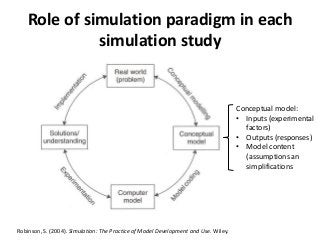
                                                                                     Conceptual model:
                                                                                     • Inputs (experimental
                                                                                       factors)
                                                                                     • Outputs (responses)
                                                                                     • Model content
                                                                                       (assumptions an
                                                                                       simplifications


Robinson, S. (2004). Simulation: The Practice of Model Development and Use. Wiley.
Role of simulation paradigm in each
             simulation study
• Meadows and Robinson (1985, p. 17):
     “every modeling discipline depends on unique
     underlying assumptions; that is, each modeling
     method is itself based on a model of how modeling
     should be done”.
• For example, by selecting System Dynamics
  we implicitly assume that:
     “the world is made up of rates, levels and feedback
     loops” (Meadows, 1989).

- Meadows, D. and Robinson, J. (1985). The Electronic Oracle: Computer Models and Social Decisions, John Wiley & Sons
- Meadows, D.H. (1989). System dynamics meets the press, System Dynamics Review 5(1): 68-80.
Role of simulation paradigm in each
           simulation study
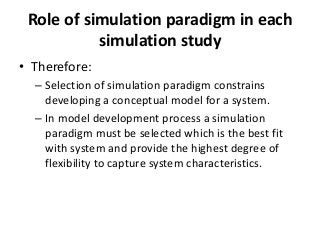
• Therefore:
  – Selection of simulation paradigm constrains
    developing a conceptual model for a system.
  – In model development process a simulation
    paradigm must be selected which is the best fit
    with system and provide the highest degree of
    flexibility to capture system characteristics.
Supply chains as socio-technical
                     systems
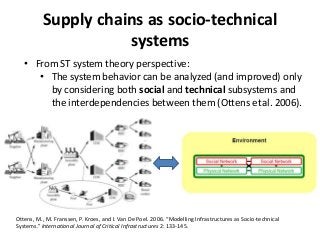
   • From ST system theory perspective:
      • The system behavior can be analyzed (and improved) only
        by considering both social and technical subsystems and
        the interdependencies between them (Ottens etal. 2006).


Ottens, M., M. Franssen, P. Kroes, and I. Van De Poel. 2006. “Modelling Infrastructures as Socio-technical
Systems.” International Journal of Critical Infrastructures 2: 133-145.
Supply chains as complex adaptive
                systems
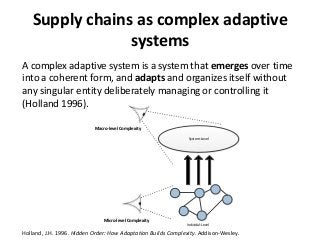
A complex adaptive system is a system that emerges over time
into a coherent form, and adapts and organizes itself without
any singular entity deliberately managing or controlling it
(Holland 1996).

                           Macro-level Complexity

                                                               System-Level


                               Micro-level Complexity
                                                              Individal-Level

Holland, J.H. 1996. Hidden Order: How Adaptation Builds Complexity. Addison-Wesley.
Supply chains as complex adaptive
               systems
• Micro-level properties:
  – Numerousness and heterogeneity
  – Local Interactions
  – Nestedness
  – Adaptiveness
Supply chains as complex adaptive
               systems
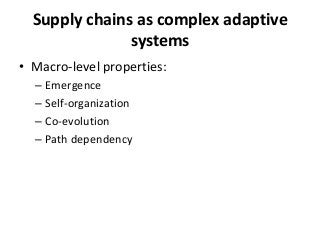
• Macro-level properties:
  – Emergence
  – Self-organization
  – Co-evolution
  – Path dependency
Comparison of simulation paradigms
         for supply chain simulation
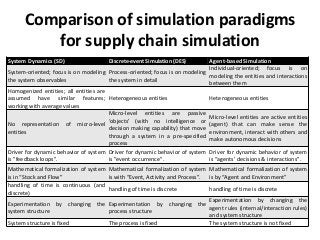
System Dynamics (SD)                   Discrete-event Simulation (DES)       Agent-based Simulation
                                                                             Individual-oriented; focus is on
System-oriented; focus is on modeling Process-oriented; focus is on modeling
                                                                             modeling the entities and interactions
the system observables                 the system in detail
                                                                             between them
Homogenized entities; all entities are
assumed have similar features; Heterogeneous entities                        Heterogeneous entities
working with average values
                                       Micro-level entities are passive
                                                                             Micro-level entities are active entities
                                       ‘objects’ (with no intelligence or
No representation of micro-level                                             (agent) that can make sense the
                                       decision making capability) that move
entities                                                                     environment, interact with others and
                                       through a system in a pre-specified
                                                                             make autonomous decisions
                                       process
Driver for dynamic behavior of system Driver for dynamic behavior of system Driver for dynamic behavior of system
is "feedback loops".                   is "event occurrence".                is “agents' decisions & interactions".
Mathematical formalization of system Mathematical formalization of system Mathematical formalization of system
is in “Stock and Flow”               is with “Event, Activity and Process”. is by “Agent and Environment”
handling of time is continuous (and
                                     handling of time is discrete           handling of time is discrete
discrete)
                                                                            Experimentation by changing the
Experimentation by changing the Experimentation by changing the
                                                                            agent rules (internal/interaction rules)
system structure                     process structure
                                                                            and system structure
System structure is fixed            The process is fixed                   The system structure is not fixed
Comparison of simulation paradigms
   for supply chain simulation

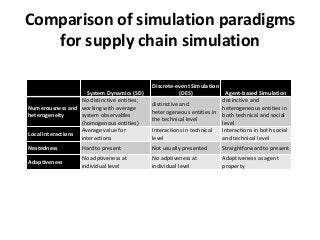
                                              Discrete-event Simulation
                     System Dynamics (SD)                 (DES)          Agent-based Simulation
                   No distinctive entities;                             distinctive and
                                              distinctive and
Numerousness and working with average                                   heterogeneous entities in
                                              heterogeneous entities in
heterogeneity      system observables                                   both technical and social
                                              the technical level
                   (homogenous entities)                                level
                   Average value for          Interactions in technical Interactions in both social
Local Interactions
                   interactions               level                     and technical level
Nestedness         Hard to present            Not usually presented      Straightforward to present
                   No adptiveness at          No adptiveness at          Adaptiveness as agent
Adaptiveness
                   individual level           individual level           property
Comparison of simulation paradigms
   for supply chain simulation
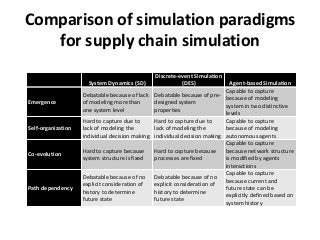
                                               Discrete-event Simulation
                      System Dynamics (SD)               (DES)              Agent-based Simulation
                                                                          Capable to capture
                    Debatable because of lack Debatable because of pre-
                                                                          because of modeling
Emergence           of modeling more than      designed system
                                                                          system in two distinctive
                    one system level           properties
                                                                          levels
                    Hard to capture due to     Hard to capture due to     Capable to capture
Self-organization   lack of modeling the       lack of modeling the       because of modeling
                    individual decision making individual decision making autonomous agents
                                                                          Capable to capture
                    Hard to capture because    Hard to capture because    because network structure
Co-evolution
                    system structure is fixed  processes are fixed        is modified by agents
                                                                          interactions
                                                                          Capable to capture
                    Debatable because of no Debatable because of no
                                                                          because current and
                    explicit consideration of  explicit consideration of
Path dependency                                                           future state can be
                    history to determine       history to determine
                                                                          explicitly defined based on
                    future state               future state
                                                                          system history
Concluding remarks
• Each simulation paradigm is characterized by a
  set of core assumptions and some underlying
  concepts to describe the world. These
  assumptions constrain the development of a
  conceptual model for the system of study.
• Selection of an appropriate modeling
  paradigm is absent in most of presented
  procedures for simulation studies.
Concluding remarks
• It might not be necessary to capture all
  complexity dimensions of a supply chain in every
  modeling effort; however, we must be aware how
  selection of simulation paradigm impacts
  (constrains) our model development.
• The discussions in this paper is not ABM is always
  the best option; especially in the model coding
  step. ABM has also its drawbacks!
• The arguments in this paper can be valid for
  other complex ST systems.
A copy of paper can be found in:
     http://dl.acm.org/citation.cfm?id=2430294

     http://www.academia.edu/1523272/Evaluati
     on_of_Paradigms_for_Modeling_Supply_Cha
     ins_as_Complex_Socio-Technical_Systems

     You can also find me on:
     behzadb09@gmail.com
15

Agent-based modeling, System Dynamics or Discrete-event Simulation; Modeling Paradigm for Supply Chains Simulation

  • 1.
    Evaluation of Paradigmsfor Modeling Supply Chains as Complex Socio-technical Systems Behzad Behdani Faculty of Technology, Policy and Management Delft University of Technology
  • 2.
    Outline • Role ofsimulation paradigm in each simulation study • Supply chains as socio-technical systems • Supply chains as complex adaptive systems • Comparison of simulation paradigms for supply chain simulation • Concluding remarks
  • 3.
    Role of simulationparadigm in each simulation study Conceptual model: • Inputs (experimental factors) • Outputs (responses) • Model content (assumptions an simplifications Robinson, S. (2004). Simulation: The Practice of Model Development and Use. Wiley.
  • 4.
    Role of simulationparadigm in each simulation study • Meadows and Robinson (1985, p. 17): “every modeling discipline depends on unique underlying assumptions; that is, each modeling method is itself based on a model of how modeling should be done”. • For example, by selecting System Dynamics we implicitly assume that: “the world is made up of rates, levels and feedback loops” (Meadows, 1989). - Meadows, D. and Robinson, J. (1985). The Electronic Oracle: Computer Models and Social Decisions, John Wiley & Sons - Meadows, D.H. (1989). System dynamics meets the press, System Dynamics Review 5(1): 68-80.
  • 5.
    Role of simulationparadigm in each simulation study • Therefore: – Selection of simulation paradigm constrains developing a conceptual model for a system. – In model development process a simulation paradigm must be selected which is the best fit with system and provide the highest degree of flexibility to capture system characteristics.
  • 6.
    Supply chains associo-technical systems • From ST system theory perspective: • The system behavior can be analyzed (and improved) only by considering both social and technical subsystems and the interdependencies between them (Ottens etal. 2006). Ottens, M., M. Franssen, P. Kroes, and I. Van De Poel. 2006. “Modelling Infrastructures as Socio-technical Systems.” International Journal of Critical Infrastructures 2: 133-145.
  • 7.
    Supply chains ascomplex adaptive systems A complex adaptive system is a system that emerges over time into a coherent form, and adapts and organizes itself without any singular entity deliberately managing or controlling it (Holland 1996). Macro-level Complexity System-Level Micro-level Complexity Individal-Level Holland, J.H. 1996. Hidden Order: How Adaptation Builds Complexity. Addison-Wesley.
  • 8.
    Supply chains ascomplex adaptive systems • Micro-level properties: – Numerousness and heterogeneity – Local Interactions – Nestedness – Adaptiveness
  • 9.
    Supply chains ascomplex adaptive systems • Macro-level properties: – Emergence – Self-organization – Co-evolution – Path dependency
  • 10.
    Comparison of simulationparadigms for supply chain simulation System Dynamics (SD) Discrete-event Simulation (DES) Agent-based Simulation Individual-oriented; focus is on System-oriented; focus is on modeling Process-oriented; focus is on modeling modeling the entities and interactions the system observables the system in detail between them Homogenized entities; all entities are assumed have similar features; Heterogeneous entities Heterogeneous entities working with average values Micro-level entities are passive Micro-level entities are active entities ‘objects’ (with no intelligence or No representation of micro-level (agent) that can make sense the decision making capability) that move entities environment, interact with others and through a system in a pre-specified make autonomous decisions process Driver for dynamic behavior of system Driver for dynamic behavior of system Driver for dynamic behavior of system is "feedback loops". is "event occurrence". is “agents' decisions & interactions". Mathematical formalization of system Mathematical formalization of system Mathematical formalization of system is in “Stock and Flow” is with “Event, Activity and Process”. is by “Agent and Environment” handling of time is continuous (and handling of time is discrete handling of time is discrete discrete) Experimentation by changing the Experimentation by changing the Experimentation by changing the agent rules (internal/interaction rules) system structure process structure and system structure System structure is fixed The process is fixed The system structure is not fixed
  • 11.
    Comparison of simulationparadigms for supply chain simulation Discrete-event Simulation System Dynamics (SD) (DES) Agent-based Simulation No distinctive entities; distinctive and distinctive and Numerousness and working with average heterogeneous entities in heterogeneous entities in heterogeneity system observables both technical and social the technical level (homogenous entities) level Average value for Interactions in technical Interactions in both social Local Interactions interactions level and technical level Nestedness Hard to present Not usually presented Straightforward to present No adptiveness at No adptiveness at Adaptiveness as agent Adaptiveness individual level individual level property
  • 12.
    Comparison of simulationparadigms for supply chain simulation Discrete-event Simulation System Dynamics (SD) (DES) Agent-based Simulation Capable to capture Debatable because of lack Debatable because of pre- because of modeling Emergence of modeling more than designed system system in two distinctive one system level properties levels Hard to capture due to Hard to capture due to Capable to capture Self-organization lack of modeling the lack of modeling the because of modeling individual decision making individual decision making autonomous agents Capable to capture Hard to capture because Hard to capture because because network structure Co-evolution system structure is fixed processes are fixed is modified by agents interactions Capable to capture Debatable because of no Debatable because of no because current and explicit consideration of explicit consideration of Path dependency future state can be history to determine history to determine explicitly defined based on future state future state system history
  • 13.
    Concluding remarks • Eachsimulation paradigm is characterized by a set of core assumptions and some underlying concepts to describe the world. These assumptions constrain the development of a conceptual model for the system of study. • Selection of an appropriate modeling paradigm is absent in most of presented procedures for simulation studies.
  • 14.
    Concluding remarks • Itmight not be necessary to capture all complexity dimensions of a supply chain in every modeling effort; however, we must be aware how selection of simulation paradigm impacts (constrains) our model development. • The discussions in this paper is not ABM is always the best option; especially in the model coding step. ABM has also its drawbacks! • The arguments in this paper can be valid for other complex ST systems.
  • 15.
    A copy ofpaper can be found in: http://dl.acm.org/citation.cfm?id=2430294 http://www.academia.edu/1523272/Evaluati on_of_Paradigms_for_Modeling_Supply_Cha ins_as_Complex_Socio-Technical_Systems You can also find me on: behzadb09@gmail.com 15

Editor's Notes

  • #5 Each paradigm is characterized by a set of core – or fundamental - assumptions and some underlying concepts (Lorenz and Jost, 2006) or, as Meadows and Robinson (1985, p. 17) explain, “every modeling discipline depends on unique underlying assumptions; that is, each modeling method is itself based on a model of how modeling should be done”. For example, when a modeler selects System Dynamics as a simulation paradigm, he explicitly assumes that “the world is made up of rates, levels and feedback loops” (Meadows, 1989). The types of assumptions brought by selection of a particular modeling and simulation paradigm are also called “heroic assumptions” by North and Macal (2007). The existence of these assumptions in each simulation paradigm implies that selection of a modeling paradigm is part of the conceptualization process in a simulation study.
  • #14 that it might not be necessary to capture all complexity dimensions of a supply chain in every modeling effort; however, when we choose a simulation paradigm or when we make some simple assumptions to reduce the complexity of a system in the model development process, we must be fully aware of complexity dimensions that are influenced by decisions we make