Vehicle Control SystemsVehicle Control Systems
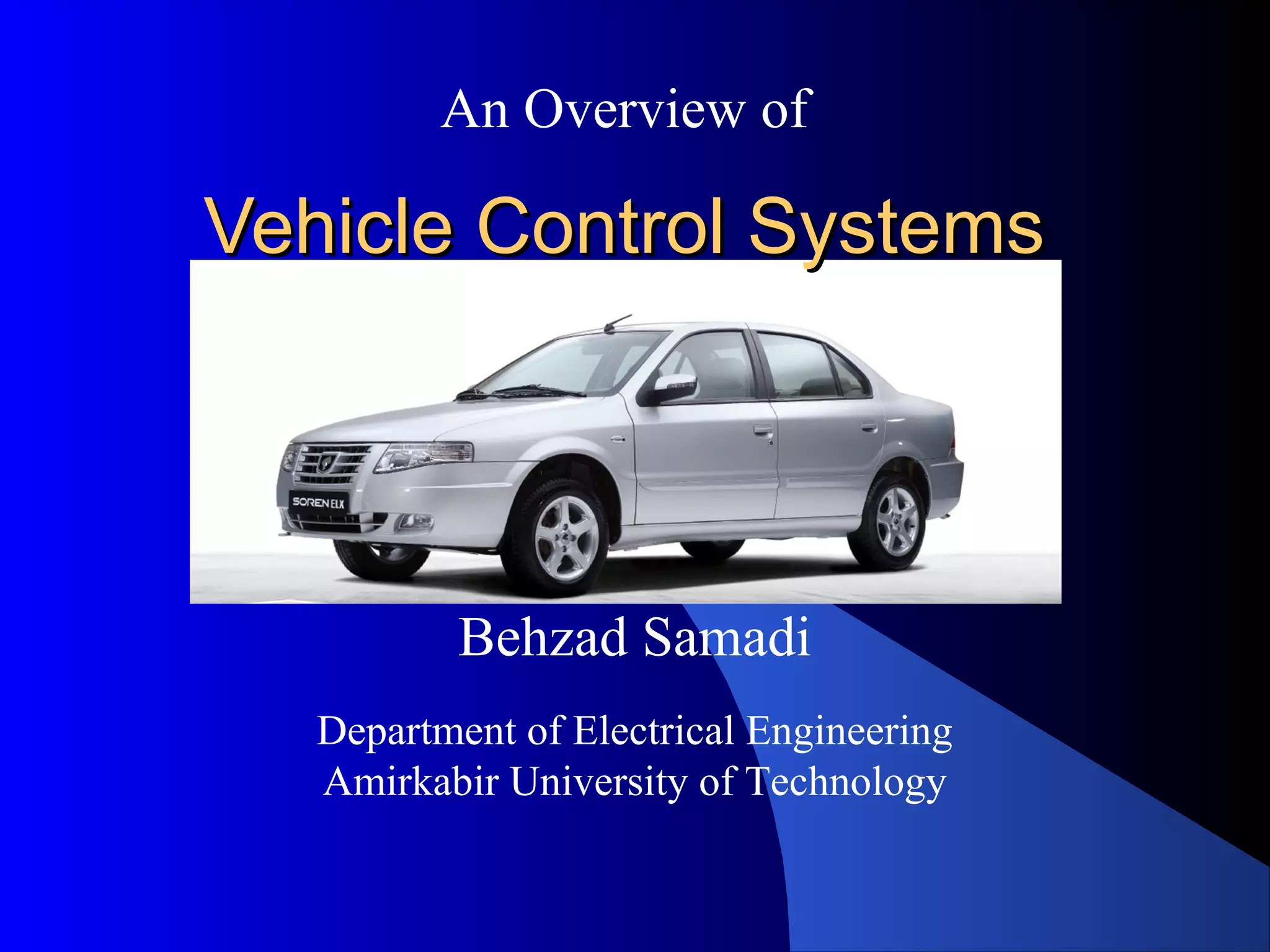
An Overview of
Behzad Samadi
Department of Electrical Engineering
Amirkabir University of Technology
Vehicle Control Systems
2
Vehicle Control SystemsVehicle Control Systems
 ABS
 TCS
 ESP
 4WS
 EPS
 Active Suspension
 AWD
 Drive by Wire
 ANC
 AEM
 ACC
 S&G
 ACA
 OW
 LW
 A/F Ratio Control
 Knock Control
 Idle Speed Control
 Variable Compression
Engine
 VVT
 ATC
 CVT
Vehicle Control Systems
3
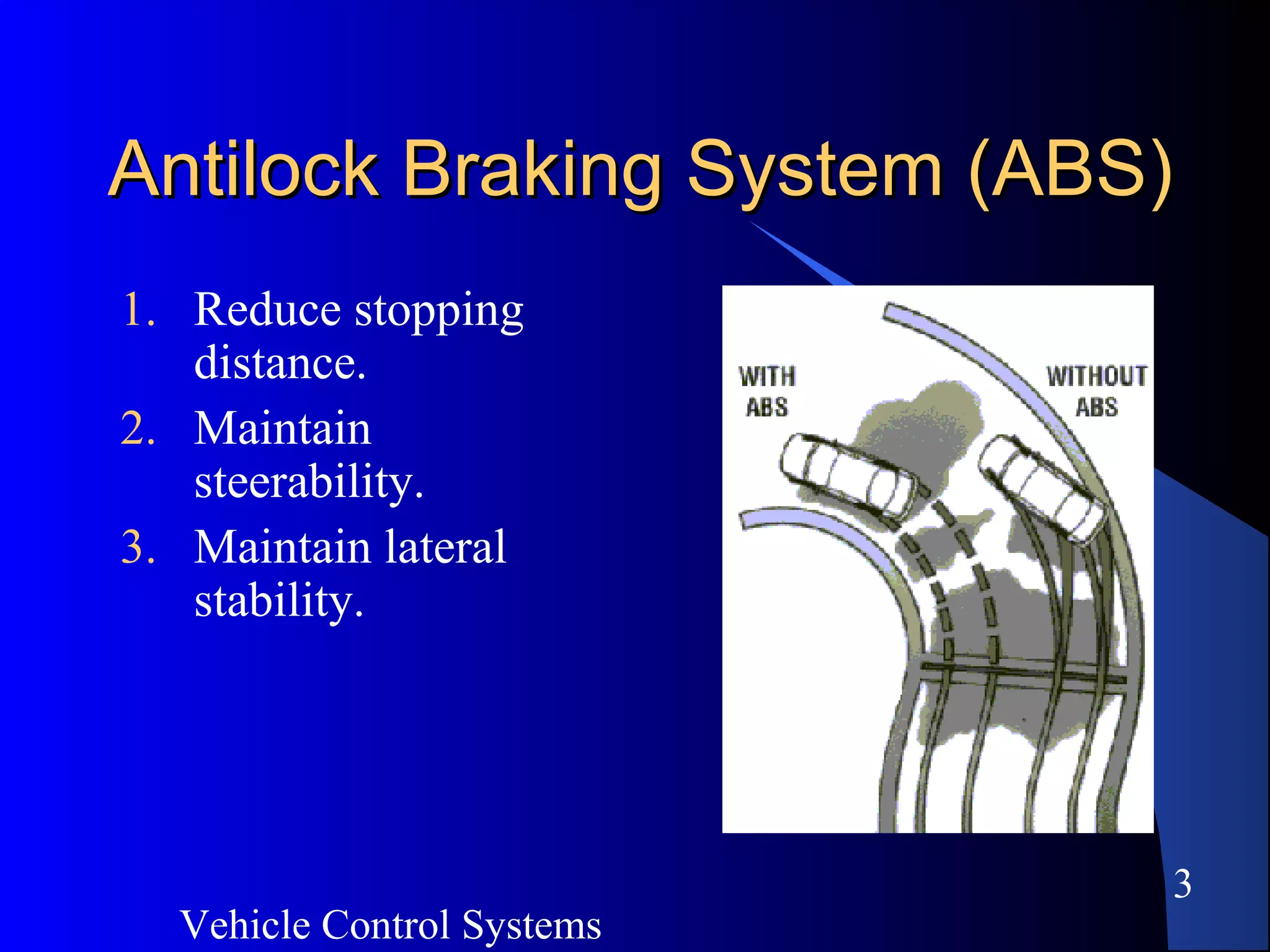
Antilock Braking System (ABS)Antilock Braking System (ABS)
1. Reduce stopping
distance.
2. Maintain
steerability.
3. Maintain lateral
stability.
Vehicle Control Systems
4
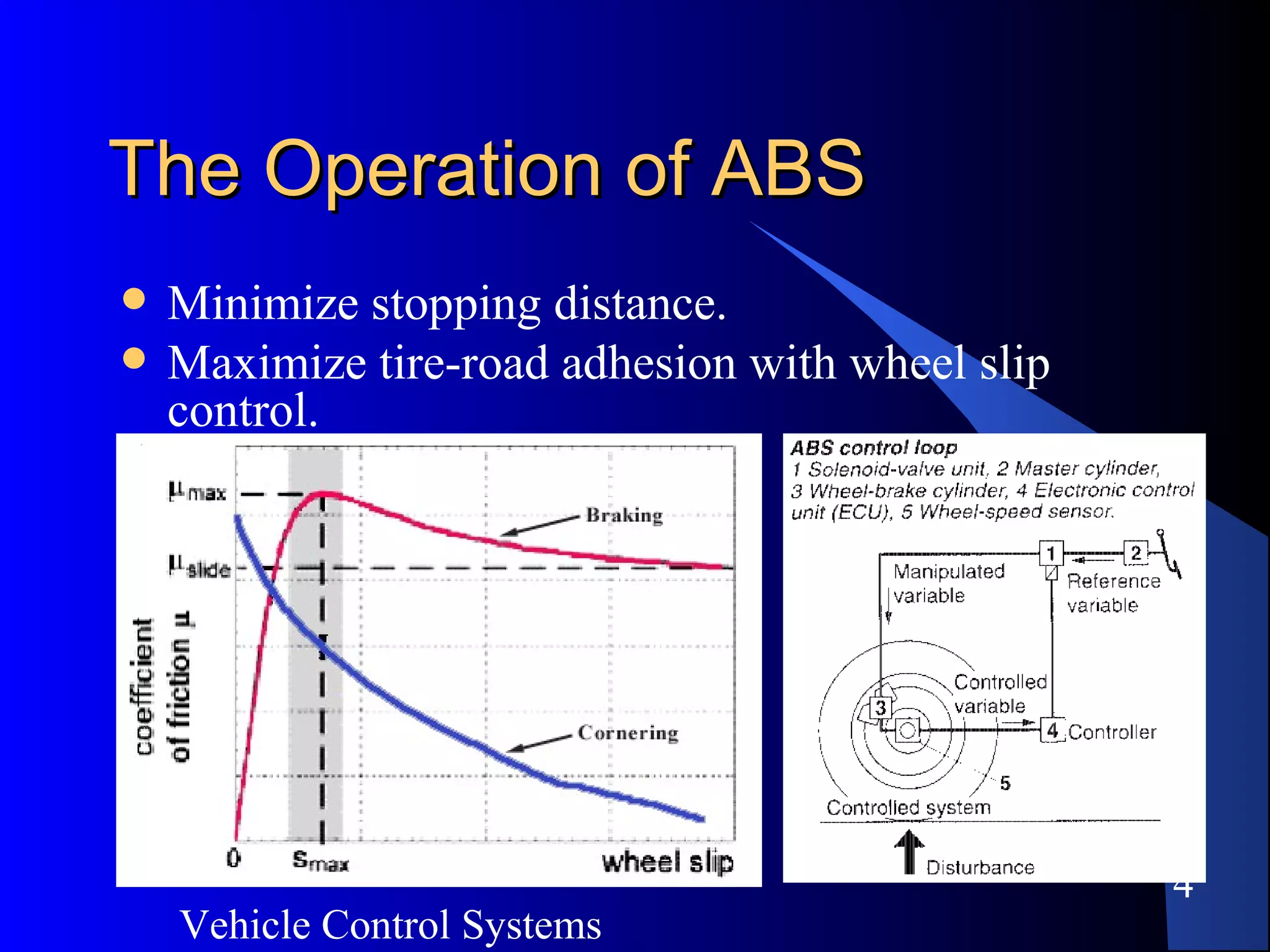
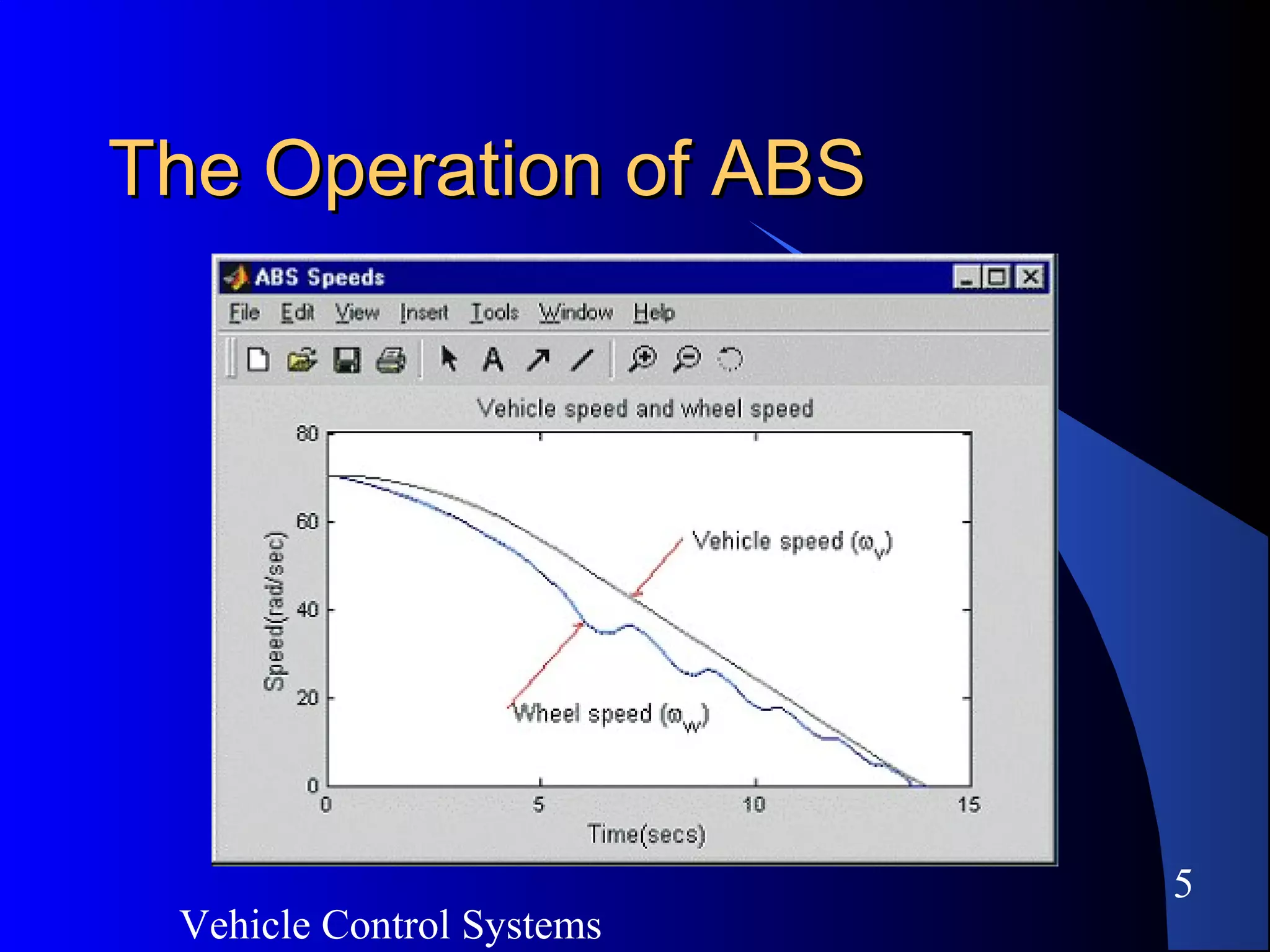
The Operation of ABSThe Operation of ABS
 Minimize stopping distance.
 Maximize tire-road adhesion with wheel slip
control.
Vehicle Control Systems
5
The Operation of ABSThe Operation of ABS
Vehicle Control Systems
6
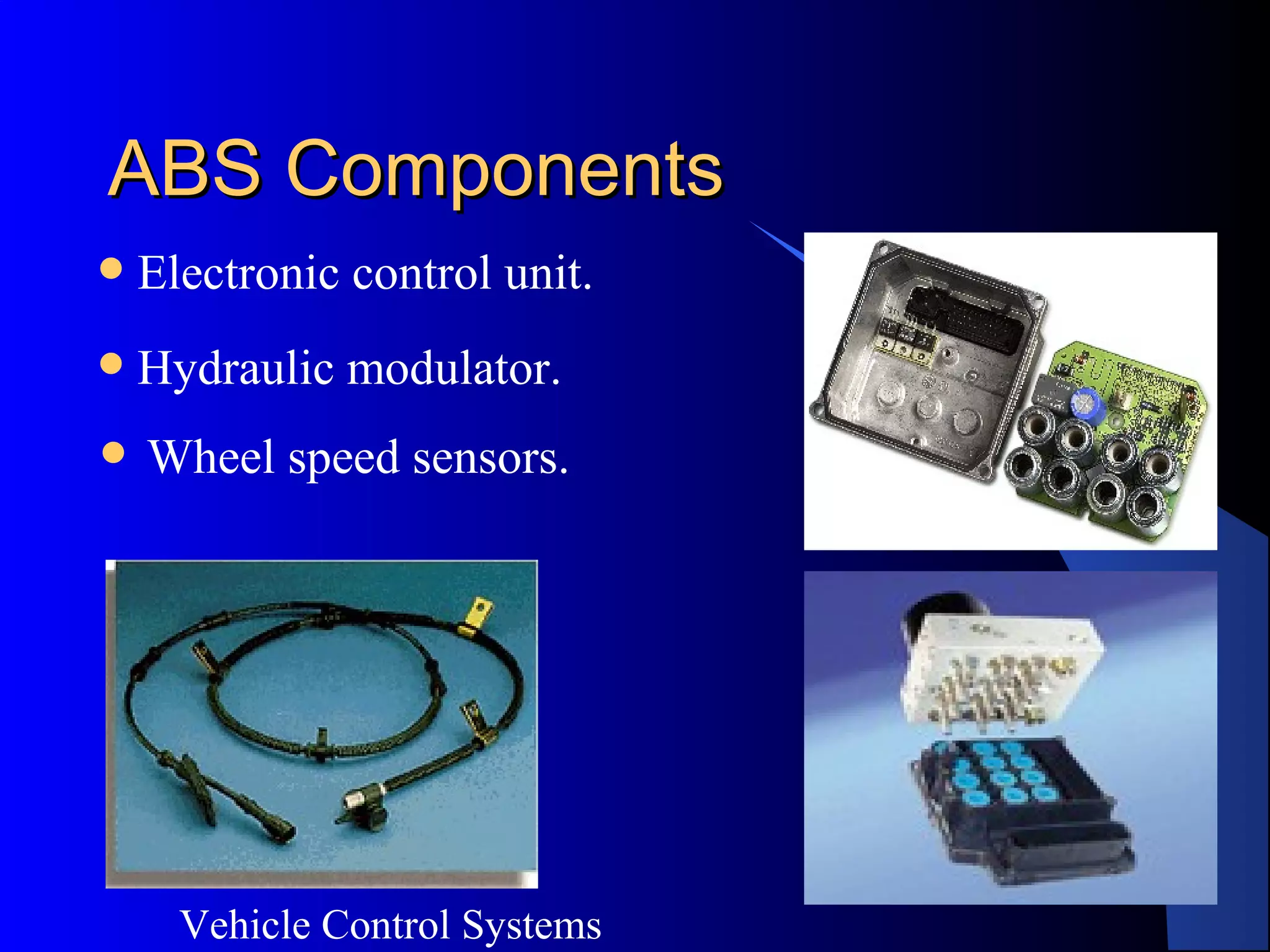
ABS ComponentsABS Components
 Wheel speed sensors.
 Electronic control unit.
 Hydraulic modulator.
Vehicle Control Systems
7
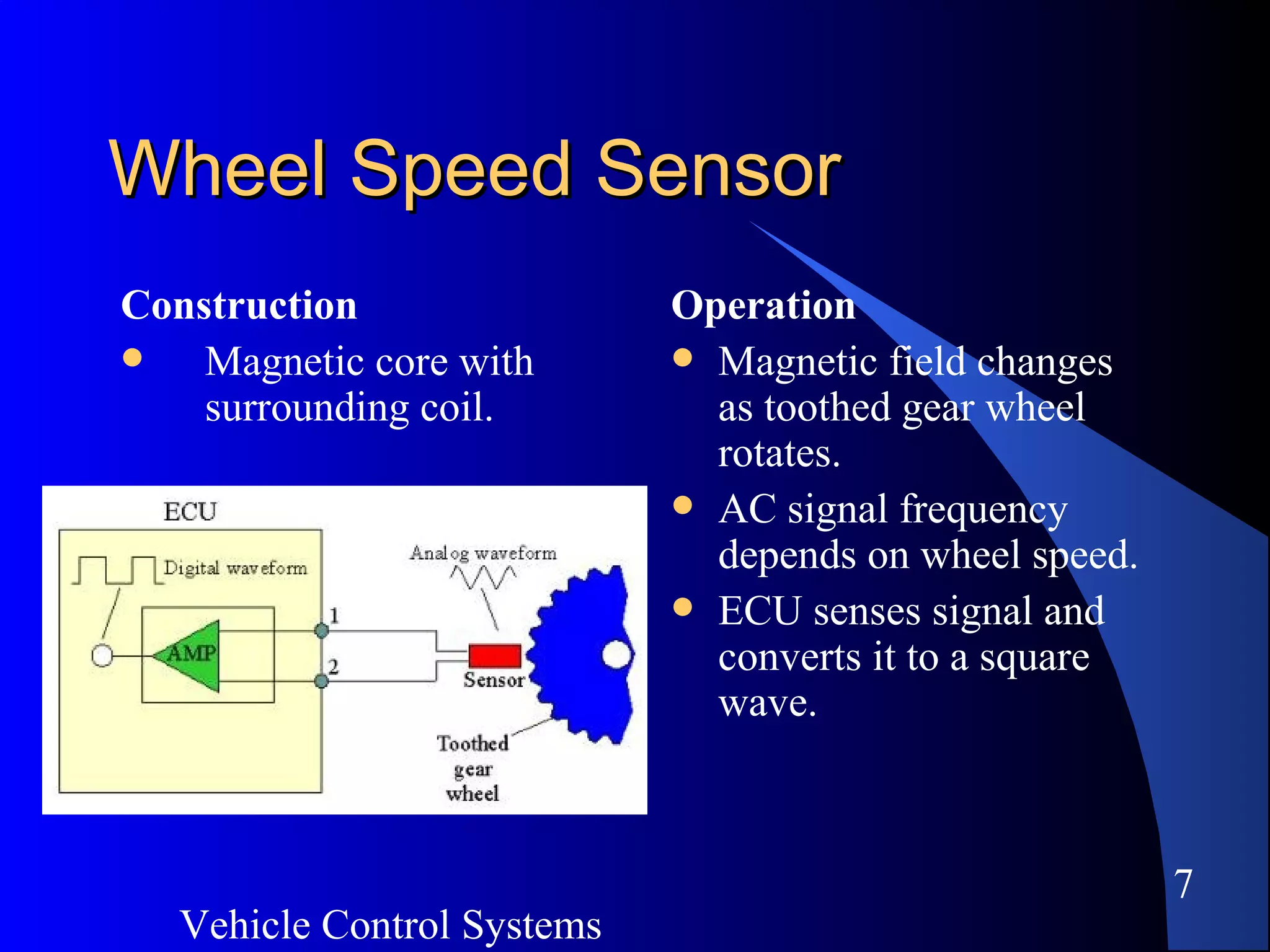
Wheel Speed SensorWheel Speed Sensor
Construction
 Magnetic core with
surrounding coil.
Operation
 Magnetic field changes
as toothed gear wheel
rotates.
 AC signal frequency
depends on wheel speed.
 ECU senses signal and
converts it to a square
wave.
Vehicle Control Systems
8
ABS in Action!ABS in Action!
Vehicle Control Systems
9
Traction Control System (TCS)Traction Control System (TCS)
 Traction control prevents a vehicle's
wheels from spinning excessively while on
slippery surfaces.
 Traction control is intended as a driver aid
which allows a vehicle to make better use
of available traction on slippery surfaces.
 It shares many of the mechanical and
electronic elements of the ABS.
Vehicle Control Systems
10
How TCS Works?How TCS Works?
Depending on the type of traction control
system fitted to the vehicle, wheel spin is
controlled by one or a combination of the
following:
 Brake application at one or more wheels.
 Closing the throttle.
 Retarding the spark.
 Fuel cutout.
 Leaner air/fuel ratio.
Vehicle Control Systems
11
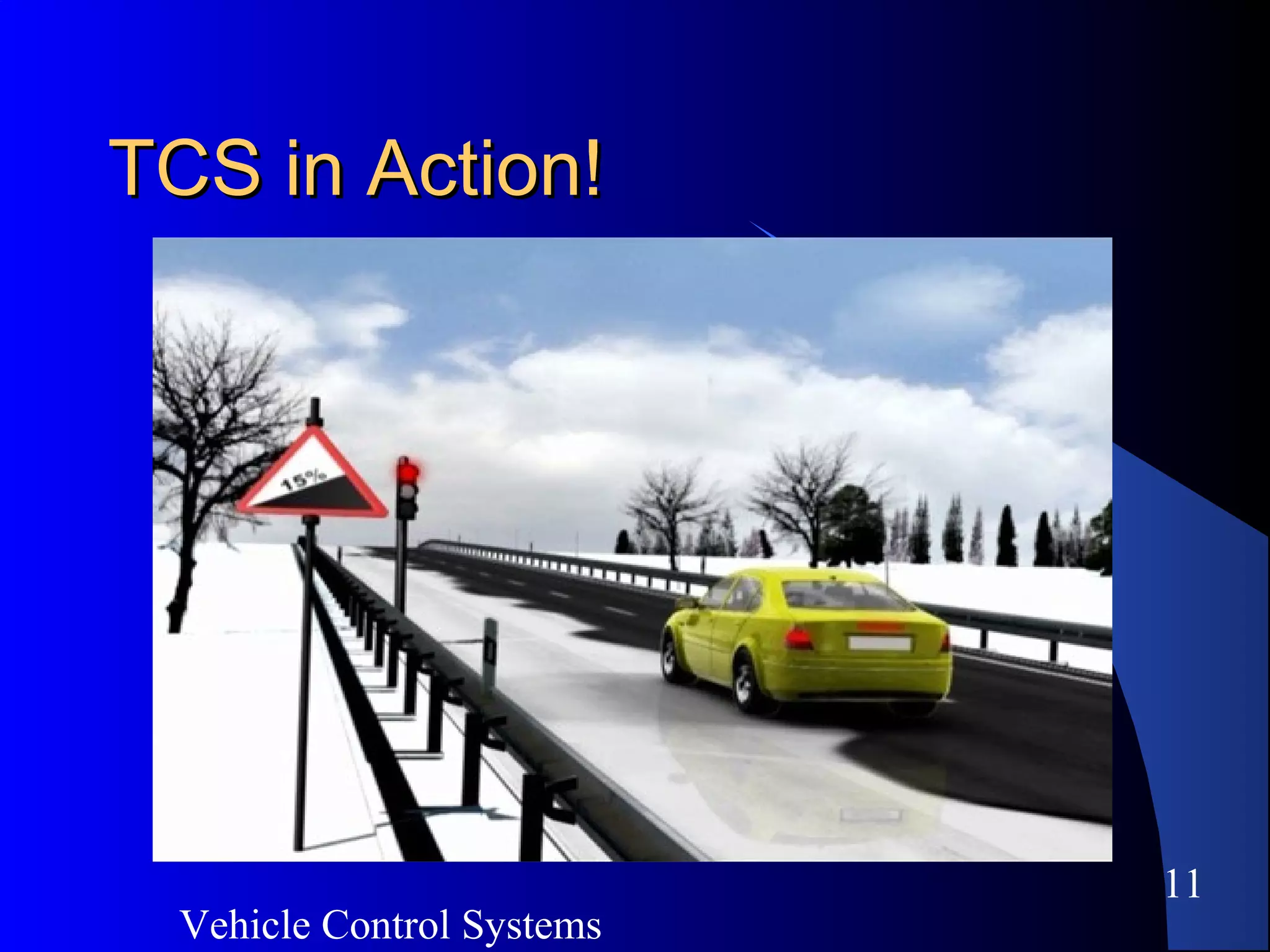
TCS in Action!TCS in Action!
Vehicle Control Systems
12
Electronic Stability ProgramElectronic Stability Program
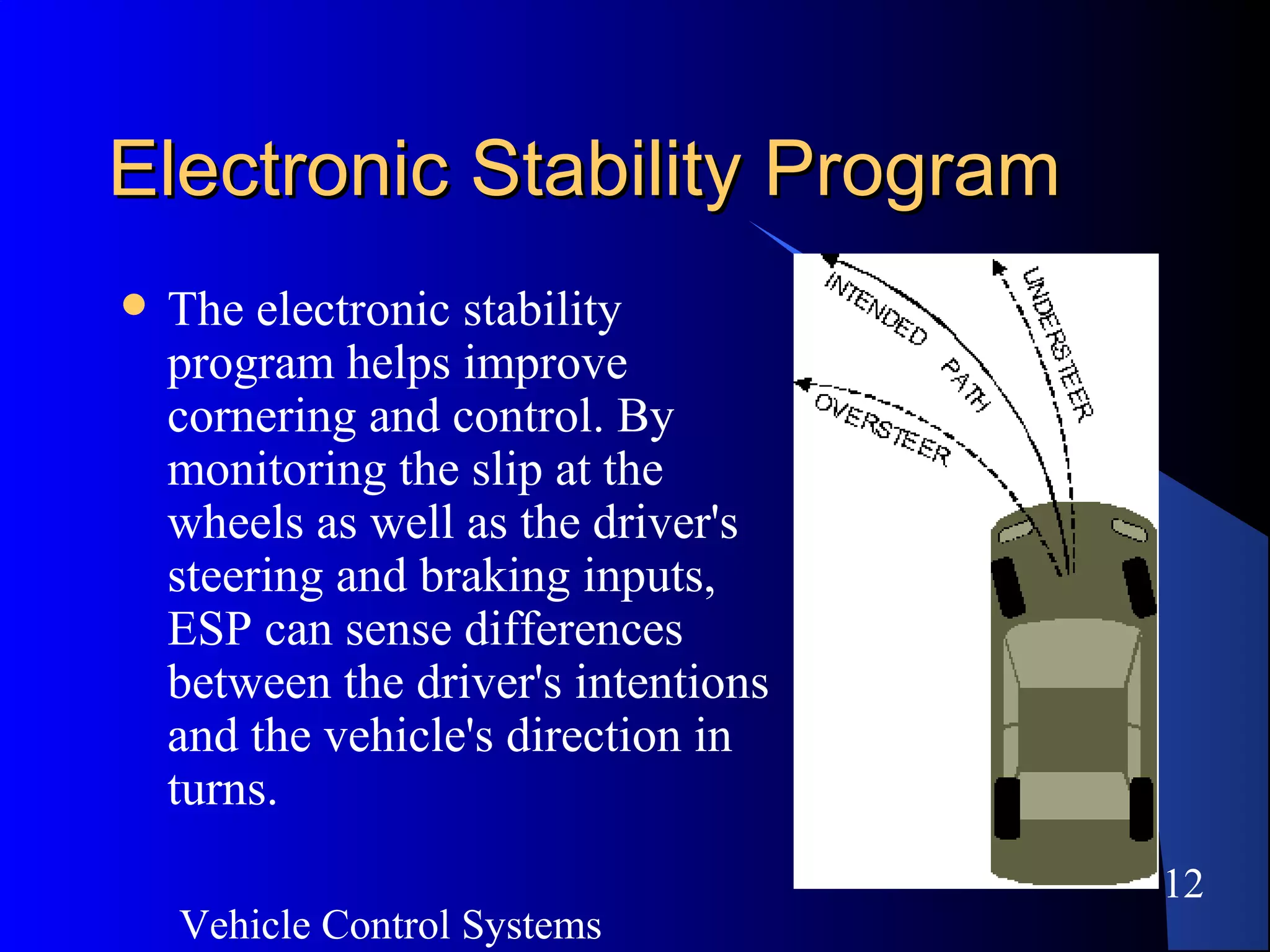
 The electronic stability
program helps improve
cornering and control. By
monitoring the slip at the
wheels as well as the driver's
steering and braking inputs,
ESP can sense differences
between the driver's intentions
and the vehicle's direction in
turns.
Vehicle Control Systems
13
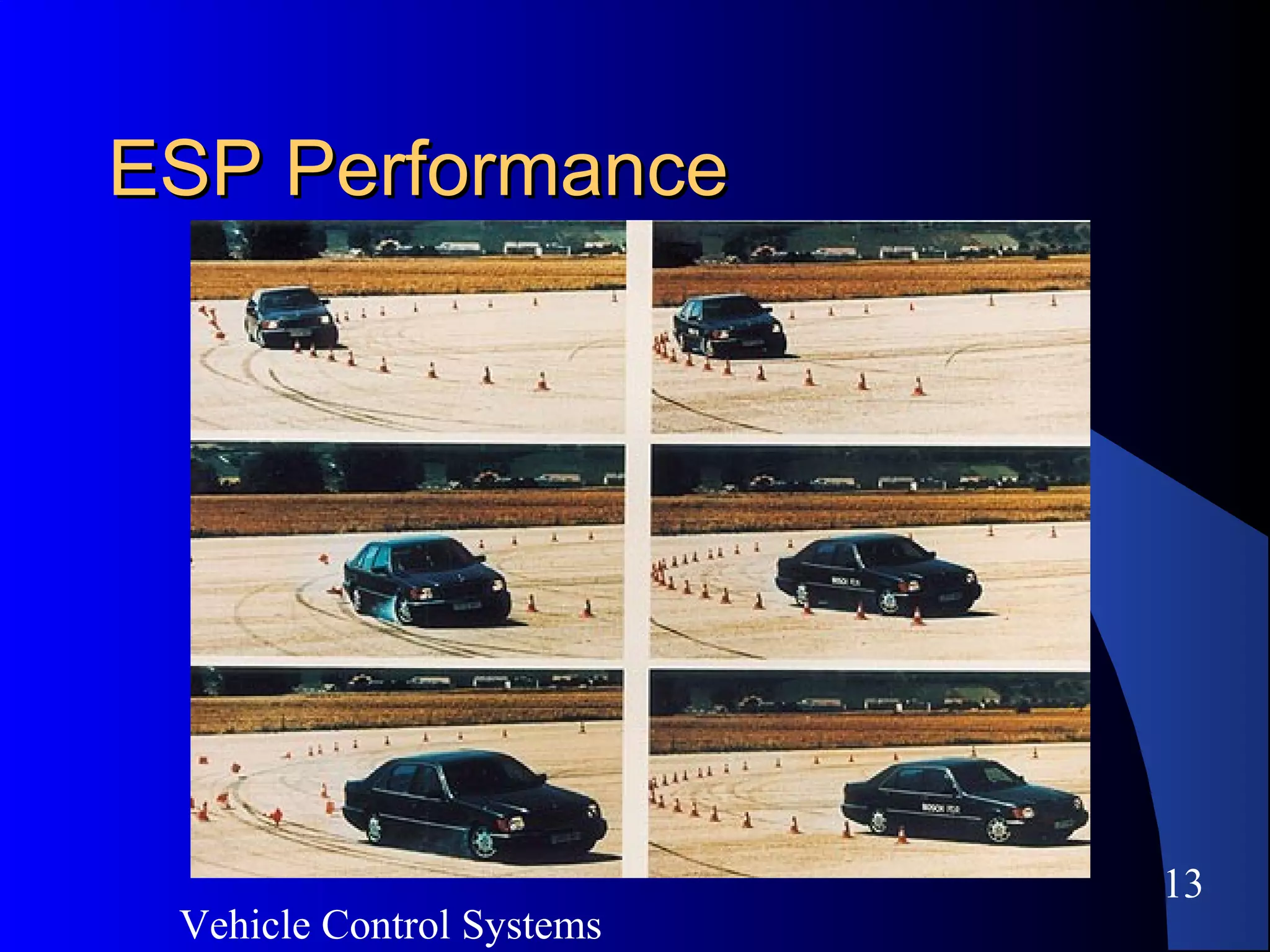
ESP PerformanceESP Performance
Vehicle Control Systems
14
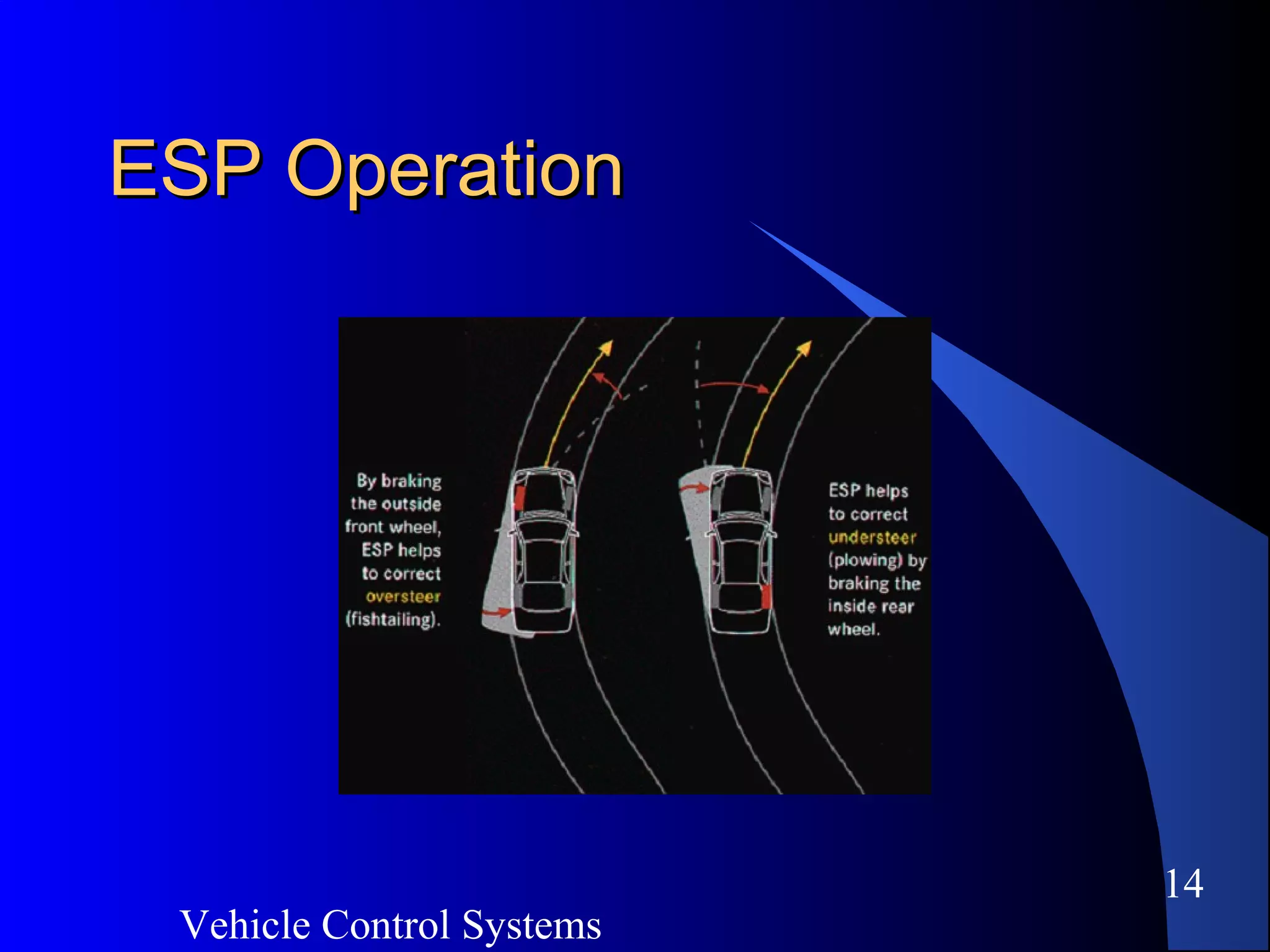
ESP OperationESP Operation
Vehicle Control Systems
15
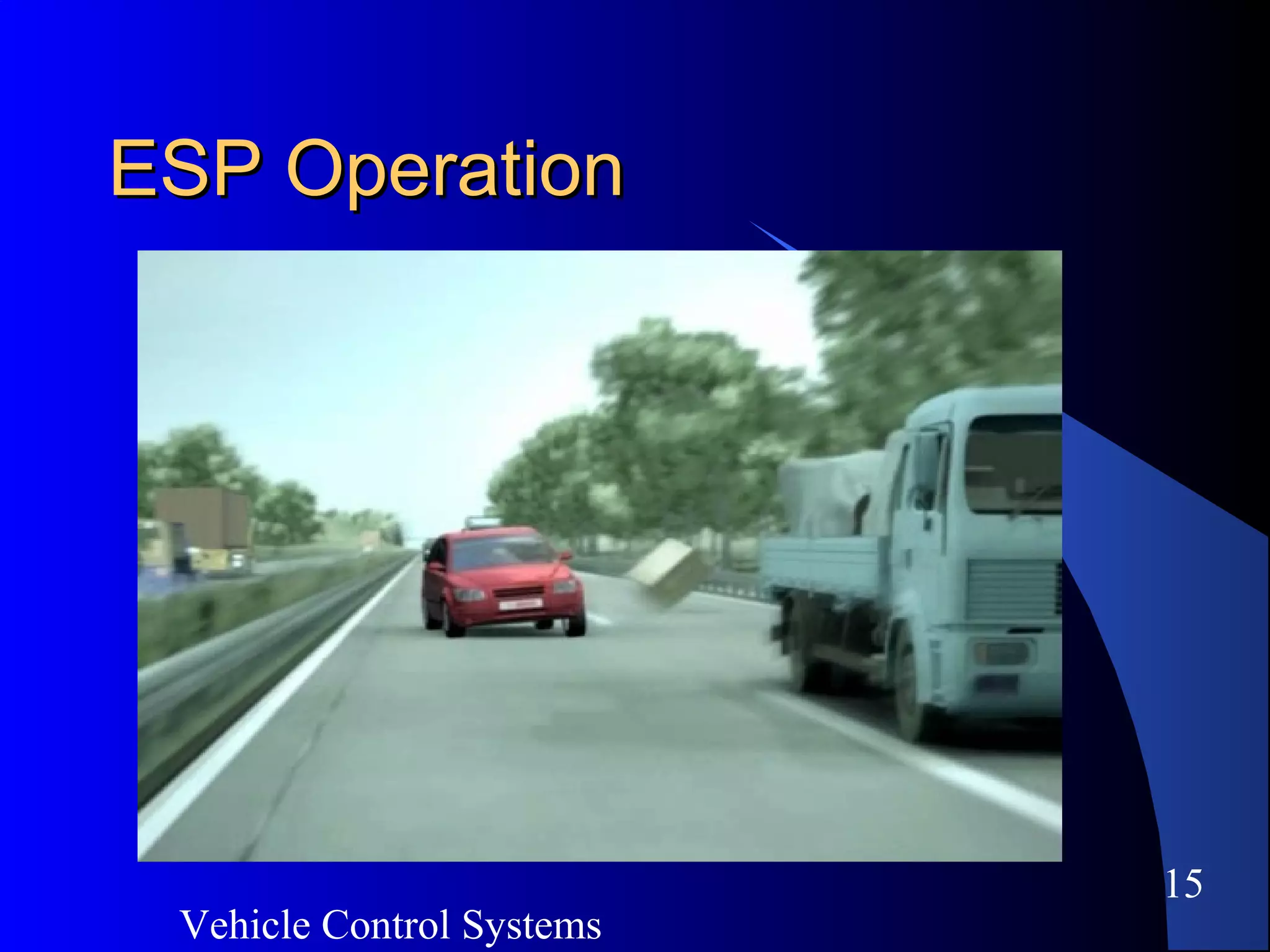
ESP OperationESP Operation
Vehicle Control Systems
16
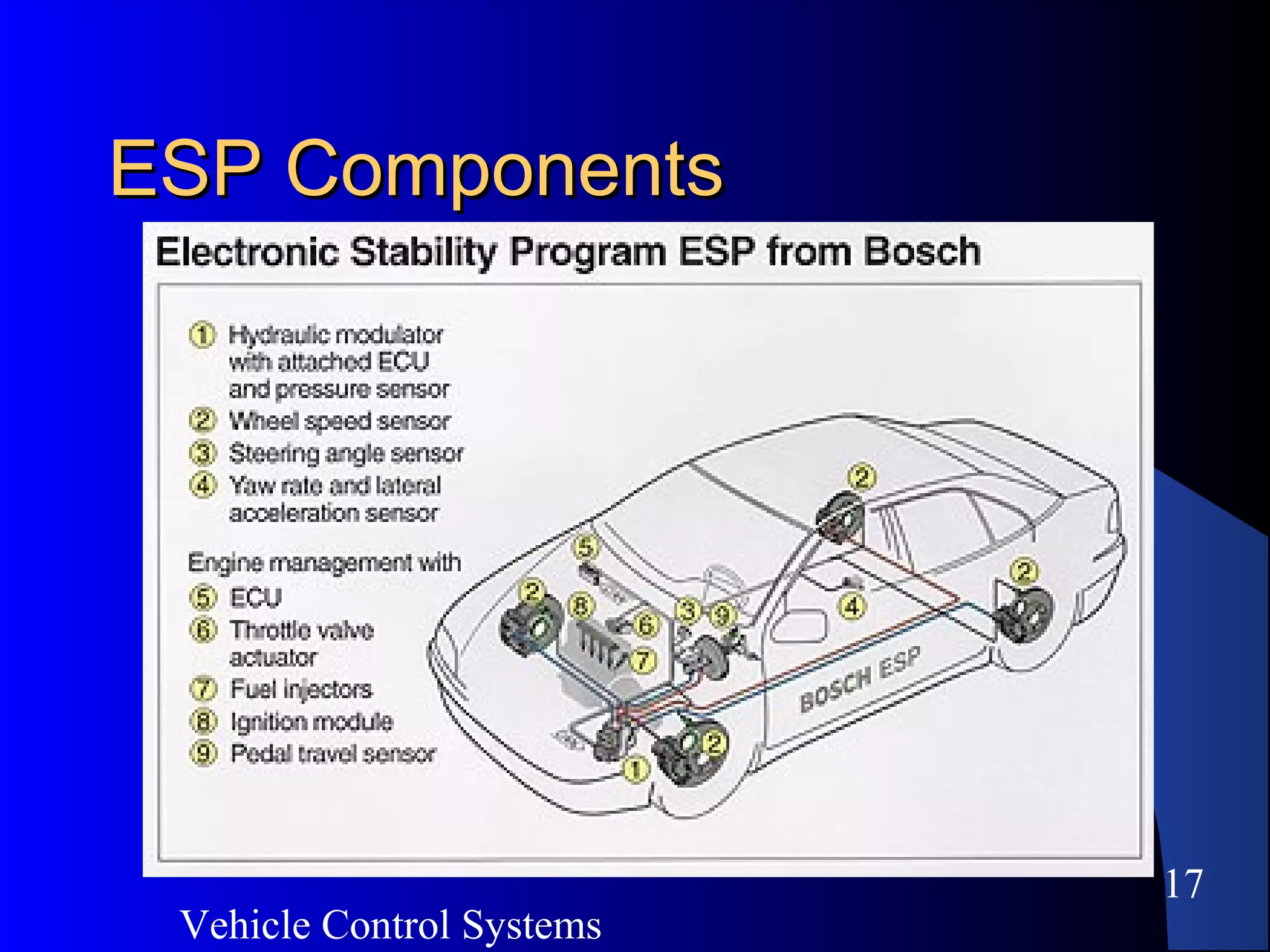
ESP ComponentsESP Components
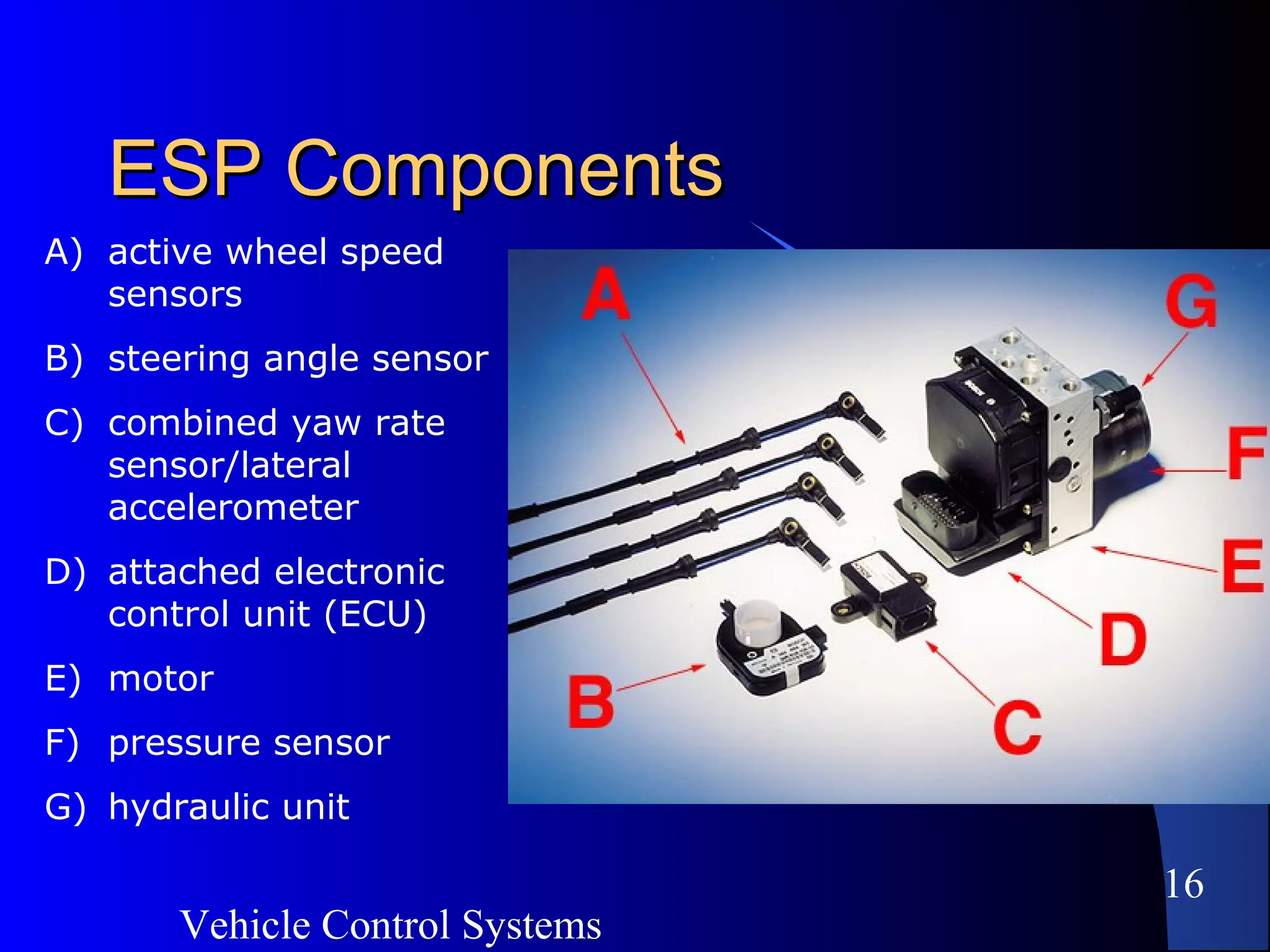
A) active wheel speed
sensors
B) steering angle sensor
C) combined yaw rate
sensor/lateral
accelerometer
D) attached electronic
control unit (ECU)
E) motor
F) pressure sensor
G) hydraulic unit
Vehicle Control Systems
17
ESP ComponentsESP Components
Vehicle Control Systems
18
Automakers & Stability ControlAutomakers & Stability Control
 Audi: electronic stability program (ESP).
 BMW: dynamic stability control (DSC).
 DaimlerChrysler: electronic stability program (ESP).
 Ford motor company: advance Trac.
 General motors: active handling system (corvette), precision
control system (Oldsmobile), Stabilitrak (Pontiac, Buick,
Cadillac).
 Jaguar: dynamic stability control (DSC).
 Lexus: vehicle skid control (VSC)
 Porsche: Porsche stability management (PSM).
 Volkswagen: electronic stability program (ESP).
 Volvo: dynamic stability traction control (DSTC).
Vehicle Control Systems
19
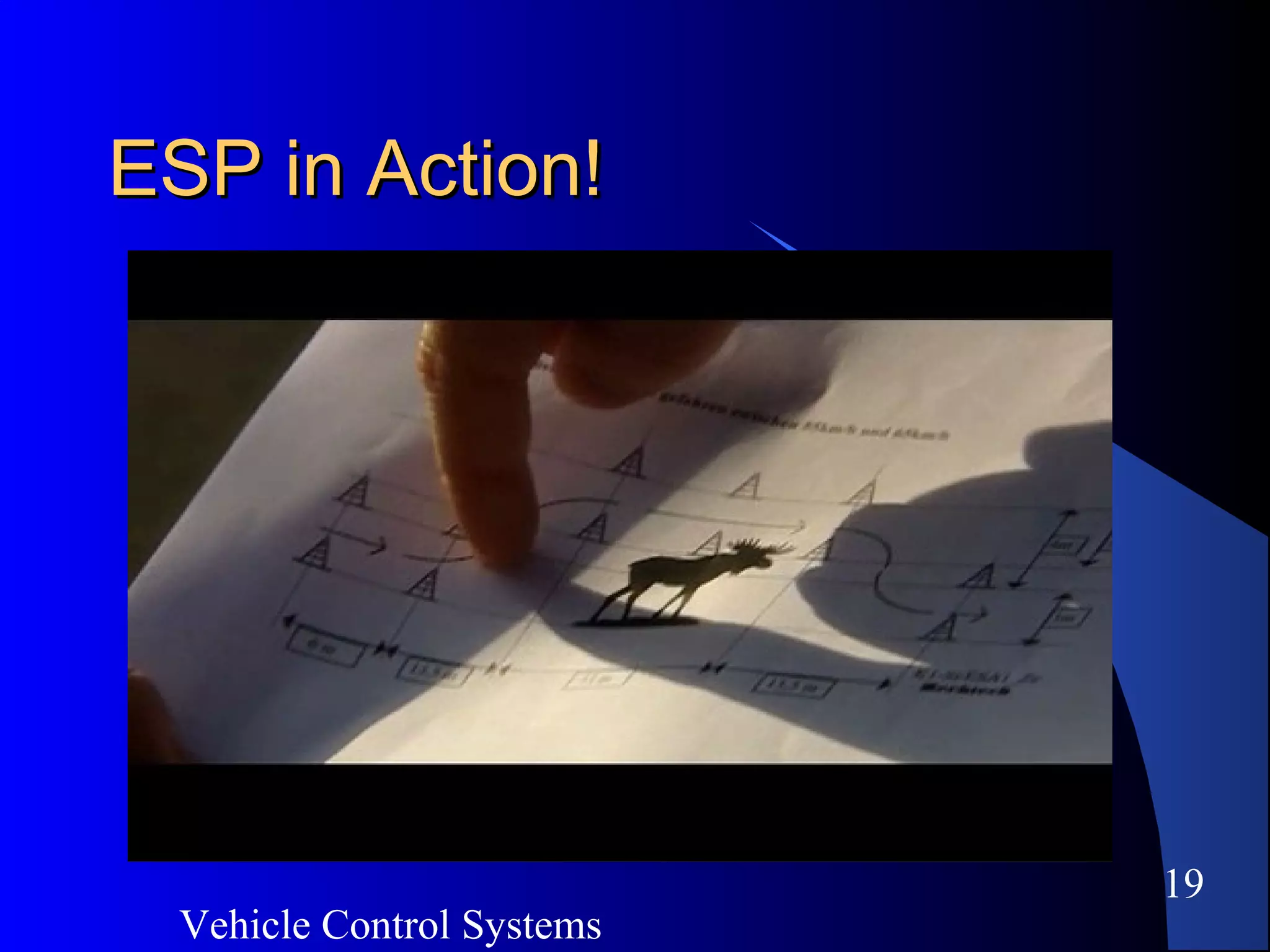
ESP in Action!ESP in Action!
Vehicle Control Systems
20
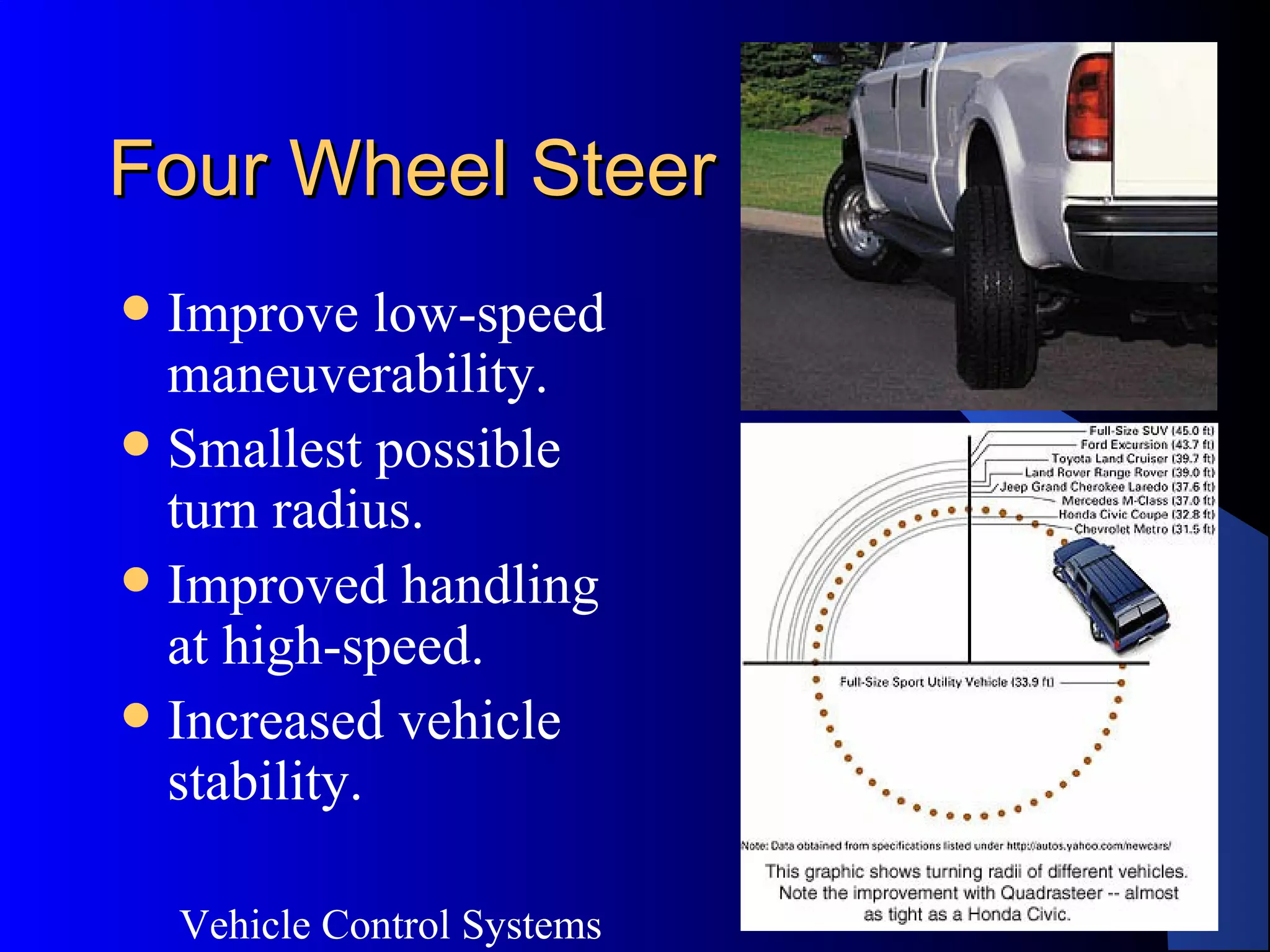
Four Wheel SteerFour Wheel Steer
 Improve low-speed
maneuverability.
 Smallest possible
turn radius.
 Improved handling
at high-speed.
 Increased vehicle
stability.
Vehicle Control Systems
21
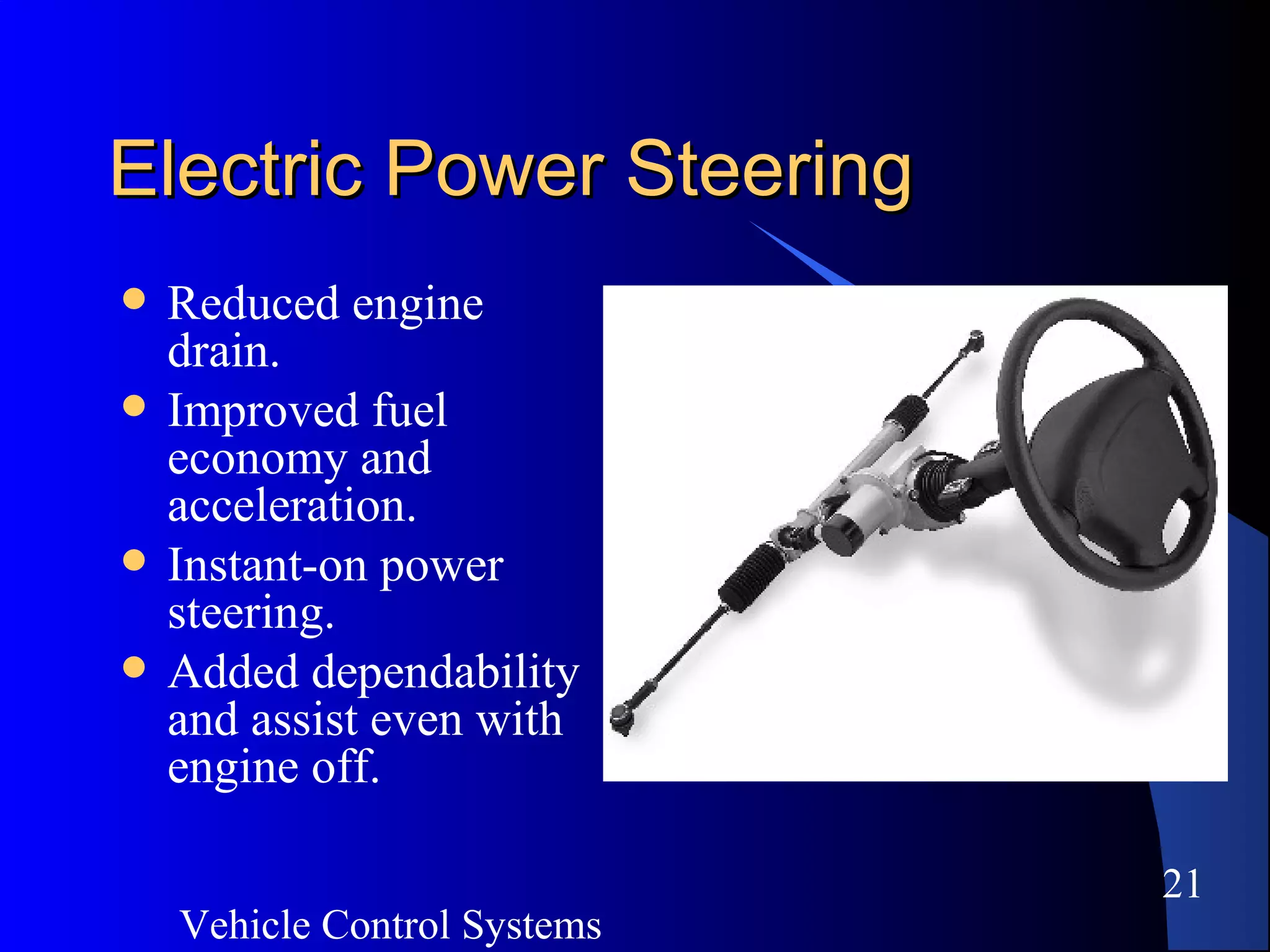
Electric Power SteeringElectric Power Steering
 Reduced engine
drain.
 Improved fuel
economy and
acceleration.
 Instant-on power
steering.
 Added dependability
and assist even with
engine off.
Vehicle Control Systems
22
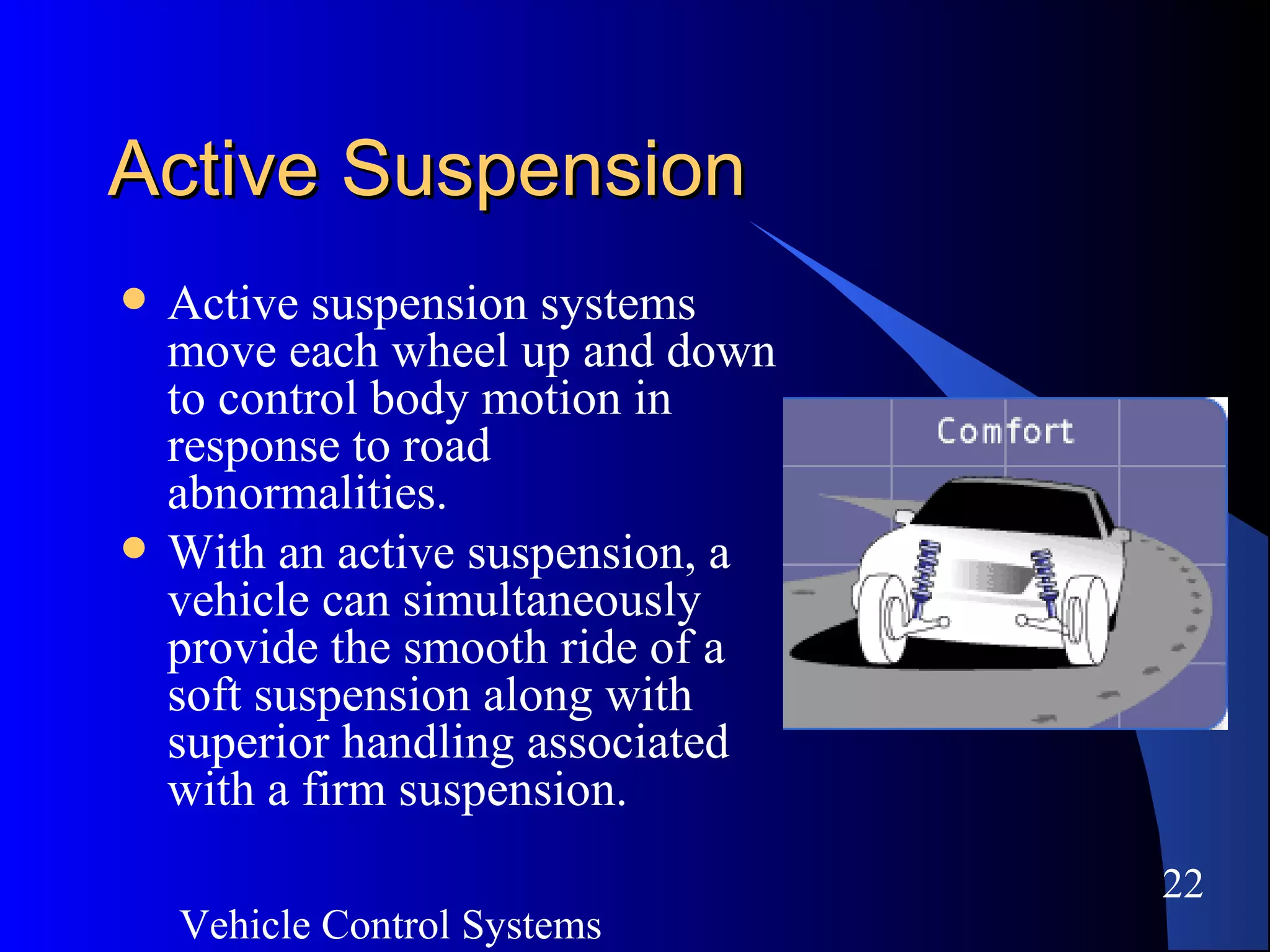
Active SuspensionActive Suspension
 Active suspension systems
move each wheel up and down
to control body motion in
response to road
abnormalities.
 With an active suspension, a
vehicle can simultaneously
provide the smooth ride of a
soft suspension along with
superior handling associated
with a firm suspension.
Vehicle Control Systems
23
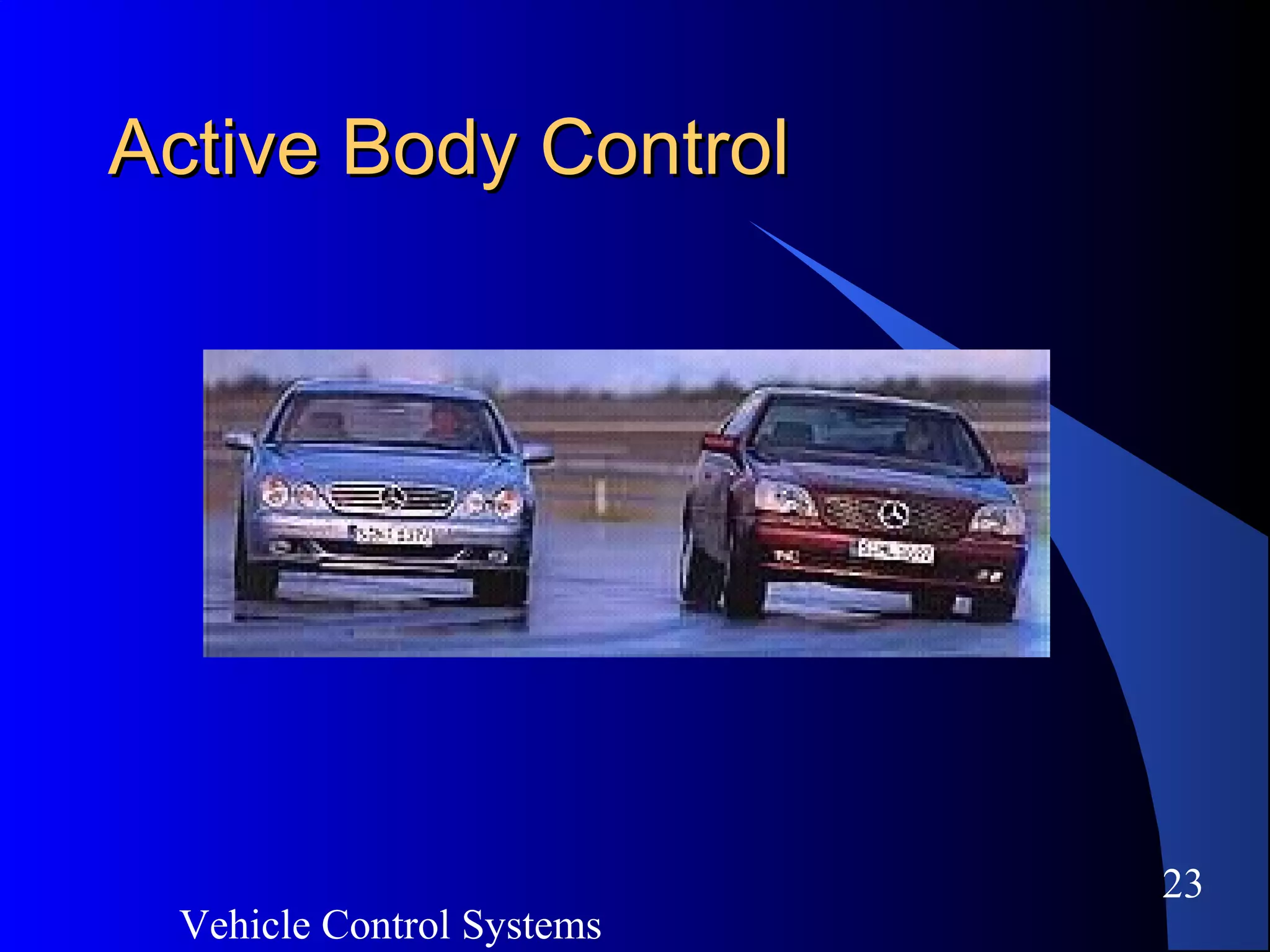
Active Body ControlActive Body Control
Vehicle Control Systems
24
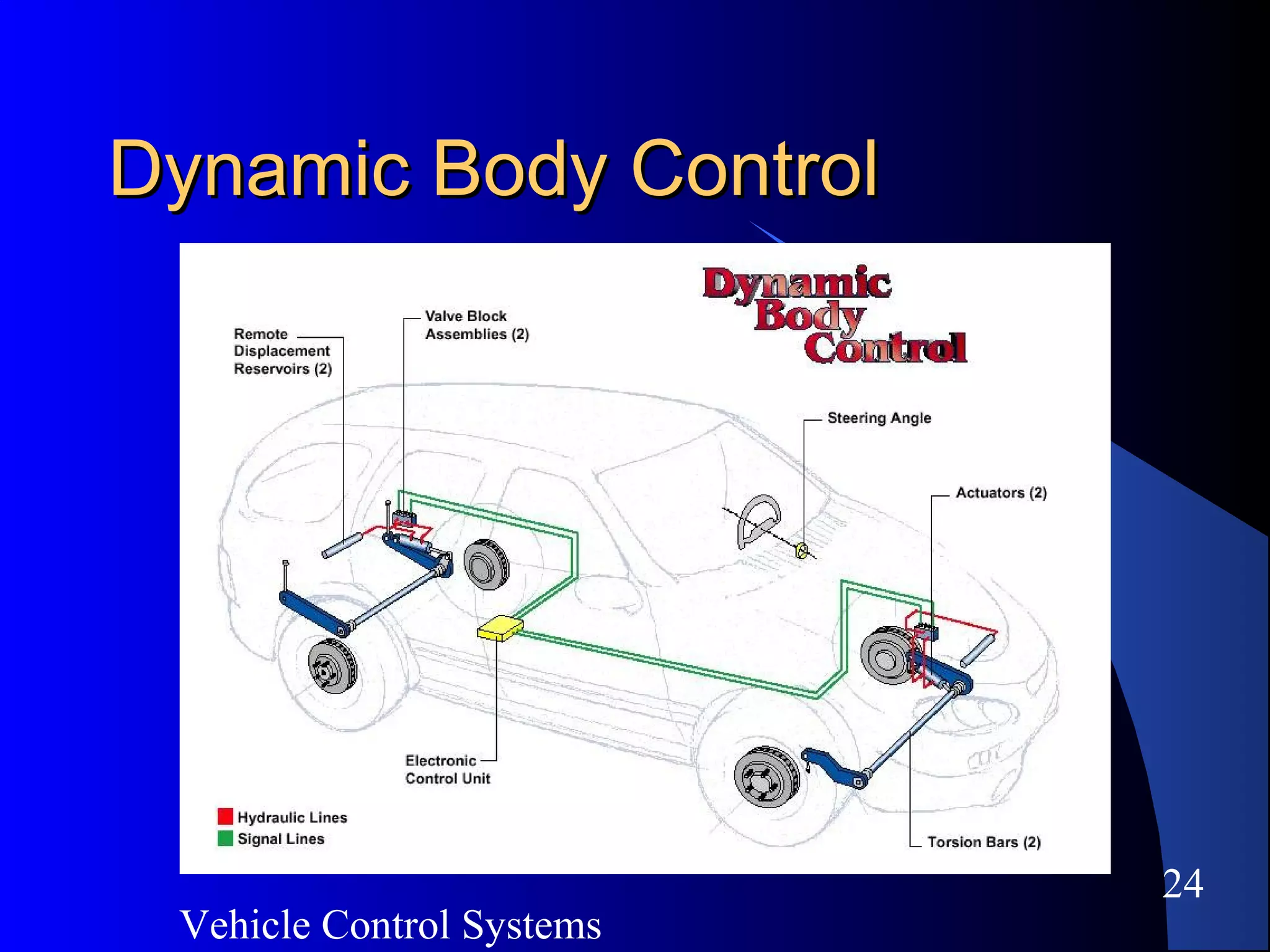
Dynamic Body ControlDynamic Body Control
Vehicle Control Systems
25
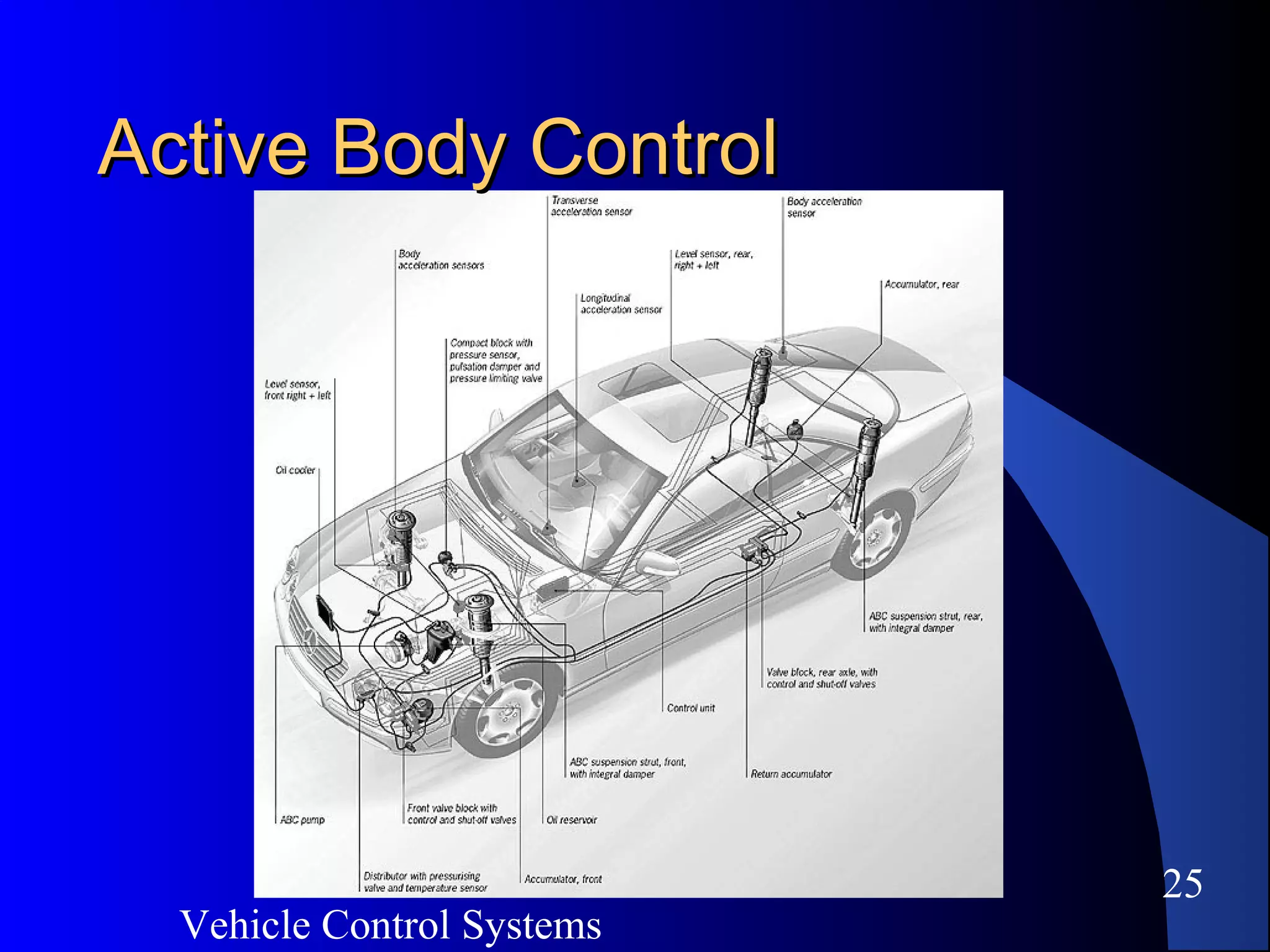
Active Body ControlActive Body Control
Vehicle Control Systems
26
Suspension Control in Action!Suspension Control in Action!
Vehicle Control Systems
27
Suspension Control in Action!Suspension Control in Action!
Vehicle Control Systems
28
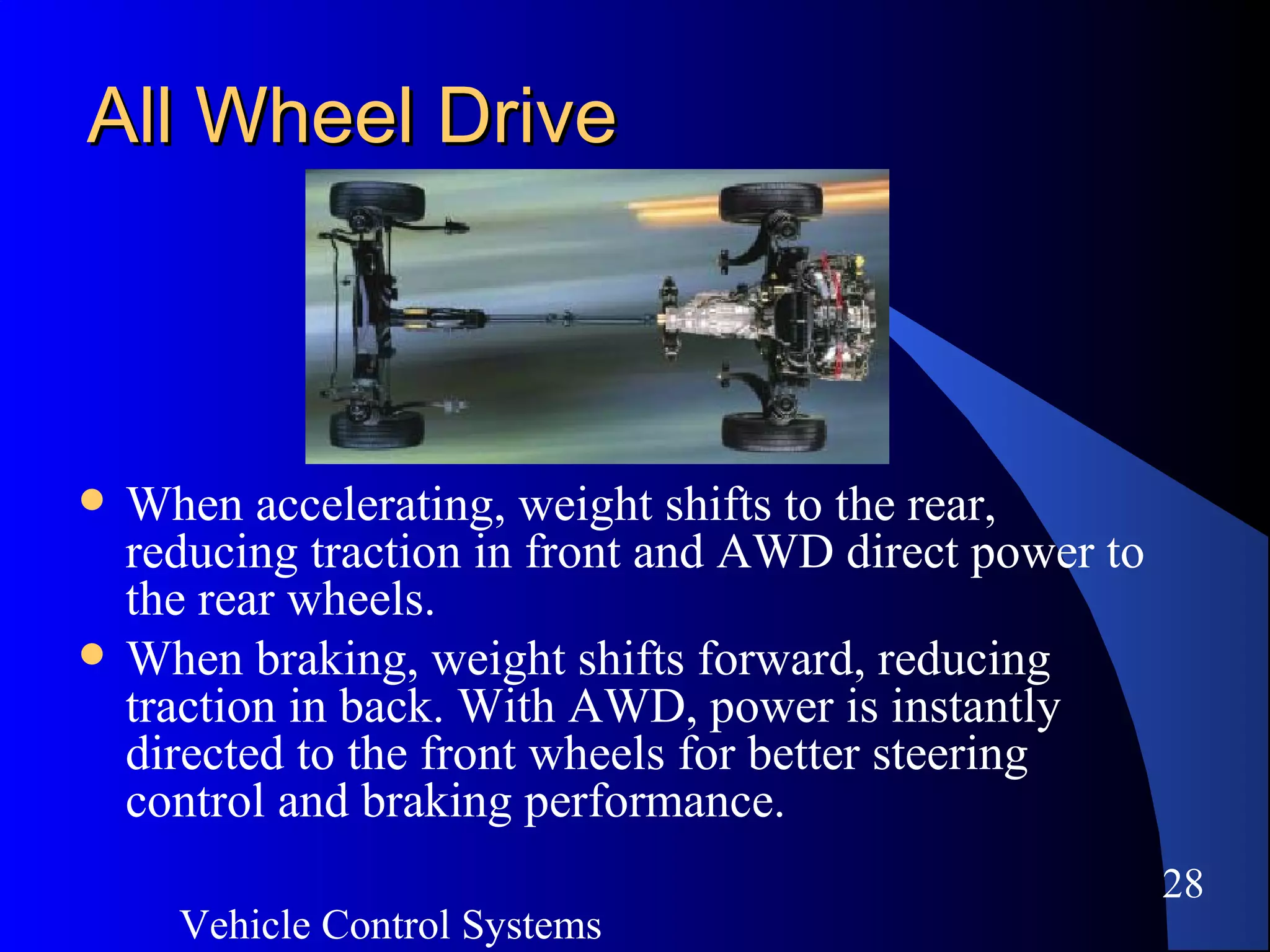
All Wheel DriveAll Wheel Drive
 When accelerating, weight shifts to the rear,
reducing traction in front and AWD direct power to
the rear wheels.
 When braking, weight shifts forward, reducing
traction in back. With AWD, power is instantly
directed to the front wheels for better steering
control and braking performance.
Vehicle Control Systems
29
All Wheel DriveAll Wheel Drive
 Whether icy, oily, wet, or rough, if front
wheels start to slip, AWD system instantly
directs power the rear wheels; If rear
wheels start to slip, power is directed to
the front wheels.
 The power is automatically transferred to
the wheels with the best traction.
Unwanted understeer and oversteer is
virtually eliminated.
Vehicle Control Systems
30
Drive by WireDrive by Wire
 Replacement of traditional mechanical
systems for steering, braking, throttle and
suspension functions, with electronic
controller, actuators and sensors.
Vehicle Control Systems
31
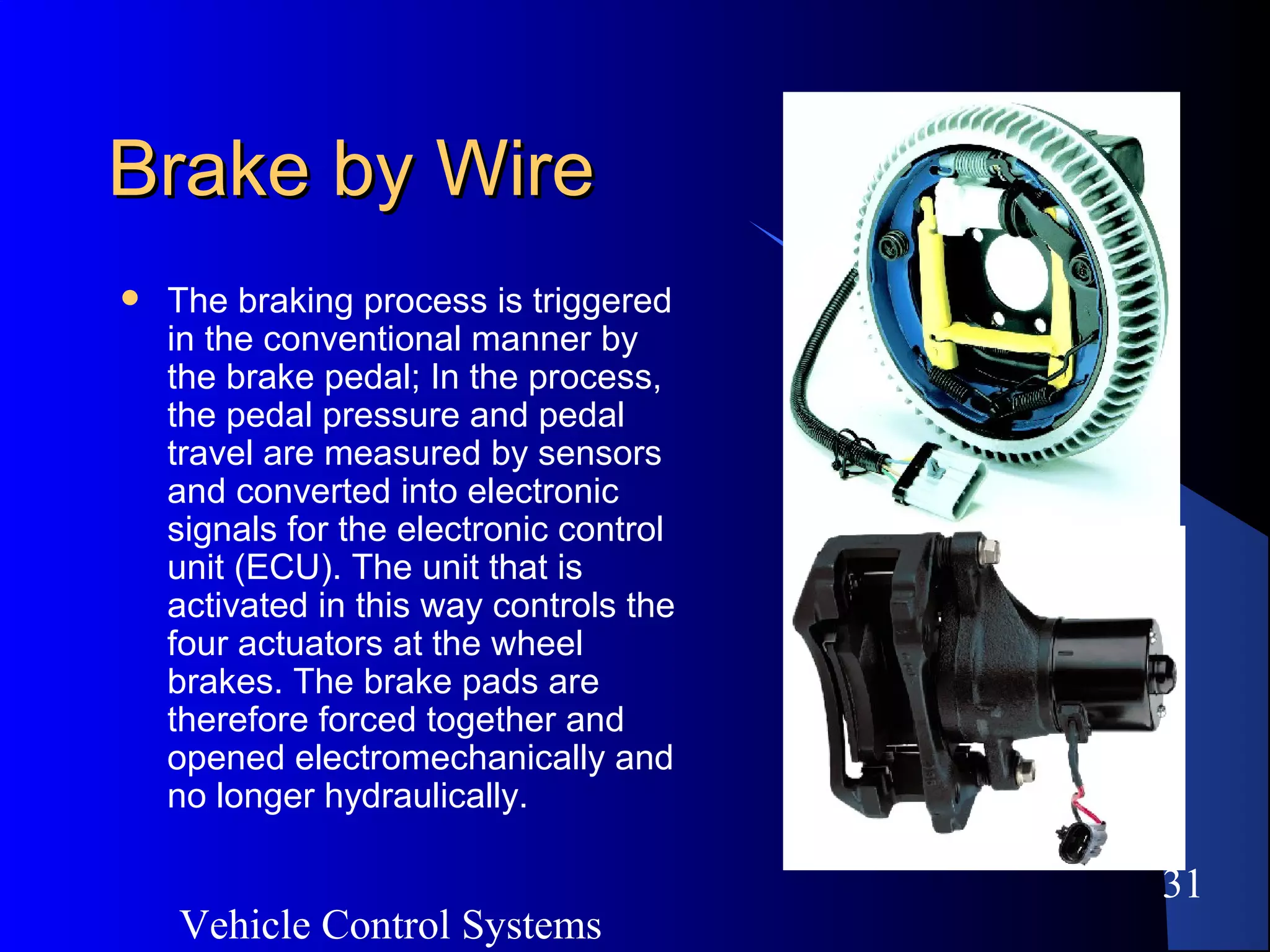
Brake by WireBrake by Wire
 The braking process is triggered
in the conventional manner by
the brake pedal; In the process,
the pedal pressure and pedal
travel are measured by sensors
and converted into electronic
signals for the electronic control
unit (ECU). The unit that is
activated in this way controls the
four actuators at the wheel
brakes. The brake pads are
therefore forced together and
opened electromechanically and
no longer hydraulically.
Vehicle Control Systems
32
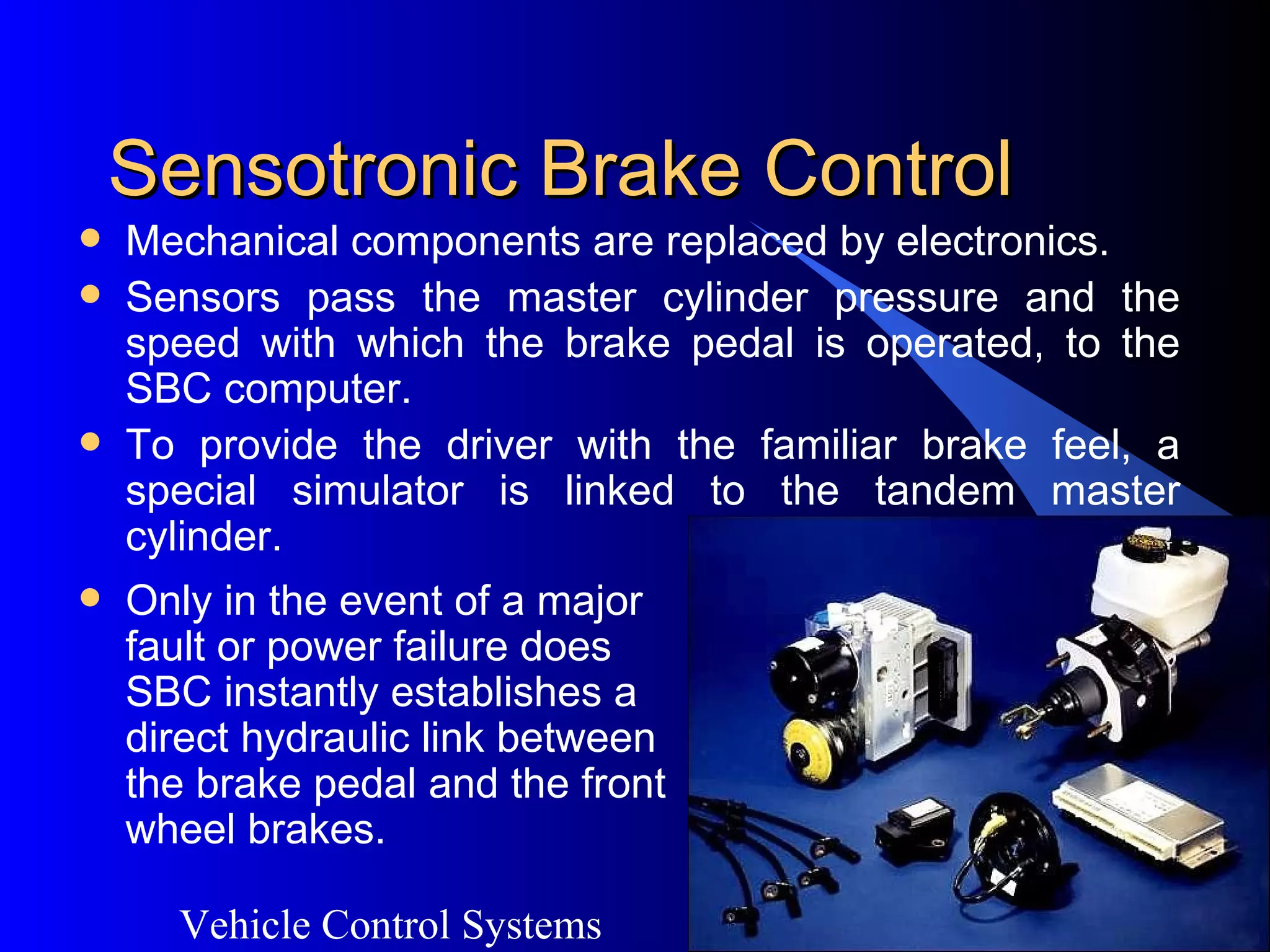
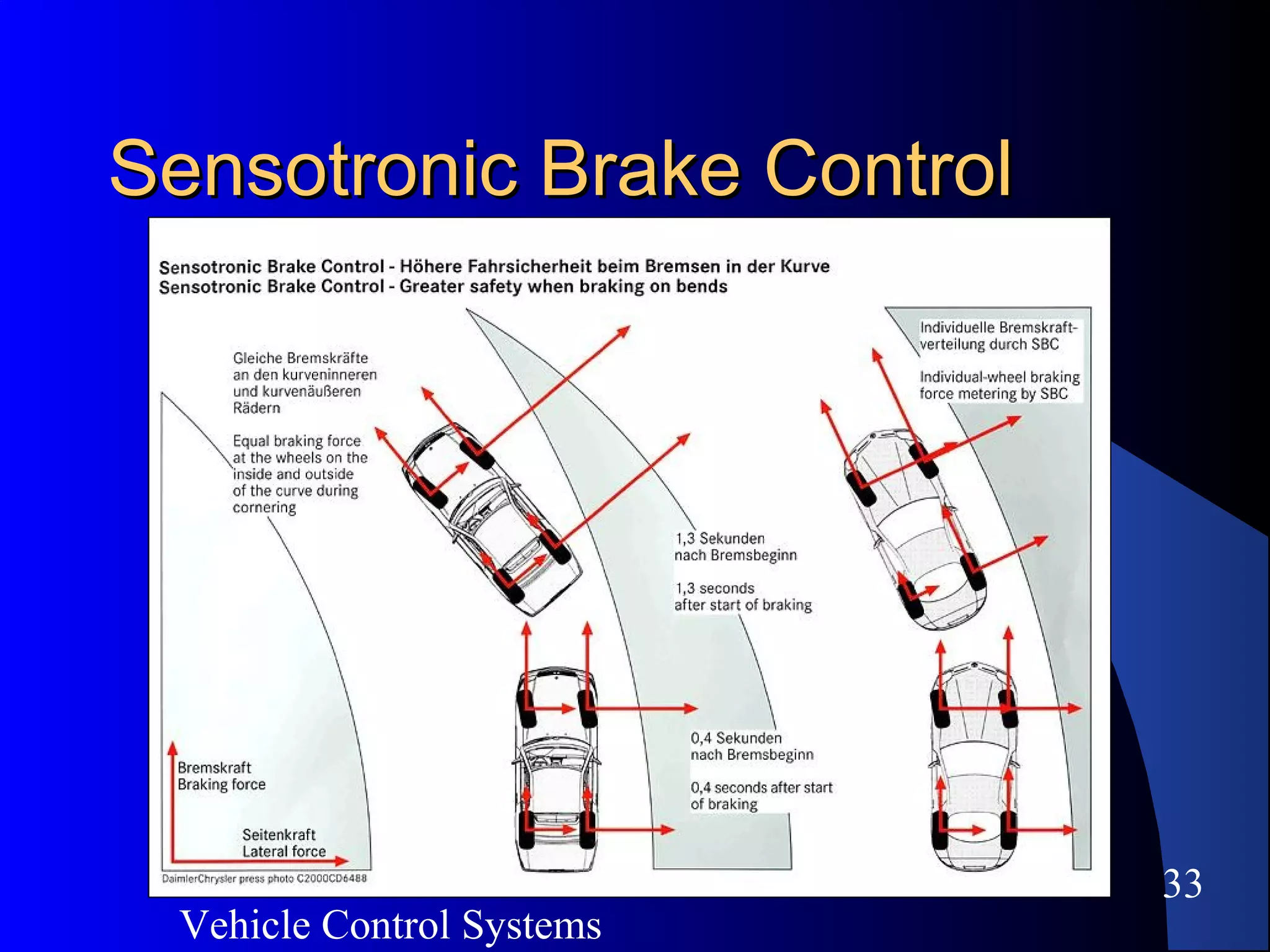
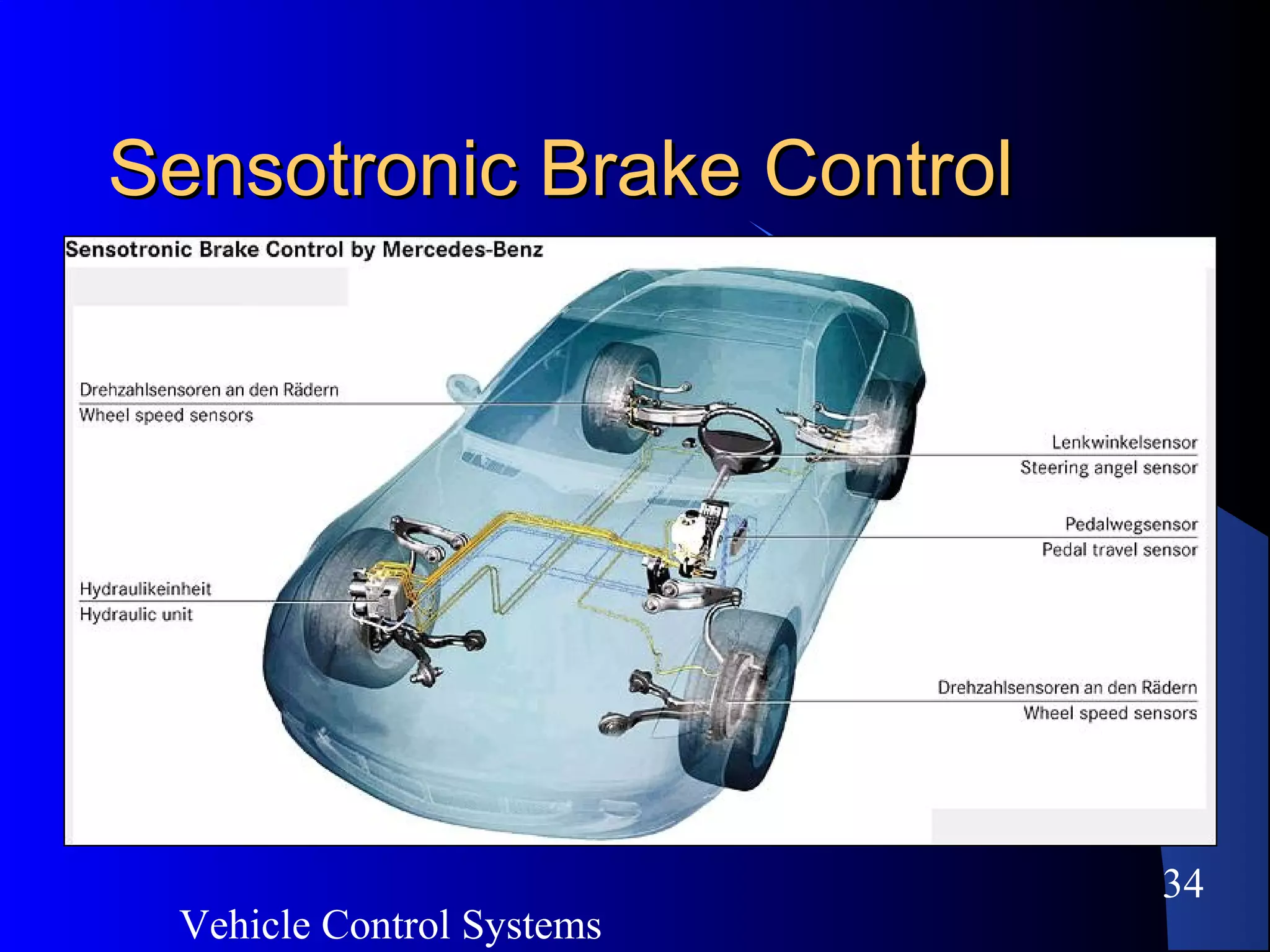
Sensotronic Brake ControlSensotronic Brake Control
 Mechanical components are replaced by electronics.
 Sensors pass the master cylinder pressure and the
speed with which the brake pedal is operated, to the
SBC computer.
 To provide the driver with the familiar brake feel, a
special simulator is linked to the tandem master
cylinder.
 Only in the event of a major
fault or power failure does
SBC instantly establishes a
direct hydraulic link between
the brake pedal and the front
wheel brakes.
Vehicle Control Systems
33
Sensotronic Brake ControlSensotronic Brake Control
Vehicle Control Systems
34
Sensotronic Brake ControlSensotronic Brake Control
Vehicle Control Systems
35
Steer by WireSteer by Wire
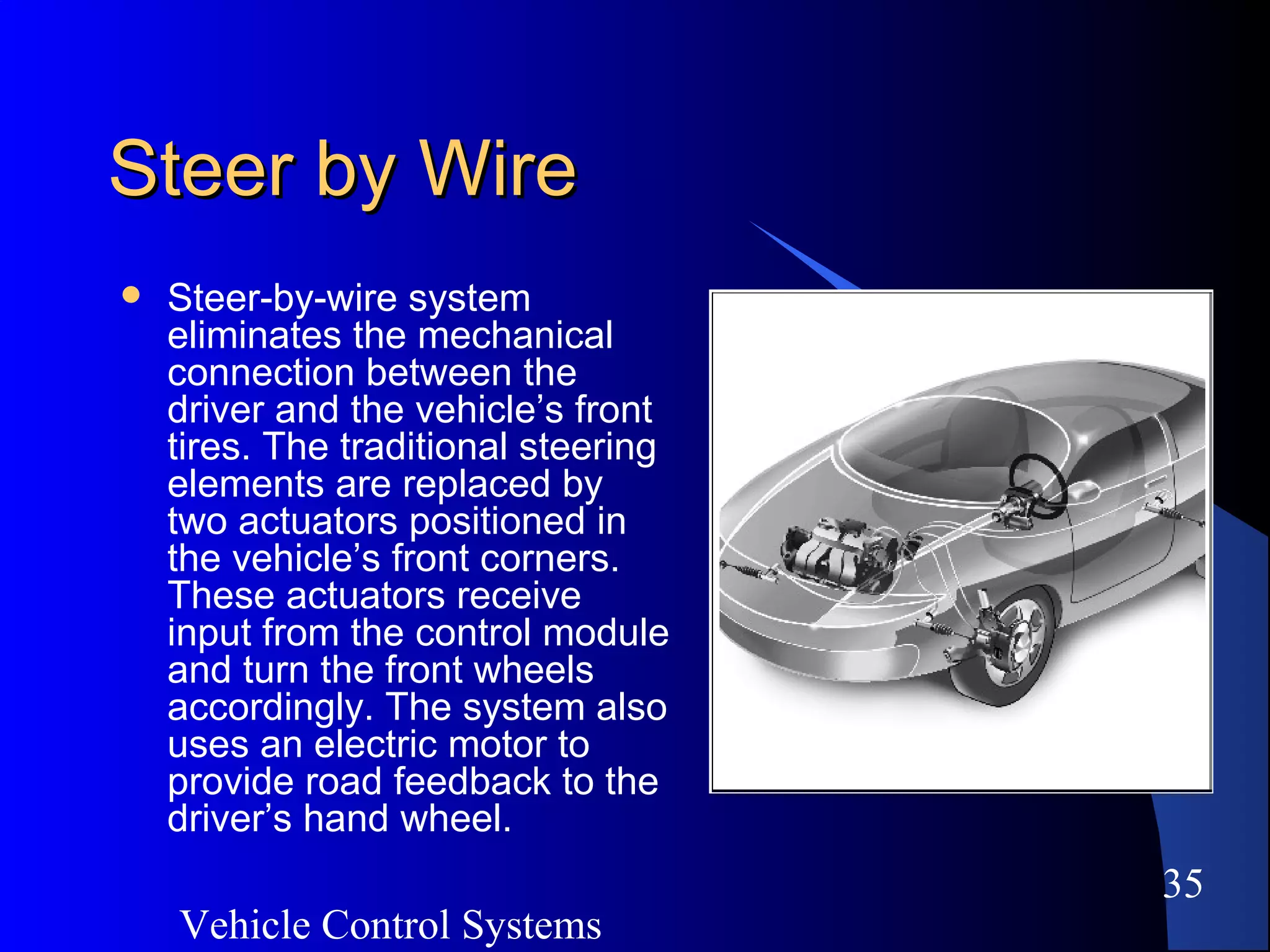
 Steer-by-wire system
eliminates the mechanical
connection between the
driver and the vehicle’s front
tires. The traditional steering
elements are replaced by
two actuators positioned in
the vehicle’s front corners.
These actuators receive
input from the control module
and turn the front wheels
accordingly. The system also
uses an electric motor to
provide road feedback to the
driver’s hand wheel.
Vehicle Control Systems
36
Electronic Throttle ControlElectronic Throttle Control
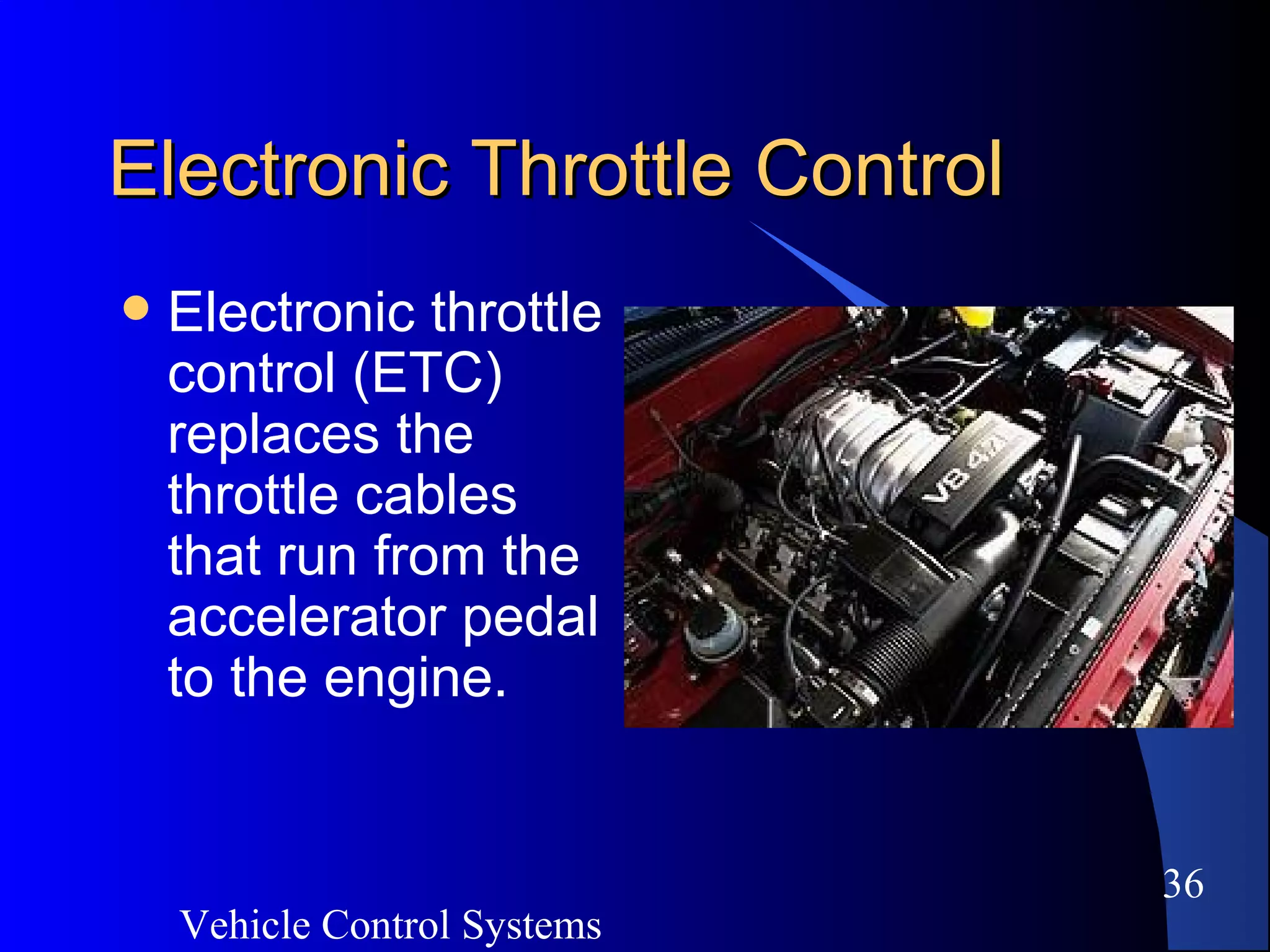
 Electronic throttle
control (ETC)
replaces the
throttle cables
that run from the
accelerator pedal
to the engine.
Vehicle Control Systems
37
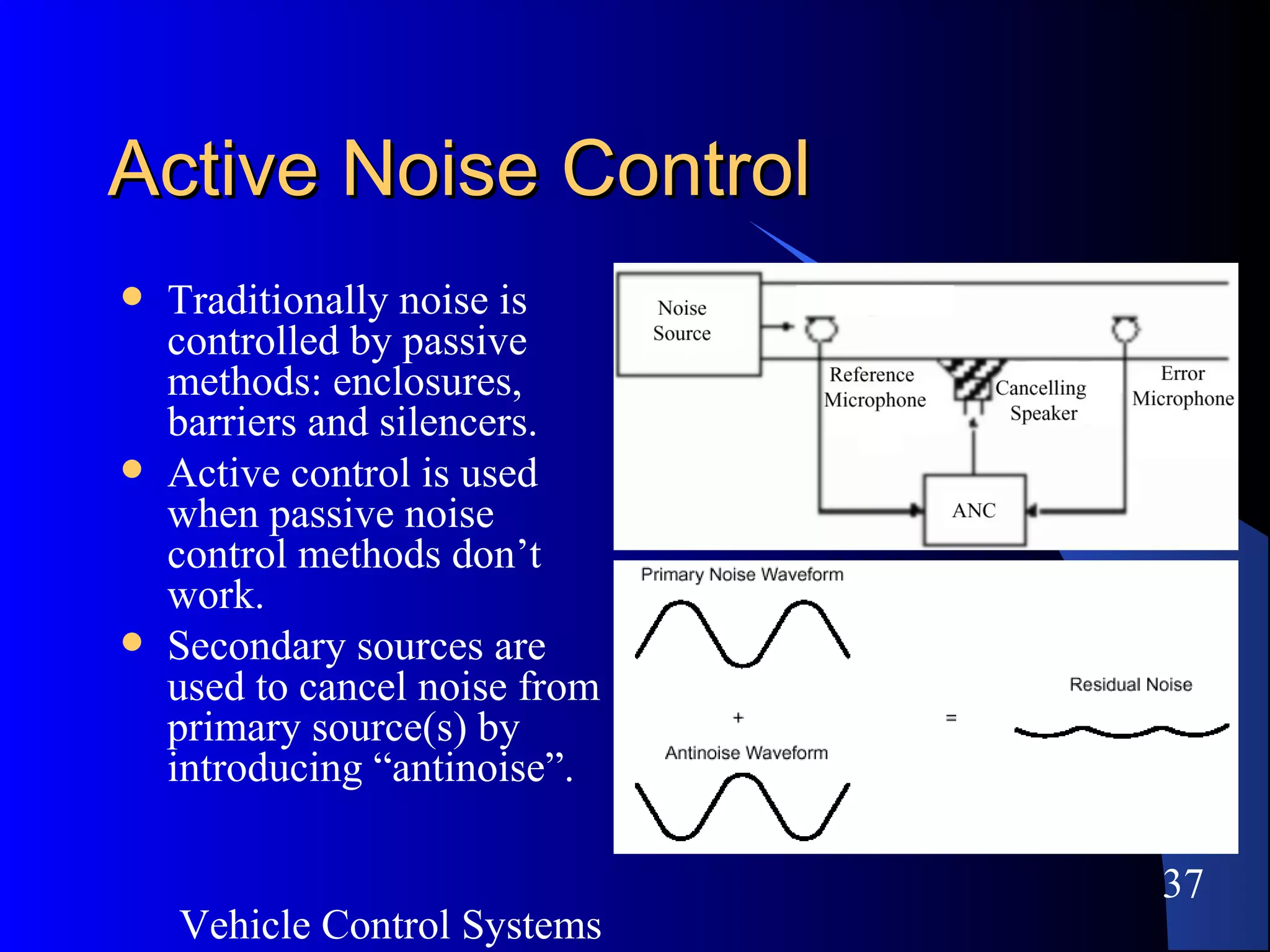
Active Noise ControlActive Noise Control
 Traditionally noise is
controlled by passive
methods: enclosures,
barriers and silencers.
 Active control is used
when passive noise
control methods don’t
work.
 Secondary sources are
used to cancel noise from
primary source(s) by
introducing “antinoise”.
Vehicle Control Systems
38
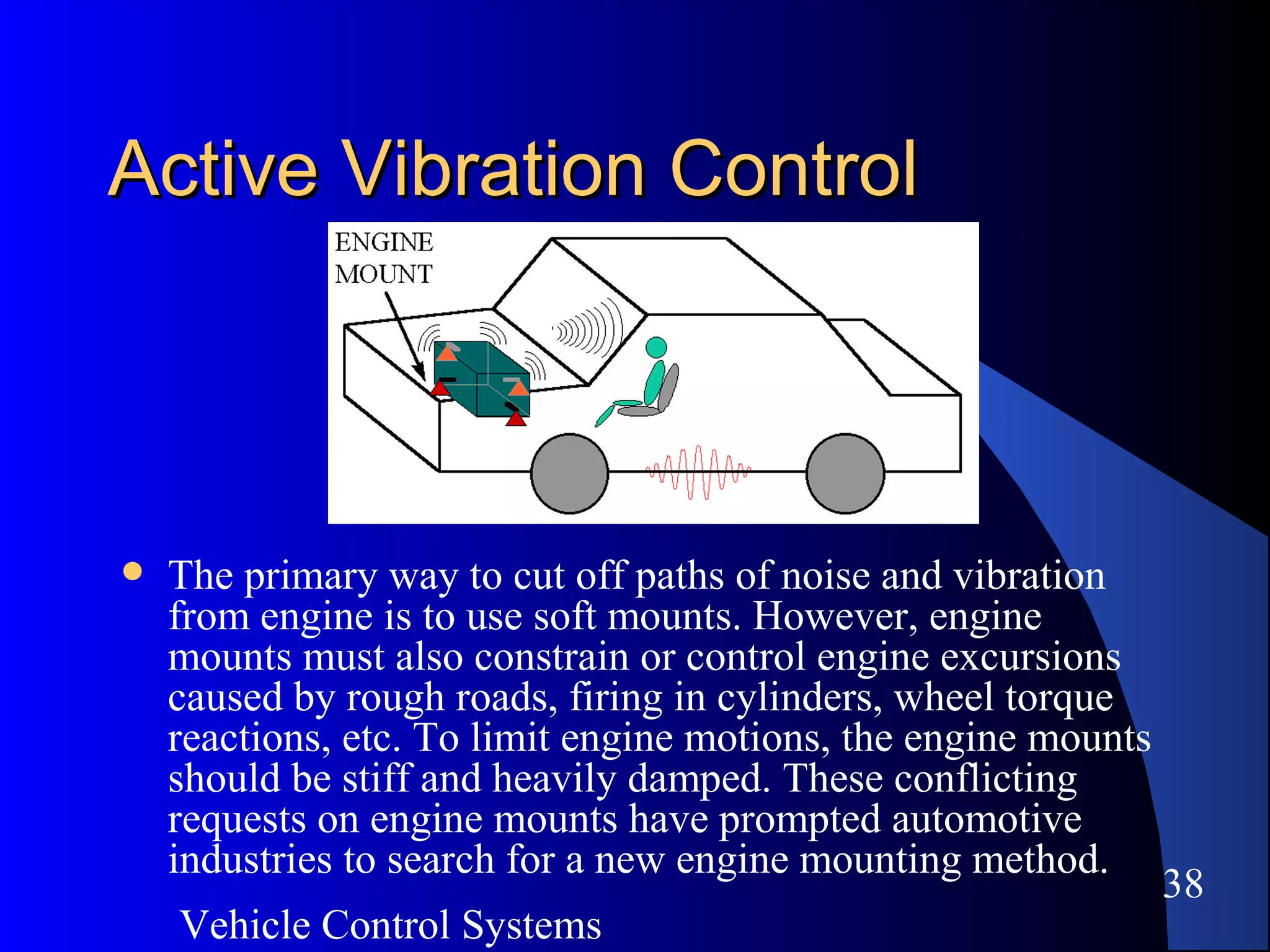
Active Vibration ControlActive Vibration Control
 The primary way to cut off paths of noise and vibration
from engine is to use soft mounts. However, engine
mounts must also constrain or control engine excursions
caused by rough roads, firing in cylinders, wheel torque
reactions, etc. To limit engine motions, the engine mounts
should be stiff and heavily damped. These conflicting
requests on engine mounts have prompted automotive
industries to search for a new engine mounting method.
Vehicle Control Systems
39
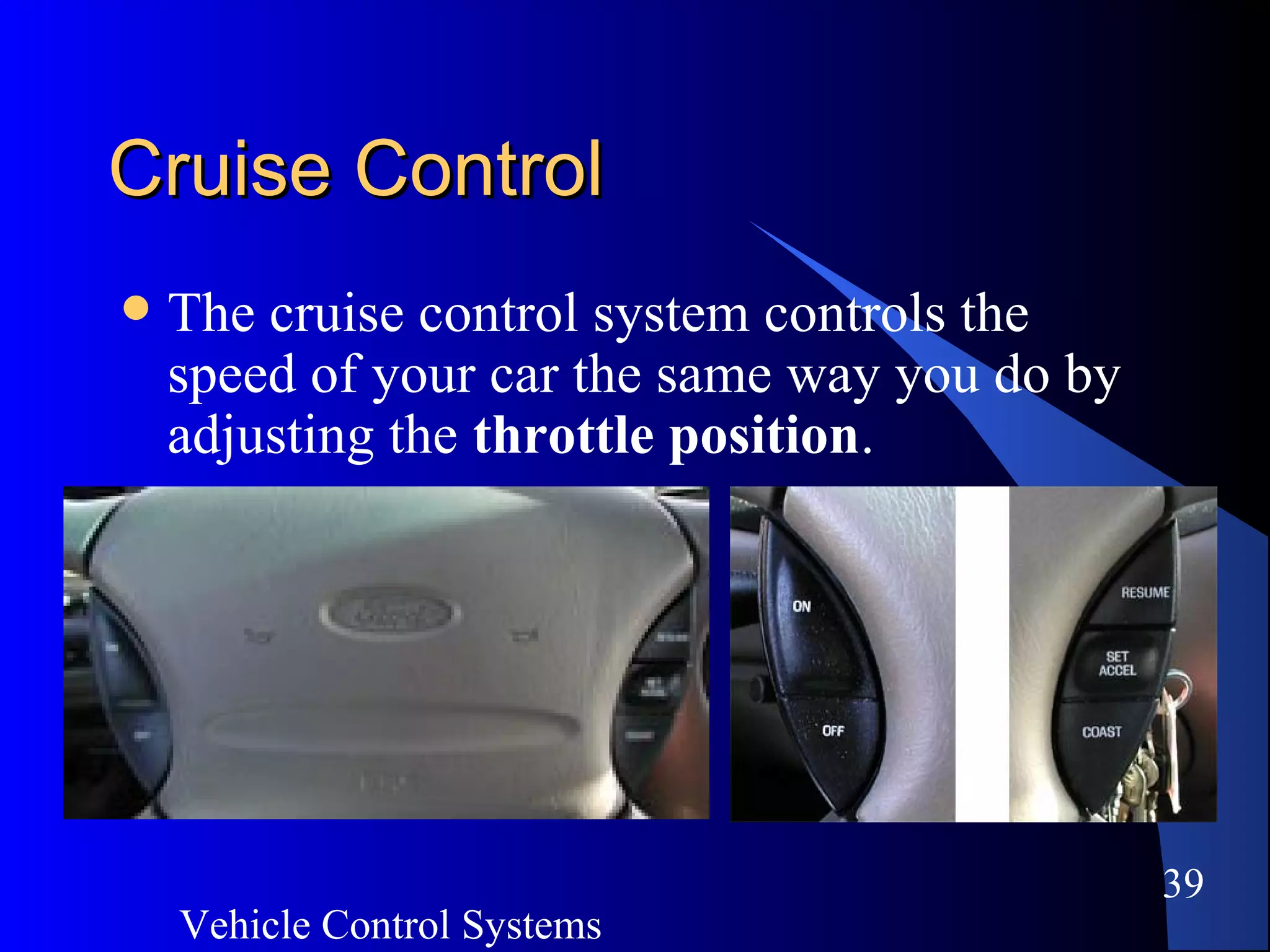
Cruise ControlCruise Control
 The cruise control system controls the
speed of your car the same way you do by
adjusting the throttle position.
Vehicle Control Systems
40
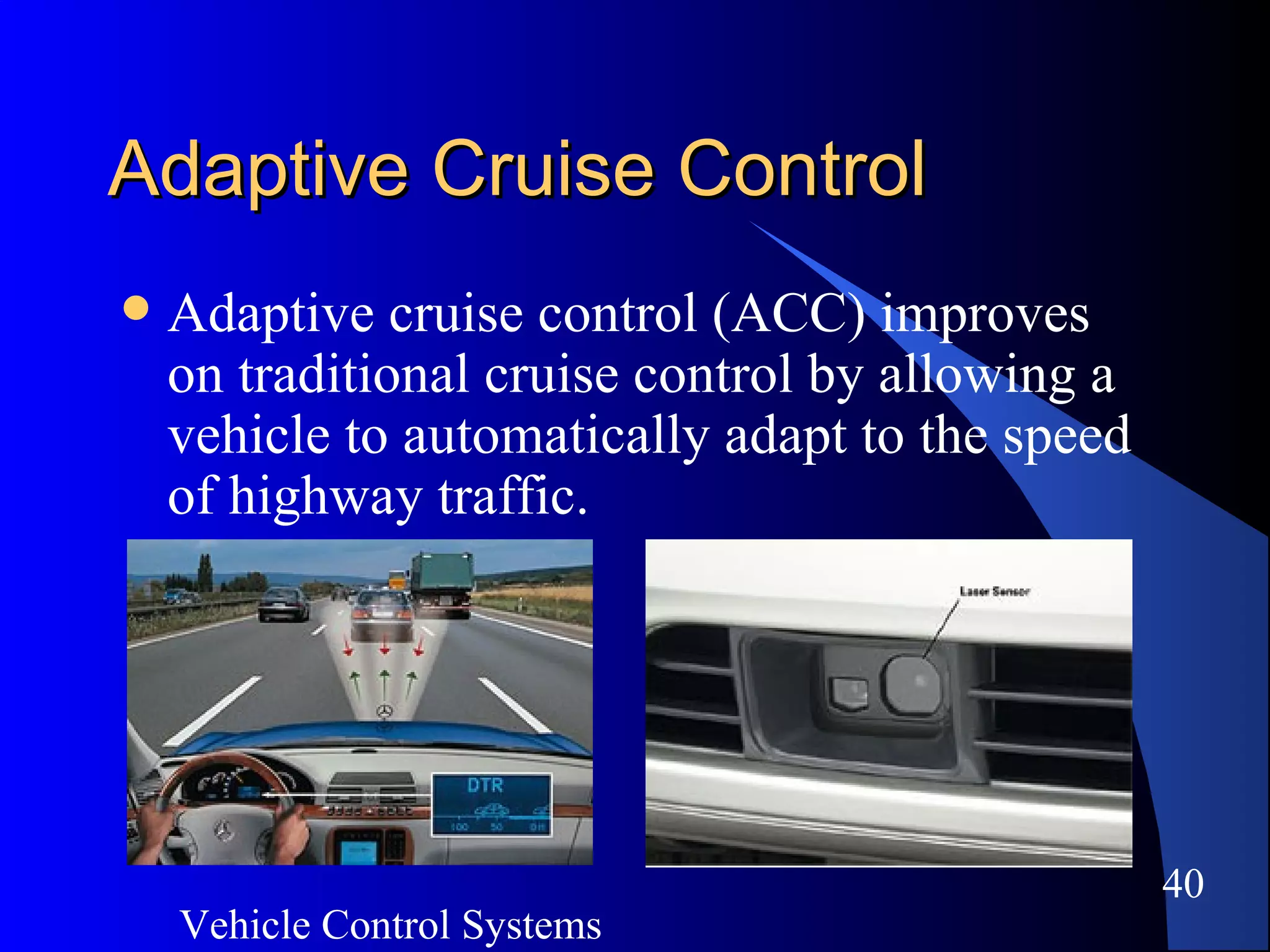
Adaptive Cruise ControlAdaptive Cruise Control
 Adaptive cruise control (ACC) improves
on traditional cruise control by allowing a
vehicle to automatically adapt to the speed
of highway traffic.
Vehicle Control Systems
41
Stop and GoStop and Go
 The Stop & Go function maintains
longitudinal car control at low speeds,
e.g. when queuing on a motorway or
waiting at a traffic light.
Vehicle Control Systems
42
Anti Collision AssistAnti Collision Assist
 This system helps prevent collisions by sending
the driver an acoustic or visual signal to warn of
the presence of standing or slow-moving
obstacles in the car's path. The system also
acts on the car's brakes when necessary.
Vehicle Control Systems
43
Overtaking WarningOvertaking Warning
 The blind spot coverage sensor warns of the
presence of vehicles about to enter the side
area not covered by the door mirrors. The
sensor turns on a warning light, which can
be used in conjunction with the door mirror.
The warning signal becomes acoustic when
the turn signal is activated.
Vehicle Control Systems
44
Lane WarningLane Warning
 This additional driving support function
automatically detects car position in relation to
lane boundaries. The system issues an advance
warning if the car inadvertently crosses the lane
boundaries. The road in front of the car is filmed
by a micro TV camera and the driver may select
between tactile or acoustic indicators.
Vehicle Control Systems
45
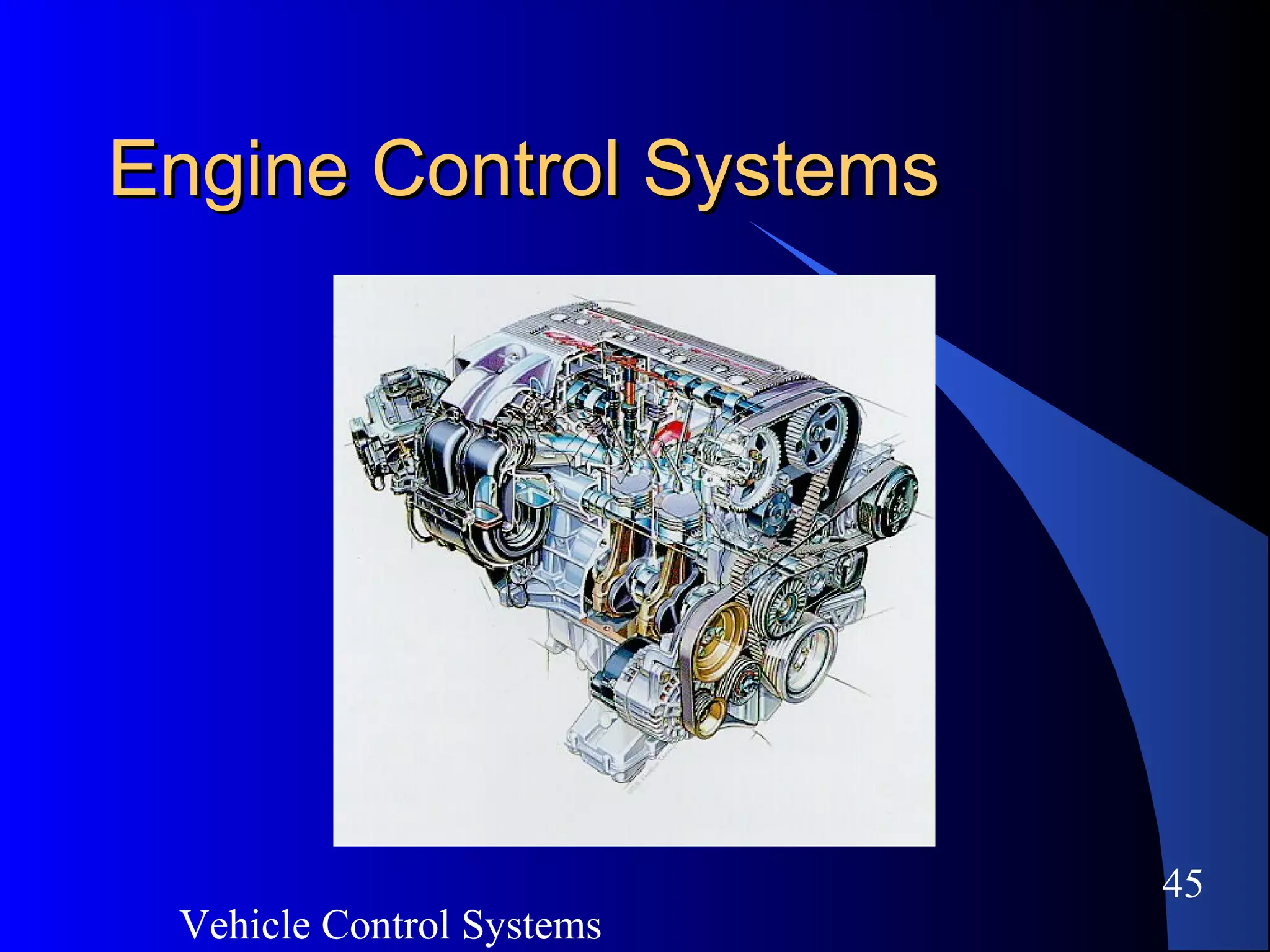
Engine Control SystemsEngine Control Systems
Vehicle Control Systems
46
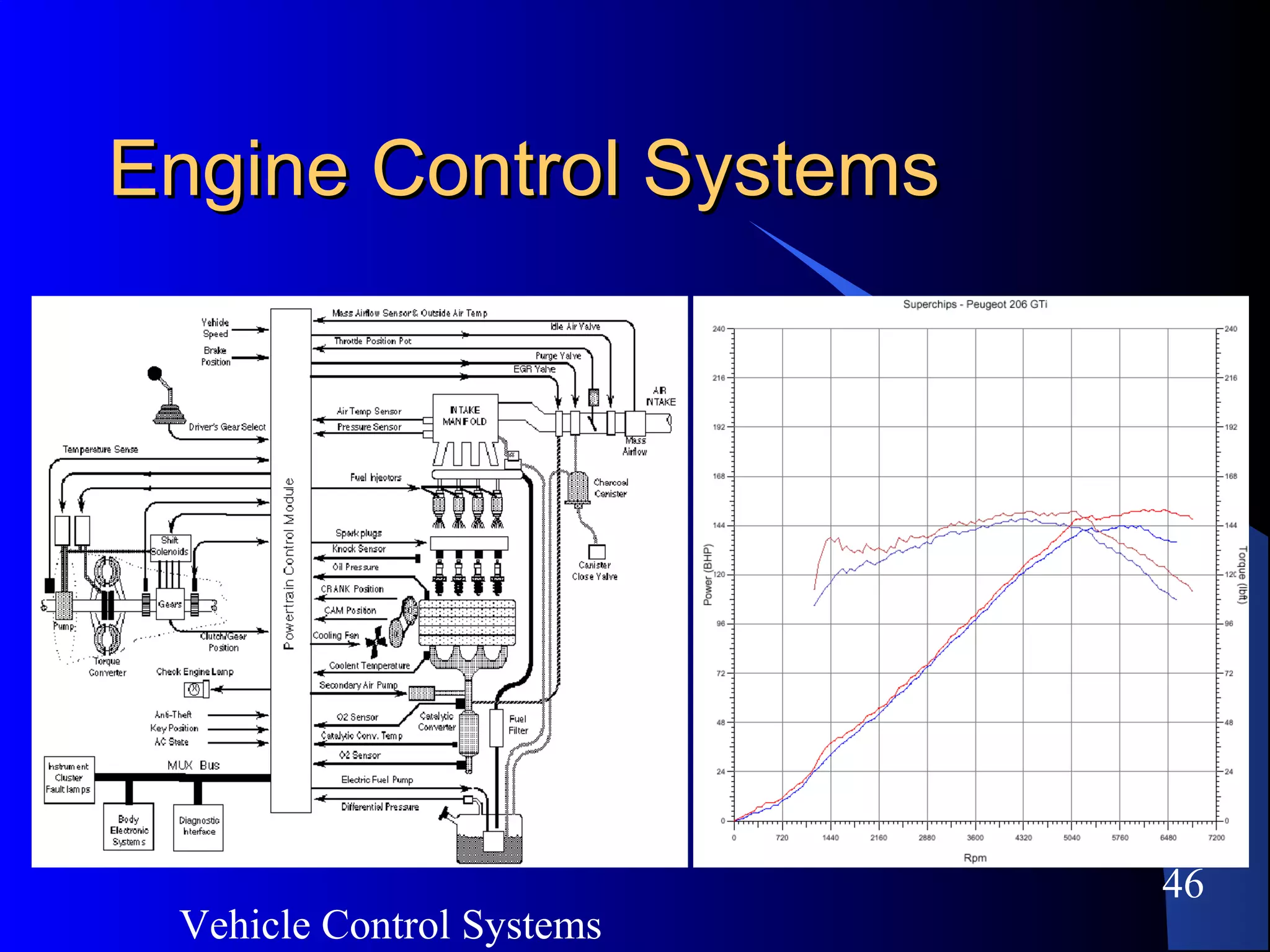
Engine Control SystemsEngine Control Systems
Vehicle Control Systems
47
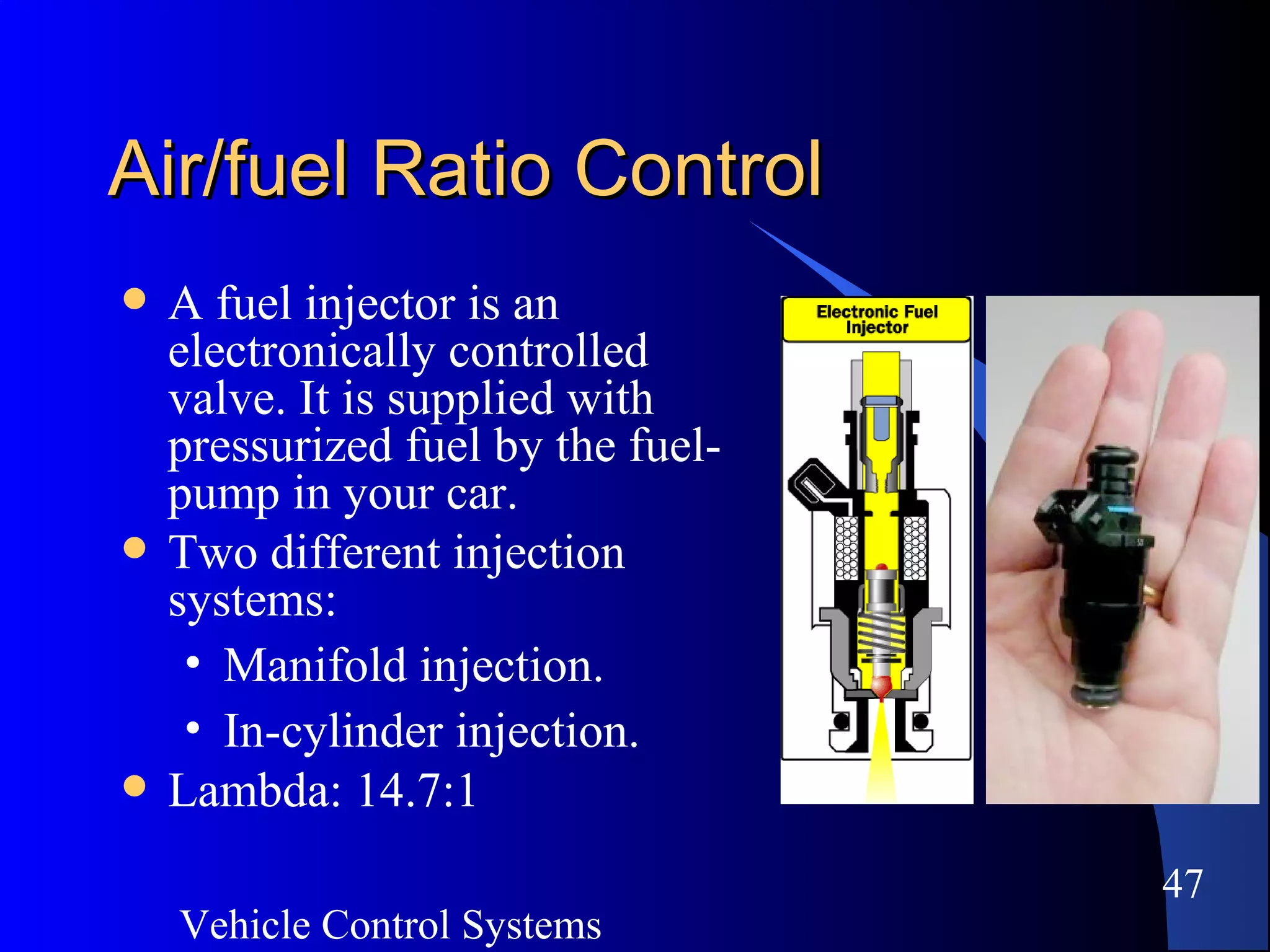
Air/fuel Ratio ControlAir/fuel Ratio Control
 A fuel injector is an
electronically controlled
valve. It is supplied with
pressurized fuel by the fuel-
pump in your car.
 Two different injection
systems:
• Manifold injection.
• In-cylinder injection.
 Lambda: 14.7:1
Vehicle Control Systems
48
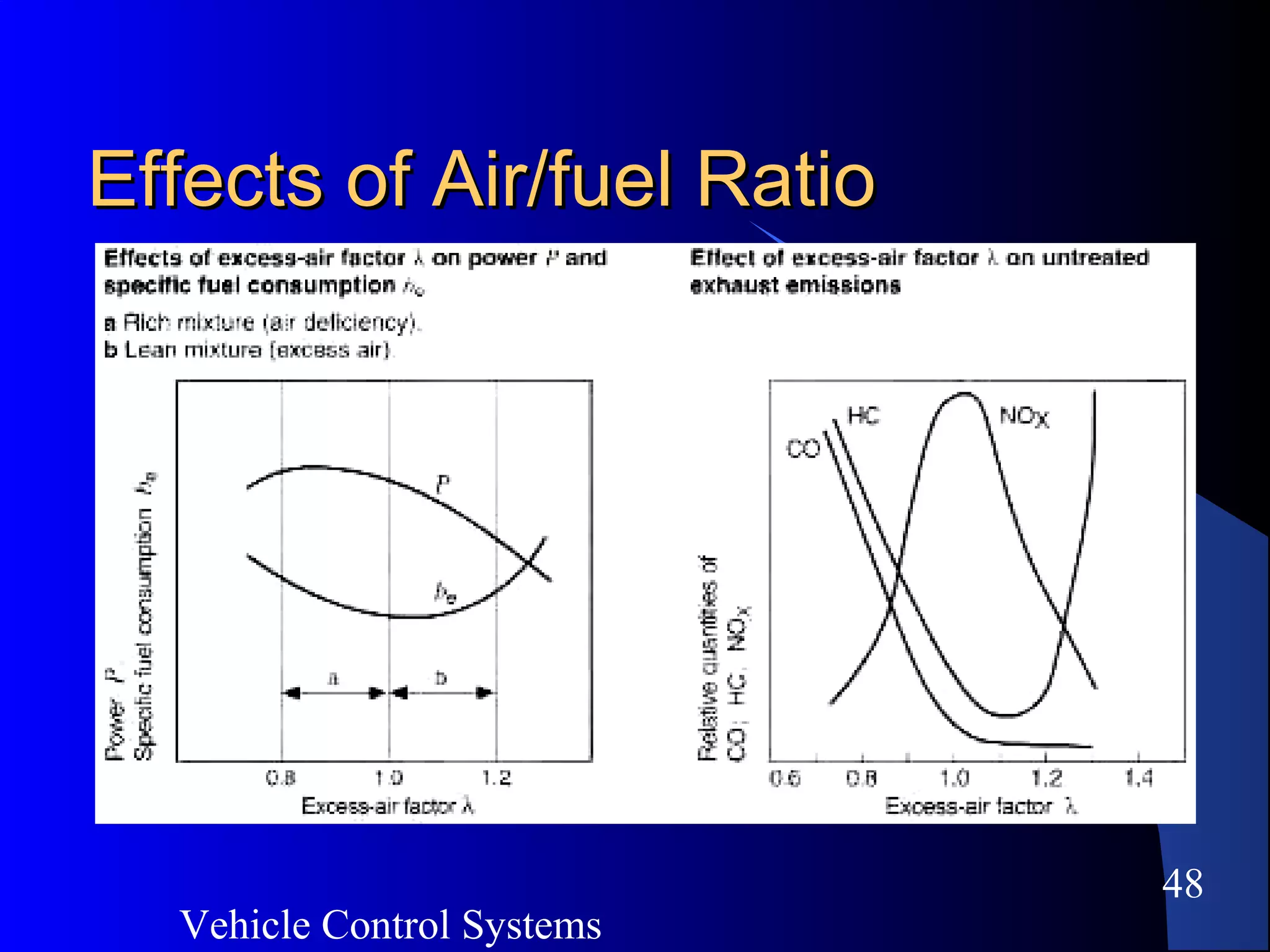
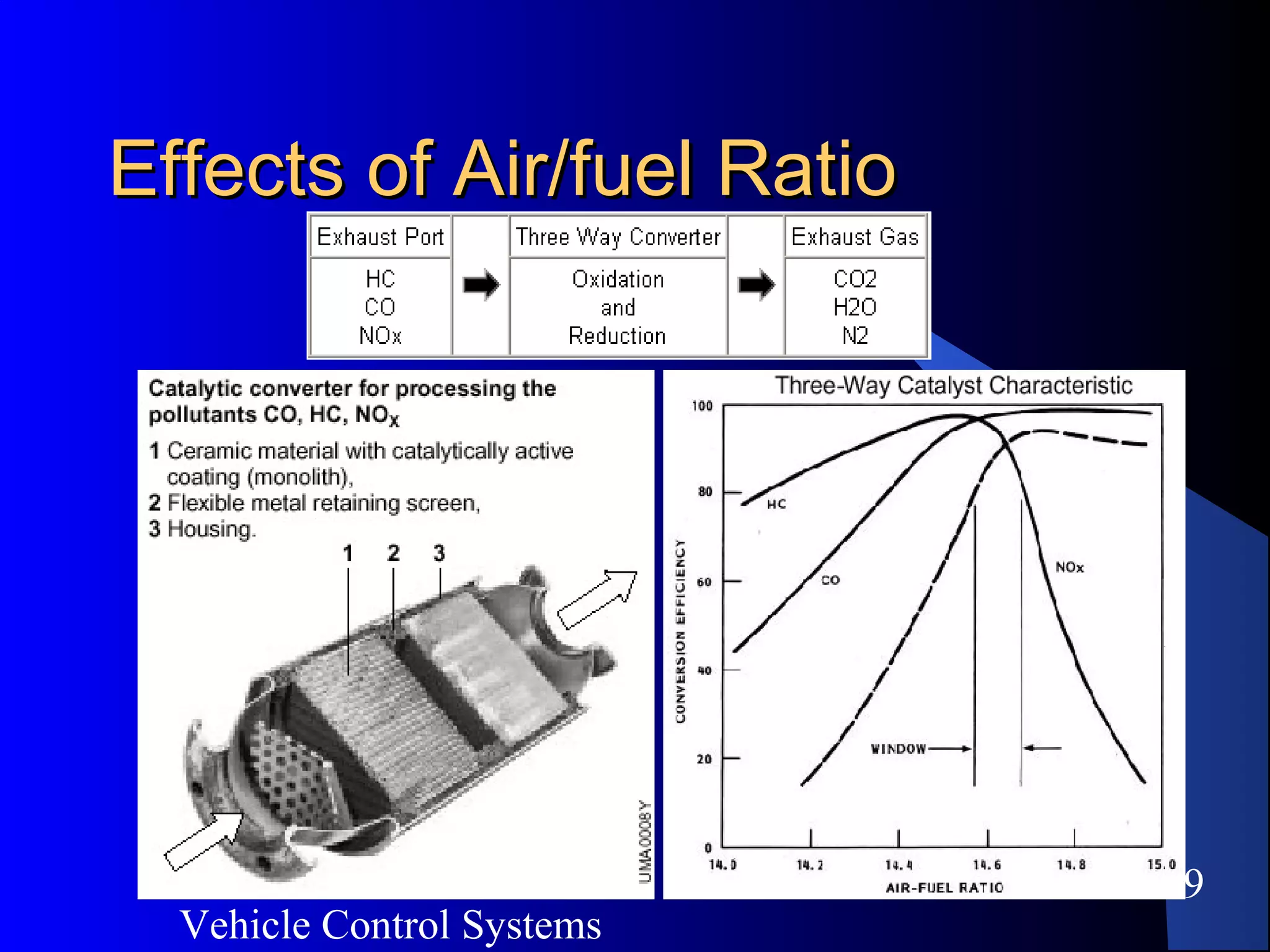
Effects of Air/fuel RatioEffects of Air/fuel Ratio
Vehicle Control Systems
49
Effects of Air/fuel RatioEffects of Air/fuel Ratio
Vehicle Control Systems
50
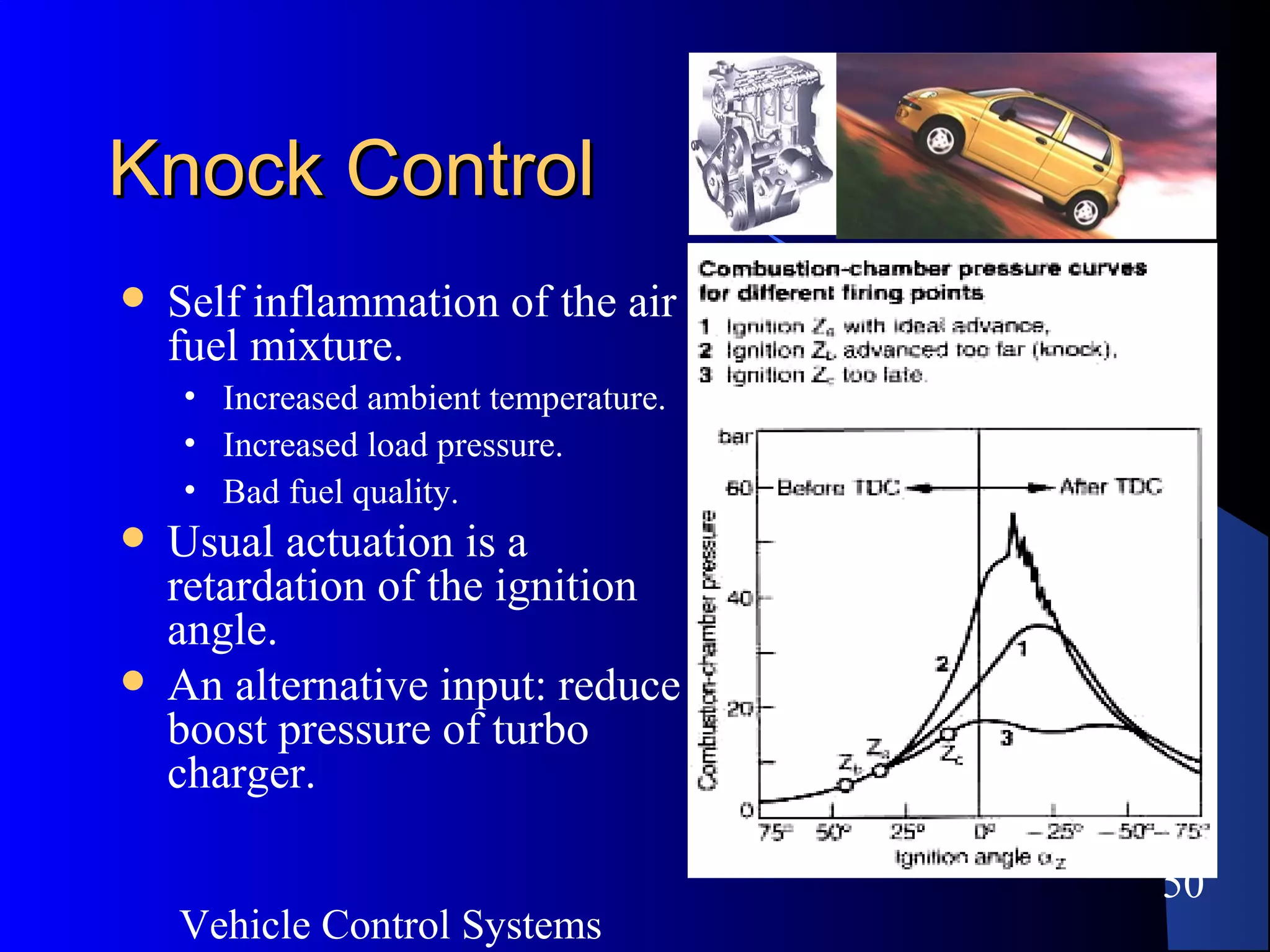
Knock ControlKnock Control
 Self inflammation of the air
fuel mixture.
• Increased ambient temperature.
• Increased load pressure.
• Bad fuel quality.
 Usual actuation is a
retardation of the ignition
angle.
 An alternative input: reduce
boost pressure of turbo
charger.
Vehicle Control Systems
51
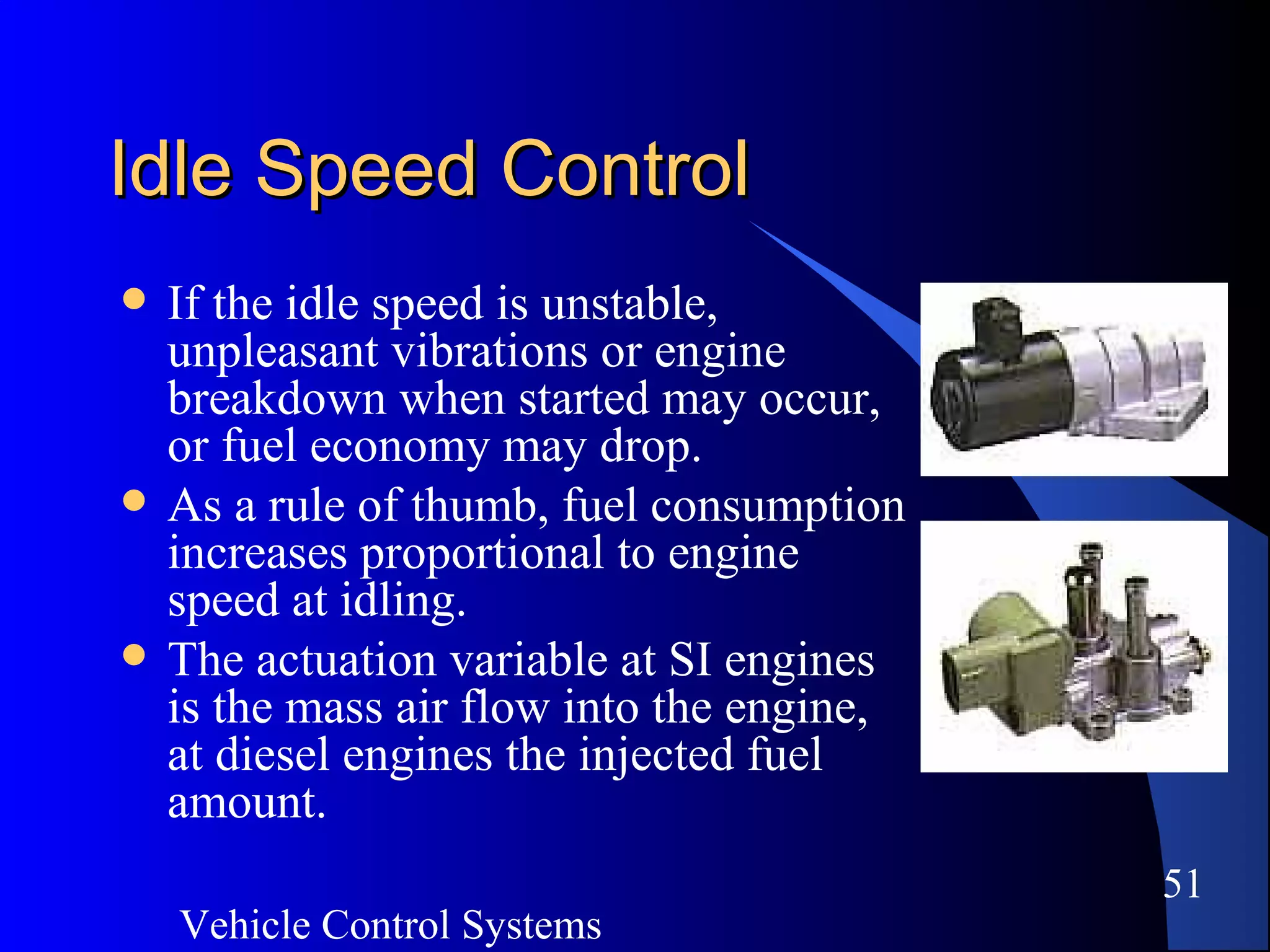
Idle Speed ControlIdle Speed Control
 If the idle speed is unstable,
unpleasant vibrations or engine
breakdown when started may occur,
or fuel economy may drop.
 As a rule of thumb, fuel consumption
increases proportional to engine
speed at idling.
 The actuation variable at SI engines
is the mass air flow into the engine,
at diesel engines the injected fuel
amount.
Vehicle Control Systems
52
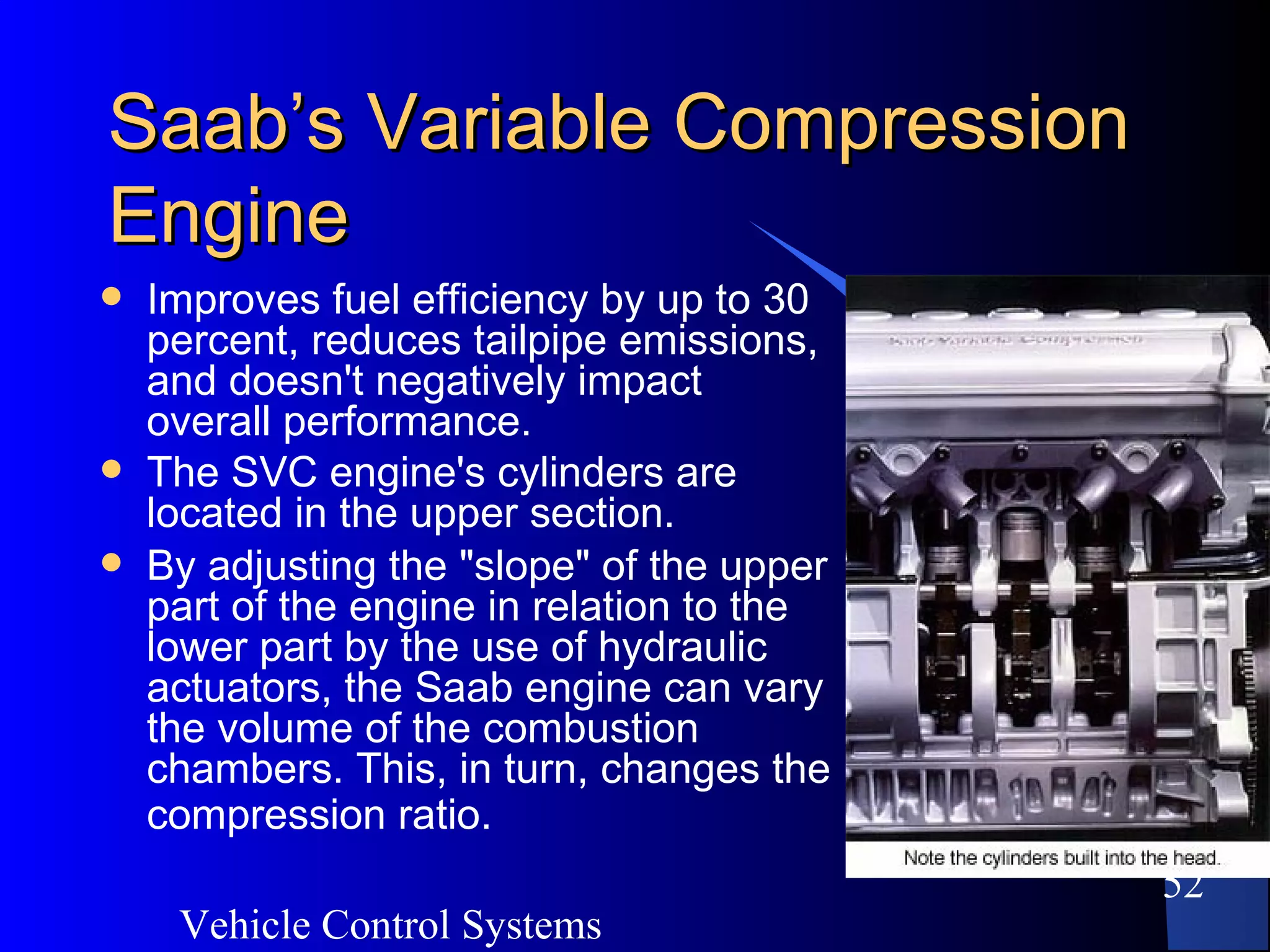
Saab’s Variable CompressionSaab’s Variable Compression
EngineEngine
 Improves fuel efficiency by up to 30
percent, reduces tailpipe emissions,
and doesn't negatively impact
overall performance.
 The SVC engine's cylinders are
located in the upper section.
 By adjusting the "slope" of the upper
part of the engine in relation to the
lower part by the use of hydraulic
actuators, the Saab engine can vary
the volume of the combustion
chambers. This, in turn, changes the
compression ratio.
Vehicle Control Systems
53
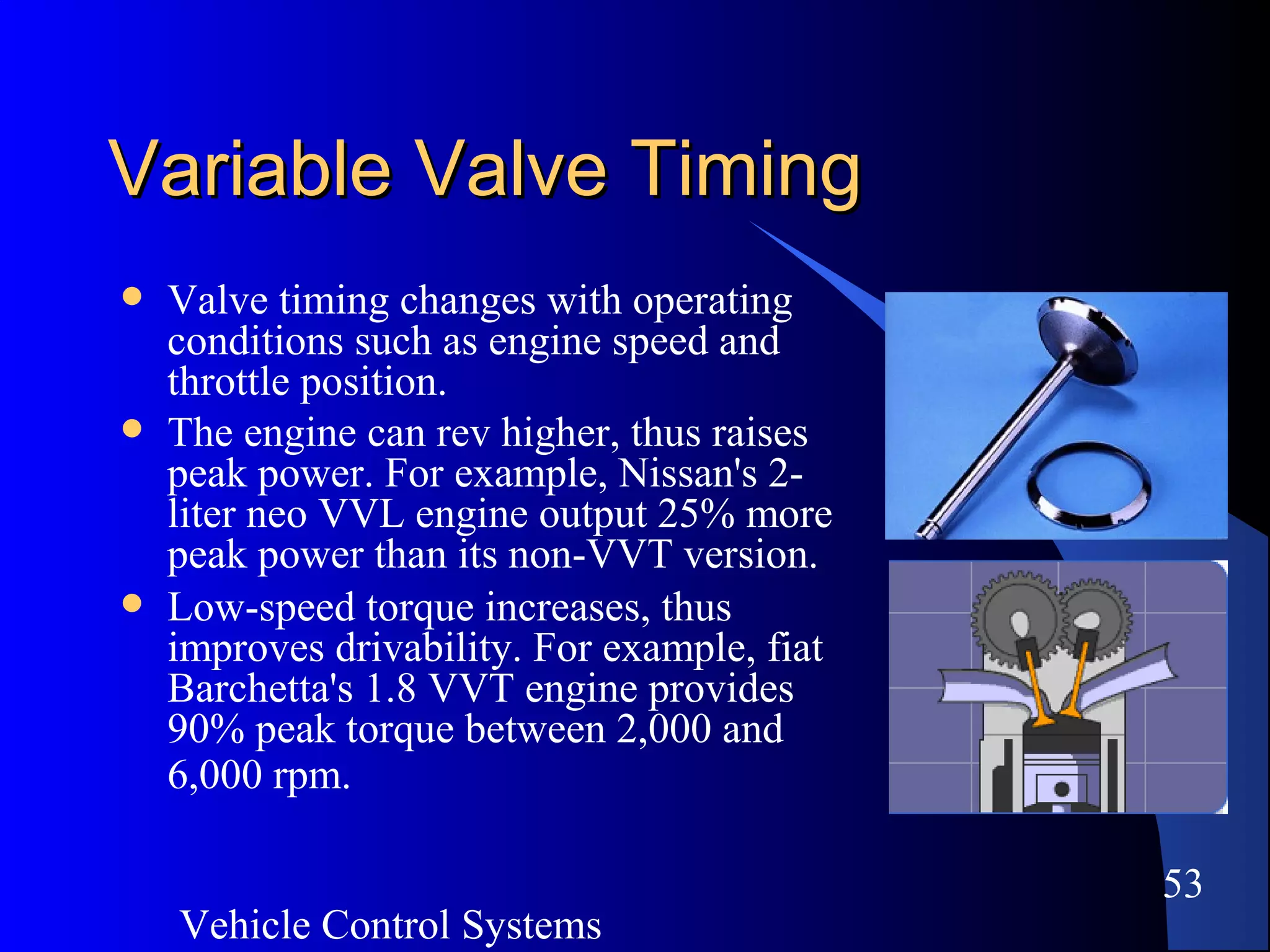
Variable Valve TimingVariable Valve Timing
 Valve timing changes with operating
conditions such as engine speed and
throttle position.
 The engine can rev higher, thus raises
peak power. For example, Nissan's 2-
liter neo VVL engine output 25% more
peak power than its non-VVT version.
 Low-speed torque increases, thus
improves drivability. For example, fiat
Barchetta's 1.8 VVT engine provides
90% peak torque between 2,000 and
6,000 rpm.
Vehicle Control Systems
54
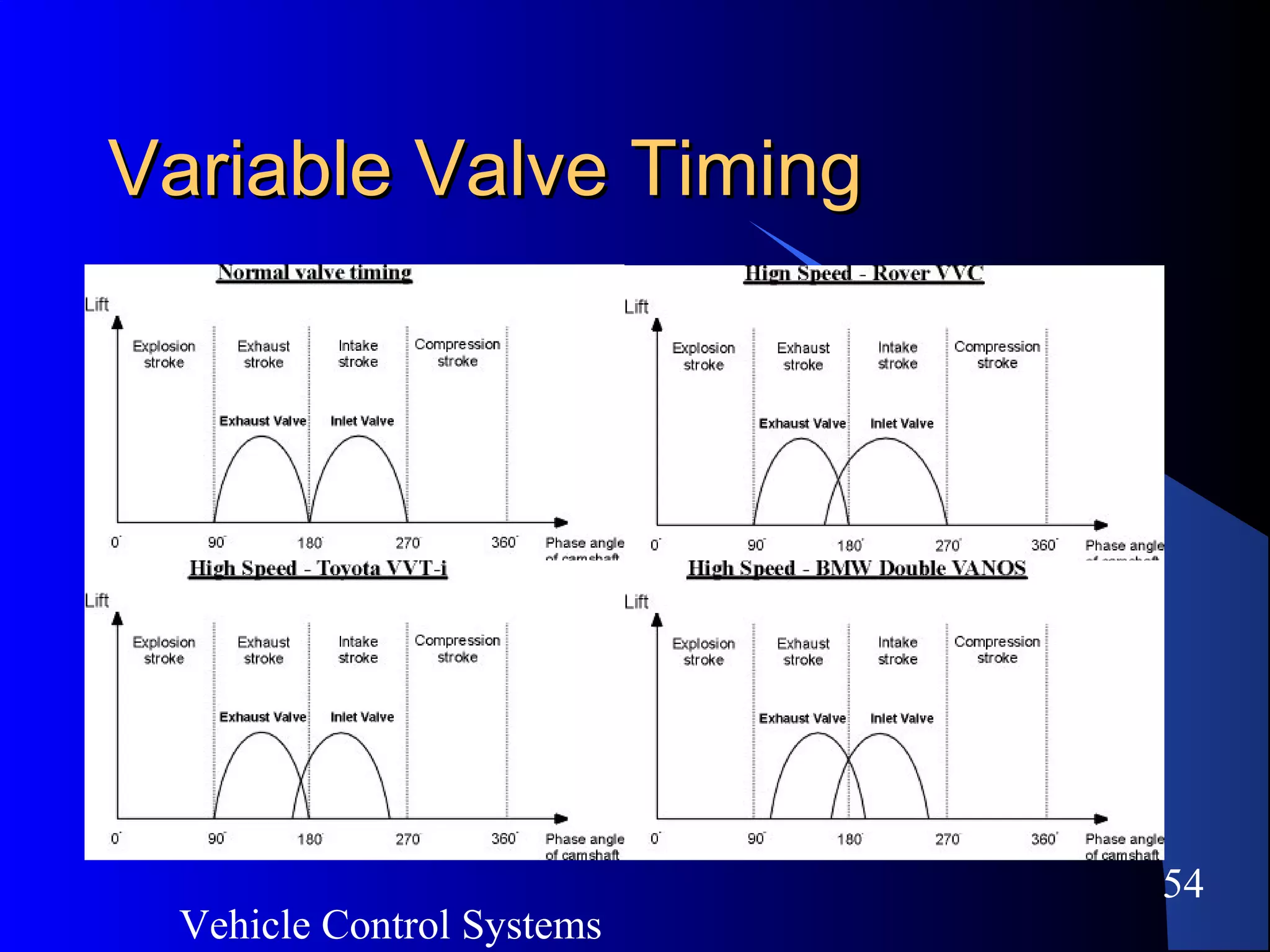
Variable Valve TimingVariable Valve Timing
Vehicle Control Systems
55
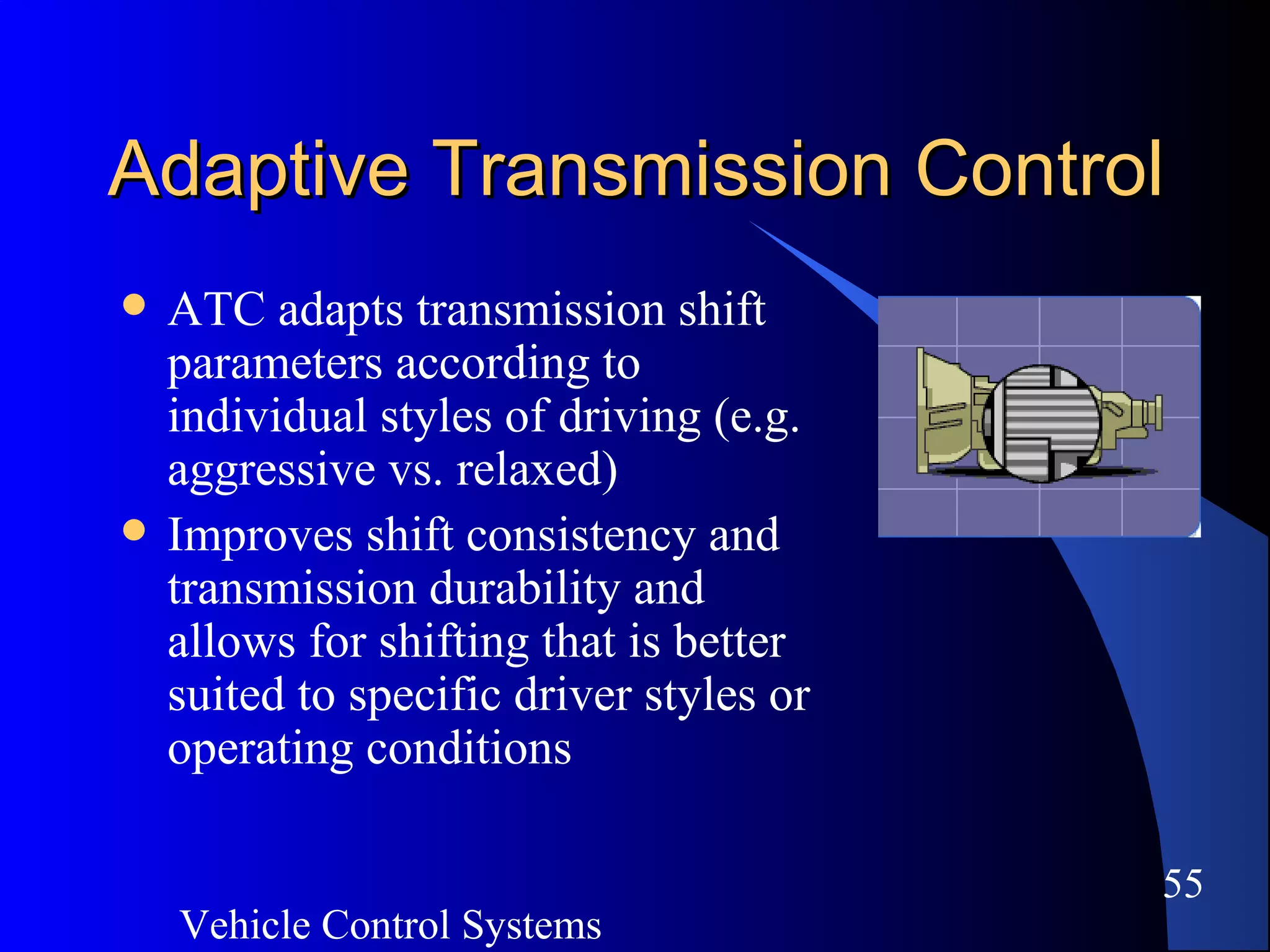
Adaptive Transmission ControlAdaptive Transmission Control
 ATC adapts transmission shift
parameters according to
individual styles of driving (e.g.
aggressive vs. relaxed)
 Improves shift consistency and
transmission durability and
allows for shifting that is better
suited to specific driver styles or
operating conditions
Vehicle Control Systems
56
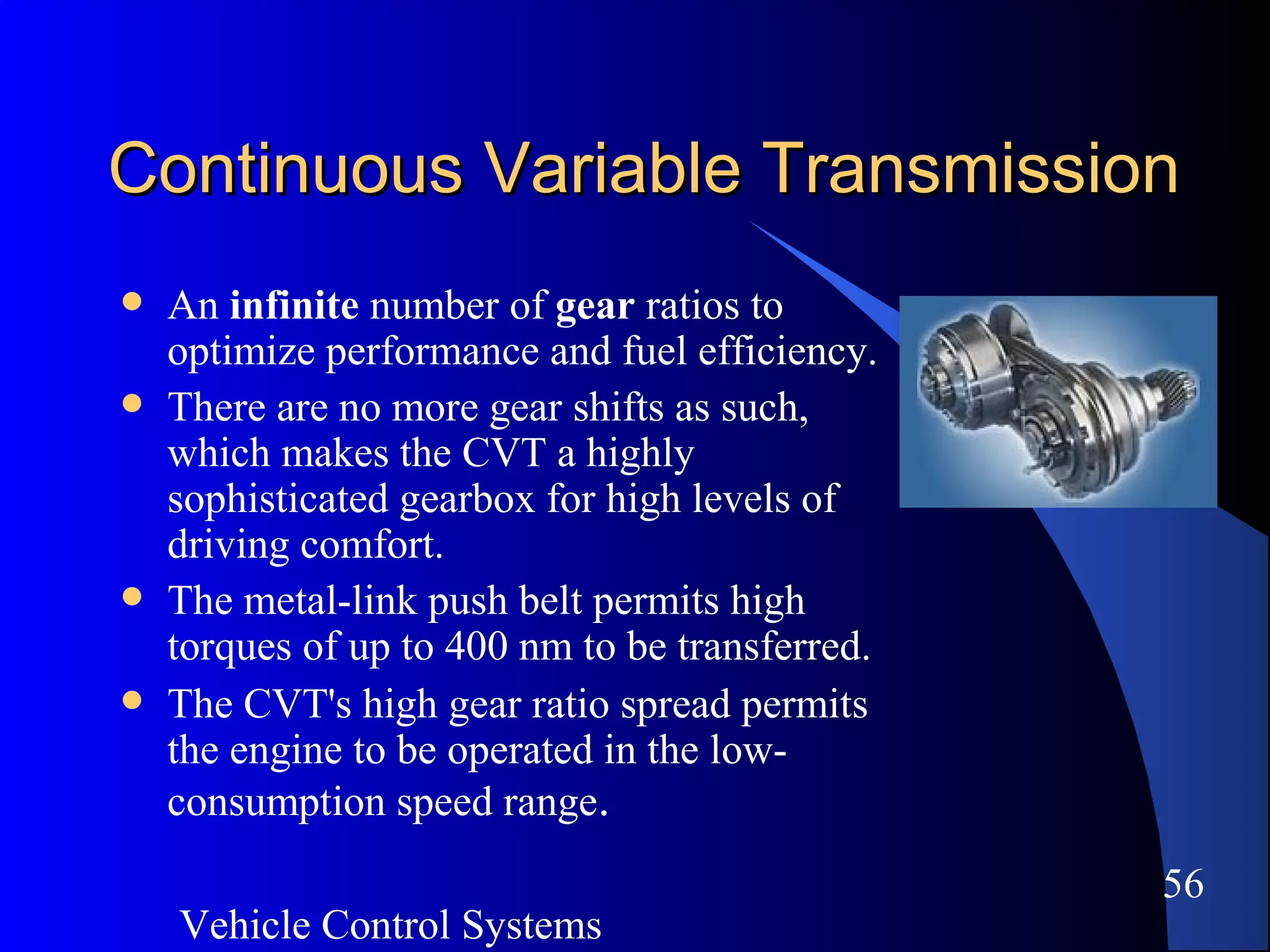
Continuous Variable TransmissionContinuous Variable Transmission
 An infinite number of gear ratios to
optimize performance and fuel efficiency.
 There are no more gear shifts as such,
which makes the CVT a highly
sophisticated gearbox for high levels of
driving comfort.
 The metal-link push belt permits high
torques of up to 400 nm to be transferred.
 The CVT's high gear ratio spread permits
the engine to be operated in the low-
consumption speed range.
Vehicle Control Systems
57
...‫دفتر‬ ‫اين‬ ‫آمد‬ ‫پايان‬ ‫به‬...‫دفتر‬ ‫اين‬ ‫آمد‬ ‫پايان‬ ‫به‬

An Overview of Vehicle Control Systems

  • 1.
    Vehicle Control SystemsVehicleControl Systems An Overview of Behzad Samadi Department of Electrical Engineering Amirkabir University of Technology
  • 2.
    Vehicle Control Systems 2 VehicleControl SystemsVehicle Control Systems  ABS  TCS  ESP  4WS  EPS  Active Suspension  AWD  Drive by Wire  ANC  AEM  ACC  S&G  ACA  OW  LW  A/F Ratio Control  Knock Control  Idle Speed Control  Variable Compression Engine  VVT  ATC  CVT
  • 3.
    Vehicle Control Systems 3 AntilockBraking System (ABS)Antilock Braking System (ABS) 1. Reduce stopping distance. 2. Maintain steerability. 3. Maintain lateral stability.
  • 4.
    Vehicle Control Systems 4 TheOperation of ABSThe Operation of ABS  Minimize stopping distance.  Maximize tire-road adhesion with wheel slip control.
  • 5.
    Vehicle Control Systems 5 TheOperation of ABSThe Operation of ABS
  • 6.
    Vehicle Control Systems 6 ABSComponentsABS Components  Wheel speed sensors.  Electronic control unit.  Hydraulic modulator.
  • 7.
    Vehicle Control Systems 7 WheelSpeed SensorWheel Speed Sensor Construction  Magnetic core with surrounding coil. Operation  Magnetic field changes as toothed gear wheel rotates.  AC signal frequency depends on wheel speed.  ECU senses signal and converts it to a square wave.
  • 8.
    Vehicle Control Systems 8 ABSin Action!ABS in Action!
  • 9.
    Vehicle Control Systems 9 TractionControl System (TCS)Traction Control System (TCS)  Traction control prevents a vehicle's wheels from spinning excessively while on slippery surfaces.  Traction control is intended as a driver aid which allows a vehicle to make better use of available traction on slippery surfaces.  It shares many of the mechanical and electronic elements of the ABS.
  • 10.
    Vehicle Control Systems 10 HowTCS Works?How TCS Works? Depending on the type of traction control system fitted to the vehicle, wheel spin is controlled by one or a combination of the following:  Brake application at one or more wheels.  Closing the throttle.  Retarding the spark.  Fuel cutout.  Leaner air/fuel ratio.
  • 11.
    Vehicle Control Systems 11 TCSin Action!TCS in Action!
  • 12.
    Vehicle Control Systems 12 ElectronicStability ProgramElectronic Stability Program  The electronic stability program helps improve cornering and control. By monitoring the slip at the wheels as well as the driver's steering and braking inputs, ESP can sense differences between the driver's intentions and the vehicle's direction in turns.
  • 13.
    Vehicle Control Systems 13 ESPPerformanceESP Performance
  • 14.
    Vehicle Control Systems 14 ESPOperationESP Operation
  • 15.
    Vehicle Control Systems 15 ESPOperationESP Operation
  • 16.
    Vehicle Control Systems 16 ESPComponentsESP Components A) active wheel speed sensors B) steering angle sensor C) combined yaw rate sensor/lateral accelerometer D) attached electronic control unit (ECU) E) motor F) pressure sensor G) hydraulic unit
  • 17.
    Vehicle Control Systems 17 ESPComponentsESP Components
  • 18.
    Vehicle Control Systems 18 Automakers& Stability ControlAutomakers & Stability Control  Audi: electronic stability program (ESP).  BMW: dynamic stability control (DSC).  DaimlerChrysler: electronic stability program (ESP).  Ford motor company: advance Trac.  General motors: active handling system (corvette), precision control system (Oldsmobile), Stabilitrak (Pontiac, Buick, Cadillac).  Jaguar: dynamic stability control (DSC).  Lexus: vehicle skid control (VSC)  Porsche: Porsche stability management (PSM).  Volkswagen: electronic stability program (ESP).  Volvo: dynamic stability traction control (DSTC).
  • 19.
    Vehicle Control Systems 19 ESPin Action!ESP in Action!
  • 20.
    Vehicle Control Systems 20 FourWheel SteerFour Wheel Steer  Improve low-speed maneuverability.  Smallest possible turn radius.  Improved handling at high-speed.  Increased vehicle stability.
  • 21.
    Vehicle Control Systems 21 ElectricPower SteeringElectric Power Steering  Reduced engine drain.  Improved fuel economy and acceleration.  Instant-on power steering.  Added dependability and assist even with engine off.
  • 22.
    Vehicle Control Systems 22 ActiveSuspensionActive Suspension  Active suspension systems move each wheel up and down to control body motion in response to road abnormalities.  With an active suspension, a vehicle can simultaneously provide the smooth ride of a soft suspension along with superior handling associated with a firm suspension.
  • 23.
    Vehicle Control Systems 23 ActiveBody ControlActive Body Control
  • 24.
    Vehicle Control Systems 24 DynamicBody ControlDynamic Body Control
  • 25.
    Vehicle Control Systems 25 ActiveBody ControlActive Body Control
  • 26.
    Vehicle Control Systems 26 SuspensionControl in Action!Suspension Control in Action!
  • 27.
    Vehicle Control Systems 27 SuspensionControl in Action!Suspension Control in Action!
  • 28.
    Vehicle Control Systems 28 AllWheel DriveAll Wheel Drive  When accelerating, weight shifts to the rear, reducing traction in front and AWD direct power to the rear wheels.  When braking, weight shifts forward, reducing traction in back. With AWD, power is instantly directed to the front wheels for better steering control and braking performance.
  • 29.
    Vehicle Control Systems 29 AllWheel DriveAll Wheel Drive  Whether icy, oily, wet, or rough, if front wheels start to slip, AWD system instantly directs power the rear wheels; If rear wheels start to slip, power is directed to the front wheels.  The power is automatically transferred to the wheels with the best traction. Unwanted understeer and oversteer is virtually eliminated.
  • 30.
    Vehicle Control Systems 30 Driveby WireDrive by Wire  Replacement of traditional mechanical systems for steering, braking, throttle and suspension functions, with electronic controller, actuators and sensors.
  • 31.
    Vehicle Control Systems 31 Brakeby WireBrake by Wire  The braking process is triggered in the conventional manner by the brake pedal; In the process, the pedal pressure and pedal travel are measured by sensors and converted into electronic signals for the electronic control unit (ECU). The unit that is activated in this way controls the four actuators at the wheel brakes. The brake pads are therefore forced together and opened electromechanically and no longer hydraulically.
  • 32.
    Vehicle Control Systems 32 SensotronicBrake ControlSensotronic Brake Control  Mechanical components are replaced by electronics.  Sensors pass the master cylinder pressure and the speed with which the brake pedal is operated, to the SBC computer.  To provide the driver with the familiar brake feel, a special simulator is linked to the tandem master cylinder.  Only in the event of a major fault or power failure does SBC instantly establishes a direct hydraulic link between the brake pedal and the front wheel brakes.
  • 33.
    Vehicle Control Systems 33 SensotronicBrake ControlSensotronic Brake Control
  • 34.
    Vehicle Control Systems 34 SensotronicBrake ControlSensotronic Brake Control
  • 35.
    Vehicle Control Systems 35 Steerby WireSteer by Wire  Steer-by-wire system eliminates the mechanical connection between the driver and the vehicle’s front tires. The traditional steering elements are replaced by two actuators positioned in the vehicle’s front corners. These actuators receive input from the control module and turn the front wheels accordingly. The system also uses an electric motor to provide road feedback to the driver’s hand wheel.
  • 36.
    Vehicle Control Systems 36 ElectronicThrottle ControlElectronic Throttle Control  Electronic throttle control (ETC) replaces the throttle cables that run from the accelerator pedal to the engine.
  • 37.
    Vehicle Control Systems 37 ActiveNoise ControlActive Noise Control  Traditionally noise is controlled by passive methods: enclosures, barriers and silencers.  Active control is used when passive noise control methods don’t work.  Secondary sources are used to cancel noise from primary source(s) by introducing “antinoise”.
  • 38.
    Vehicle Control Systems 38 ActiveVibration ControlActive Vibration Control  The primary way to cut off paths of noise and vibration from engine is to use soft mounts. However, engine mounts must also constrain or control engine excursions caused by rough roads, firing in cylinders, wheel torque reactions, etc. To limit engine motions, the engine mounts should be stiff and heavily damped. These conflicting requests on engine mounts have prompted automotive industries to search for a new engine mounting method.
  • 39.
    Vehicle Control Systems 39 CruiseControlCruise Control  The cruise control system controls the speed of your car the same way you do by adjusting the throttle position.
  • 40.
    Vehicle Control Systems 40 AdaptiveCruise ControlAdaptive Cruise Control  Adaptive cruise control (ACC) improves on traditional cruise control by allowing a vehicle to automatically adapt to the speed of highway traffic.
  • 41.
    Vehicle Control Systems 41 Stopand GoStop and Go  The Stop & Go function maintains longitudinal car control at low speeds, e.g. when queuing on a motorway or waiting at a traffic light.
  • 42.
    Vehicle Control Systems 42 AntiCollision AssistAnti Collision Assist  This system helps prevent collisions by sending the driver an acoustic or visual signal to warn of the presence of standing or slow-moving obstacles in the car's path. The system also acts on the car's brakes when necessary.
  • 43.
    Vehicle Control Systems 43 OvertakingWarningOvertaking Warning  The blind spot coverage sensor warns of the presence of vehicles about to enter the side area not covered by the door mirrors. The sensor turns on a warning light, which can be used in conjunction with the door mirror. The warning signal becomes acoustic when the turn signal is activated.
  • 44.
    Vehicle Control Systems 44 LaneWarningLane Warning  This additional driving support function automatically detects car position in relation to lane boundaries. The system issues an advance warning if the car inadvertently crosses the lane boundaries. The road in front of the car is filmed by a micro TV camera and the driver may select between tactile or acoustic indicators.
  • 45.
    Vehicle Control Systems 45 EngineControl SystemsEngine Control Systems
  • 46.
    Vehicle Control Systems 46 EngineControl SystemsEngine Control Systems
  • 47.
    Vehicle Control Systems 47 Air/fuelRatio ControlAir/fuel Ratio Control  A fuel injector is an electronically controlled valve. It is supplied with pressurized fuel by the fuel- pump in your car.  Two different injection systems: • Manifold injection. • In-cylinder injection.  Lambda: 14.7:1
  • 48.
    Vehicle Control Systems 48 Effectsof Air/fuel RatioEffects of Air/fuel Ratio
  • 49.
    Vehicle Control Systems 49 Effectsof Air/fuel RatioEffects of Air/fuel Ratio
  • 50.
    Vehicle Control Systems 50 KnockControlKnock Control  Self inflammation of the air fuel mixture. • Increased ambient temperature. • Increased load pressure. • Bad fuel quality.  Usual actuation is a retardation of the ignition angle.  An alternative input: reduce boost pressure of turbo charger.
  • 51.
    Vehicle Control Systems 51 IdleSpeed ControlIdle Speed Control  If the idle speed is unstable, unpleasant vibrations or engine breakdown when started may occur, or fuel economy may drop.  As a rule of thumb, fuel consumption increases proportional to engine speed at idling.  The actuation variable at SI engines is the mass air flow into the engine, at diesel engines the injected fuel amount.
  • 52.
    Vehicle Control Systems 52 Saab’sVariable CompressionSaab’s Variable Compression EngineEngine  Improves fuel efficiency by up to 30 percent, reduces tailpipe emissions, and doesn't negatively impact overall performance.  The SVC engine's cylinders are located in the upper section.  By adjusting the "slope" of the upper part of the engine in relation to the lower part by the use of hydraulic actuators, the Saab engine can vary the volume of the combustion chambers. This, in turn, changes the compression ratio.
  • 53.
    Vehicle Control Systems 53 VariableValve TimingVariable Valve Timing  Valve timing changes with operating conditions such as engine speed and throttle position.  The engine can rev higher, thus raises peak power. For example, Nissan's 2- liter neo VVL engine output 25% more peak power than its non-VVT version.  Low-speed torque increases, thus improves drivability. For example, fiat Barchetta's 1.8 VVT engine provides 90% peak torque between 2,000 and 6,000 rpm.
  • 54.
    Vehicle Control Systems 54 VariableValve TimingVariable Valve Timing
  • 55.
    Vehicle Control Systems 55 AdaptiveTransmission ControlAdaptive Transmission Control  ATC adapts transmission shift parameters according to individual styles of driving (e.g. aggressive vs. relaxed)  Improves shift consistency and transmission durability and allows for shifting that is better suited to specific driver styles or operating conditions
  • 56.
    Vehicle Control Systems 56 ContinuousVariable TransmissionContinuous Variable Transmission  An infinite number of gear ratios to optimize performance and fuel efficiency.  There are no more gear shifts as such, which makes the CVT a highly sophisticated gearbox for high levels of driving comfort.  The metal-link push belt permits high torques of up to 400 nm to be transferred.  The CVT's high gear ratio spread permits the engine to be operated in the low- consumption speed range.
  • 57.
    Vehicle Control Systems 57 ...‫دفتر‬‫اين‬ ‫آمد‬ ‫پايان‬ ‫به‬...‫دفتر‬ ‫اين‬ ‫آمد‬ ‫پايان‬ ‫به‬