How to develop effective
monitoring & Evaluation Plan
Amutha Pannerselvam
Understand the terminology
Monitoring:
 Monitoring refers to setting targets and milestones to
measure progress and achievement, and whether the inputs
are producing the planned outputs.
“In other words, monitoring sees whether the project is
consistent with the design”
Evaluation:
 Evaluation is a structured process of assessing the success
of a project in meeting its goals and to reflect on the lessons
learned.
Amutha Pannerselvam
Difference between M & E
 The key difference between
monitoring and evaluation is,
evaluation is about placing a value
judgment on the information gathered
during a project, including the
monitoring data.
Amutha Pannerselvam
Need of M&E
 To assess whether a project has achieved its
intended goals
 To understand how the project has achieved
its intended purpose, or why it may not have
done so
 To identify how efficient the project was in
converting resources (funded and in-kind)
into activities, objectives and goals
 To assess how sustainable and meaningful
the project was for participants
 To inform decision makers about how to build
on or improve a project.
Amutha Pannerselvam
Elements of M&E/ Points being
considered in M&E process
 Activities
 Efficiency
 Effectiveness
 Impact
 Qualitative
 Quantitative
 Outcome
 Relevance
 Sustainability
Amutha Pannerselvam
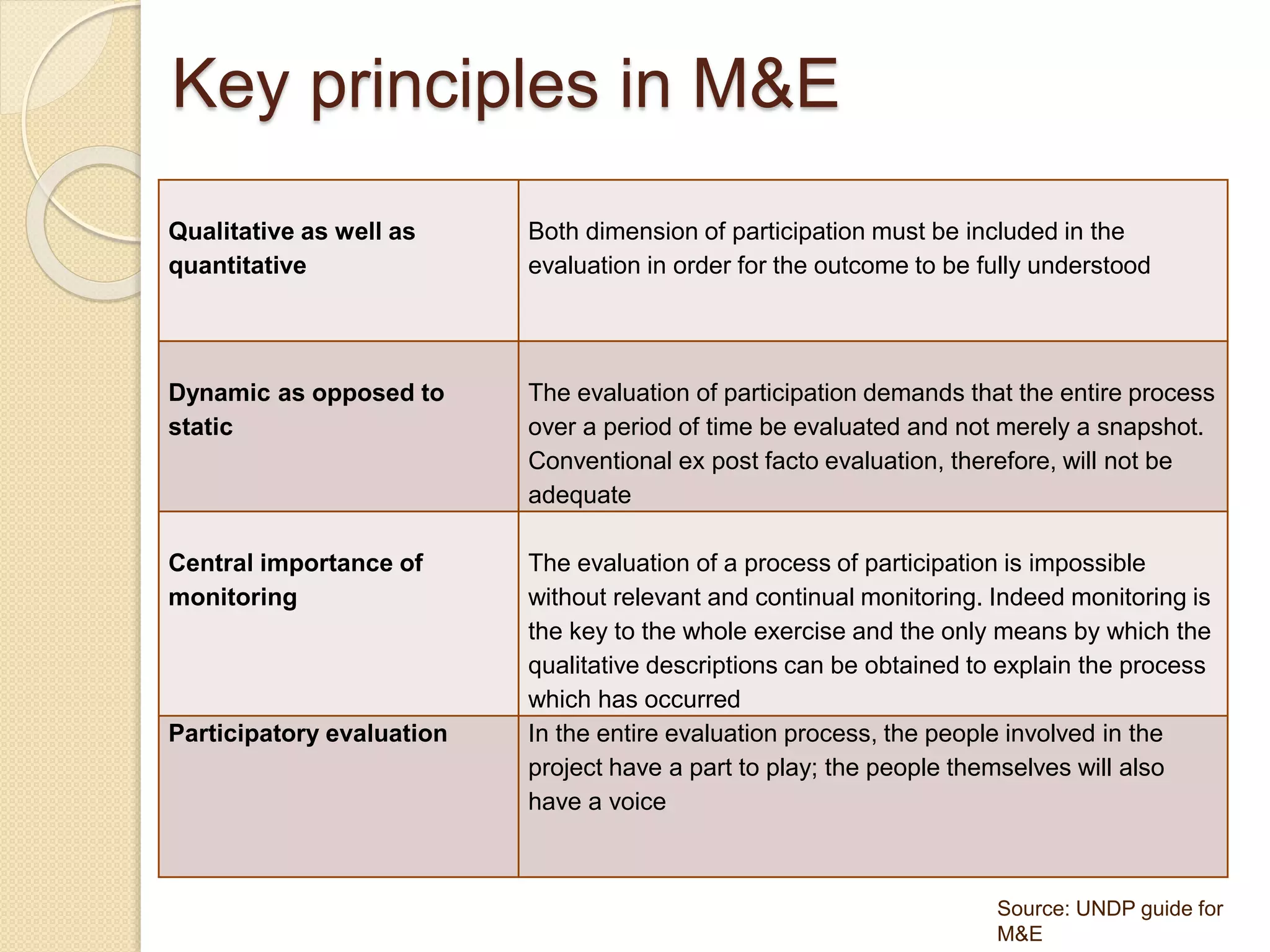
Key principles in M&E
Qualitative as well as
quantitative
Both dimension of participation must be included in the
evaluation in order for the outcome to be fully understood
Dynamic as opposed to
static
The evaluation of participation demands that the entire process
over a period of time be evaluated and not merely a snapshot.
Conventional ex post facto evaluation, therefore, will not be
adequate
Central importance of
monitoring
The evaluation of a process of participation is impossible
without relevant and continual monitoring. Indeed monitoring is
the key to the whole exercise and the only means by which the
qualitative descriptions can be obtained to explain the process
which has occurred
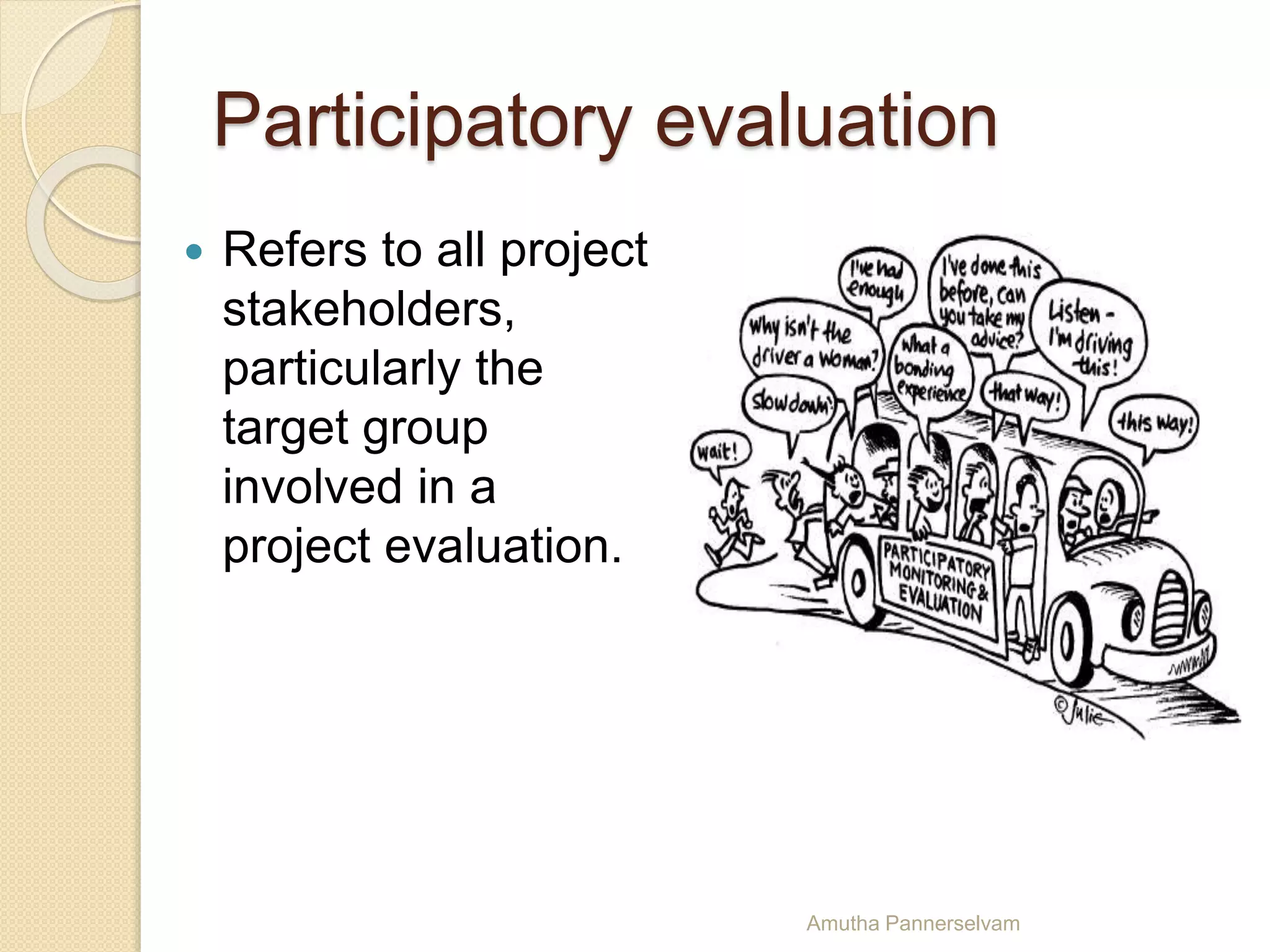
Participatory evaluation In the entire evaluation process, the people involved in the
project have a part to play; the people themselves will also
have a voice
Source: UNDP guide for
M&E
Types of Evaluation based on
process
 In broader we can divide evaluation as internal
evaluation, external evaluation and self evaluation
Internal evaluation :
 Evaluation by individuals who belong to the
management of the donor or implementing
organization
External evaluation
 Evaluation by institutions/individuals who belong
neither to the donor nor to the implementing
organization
Self evaluation:
 Evaluation by the professionals who implement the
activities Amutha Pannerselvam
Types of evaluation based on
character
 Evaluation can be characterized as
being either formative or summative
and goal based evaluation .
 Broadly, formative evaluation looks at
what leads to an intervention working
(the process), whereas summative
evaluation looks at the short-term to
long-term outcomes of an intervention
on the target group.
Amutha Pannerselvam
Formative evaluation
 Formative evaluation takes place in
the lead up to the project, as well as
during the project in order to improve
the project design as it is being
implemented (continual improvement).
Formative evaluation often lends itself
to qualitative methods of inquiry.
Amutha Pannerselvam
Summative evaluation
 Summative evaluation takes place during
and following the project implementation,
and is associated with more objective,
quantitative methods. The distinction
between formative and summative
evaluation can become blurred.
Generally it is important to know both
how an intervention works, as well as if it
worked. It is therefore important to
capture and assess both qualitative and
quantitative data.
Amutha PAnnerselvam
Goal based evaluation
 Evaluation has typically involved
measuring whether predetermined
targets have been met. You may be
familiar with the term ‘SMART’
(Specific, Measurable, Attainable,
Relevant, and Timely) targets. These
type of targets fall under the banner of
goals-based evaluation
Amutha Pannerselvam
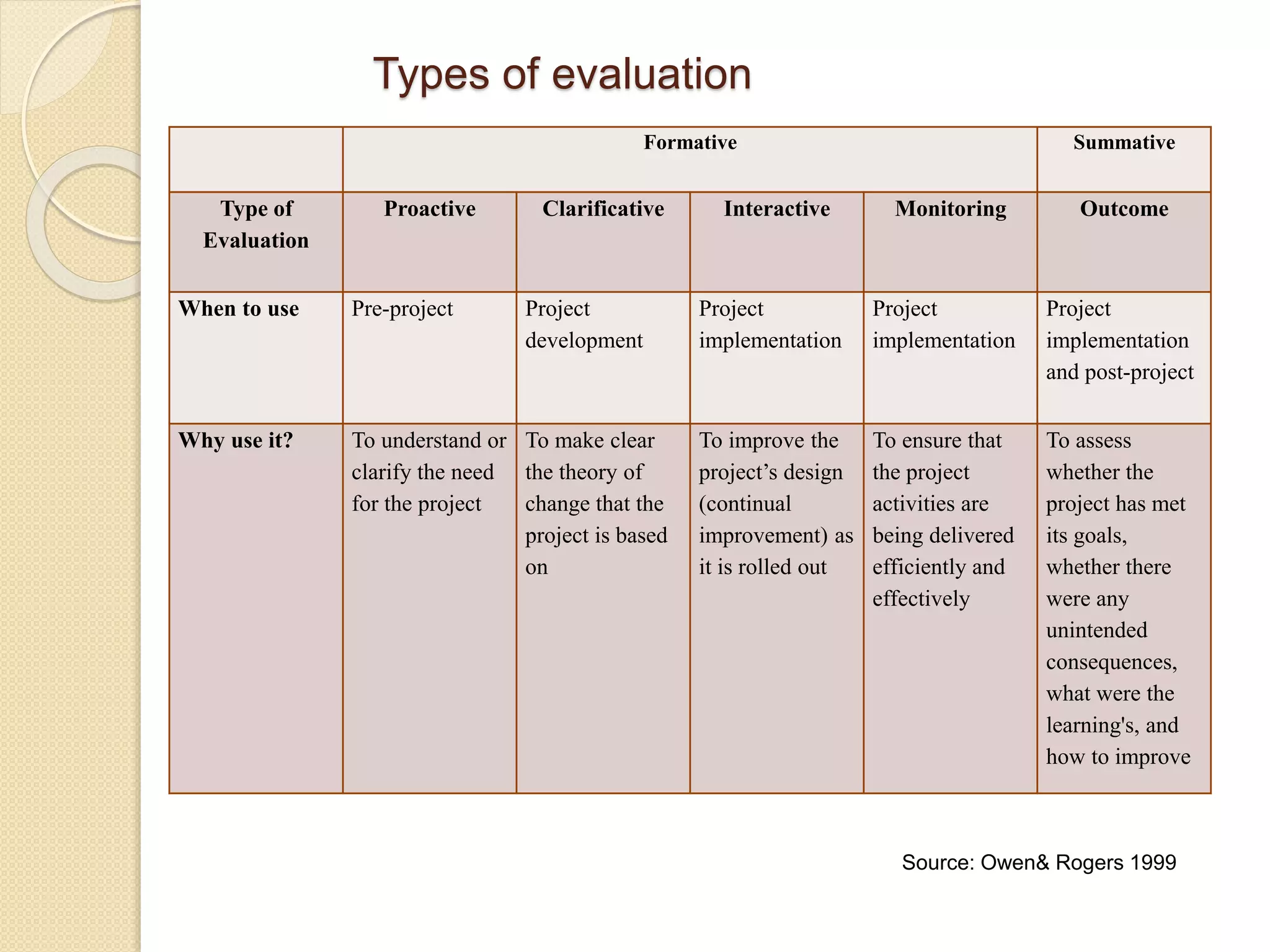
Types of evaluation
Formative Summative
Type of
Evaluation
Proactive Clarificative Interactive Monitoring Outcome
When to use Pre-project Project
development
Project
implementation
Project
implementation
Project
implementation
and post-project
Why use it? To understand or
clarify the need
for the project
To make clear
the theory of
change that the
project is based
on
To improve the
project’s design
(continual
improvement) as
it is rolled out
To ensure that
the project
activities are
being delivered
efficiently and
effectively
To assess
whether the
project has met
its goals,
whether there
were any
unintended
consequences,
what were the
learning's, and
how to improve
Source: Owen& Rogers 1999
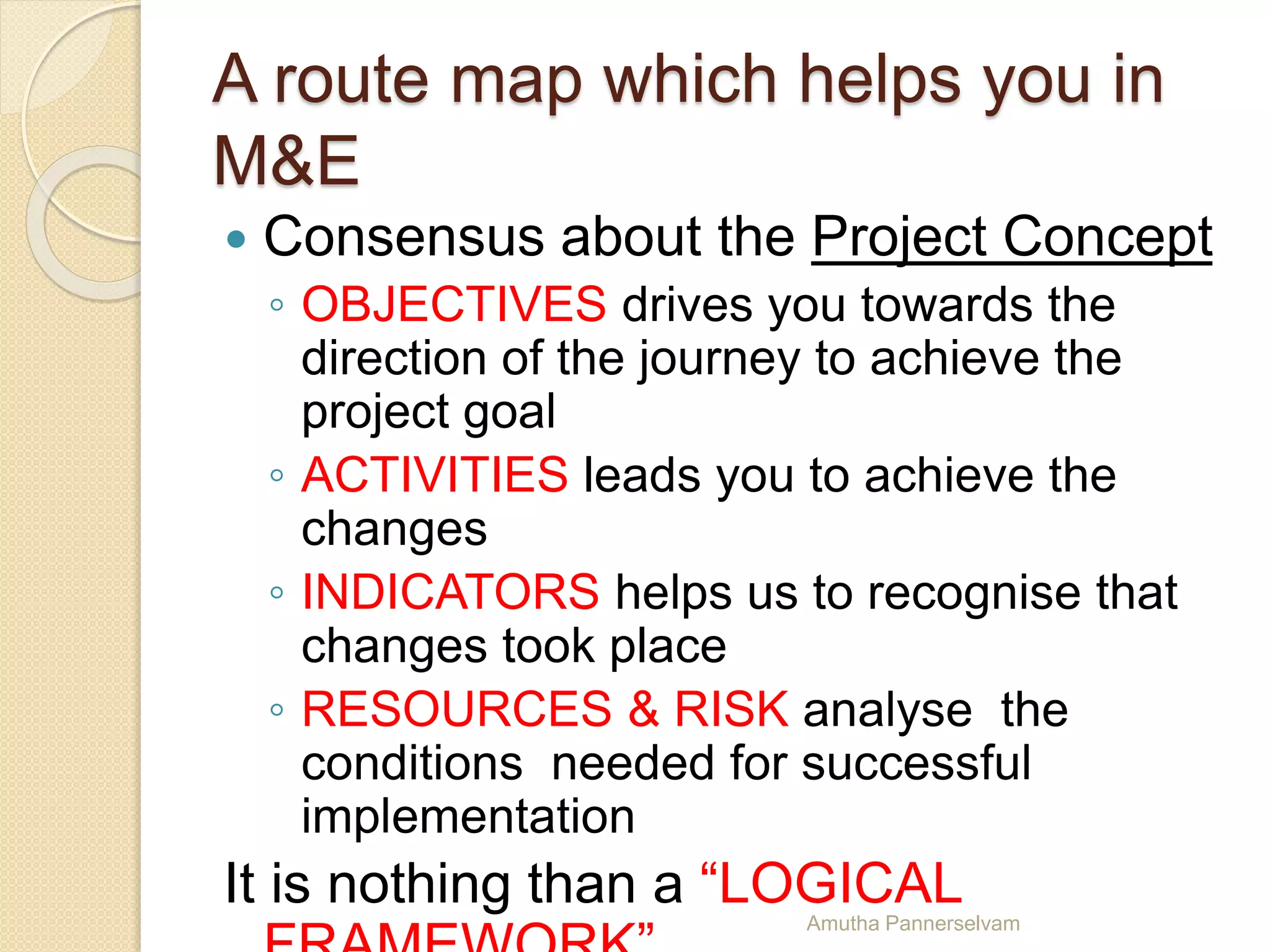
A route map which helps you in
M&E
 Consensus about the Project Concept
◦ OBJECTIVES drives you towards the
direction of the journey to achieve the
project goal
◦ ACTIVITIES leads you to achieve the
changes
◦ INDICATORS helps us to recognise that
changes took place
◦ RESOURCES & RISK analyse the
conditions needed for successful
implementation
It is nothing than a “LOGICALAmutha Pannerselvam
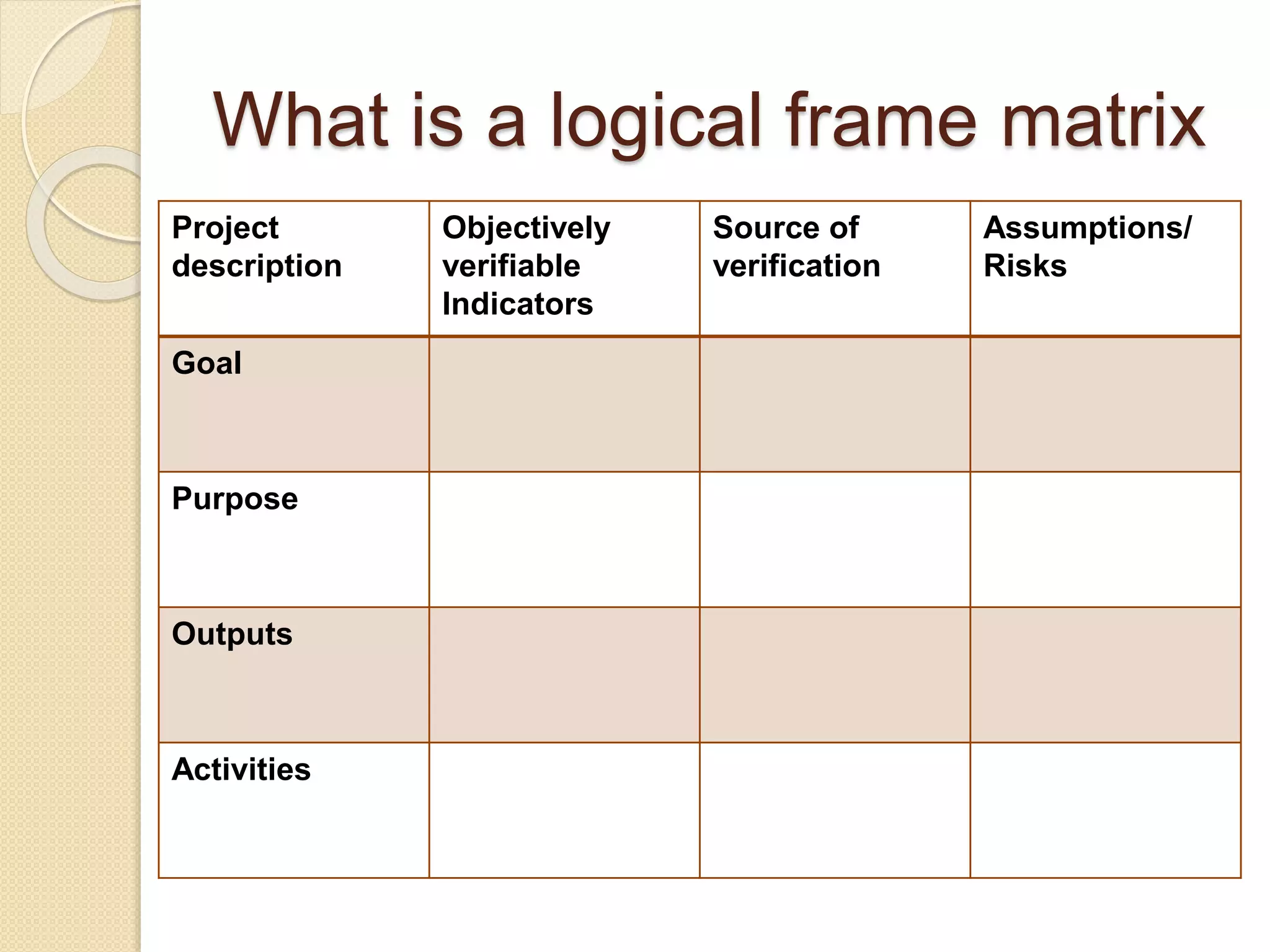
What is a logical frame matrix
Project
description
Objectively
verifiable
Indicators
Source of
verification
Assumptions/
Risks
Goal
Purpose
Outputs
Activities
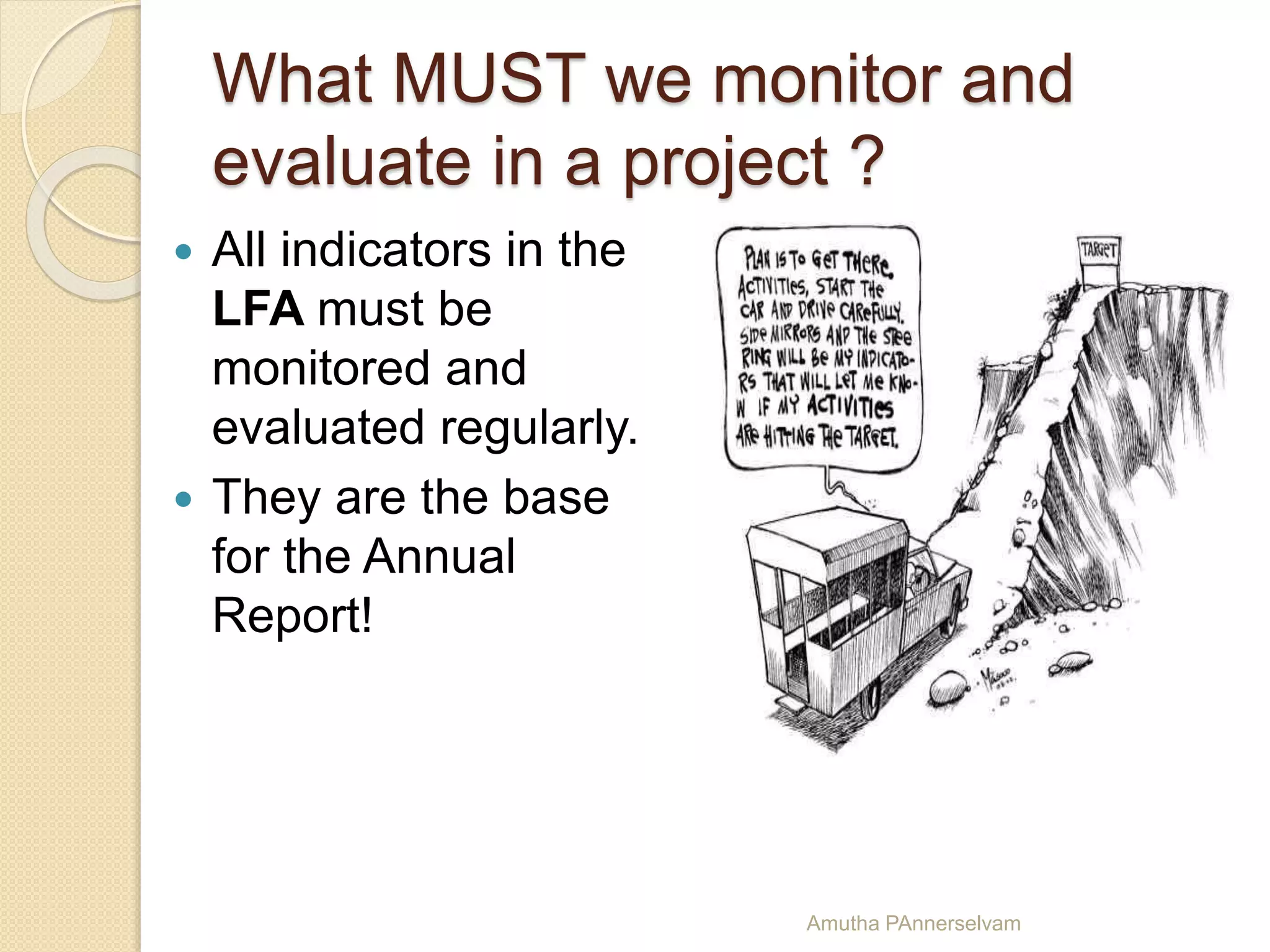
What MUST we monitor and
evaluate in a project ?
 All indicators in the
LFA must be
monitored and
evaluated regularly.
 They are the base
for the Annual
Report!
Amutha PAnnerselvam
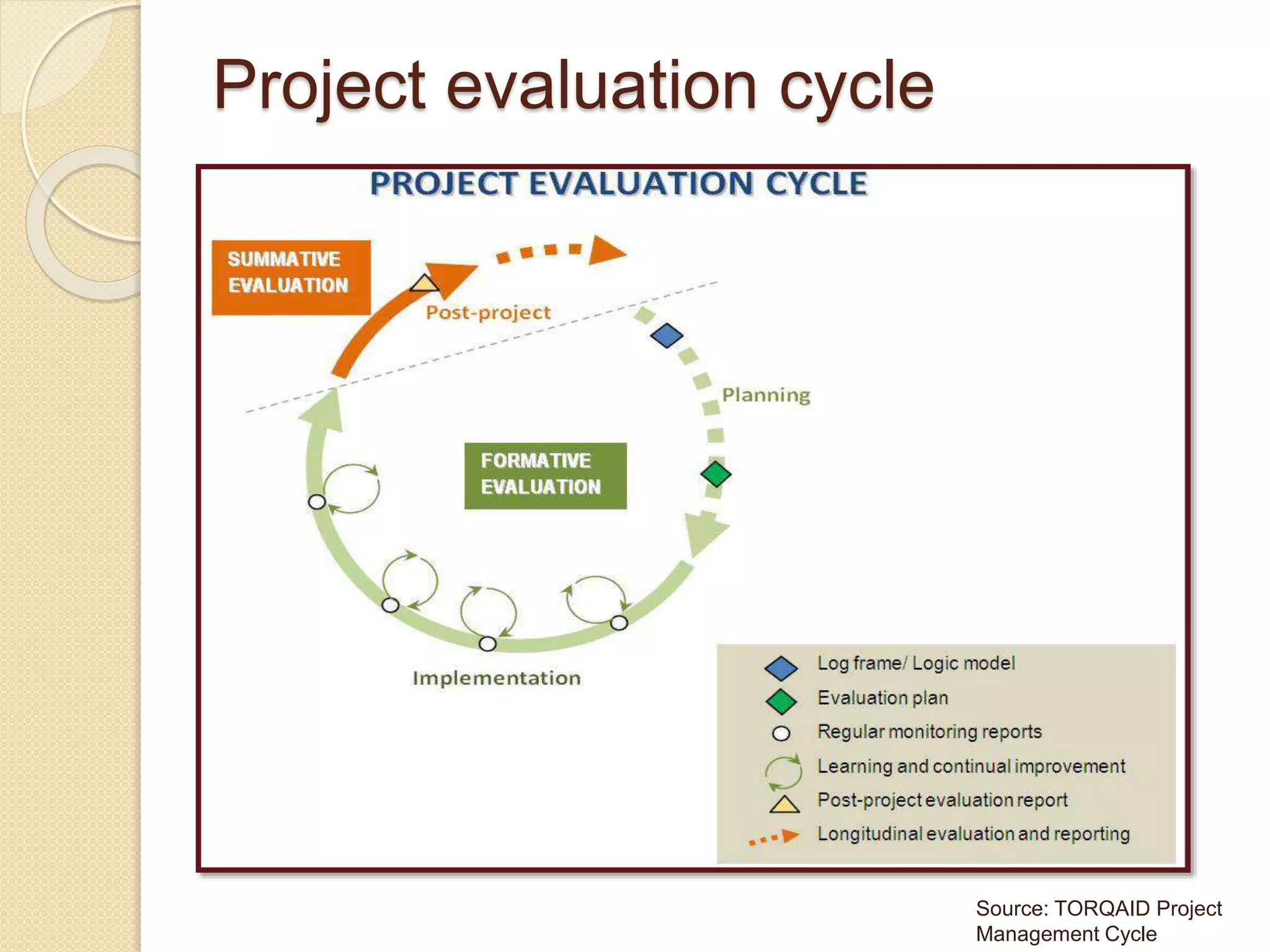
Project evaluation cycle
Source: TORQAID Project
Management Cycle
Participatory evaluation
 Refers to all project
stakeholders,
particularly the
target group
involved in a
project evaluation.
Amutha Pannerselvam
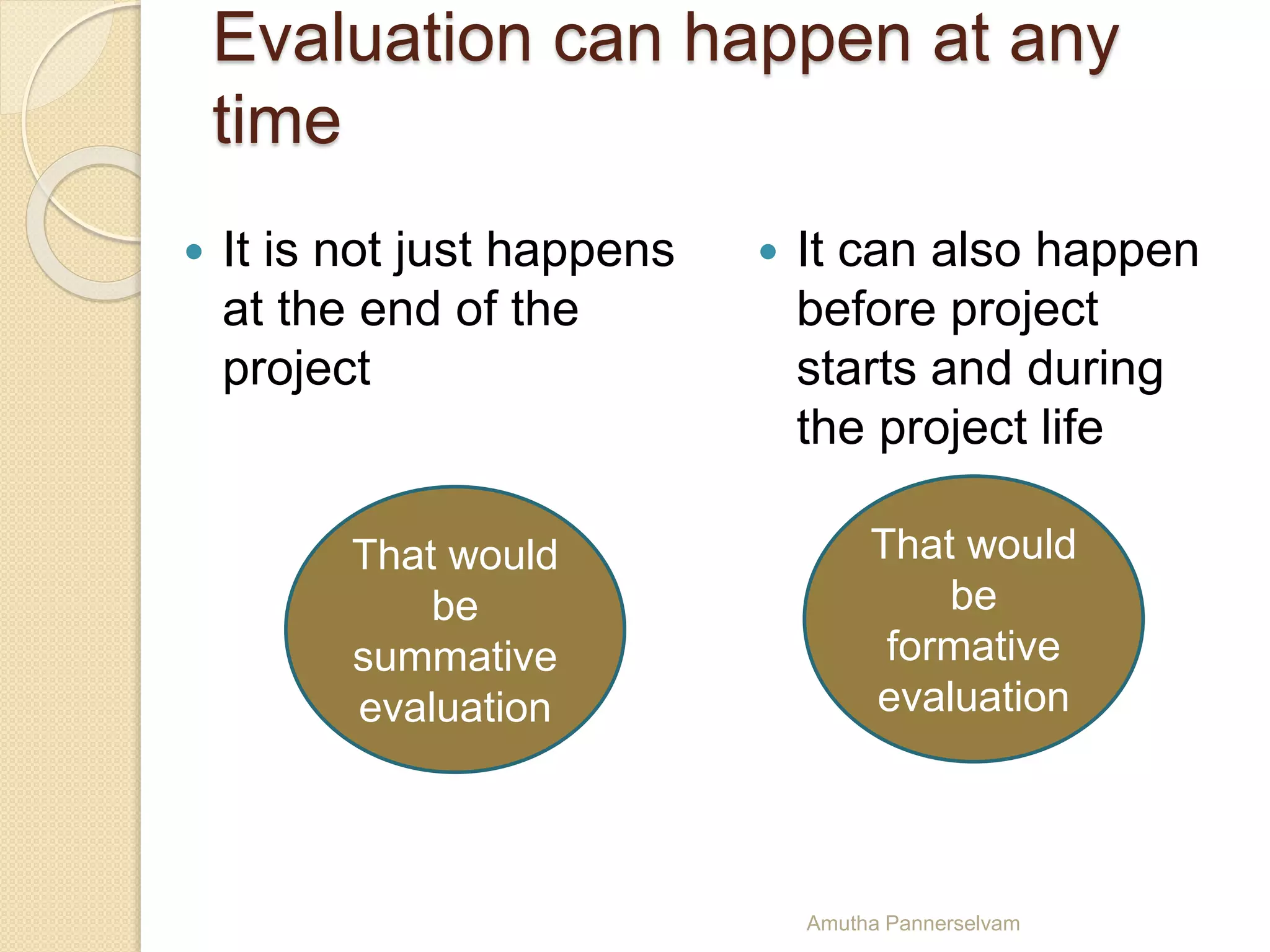
Evaluation can happen at any
time
 It is not just happens
at the end of the
project
 It can also happen
before project
starts and during
the project life
That would
be
summative
evaluation
That would
be
formative
evaluation
Amutha Pannerselvam
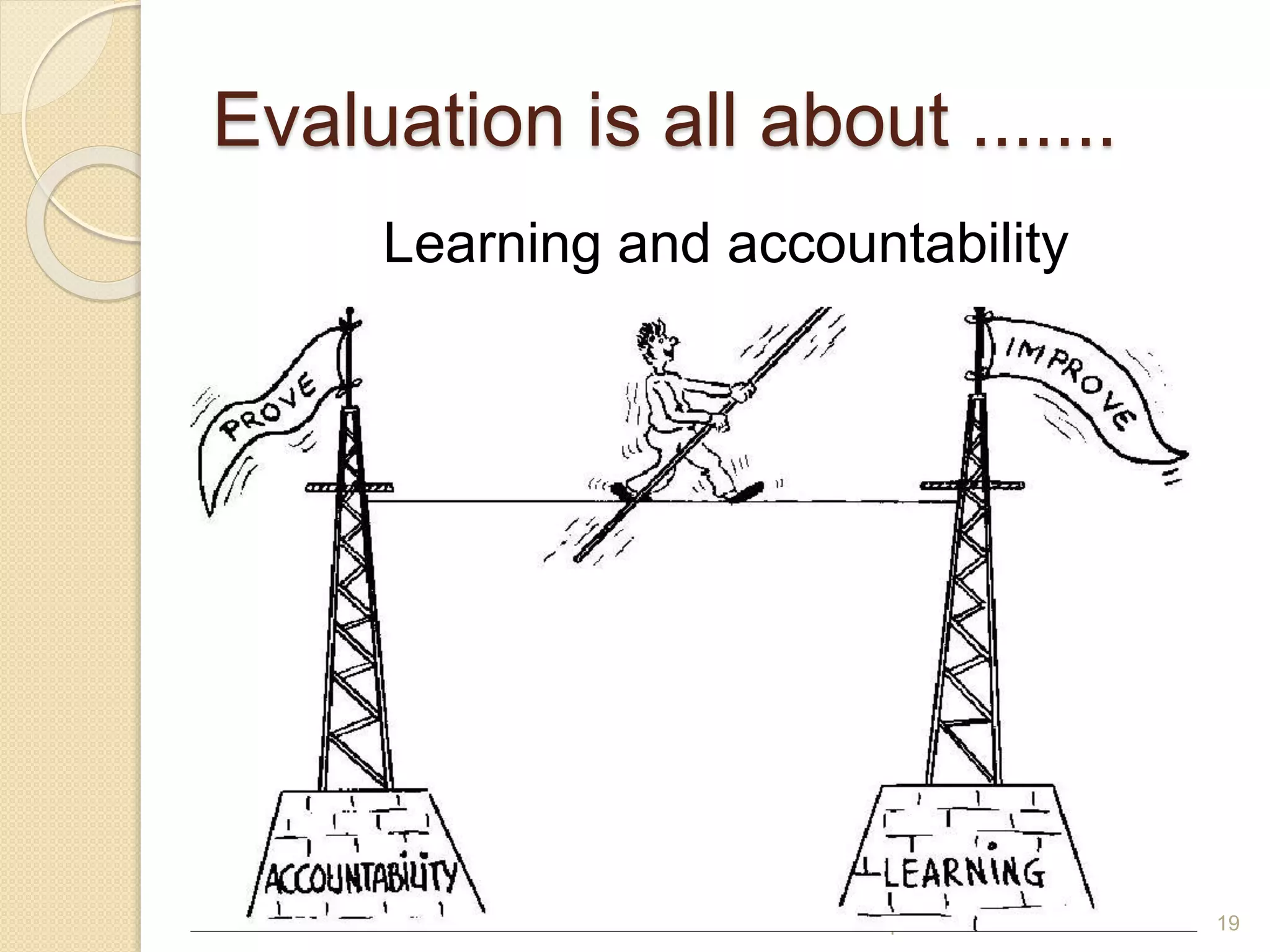
Evaluation is all about .......
24/01/2015 Workshop M&E 19
Learning and accountability
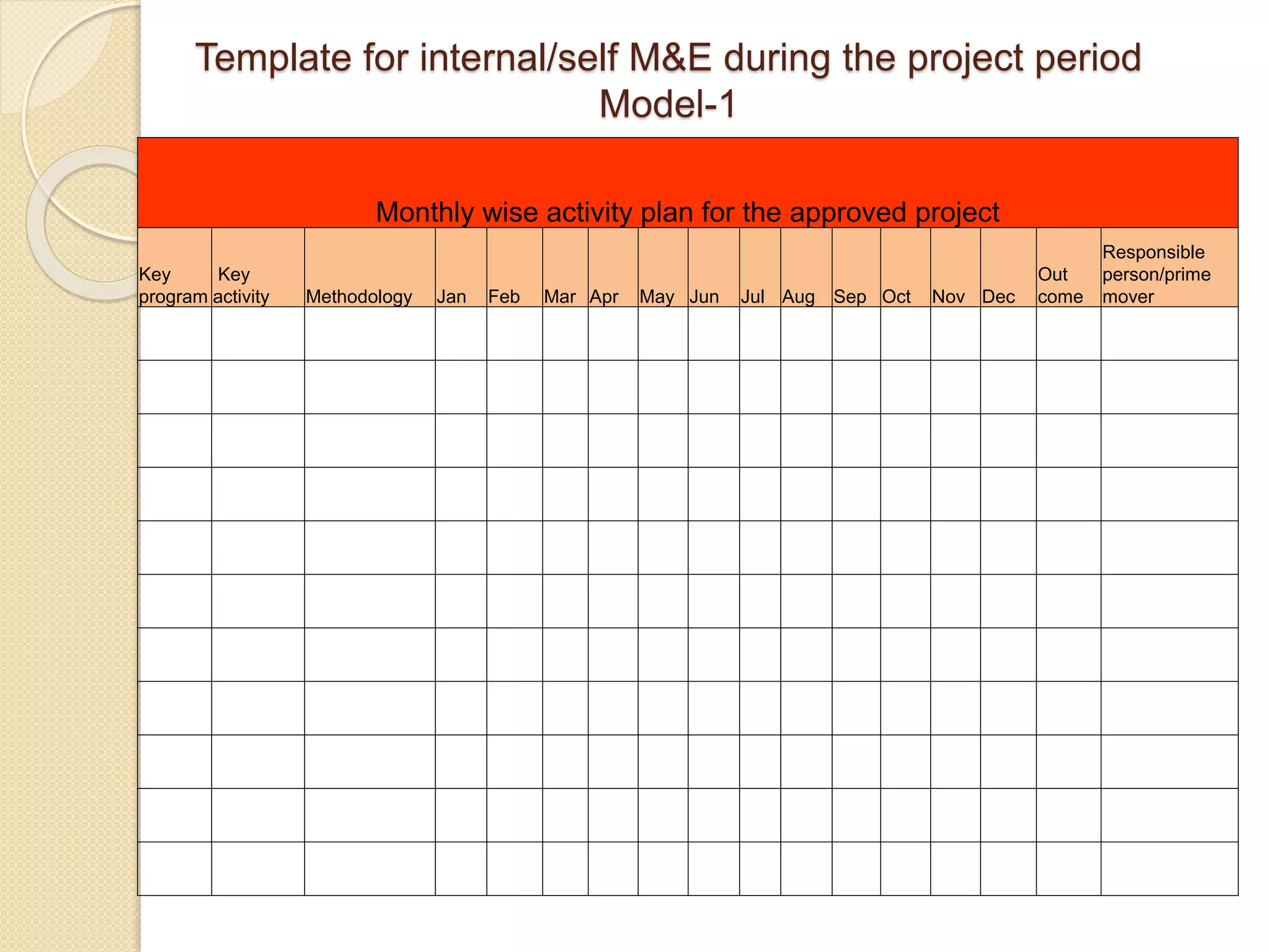
Monthly wise activity plan for the approved project
Key
program
Key
activity Methodology Jan Feb Mar Apr May Jun Jul Aug Sep Oct Nov Dec
Out
come
Responsible
person/prime
mover
Template for internal/self M&E during the project period
Model-1
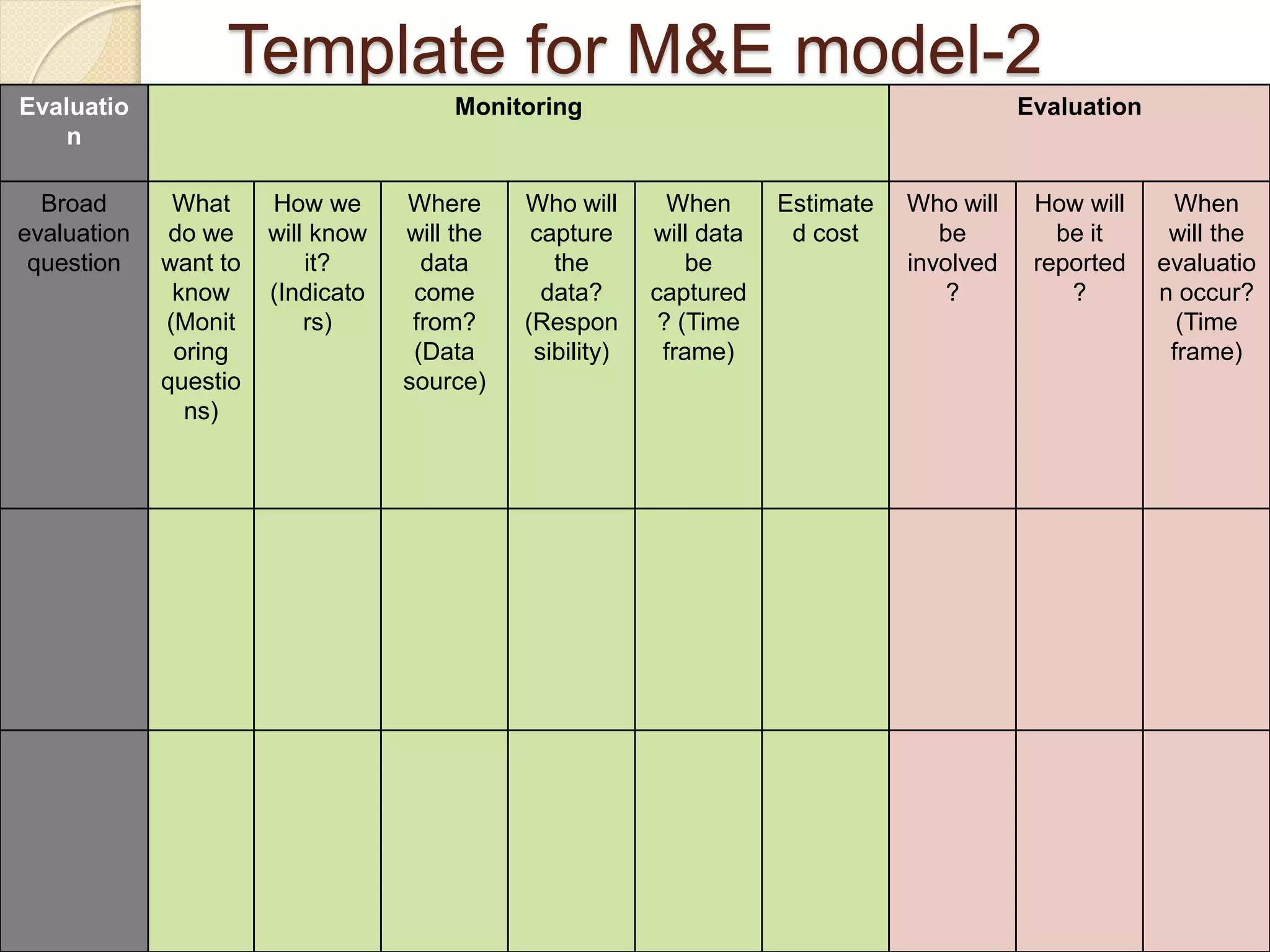
Template for M&E model-2
Evaluatio
n
Monitoring Evaluation
Broad
evaluation
question
What
do we
want to
know
(Monit
oring
questio
ns)
How we
will know
it?
(Indicato
rs)
Where
will the
data
come
from?
(Data
source)
Who will
capture
the
data?
(Respon
sibility)
When
will data
be
captured
? (Time
frame)
Estimate
d cost
Who will
be
involved
?
How will
be it
reported
?
When
will the
evaluatio
n occur?
(Time
frame)
Thank you
1/24/2015 Amutha Pannerselvam

M& e slide share

  • 1.
    How to developeffective monitoring & Evaluation Plan Amutha Pannerselvam
  • 2.
    Understand the terminology Monitoring: Monitoring refers to setting targets and milestones to measure progress and achievement, and whether the inputs are producing the planned outputs. “In other words, monitoring sees whether the project is consistent with the design” Evaluation:  Evaluation is a structured process of assessing the success of a project in meeting its goals and to reflect on the lessons learned. Amutha Pannerselvam
  • 3.
    Difference between M& E  The key difference between monitoring and evaluation is, evaluation is about placing a value judgment on the information gathered during a project, including the monitoring data. Amutha Pannerselvam
  • 4.
    Need of M&E To assess whether a project has achieved its intended goals  To understand how the project has achieved its intended purpose, or why it may not have done so  To identify how efficient the project was in converting resources (funded and in-kind) into activities, objectives and goals  To assess how sustainable and meaningful the project was for participants  To inform decision makers about how to build on or improve a project. Amutha Pannerselvam
  • 5.
    Elements of M&E/Points being considered in M&E process  Activities  Efficiency  Effectiveness  Impact  Qualitative  Quantitative  Outcome  Relevance  Sustainability Amutha Pannerselvam
  • 6.
    Key principles inM&E Qualitative as well as quantitative Both dimension of participation must be included in the evaluation in order for the outcome to be fully understood Dynamic as opposed to static The evaluation of participation demands that the entire process over a period of time be evaluated and not merely a snapshot. Conventional ex post facto evaluation, therefore, will not be adequate Central importance of monitoring The evaluation of a process of participation is impossible without relevant and continual monitoring. Indeed monitoring is the key to the whole exercise and the only means by which the qualitative descriptions can be obtained to explain the process which has occurred Participatory evaluation In the entire evaluation process, the people involved in the project have a part to play; the people themselves will also have a voice Source: UNDP guide for M&E
  • 7.
    Types of Evaluationbased on process  In broader we can divide evaluation as internal evaluation, external evaluation and self evaluation Internal evaluation :  Evaluation by individuals who belong to the management of the donor or implementing organization External evaluation  Evaluation by institutions/individuals who belong neither to the donor nor to the implementing organization Self evaluation:  Evaluation by the professionals who implement the activities Amutha Pannerselvam
  • 8.
    Types of evaluationbased on character  Evaluation can be characterized as being either formative or summative and goal based evaluation .  Broadly, formative evaluation looks at what leads to an intervention working (the process), whereas summative evaluation looks at the short-term to long-term outcomes of an intervention on the target group. Amutha Pannerselvam
  • 9.
    Formative evaluation  Formativeevaluation takes place in the lead up to the project, as well as during the project in order to improve the project design as it is being implemented (continual improvement). Formative evaluation often lends itself to qualitative methods of inquiry. Amutha Pannerselvam
  • 10.
    Summative evaluation  Summativeevaluation takes place during and following the project implementation, and is associated with more objective, quantitative methods. The distinction between formative and summative evaluation can become blurred. Generally it is important to know both how an intervention works, as well as if it worked. It is therefore important to capture and assess both qualitative and quantitative data. Amutha PAnnerselvam
  • 11.
    Goal based evaluation Evaluation has typically involved measuring whether predetermined targets have been met. You may be familiar with the term ‘SMART’ (Specific, Measurable, Attainable, Relevant, and Timely) targets. These type of targets fall under the banner of goals-based evaluation Amutha Pannerselvam
  • 12.
    Types of evaluation FormativeSummative Type of Evaluation Proactive Clarificative Interactive Monitoring Outcome When to use Pre-project Project development Project implementation Project implementation Project implementation and post-project Why use it? To understand or clarify the need for the project To make clear the theory of change that the project is based on To improve the project’s design (continual improvement) as it is rolled out To ensure that the project activities are being delivered efficiently and effectively To assess whether the project has met its goals, whether there were any unintended consequences, what were the learning's, and how to improve Source: Owen& Rogers 1999
  • 13.
    A route mapwhich helps you in M&E  Consensus about the Project Concept ◦ OBJECTIVES drives you towards the direction of the journey to achieve the project goal ◦ ACTIVITIES leads you to achieve the changes ◦ INDICATORS helps us to recognise that changes took place ◦ RESOURCES & RISK analyse the conditions needed for successful implementation It is nothing than a “LOGICALAmutha Pannerselvam
  • 14.
    What is alogical frame matrix Project description Objectively verifiable Indicators Source of verification Assumptions/ Risks Goal Purpose Outputs Activities
  • 15.
    What MUST wemonitor and evaluate in a project ?  All indicators in the LFA must be monitored and evaluated regularly.  They are the base for the Annual Report! Amutha PAnnerselvam
  • 16.
    Project evaluation cycle Source:TORQAID Project Management Cycle
  • 17.
    Participatory evaluation  Refersto all project stakeholders, particularly the target group involved in a project evaluation. Amutha Pannerselvam
  • 18.
    Evaluation can happenat any time  It is not just happens at the end of the project  It can also happen before project starts and during the project life That would be summative evaluation That would be formative evaluation Amutha Pannerselvam
  • 19.
    Evaluation is allabout ....... 24/01/2015 Workshop M&E 19 Learning and accountability
  • 20.
    Monthly wise activityplan for the approved project Key program Key activity Methodology Jan Feb Mar Apr May Jun Jul Aug Sep Oct Nov Dec Out come Responsible person/prime mover Template for internal/self M&E during the project period Model-1
  • 21.
    Template for M&Emodel-2 Evaluatio n Monitoring Evaluation Broad evaluation question What do we want to know (Monit oring questio ns) How we will know it? (Indicato rs) Where will the data come from? (Data source) Who will capture the data? (Respon sibility) When will data be captured ? (Time frame) Estimate d cost Who will be involved ? How will be it reported ? When will the evaluatio n occur? (Time frame)
  • 22.